

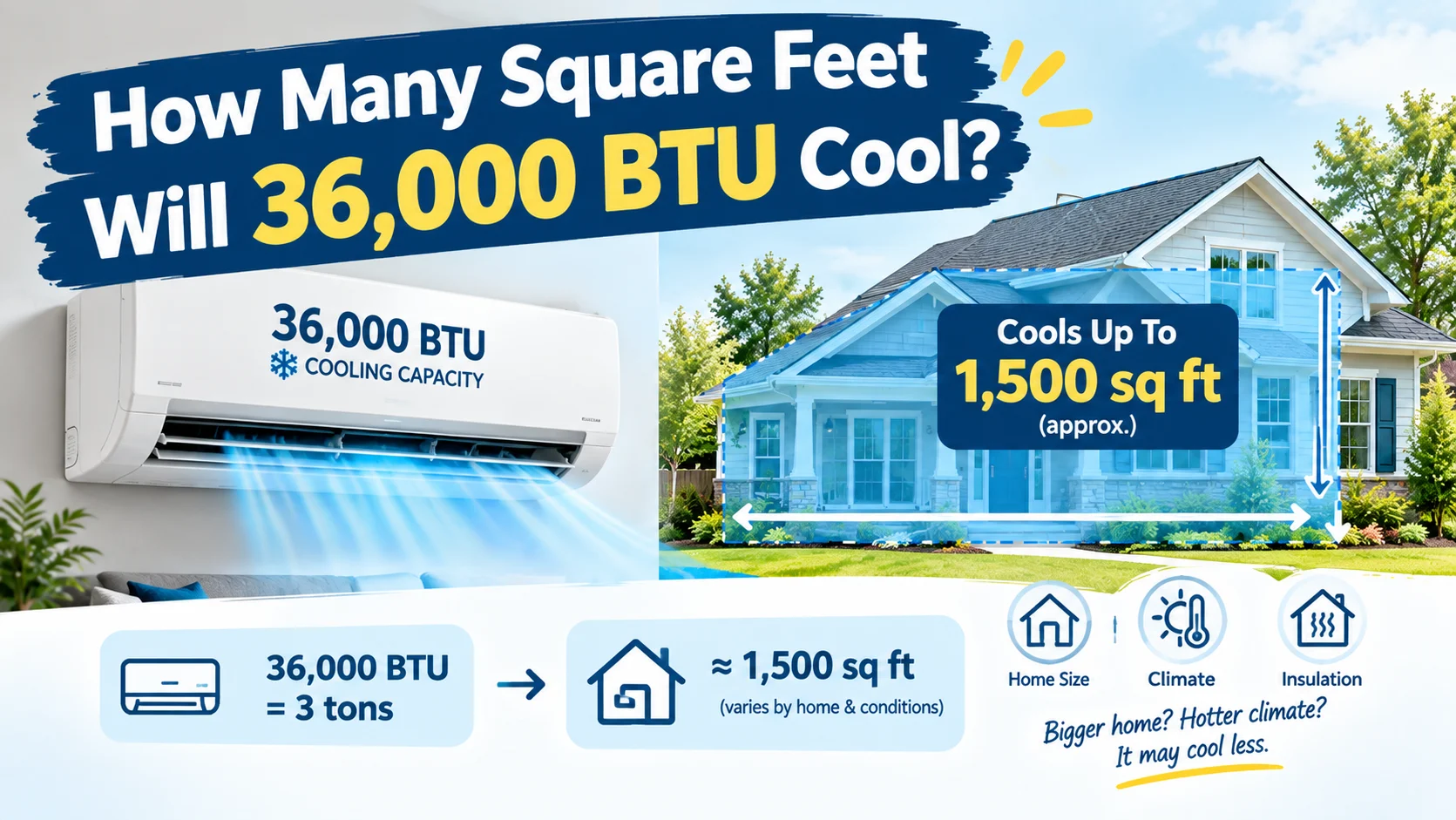
If you’re shopping for a central air conditioner, mini-split, packaged unit, or other cooling system, one of the most important questions is whether the unit has enough capacity for your space. A 36,000 BTU air conditioner is a relatively large residential cooling system, commonly used for larger homes, open floor plans, offices, and other spaces with significant cooling demands.
So, how many square feet will 36,000 BTU cool?
As a general estimate, a 36,000 BTU air conditioner can cool about 1,500 to 2,000 square feet under typical conditions. A commonly used starting point is around 1,800 square feet, but the actual coverage can be substantially different depending on climate, insulation, windows, ceiling height, sunlight, occupancy, and other factors.
A 36,000 BTU system is also equal to 3 tons of cooling, because one ton of air-conditioning capacity equals 12,000 BTUs.
This guide explains how much space 36,000 BTUs can cool, how to estimate your required capacity, when 36,000 BTUs may be too much or too little, and what factors can change the calculation.
Quick Answer: How Many Square Feet Will 36,000 BTU Cool?
A 36,000 BTU air conditioner will generally cool approximately 1,500 to 2,000 square feet, depending on the building and climate.
For a quick estimate:
36,000 BTU ÷ 20 BTU per square foot = 1,800 square feet
So, 1,800 square feet is a reasonable midpoint estimate.
However, BTU-per-square-foot rules are only rough sizing methods. A professional load calculation can produce a more accurate result.
| Cooling Capacity | Approximate Capacity |
|---|---|
| 12,000 BTU | 1 ton |
| 18,000 BTU | 1.5 tons |
| 24,000 BTU | 2 tons |
| 30,000 BTU | 2.5 tons |
| 36,000 BTU | 3 tons |
| 48,000 BTU | 4 tons |
| 60,000 BTU | 5 tons |
What Does 36,000 BTU Mean?
BTU stands for British Thermal Unit. In air conditioning, BTUs describe the amount of heat a cooling system can remove from a space over time.
A higher BTU rating generally means greater cooling capacity.
A 36,000 BTU air conditioner has a nominal cooling capacity of:
36,000 BTUs per hour
This is commonly expressed as 36,000 BTU/h.
It doesn’t mean that the system will automatically cool exactly 36,000 square feet or any other fixed area. BTU measures cooling capacity, while square footage measures floor area.
The relationship between the two depends on the heat load of the building.
Is 36,000 BTU the Same as 3 Tons?
Yes.
In air-conditioning terminology:
1 ton = 12,000 BTU/h
Therefore:
36,000 ÷ 12,000 = 3 tons
So:
36,000 BTU = 3 tons of cooling
This is an important conversion when comparing different types of air-conditioning equipment.
For example:
- 24,000 BTU = 2 tons
- 30,000 BTU = 2.5 tons
- 36,000 BTU = 3 tons
- 48,000 BTU = 4 tons
How Much Space Can 36,000 BTU Cool?
There isn’t a single square-foot number that applies to every building.
A rough range is:
1,500–2,000 square feet
But the appropriate capacity may be different depending on the conditions.
For example, a well-insulated home in a moderate climate may require less cooling capacity than a poorly insulated home of the same size in a very hot climate.
Here is a simplified estimate:
| Approx. BTU per Sq. Ft. | 36,000 BTU Coverage |
|---|---|
| 15 BTU/sq ft | 2,400 sq ft |
| 18 BTU/sq ft | 2,000 sq ft |
| 20 BTU/sq ft | 1,800 sq ft |
| 22 BTU/sq ft | 1,636 sq ft |
| 24 BTU/sq ft | 1,500 sq ft |
| 25 BTU/sq ft | 1,440 sq ft |
These figures are rough estimates, not a substitute for a professional cooling-load calculation.
How to Calculate Square Footage for 36,000 BTU
If you’re using a basic BTU-per-square-foot estimate, you can calculate the approximate coverage with this formula:
Square feet = BTUs ÷ BTU requirement per square foot
For example, using 20 BTUs per square foot:
36,000 ÷ 20 = 1,800 square feet
Therefore, a 36,000 BTU system could theoretically provide enough cooling capacity for approximately 1,800 square feet under those assumptions.
If the space requires 24 BTUs per square foot:
36,000 ÷ 24 = 1,500 square feet
This demonstrates why there isn’t one universal answer.
36,000 BTU Cooling Capacity by Climate
Climate has a major effect on air-conditioning requirements.
A 36,000 BTU system may cool a larger area in a mild climate than it can in an extremely hot climate.
Mild Climate
In a mild climate, a properly insulated 36,000 BTU system may potentially serve a space toward the upper end of the estimated range.
Moderate Climate
In moderate conditions, around 1,700–1,900 square feet may be a reasonable starting point for a rough estimate.
Hot Climate
In a hot climate, the same 36,000 BTU capacity may be better suited to a smaller space because the air conditioner has to remove more heat.
Very Hot or High-Heat-Gain Conditions
Homes with intense sun exposure, poor insulation, large windows, high ceilings, or substantial air leakage can require considerably more cooling capacity per square foot.
Factors That Determine How Much 36,000 BTU Can Cool
Square footage is only one part of air-conditioner sizing.
1. Climate
Outdoor temperature and humidity affect the amount of heat entering the building.
A home in a very hot region can require more cooling capacity than a similar-sized home in a mild area.
2. Insulation
Good insulation slows heat transfer between the outdoors and indoors.
A well-insulated building may require less cooling capacity.
Poor insulation can increase the cooling load.
3. Windows
Windows can be a major source of solar heat gain.
Large windows that receive direct afternoon sunlight can increase cooling requirements.
Window quality, glazing, orientation, shading, and size all matter.
4. Ceiling Height
Floor area doesn’t tell you the entire volume of a room.
Consider two buildings with 1,800 square feet:
- 8-foot ceilings = 14,400 cubic feet
- 12-foot ceilings = 21,600 cubic feet
The second building contains substantially more air volume and may have different cooling requirements.
5. Sun Exposure
A home with a large west-facing glass area may gain more heat during the afternoon than a shaded building.
Roof exposure is also important, particularly in hot climates.
6. Number of Occupants
People generate heat.
A home with many occupants can have a higher cooling load than an otherwise identical home with fewer occupants.
7. Appliances and Electronics
Ovens, refrigerators, computers, televisions, lighting, and other equipment contribute heat to indoor spaces.
A kitchen-heavy or equipment-heavy area may need additional cooling capacity.
8. Air Leakage
Cracks around doors, windows, ductwork, and other openings can allow outdoor air to enter.
Air leakage can increase both sensible and latent cooling loads.
9. Ductwork
For central air-conditioning systems, duct design and condition matter.
Leaky or poorly insulated ducts can reduce the amount of cooling that effectively reaches the living space.
Is 36,000 BTU Enough for 1,500 Square Feet?
In many situations, 36,000 BTUs can be enough for 1,500 square feet.
At a rough requirement of 24 BTUs per square foot:
1,500 × 24 = 36,000 BTUs
However, if the home is highly insulated and located in a mild climate, the actual required capacity could be lower.
Conversely, a poorly insulated 1,500-square-foot home in a very hot climate could have a significant cooling load.
The home’s actual heat gain should determine the final equipment size.
Is 36,000 BTU Enough for 1,800 Square Feet?
Using a rough estimate of 20 BTUs per square foot:
1,800 × 20 = 36,000 BTUs
Therefore, 36,000 BTUs is a reasonable rough estimate for 1,800 square feet under those assumptions.
This is why 1,800 square feet is often used as a convenient midpoint when discussing a 36,000 BTU air conditioner.
However, actual requirements may be higher or lower.
Is 36,000 BTU Enough for 2,000 Square Feet?
It can be, but it depends heavily on the building.
At 18 BTUs per square foot:
2,000 × 18 = 36,000 BTUs
So a well-insulated 2,000-square-foot home in favorable conditions could potentially be served by a 36,000 BTU system.
But if the property has high heat gain, poor insulation, large unshaded windows, or a hot climate, 36,000 BTUs may not be enough.
This is why simply matching BTUs to square footage isn’t the best way to size a system.
What Size AC Do You Need for 1,000 to 2,500 Square Feet?
Using rough estimates, the relationship might look like this:
| Home Size | Rough BTU Range* | Approx. Tons |
|---|---|---|
| 1,000 sq ft | 18,000–24,000 | 1.5–2 |
| 1,200 sq ft | 21,600–28,800 | 1.8–2.4 |
| 1,500 sq ft | 27,000–36,000 | 2.25–3 |
| 1,800 sq ft | 32,400–43,200 | 2.7–3.6 |
| 2,000 sq ft | 36,000–48,000 | 3–4 |
| 2,200 sq ft | 39,600–52,800 | 3.3–4.4 |
| 2,500 sq ft | 45,000–60,000 | 3.75–5 |
*These are simplified planning estimates, not equipment-sizing recommendations.
Can a 36,000 BTU Mini-Split Cool 1,800 Square Feet?
A 36,000 BTU mini-split can potentially provide substantial cooling for a large area, but whether one indoor unit can effectively cool 1,800 square feet depends on the floor plan.
An open-concept space may be easier to cool with one indoor unit.
A home divided into many bedrooms and closed rooms may require multiple indoor units or zones.
For example, a multi-zone mini-split could distribute cooling to:
- Living room
- Kitchen
- Primary bedroom
- Guest bedroom
- Office
This can provide better temperature control than trying to push all the cooling from one indoor unit into separated rooms.
Can a 36,000 BTU AC Cool 2,000 Square Feet?
Possibly.
A 36,000 BTU system has enough nominal capacity to serve 2,000 square feet in some buildings, particularly when the building has favorable insulation and relatively low heat gain.
But you shouldn’t automatically purchase a 3-ton system just because your home is 2,000 square feet.
The actual cooling load should be considered.
What Happens If an AC Is Too Large?
It might seem like a larger air conditioner is always better, but that’s not necessarily true.
An oversized system may cool the room quickly but fail to run long enough to properly manage indoor humidity.
Potential problems can include:
- Short cycling
- Uneven temperatures
- Poor humidity control
- Increased wear
- Less comfortable indoor conditions
- Potentially higher operating costs
The goal is not to buy the biggest air conditioner available.
The goal is to select the appropriate capacity for the actual cooling load.
What Happens If an AC Is Too Small?
An undersized system can also cause problems.
When an air conditioner doesn’t have enough capacity, it may run continuously during very hot weather without maintaining the desired indoor temperature.
Possible symptoms include:
- Long operating cycles
- Difficulty reaching the thermostat setting
- Poor comfort during peak heat
- Excessive strain on the system
- Higher energy consumption in some situations
Proper sizing helps avoid both extremes.
How Many Tons Is 36,000 BTU?
A 36,000 BTU air conditioner is:
3 tons
The formula is:
36,000 ÷ 12,000 = 3
Therefore:
36,000 BTU = 3 tons
This is often useful when comparing central AC systems because residential equipment is commonly described by tonnage.
How Many BTUs Per Square Foot Should You Use?
A common rough planning range is approximately 18–25 BTUs per square foot, but this should not be treated as a universal rule.
For example:
At 18 BTU/sq ft
36,000 ÷ 18 = 2,000 sq ft
At 20 BTU/sq ft
36,000 ÷ 20 = 1,800 sq ft
At 22 BTU/sq ft
36,000 ÷ 22 = 1,636 sq ft
At 25 BTU/sq ft
36,000 ÷ 25 = 1,440 sq ft
This range demonstrates why a 36,000 BTU unit might be suitable for anywhere from roughly 1,400 to 2,000+ square feet depending on conditions.
How to Get a More Accurate AC Size
For a real installation, the best approach is to perform a cooling-load calculation rather than relying solely on square footage.
A proper calculation considers factors such as:
- Outdoor design temperature
- Indoor design temperature
- Building orientation
- Window area
- Window type
- Solar exposure
- Insulation levels
- Ceiling height
- Occupancy
- Lighting
- Appliances
- Air infiltration
- Duct losses
- Building construction
For larger investments, having an HVAC professional calculate the load can help you avoid selecting an improperly sized system.
36,000 BTU vs. Other AC Sizes
Here’s how a 36,000 BTU system compares with several common capacities:
| BTU Capacity | Tons | Approx. Rough Coverage |
|---|---|---|
| 12,000 | 1 | 500–700 sq ft |
| 18,000 | 1.5 | 750–1,000 sq ft |
| 24,000 | 2 | 1,000–1,300 sq ft |
| 30,000 | 2.5 | 1,250–1,650 sq ft |
| 36,000 | 3 | 1,500–2,000 sq ft |
| 48,000 | 4 | 2,000–2,500 sq ft |
| 60,000 | 5 | 2,500–3,000+ sq ft |
These coverage figures are rough guidelines and shouldn’t replace a load calculation.
Tips for Making a 36,000 BTU AC More Effective
Even a properly sized air conditioner can struggle if the building has excessive heat gain.
You can improve cooling performance by:
Improve Insulation
Insulate the attic, walls, and other areas where heat transfer is significant.
Seal Air Leaks
Weatherstrip doors and windows and seal obvious gaps.
Improve Window Performance
Use energy-efficient windows or appropriate shades and curtains to reduce solar heat gain.
Maintain the AC
Keep filters clean and follow the manufacturer’s maintenance recommendations.
Check Ductwork
If you have central AC, damaged or poorly insulated ducts can reduce system performance.
Reduce Indoor Heat
Efficient lighting and appliances can reduce the amount of heat produced inside the home.
FAQs
How many square feet will 36,000 BTU cool?
A 36,000 BTU air conditioner can generally cool around 1,500 to 2,000 square feet, depending on climate, insulation, ceiling height, windows, sunlight, and other factors.
Is 36,000 BTU enough for 2,000 square feet?
It can be in some well-insulated homes and favorable climates. However, a 2,000-square-foot home with high heat gain may require more capacity.
How many tons is 36,000 BTU?
36,000 BTUs equals 3 tons of cooling capacity.
How many BTUs do I need for 1,800 square feet?
A rough estimate could be around 32,400–45,000 BTUs, depending on the building. Using 20 BTUs per square foot gives 36,000 BTUs.
Can a 36,000 BTU mini-split cool a large house?
It can potentially cool a large open area, but a house with multiple closed rooms may require multiple indoor units or zones for effective air distribution.
Is a 3-ton AC the same as 36,000 BTU?
Yes. A nominal 3-ton air conditioner has a cooling capacity of approximately 36,000 BTU/h.
Is a bigger AC always better?
No. An oversized system can cycle too frequently and may not remove humidity effectively. Proper sizing is more important than simply choosing a larger system.
What factors affect how much area 36,000 BTU can cool?
Climate, insulation, windows, ceiling height, sunlight, occupancy, appliances, air leakage, ductwork, and building design can all affect the required cooling capacity.
Final Answer: How Many Square Feet Will 36,000 BTU Cool?
So, how many square feet will 36,000 BTU cool?
A reasonable general estimate is about 1,500 to 2,000 square feet, with around 1,800 square feet serving as a useful midpoint for basic calculations.
A 36,000 BTU air conditioner is equivalent to 3 tons of cooling capacity.
The important thing to remember is that square footage alone doesn’t determine the correct AC size. A 1,800-square-foot home with excellent insulation and shaded windows can have very different cooling requirements from a 1,800-square-foot home with poor insulation, high ceilings, large sunny windows, and significant air leakage.
For the most accurate sizing, use a proper cooling-load calculation and consider the specific characteristics of your home rather than relying solely on a BTU-per-square-foot rule.



Pingback: How Many Floors Is 100 Feet? Complete Guide to Building Height
Pingback: 10x10 Equals How Many Square Feet? Complete Guide