

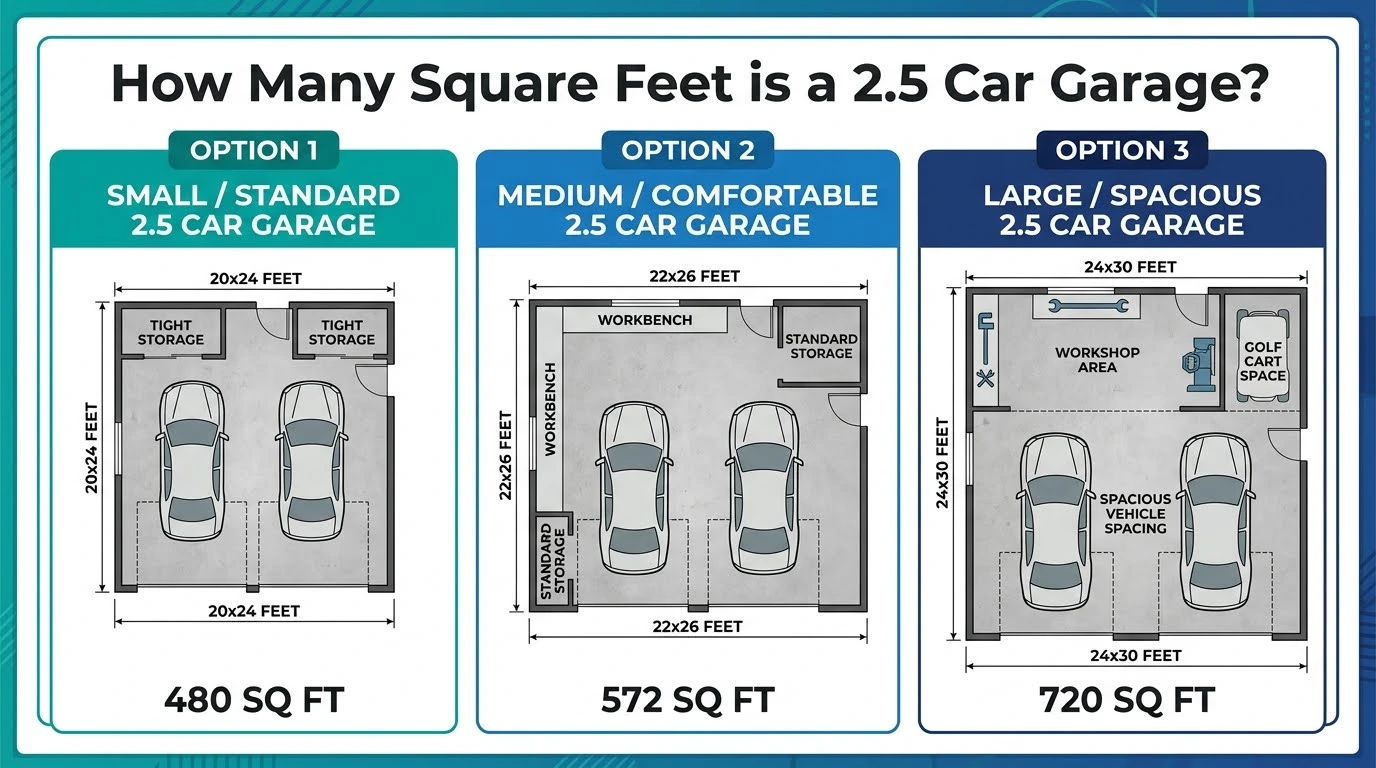
A 2.5-car garage typically measures 600 to 800 square feet, depending on the layout, vehicle sizes, and amount of extra storage space. Unlike a standard two-car garage, a 2.5-car garage provides additional room for bicycles, tools, lawn equipment, workbenches, or other household items.
For example, a garage measuring 25 feet wide by 28 feet deep has an area of 700 square feet. This size can provide space for two vehicles along with a small storage or work area, although the actual fit depends on the vehicles and the garage’s interior dimensions.
In this guide, you will learn the typical square footage of a 2.5-car garage, common dimensions, how to calculate its area, and how it compares with one-, two-, and three-car garages. You will also find practical tips for planning a garage that fits your vehicles and storage needs.
How Many Square Feet Is a 2.5 Car Garage?
A 2.5-car garage generally has 600 to 800 square feet of floor space. Some designs may be smaller or larger depending on the depth, width, and intended use.
Here are examples of common dimensions and their corresponding floor areas:
| Garage dimensions | Total square feet |
|---|---|
| 20 × 28 feet | 560 sq. ft. |
| 22 × 28 feet | 616 sq. ft. |
| 24 × 26 feet | 624 sq. ft. |
| 25 × 28 feet | 700 sq. ft. |
| 26 × 28 feet | 728 sq. ft. |
| 28 × 28 feet | 784 sq. ft. |
| 28 × 30 feet | 840 sq. ft. |
These are illustrative dimensions rather than fixed industry standards. A 2.5-car garage is not a universally standardized size, so check the actual plans before purchasing materials or planning construction.
What Is a 2.5 Car Garage?
A 2.5-car garage is a garage designed primarily to accommodate two vehicles while providing additional space for storage, hobbies, or workshop activities.
The term does not necessarily mean that three full-size cars will fit comfortably. Instead, the extra half-car capacity usually refers to the additional floor space beyond a conventional two-car layout.
Depending on the design, that extra space might be used for:
- Bicycles and sports equipment
- Lawn mowers and gardening tools
- Shelving and storage cabinets
- A small workbench
- Seasonal decorations
- Motorcycle or compact-vehicle storage
The usefulness of a 2.5-car garage depends on how its extra area is arranged. A wider garage may provide a dedicated side storage area, while a deeper garage may allow additional space in front of parked vehicles.
Common Dimensions of a 2.5 Car Garage
The square footage of a garage depends on its width and depth. A 2.5-car garage often falls within a range of approximately 600 to 800 square feet, but the best dimensions depend on the vehicles and how you intend to use the space.
1. A 22 × 28 Foot Garage
Calculation:
22 × 28 = 616 square feet
A garage measuring 22 feet wide and 28 feet deep provides 616 square feet. It may work for two appropriately sized vehicles with some additional space, but storage could be limited depending on vehicle widths and door clearances.
2. A 24 × 26 Foot Garage
Calculation:
24 × 26 = 624 square feet
This layout provides 624 square feet. Its relatively balanced dimensions may suit two vehicles, but the available space for storage depends on the vehicles’ dimensions and how much room is needed to open doors.
3. A 25 × 28 Foot Garage
Calculation:
25 × 28 = 700 square feet
A 25 × 28 foot garage offers 700 square feet. This can be a practical option for two vehicles and a small work or storage area, provided the interior layout is planned carefully.
4. A 28 × 28 Foot Garage
Calculation:
28 × 28 = 784 square feet
A 28 × 28 foot garage provides 784 square feet. The additional width and depth may make it easier to accommodate larger vehicles, storage shelving, and a workbench.
Before choosing a layout, remember that the dimensions shown on building plans may refer to the exterior of the structure. Interior usable floor space can be smaller because of wall thickness, framing, and other construction features.
How to Calculate the Square Footage of a 2.5 Car Garage
Calculating garage square footage is simple when the floor plan is rectangular.
Use this formula:
Square footage = Length × Width
Measure the garage’s length and width in feet, then multiply the two measurements.
For example, suppose your garage is 25 feet wide and 28 feet long.
Step 1: Identify the width.
Width = 25 feet
Step 2: Identify the length.
Length = 28 feet
Step 3: Multiply the measurements.
25 × 28 = 700
The garage has a floor area of 700 square feet.
What If the Garage Has an Irregular Shape?
If your garage includes an extension or a separate storage section, divide the floor plan into rectangles.
For example:
- Main garage: 24 × 24 = 576 square feet
- Additional storage section: 8 × 10 = 80 square feet
Total area:
576 + 80 = 656 square feet
The combined floor area is 656 square feet, assuming the two sections do not overlap.
For an accurate construction estimate, use the dimensions specified in your building plans and confirm whether they describe interior or exterior measurements.
How Does a 2.5 Car Garage Compare With Other Garage Sizes?
A 2.5-car garage falls between a typical two-car and three-car garage in terms of intended capacity. However, garage sizes vary, and the number of vehicles alone does not determine the total floor area.
| Garage type | Approximate floor area | Typical purpose |
|---|---|---|
| One-car garage | 200–300 sq. ft. | One vehicle with limited storage |
| Two-car garage | 400–600 sq. ft. | Two vehicles |
| 2.5-car garage | 600–800 sq. ft. | Two vehicles with extra storage or workspace |
| Three-car garage | 700–1,000+ sq. ft. | Three vehicles or two vehicles with substantial storage |
These ranges are general planning estimates, not official standards. A large two-car garage may be bigger than a compact three-car garage, depending on its dimensions and layout.
Is a 2.5 Car Garage Bigger Than a Two-Car Garage?
Usually, yes. A 2.5-car garage generally offers more space than a conventional two-car garage, often by adding width, depth, or a dedicated storage section.
That extra area can make a meaningful difference if you want to park two vehicles without sacrificing all your storage space.
Is a 2.5 Car Garage Big Enough for Three Cars?
Not necessarily. Some compact vehicles may fit in a carefully designed layout, but many 2.5-car garages are intended for two vehicles plus storage rather than three full-size cars.
If you need to park three vehicles regularly, compare the actual vehicle dimensions with the garage’s interior width, depth, door openings, and maneuvering space. A three-car garage may be more practical.
Can Two Cars and Storage Fit in a 2.5 Car Garage?
Yes, many 2.5-car garages are designed to accommodate two cars and additional storage. However, the available space depends on vehicle size and the position of doors, cabinets, shelves, and workbenches.
Before planning the layout, consider these factors.
Vehicle Width
Two large SUVs require more width than two small sedans. Allow sufficient room between vehicles and between each vehicle and the walls so occupants can enter and exit safely.
Vehicle Length
A deeper garage can provide extra room in front of or behind parked vehicles. This space can be useful for bicycles, lawn equipment, or a workbench, provided it does not obstruct vehicle movement.
Storage Placement
Wall-mounted shelving and cabinets can help preserve floor space. However, deep cabinets may reduce the space available for opening vehicle doors.
Garage Door Width
The exterior garage door opening affects how easily vehicles can enter and exit. The total garage width does not necessarily equal the usable opening width.
Walkways and Access
Leave a clear path to interior doors, storage areas, and any equipment that needs regular access. A garage that technically fits two cars may feel cramped if there is no room to walk around them.
How Much Concrete Is Needed for a 2.5 Car Garage?
If you are building a new garage, square footage helps estimate the amount of concrete required for a slab. The final quantity depends on slab thickness, footing dimensions, reinforcement details, and the foundation design.
For a simple slab, use this formula:
Concrete volume in cubic feet = Area × Thickness in feet
One cubic yard contains 27 cubic feet.
Example: A 700 Square Foot Garage With a 4-Inch Slab
A 4-inch slab is 4 ÷ 12 = 0.333 feet thick.
Calculate the volume:
700 × 0.333 ≈ 233.3 cubic feet
Convert cubic feet to cubic yards:
233.3 ÷ 27 ≈ 8.64 cubic yards
A 700-square-foot slab at a uniform thickness of 4 inches requires approximately 8.64 cubic yards of concrete, before accounting for waste, thickened edges, footings, or other foundation requirements.
Actual slab thickness and reinforcement should be determined by local building codes, soil conditions, expected loads, and professional design. Do not use this example as a substitute for a foundation plan.
How Much Flooring or Coating Is Needed for a 2.5 Car Garage?
If you plan to install floor tiles, an epoxy coating, or another garage-floor finish, begin with the floor’s square footage.
For example, a garage measuring 25 × 28 feet has 700 square feet of floor area.
If you allow 10% extra material for cutting and waste:
700 × 1.10 = 770 square feet
You would plan for approximately 770 square feet of flooring material, although the correct allowance depends on the product, installation pattern, and manufacturer instructions.
For liquid coatings, check the manufacturer’s coverage rate per gallon and account for the number of coats and the condition of the concrete. Porous or rough surfaces may require more material.
What Is the Best Size for a 2.5 Car Garage?
The best size depends on whether you prioritize parking, storage, or workspace.
- Around 600–650 square feet: May suit two smaller vehicles with modest storage.
- Around 650–750 square feet: Can provide a useful balance of vehicle space and storage.
- Around 750–850 square feet: May offer more flexibility for larger vehicles, shelving, and hobbies.
These are planning examples, not guarantees. If you own large SUVs or pickup trucks, measure them and check the garage’s interior dimensions before settling on a plan.
It is also helpful to mark out the proposed dimensions on the ground or floor before construction. This can reveal whether there is enough room to open doors, walk around vehicles, and access stored items.
Frequently Asked Questions
How many square feet is a standard 2.5 car garage?
A 2.5-car garage typically provides about 600 to 800 square feet, although some designs fall outside this range. Its actual area depends on the width, depth, and intended storage space.
Is a 25 × 28 garage big enough for two cars?
A 25 × 28 foot garage measures 700 square feet. It may accommodate two cars and some storage, depending on the vehicles’ dimensions and the interior layout.
How many square feet is a 24 × 26 garage?
A 24 × 26 foot garage has 624 square feet because 24 × 26 = 624.
How many square feet is a 28 × 28 garage?
A 28 × 28 foot garage measures 784 square feet because 28 × 28 = 784.
Can a 2.5 car garage fit two SUVs?
It may fit two SUVs, but the exact result depends on their widths and lengths, the garage’s interior dimensions, and the room needed to open doors. Measure the vehicles before selecting a garage plan.
Can a 2.5 car garage fit a workbench?
Yes, a workbench may fit in the additional space of a 2.5-car garage. A wider or deeper layout can make this easier, but placement should not obstruct vehicles, doors, or walkways.
Is a 2.5 car garage worth building?
It can be worthwhile if you want two parking spaces plus room for tools, bicycles, seasonal storage, or a small workshop. The additional space may improve everyday convenience compared with a tightly sized two-car garage.
How do I calculate garage square footage?
Multiply the garage’s length by its width, using feet for both measurements. For example, a 25-foot-wide garage that is 28 feet long has 700 square feet.
Conclusion
A 2.5-car garage typically measures 600 to 800 square feet, with the exact size depending on its dimensions and intended use. A 25 × 28 foot garage provides 700 square feet, while a 28 × 28 foot garage offers 784 square feet.
This type of garage can be a practical choice for homeowners who need space for two vehicles along with storage or a small work area. Before building, confirm the interior dimensions, measure your vehicles, and plan enough clearance for doors, walkways, and storage. Careful planning will help you choose a garage that is functional, comfortable, and suited to your needs.