

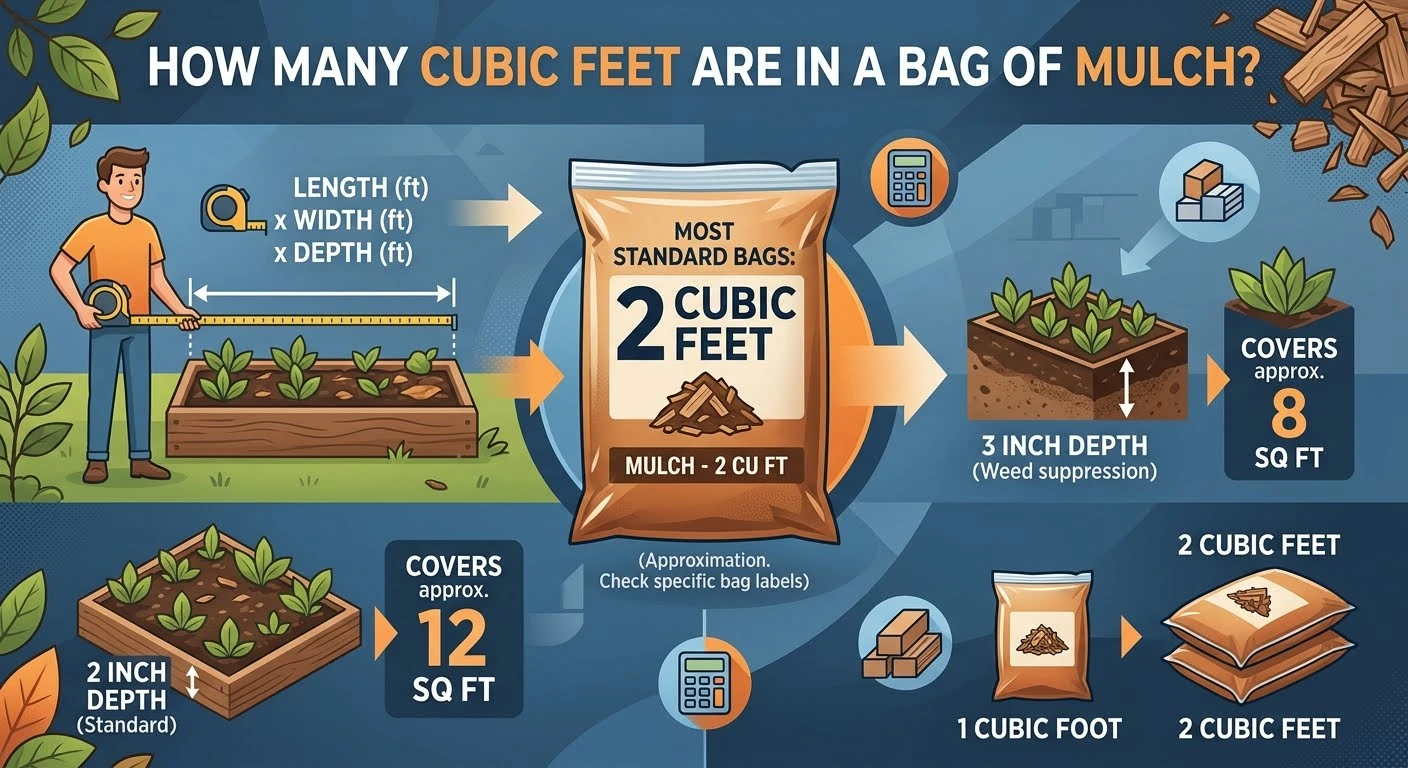
Mulch is commonly used in gardens, flower beds, around trees, and across landscaping projects to help retain soil moisture, reduce weed growth, and improve the appearance of outdoor spaces. If you are planning a landscaping project, you may wonder, how many cubic feet are in a bag of mulch?
The answer depends on the bag size. Common retail mulch bags contain 1, 1.5, 2, or 3 cubic feet of material. A 2-cubic-foot bag is a common size at many home improvement and garden retailers, but you should always check the package label before purchasing.
Knowing the cubic feet in each bag helps you calculate how much ground the mulch will cover. For example, one 2-cubic-foot bag covers approximately 12 square feet at a 2-inch depth, 8 square feet at 3 inches, or 6 square feet at 4 inches.
In this guide, you will learn how many cubic feet different mulch bags contain, how to calculate coverage, how many bags make a cubic yard, and how to estimate the mulch needed for your garden or landscaping project.
How Many Cubic Feet Are in a Bag of Mulch?
A bag of mulch can contain different amounts depending on the product and manufacturer. The volume is usually printed on the packaging in cubic feet.
Here is a quick reference for common bag sizes:
| Mulch Bag Size | Volume in Cubic Feet | Equivalent in Cubic Yards |
|---|---|---|
| Small bag | 1 cu ft | 0.037 cu yd |
| Medium bag | 1.5 cu ft | 0.056 cu yd |
| Common retail bag | 2 cu ft | 0.074 cu yd |
| Large bag | 3 cu ft | 0.111 cu yd |
| Two 2-cu-ft bags | 4 cu ft | 0.148 cu yd |
| Five 2-cu-ft bags | 10 cu ft | 0.370 cu yd |
| Thirteen 2-cu-ft bags | 26 cu ft | 0.963 cu yd |
These are volume conversions. Actual retail bag sizes vary, so check the label to confirm the amount you are buying.
Quick answer: A common mulch bag contains 2 cubic feet, but bags may hold 1, 1.5, 3, or another labeled volume.
What Does Cubic Feet Mean on a Mulch Bag?
Cubic feet measure volume: the amount of three-dimensional space occupied by the mulch.
For example, 1 cubic foot is the volume of a box measuring 1 foot long, 1 foot wide, and 1 foot high.
A mulch bag labeled 2 cubic feet contains twice that volume. It does not mean the bag covers 2 square feet of ground because coverage depends on how thickly the mulch is spread.
A thin layer covers a larger area than a thick layer using the same amount of mulch.
This distinction is important when buying mulch because landscaping projects are usually measured in square feet, while mulch is sold by volume.
How Many Square Feet Does a Bag of Mulch Cover?
The coverage depends on two factors:
- The number of cubic feet in the bag
- The depth of the mulch layer
For a bag containing 2 cubic feet, approximate coverage is:
| Mulch Depth | Coverage per 2-Cubic-Foot Bag |
|---|---|
| 1 inch | 24 sq ft |
| 2 inches | 12 sq ft |
| 3 inches | 8 sq ft |
| 4 inches | 6 sq ft |
| 5 inches | 4.8 sq ft |
| 6 inches | 4 sq ft |
These figures assume the bag contains a full 2 cubic feet and the mulch is spread evenly at the specified depth.
For example, if you want a 3-inch layer, one 2-cubic-foot bag covers approximately 8 square feet.
How to Calculate Mulch Coverage
You can calculate mulch coverage using a simple formula.
Coverage in square feet = Cubic feet of mulch × 12 ÷ Depth in inches
For example, suppose you have a 2-cubic-foot bag and want to spread the mulch 3 inches deep.
Calculation:
2 × 12 ÷ 3 = 8 square feet
Therefore, a 2-cubic-foot bag covers approximately 8 square feet at a depth of 3 inches.
For a 4-inch layer:
2 × 12 ÷ 4 = 6 square feet
The same bag covers only 6 square feet because the mulch is spread more thickly.
Example: One 1.5-Cubic-Foot Bag
Suppose the bag contains 1.5 cubic feet and you want a 3-inch layer.
1.5 × 12 ÷ 3 = 6 square feet
The bag covers approximately 6 square feet.
Example: One 3-Cubic-Foot Bag
For a 3-cubic-foot bag at 3 inches deep:
3 × 12 ÷ 3 = 12 square feet
The bag covers approximately 12 square feet.
How Many Bags of Mulch Are in a Cubic Yard?
One cubic yard equals 27 cubic feet.
To find how many bags make a cubic yard, divide 27 by the volume of one bag.
| Bag Size | Bags per Cubic Yard |
|---|---|
| 1 cu ft | 27 bags |
| 1.5 cu ft | 18 bags |
| 2 cu ft | 13.5 bags |
| 3 cu ft | 9 bags |
If you use 2-cubic-foot bags, 13.5 bags equal exactly one cubic yard by volume. Because you normally purchase whole bags, you would need 14 bags to buy at least one cubic yard’s worth.
Fourteen 2-cubic-foot bags contain 28 cubic feet, which is slightly more than one cubic yard.
A cubic yard is often useful when comparing bagged mulch with bulk mulch sold by landscaping suppliers.
How Many Bags of Mulch Do You Need for Your Yard?
The number of bags you need depends on the area you want to cover, the desired depth, and the volume of each bag.
Use this formula:
Cubic feet needed = Area in square feet × Depth in inches ÷ 12
Then calculate the number of bags:
Number of bags = Cubic feet needed ÷ Cubic feet per bag
Round up to the next whole bag so you have enough material.
Example: Mulching a 100-Square-Foot Garden
Suppose your garden covers 100 square feet, and you want a 3-inch layer of mulch.
Step 1: Calculate the volume.
100 × 3 ÷ 12 = 25 cubic feet
Step 2: Divide by the 2-cubic-foot bag size.
25 ÷ 2 = 12.5 bags
You would need 13 bags of 2-cubic-foot mulch to cover the area at the planned depth, assuming the surface is relatively level.
Example: Mulching a 200-Square-Foot Flower Bed
Suppose the flower bed measures 200 square feet and you want mulch 2 inches deep.
200 × 2 ÷ 12 = 33.33 cubic feet
For 2-cubic-foot bags:
33.33 ÷ 2 = 16.67 bags
You would need approximately 17 bags.
Example: Mulching a 500-Square-Foot Area
For a 500-square-foot area at 3 inches deep:
500 × 3 ÷ 12 = 125 cubic feet
Using 2-cubic-foot bags:
125 ÷ 2 = 62.5 bags
You would need 63 bags to meet the calculated volume.
For larger areas, bulk mulch may be more convenient than purchasing and transporting dozens of individual bags.
Mulch Bag Coverage Chart by Area
The following table estimates the number of 2-cubic-foot bags required for common garden sizes.
| Area to Cover | At 2 Inches Deep | At 3 Inches Deep | At 4 Inches Deep |
|---|---|---|---|
| 50 sq ft | 5 bags | 7 bags | 9 bags |
| 100 sq ft | 9 bags | 13 bags | 17 bags |
| 150 sq ft | 13 bags | 19 bags | 25 bags |
| 200 sq ft | 17 bags | 25 bags | 34 bags |
| 300 sq ft | 25 bags | 38 bags | 50 bags |
| 500 sq ft | 42 bags | 63 bags | 84 bags |
| 1,000 sq ft | 84 bags | 125 bags | 167 bags |
The figures are rounded up to whole bags. They assume each bag contains exactly 2 cubic feet and do not include extra material for uneven surfaces or settling.
How Many Cubic Feet of Mulch Do You Need for Different Depths?
The recommended mulch depth depends on the material and the landscaping purpose. Many garden beds use a layer around 2–3 inches deep, but existing mulch, soil conditions, and plant types can affect the appropriate depth.
Here is how much mulch is required per 100 square feet:
| Mulch Depth | Cubic Feet Needed | 2-Cubic-Foot Bags |
|---|---|---|
| 1 inch | 8.33 cu ft | 5 bags |
| 2 inches | 16.67 cu ft | 9 bags |
| 3 inches | 25 cu ft | 13 bags |
| 4 inches | 33.33 cu ft | 17 bags |
| 5 inches | 41.67 cu ft | 21 bags |
| 6 inches | 50 cu ft | 25 bags |
These bag counts are rounded up. Avoid piling mulch directly against tree trunks or plant stems, and follow recommendations appropriate for the plants and mulch type.
Is One Bag of Mulch Enough for a Garden?
One bag may be enough for a small garden bed, a narrow planting strip, or a few containers. Whether it is sufficient depends on the bag size and the area you want to cover.
For example, one 2-cubic-foot bag covers:
- 12 square feet at 2 inches deep
- 8 square feet at 3 inches deep
- 6 square feet at 4 inches deep
If your garden is 50 square feet, one bag will not provide a 2- or 3-inch layer across the entire area.
Measure the garden first, decide on a suitable depth, and then calculate the required volume.
Bagged Mulch vs. Bulk Mulch
Mulch is commonly sold in bags or in bulk by cubic yard. Each option has advantages.
| Feature | Bagged Mulch | Bulk Mulch |
|---|---|---|
| Typical purchase unit | Cubic feet per bag | Cubic yards |
| Best suited for | Small gardens and limited projects | Large beds and landscaping areas |
| Handling | Convenient individual packages | Usually delivered in a pile |
| Quantity planning | Calculate bags needed | Calculate cubic yards needed |
| Storage | Can be stored in bags if kept appropriately | Requires space for delivery and storage |
For a small flower bed, bags may be easier to manage. For several hundred square feet or a large yard, bulk mulch may reduce packaging and handling.
Compare delivered prices, quantity, mulch type, and delivery charges before deciding which option is more economical.
How to Choose the Right Mulch Bag Size
The best bag size depends on your project and how much material you can comfortably handle.
Small Bags
One-cubic-foot bags may suit small planting areas, containers, or touch-ups where you need only a little mulch.
Medium Bags
Bags containing 1.5 cubic feet offer a middle ground for small and medium garden beds.
Two-Cubic-Foot Bags
Two-cubic-foot bags are a common retail size and work well for many household landscaping projects. They are also convenient for calculations because two bags contain 4 cubic feet.
Large Bags
Three-cubic-foot bags can reduce the number of packages needed for a project. However, consider the package weight, dimensions, and your ability to transport and spread the material.
Always check the printed volume and product description. Different types of mulch can have different weights even when their stated volume is the same.
Common Mistakes When Buying Mulch
Confusing Cubic Feet With Square Feet
Cubic feet measure volume, while square feet measure area. To determine coverage, you must know how deeply the mulch will be spread.
Assuming Every Bag Contains 2 Cubic Feet
Bag sizes vary. Check the label instead of estimating the volume from the package’s appearance.
Forgetting the Mulch Depth
A bag covers less ground when you apply a thicker layer. Decide on the desired depth before calculating how many bags to buy.
Not Measuring the Garden
Estimating an area’s size by eye can lead to buying too much or too little mulch. Measure rectangular areas and divide irregular beds into smaller shapes.
Ignoring Existing Mulch
If the bed already has mulch, account for its condition and remaining depth before adding more. Simply adding a full new layer may make the mulch too deep.
Forgetting to Round Up
If your calculation gives 12.5 bags, you generally need to purchase 13 whole bags to obtain at least the calculated volume.
Frequently Asked Questions
How many cubic feet are in a typical bag of mulch?
A common retail bag contains 2 cubic feet, although bags also come in sizes such as 1, 1.5, and 3 cubic feet. Check the label for the exact amount.
How many cubic feet are in a 2-cubic-foot bag of mulch?
A 2-cubic-foot bag contains exactly 2 cubic feet of mulch by its labeled volume.
How many bags of mulch make one cubic yard?
One cubic yard equals 27 cubic feet. It takes 27 one-cubic-foot bags, 18 bags of 1.5 cubic feet, 13.5 bags of 2 cubic feet, or 9 bags of 3 cubic feet to equal one cubic yard by volume.
How many square feet does a 2-cubic-foot bag of mulch cover?
A 2-cubic-foot bag covers approximately 12 square feet at 2 inches deep, 8 square feet at 3 inches deep, or 6 square feet at 4 inches deep.
How many bags of mulch do I need for 100 square feet?
For a 100-square-foot area, you need approximately 9 bags of 2-cubic-foot mulch at 2 inches deep or 13 bags at 3 inches deep. These estimates round up to whole bags.
How many cubic feet of mulch do I need for 500 square feet?
At 3 inches deep, 500 square feet requires 125 cubic feet of mulch. That equals 62.5 bags of 2-cubic-foot mulch, so you would need 63 bags.
Is bulk mulch cheaper than bagged mulch?
Bulk mulch can be more economical for larger projects, but the final cost depends on local prices, delivery fees, mulch quality, and the quantity purchased. Compare the cost for the same total volume before deciding.
How do I convert cubic feet of mulch to cubic yards?
Divide the number of cubic feet by 27.
For example:
54 cubic feet ÷ 27 = 2 cubic yards.
How deep should mulch be spread?
Many landscape beds use approximately 2–3 inches of mulch, although the ideal depth depends on the material and plants. Avoid piling mulch against trunks and stems, and consider existing mulch before adding another layer.
Conclusion
So, how many cubic feet are in a bag of mulch? It depends on the package size, but 2 cubic feet is a common retail bag size. Other bags may contain 1, 1.5, or 3 cubic feet.
To estimate coverage, use the formula:
Cubic feet needed = Square feet × Depth in inches ÷ 12
Then divide the required cubic feet by the volume of one bag and round up to the next whole bag.
For example, a 100-square-foot garden bed covered with mulch 3 inches deep needs 25 cubic feet, or approximately 13 bags of 2-cubic-foot mulch. Measuring the area and choosing a depth before shopping can help you buy the right amount and avoid unnecessary trips to the store.



Pingback: How Many Square Feet Will a 2 Ton AC Cool?
Pingback: How Many Feet in a Hundred Yards?
Pingback: How Many Feet Is the Empire State Building?