

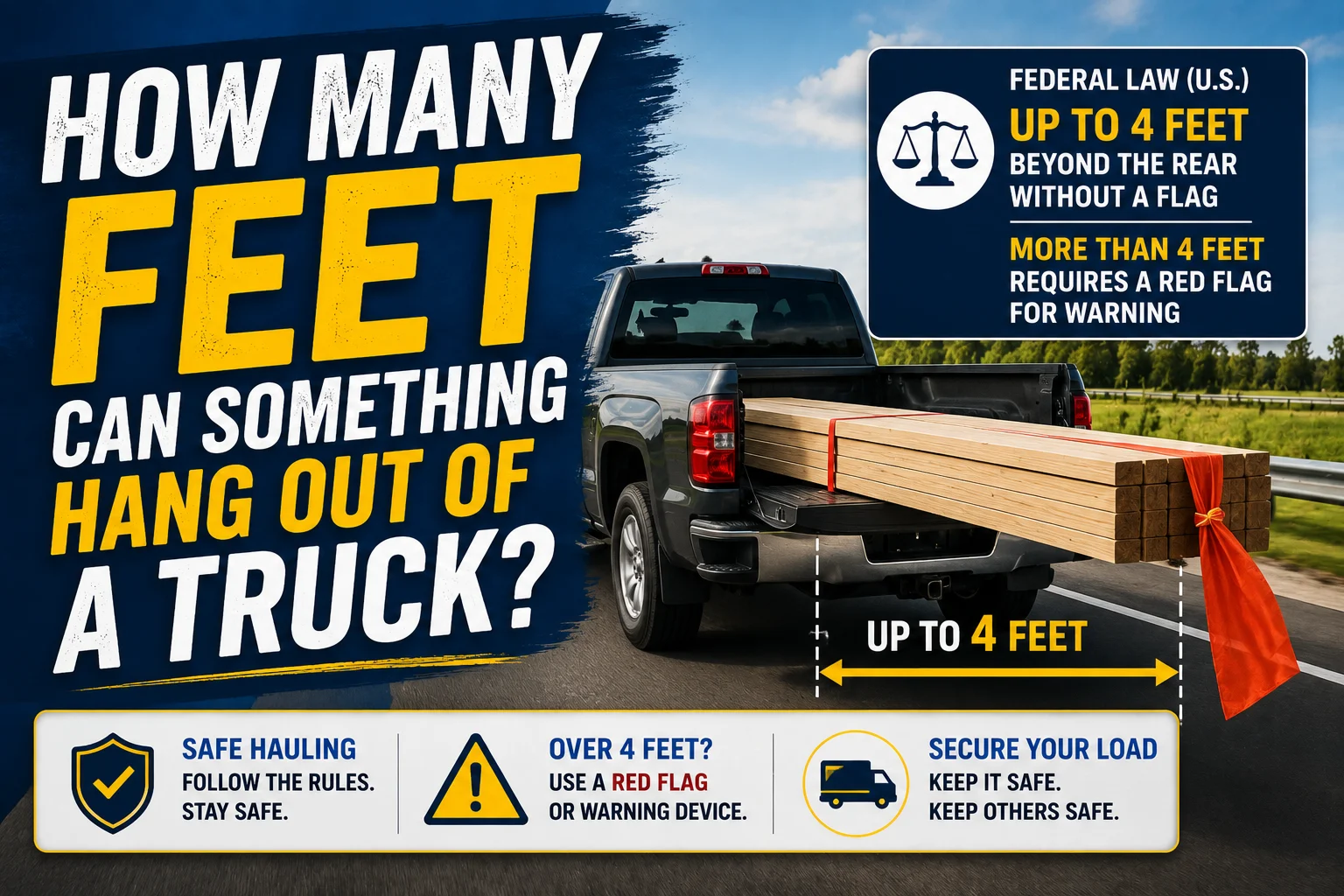
If you’re transporting lumber, pipes, ladders, furniture, or another long item in a pickup truck, you may wonder: how many feet can something hang out of a truck?
There isn’t one universal number that applies everywhere. Overhang laws vary by state and by the type of vehicle and load. Federal commercial-vehicle rules also establish marking requirements for projecting loads, while individual states can impose their own limits.
For a general U.S. reference, federal regulations require a commercial motor vehicle carrying a load that extends more than 4 feet beyond the rear to display warning flags at the end of the projecting load. That 4-foot rule is a marking requirement, not a universal statement that you are automatically allowed to have 4 feet of overhang.
For example, Pennsylvania law allows a load on a vehicle operated alone, or a nondivisible load on the rear vehicle of a combination, to extend up to 6 feet beyond the rear of the bed or body, subject to other length restrictions. Pennsylvania also requires a red flag or cloth when the load extends more than 4 feet beyond the rear.
So the safest answer is:
The legal amount depends on where you are and what vehicle/load you’re using.
Quick Answer
If you’re asking about the United States:
- More than 4 feet of rear projection: Federal commercial-vehicle rules require specific warning flags.
- The maximum legal overhang: Varies by state and vehicle type.
- Pennsylvania example: Certain loads may extend up to 6 feet beyond the rear of the bed/body, subject to applicable restrictions.
- Cargo must be properly secured: Federal cargo-securement rules require cargo to be firmly immobilized or secured to prevent shifting and falling.
Therefore, don’t assume that “4 feet” is the maximum allowed everywhere.
What Does Truck Overhang Mean?
Overhang is the portion of a load that extends beyond the supporting part of the vehicle.
For example, suppose you have:
- An 8-foot pickup bed
- A 12-foot piece of lumber
If the lumber is positioned with 8 feet supported by the bed and 4 feet extending beyond the tailgate, the rear overhang is:
4 feet
The length of the entire piece doesn’t determine the overhang. What matters is how much extends beyond the vehicle.
How Far Can Lumber Hang Out of a Truck?
Lumber is one of the most common reasons people transport long loads in pickup trucks.
A 10-, 12-, 16-, or even longer piece of lumber may extend beyond the truck bed.
For example:
12-foot board
If 8 feet are supported by the truck:
12 − 8 = 4 feet
The board has a 4-foot rear overhang.
16-foot board
If 8 feet are supported:
16 − 8 = 8 feet
The board has an 8-foot rear overhang.
Whether an 8-foot overhang is legal depends on the applicable state and vehicle rules. You should not assume that because the load can physically fit, it is legal to transport it that way.
Does a 4-Foot Overhang Require a Flag?
For commercial motor vehicles subject to the Federal Motor Carrier Safety Regulations, a load extending more than 4 feet beyond the rear must be marked with warning flags under the applicable federal rule.
The federal rule specifies:
- A single red or orange fluorescent warning flag when the projecting load is 2 feet wide or less.
- Two warning flags when the projecting load is wider than 2 feet.
The flags are placed at the extreme rear of the projecting load.
This is an important distinction:
4 feet is a warning/marking threshold under the federal commercial-vehicle rule not necessarily a maximum overhang limit.
State laws can establish different maximums.
What About a Pickup Truck?
A personal pickup truck isn’t necessarily subject to exactly the same requirements as a commercial motor vehicle operating under federal interstate regulations.
That’s why you need to check the law where you’re driving.
State laws may regulate:
- Maximum rear projection
- Maximum front projection
- Maximum overall vehicle/load length
- Required flags
- Required lights at night
- Load width
- Special permits
- Types of loads that can project
For a pickup truck carrying lumber for a personal project, the applicable state law may be different from the federal commercial-motor-vehicle requirements.
Example: Pennsylvania Truck Overhang Law
Pennsylvania provides a useful example of why you need to look at state law.
Under Pennsylvania’s vehicle code, a load on a vehicle operated alone or a nondivisible load on the rear vehicle of a combination generally may not extend more than:
6 feet beyond the rear of the bed or body
The same provision limits front projection to 3 feet and states that the overhang allowance does not override maximum vehicle-length restrictions.
Pennsylvania also requires:
A red flag or cloth at the end of the load when it extends more than 4 feet beyond the rear.
At night, a red light is required in place of the flag or cloth.
This illustrates why an article that simply says “you can have 4 feet sticking out” can be misleading.
How Far Can Something Stick Out of a Truck Bed?
There are two separate questions:
1. How far can it physically stick out?
This depends on the truck and cargo.
2. How far can it legally stick out?
This depends on the applicable law.
For example, a long board could physically extend several feet beyond a pickup bed. But if the overhang exceeds your state’s legal limit, you may need a different vehicle, special equipment, or a permit.
What If the Load Extends More Than 4 Feet?
If you’re subject to the federal commercial-vehicle rules, a rear projection of more than 4 feet triggers specific warning-marking requirements.
You also need to make sure the load:
- Is securely tied down
- Cannot shift sideways
- Cannot slide backward
- Cannot fall from the vehicle
- Doesn’t obscure required lights
- Doesn’t interfere with vehicle operation
Federal cargo-securement rules require cargo to be firmly immobilized or secured using appropriate structures, blocking, bracing, tiedowns, or combinations of these methods.
How to Secure a Long Load in a Truck
A long load needs more than a single rope thrown over the top.
Use appropriate:
- Ratchet straps
- Tie-downs
- Blocking
- Bed extenders where appropriate
- Proper anchor points
The goal is to prevent the material from:
- Sliding backward
- Moving sideways
- Shifting during braking
- Falling onto the roadway
Federal cargo-securement rules also establish requirements concerning the number and working load limits of tiedowns for commercial motor vehicles.
Can You Put a Long Board on a Pickup With the Tailgate Down?
Yes, in situations where the load and vehicle are otherwise legal, lowering the tailgate can provide additional support.
However, simply lowering the tailgate does not automatically make an overhanging load legal or safe.
The important factors include:
- How much the load extends beyond the vehicle
- Whether the load is properly supported
- Whether it is secured
- Whether required flags or lights are displayed
- Whether the total vehicle/load length complies with local law
Is It Better to Leave the Tailgate Up or Down?
It depends on the cargo.
For some long materials, leaving the tailgate down can provide additional usable bed length. For other loads, an appropriate bed extender or support system may be safer.
Regardless of the position of the tailgate, the cargo must be adequately secured.
Never rely on the tailgate alone to keep a long, heavy object from shifting.
Can Something Hang Out of the Front of a Truck?
Yes, but front projection can be regulated separately from rear projection.
The allowable distance can be different from the rear limit.
For example, Pennsylvania generally limits the load on a vehicle to 3 feet beyond the foremost part of the vehicle, subject to the specific statutory exceptions and other restrictions.
Other jurisdictions may have different requirements.
So don’t assume that a state allows the same amount of overhang in front and behind.
Can a Load Stick Out the Side of a Truck?
Side overhang is also regulated.
Rules can specify how far cargo may extend beyond:
- The left side
- The right side
- The vehicle body
- The mirrors
Side projection can be especially dangerous because it affects:
- Lane position
- Passing clearance
- Turning
- Pedestrian clearance
- Visibility
- Other vehicles
Federal and state rules should be checked before transporting unusually wide loads.
What Color Flag Is Required for an Overhanging Load?
For commercial motor vehicles subject to the federal rule, projecting loads that extend more than 4 feet beyond the rear require prescribed warning flags. The federal regulation refers to red or orange fluorescent warning flags, with the number depending on the width of the projecting load.
State rules can specify additional or different requirements, so always follow the law applicable to your route.
What Happens at Night With an Overhanging Load?
Visibility becomes even more important after dark.
Some state laws require a red light at the rear of a sufficiently projecting load rather than—or in addition to—the daytime flag.
For example, Pennsylvania requires a red light at the end of the load during hours of darkness when the load extends more than 4 feet beyond the rear.
Never assume a daytime flag is sufficient for nighttime travel.
How Much Can Lumber Stick Out of a Truck Safely?
Safety and legality aren’t exactly the same thing.
Even when an overhang is technically legal, you should consider:
- Weight distribution
- Cargo support
- Load stability
- Road conditions
- Braking
- Turning
- Wind
- Visibility
For long boards, pipes, or similar materials, the load should be supported as close to the center of gravity as practical and securely restrained.
A very long object can act like a lever, placing additional stress on the support points.
Why Long Loads Can Be Dangerous
An improperly secured long load can:
- Fall onto the roadway
- Strike another vehicle
- Shift during braking
- Swing during turns
- Damage the truck
- Obscure lights
- Reduce visibility
- Create a serious crash hazard
FMCSA’s cargo-securement requirements exist specifically to reduce crashes caused by cargo shifting or falling from commercial vehicles.
What Is the Difference Between Overhang and Overall Length?
These measurements are not the same.
Overhang
The distance cargo extends beyond the truck.
Overall length
The total length of the vehicle and load, where applicable.
For example, imagine:
- Truck: 20 feet
- Cargo: extends 5 feet beyond the rear
The overall vehicle/load length could be approximately:
20 + 5 = 25 feet
But the rear overhang is only:
5 feet
A legal overhang can still result in an overall length that exceeds another applicable limit.
Does the Type of Cargo Matter?
Yes.
Some laws treat divisible and nondivisible loads differently.
A nondivisible load is generally something that cannot reasonably be divided into smaller pieces without compromising its intended use or damaging it.
This distinction can affect:
- Permitting
- Length limits
- Oversize-load rules
- Routing requirements
Pennsylvania, for example, specifically distinguishes certain nondivisible loads in its projecting-load provision.
Do You Need a Special Permit for a Long Load?
Possibly.
If your cargo exceeds the normal size or length limits, your state may require an oversize-load permit.
Permit requirements can depend on:
- Total vehicle length
- Load length
- Load width
- Load height
- Weight
- Route
- Time of travel
- Whether the load is divisible
Don’t assume that a warning flag makes an otherwise oversized load legal.
A flag generally communicates that something is projecting; it doesn’t automatically grant permission to exceed a statutory maximum.
How to Measure Truck Load Overhang
Measuring overhang is simple.
Step 1: Measure from the rear of the truck bed or body
Find the point where the cargo stops being supported by the vehicle.
Step 2: Measure to the extreme rear of the cargo
The distance between those points is your rear overhang.
Example
If a board extends 5 feet beyond the rear of the truck:
Rear overhang = 5 feet
Remember that legal measurement methods can depend on the jurisdiction and vehicle type.
Truck Overhang Example
Suppose you have a 16-foot board and a pickup bed that is 8 feet long.
If the board is supported entirely along the bed:
16 − 8 = 8 feet
So approximately 8 feet would extend beyond the rear if the board were positioned with its front end flush with the front of the bed.
That is a substantial overhang.
Before transporting it, check:
- Your state’s maximum projection.
- Whether the load requires a flag.
- Whether nighttime lighting is required.
- Whether the board needs additional support.
- Whether the overall length is legal.
- Whether a permit is required.
How to Transport 16-Foot Lumber in a Pickup
A 16-foot board is substantially longer than a typical pickup bed.
If you must transport long lumber, consider using:
- A properly rated bed extender
- A ladder rack
- A trailer
- A lumber rack
- Appropriate support equipment
A trailer or rack designed for long materials may provide substantially better support than simply resting the material on the tailgate.
Whatever method you use, secure the load so it cannot shift or fall.
Common Mistakes With Truck Overhang
1. Assuming 4 Feet Is the Maximum
The federal 4-foot figure is commonly misunderstood. For applicable commercial vehicles, it is a warning-flag threshold, not a universal maximum.
2. Ignoring State Law
State requirements can differ significantly.
3. Using Only One Tie-Down
Long cargo may need multiple securement points depending on its length, weight, and how it is positioned.
4. Forgetting Nighttime Requirements
Some jurisdictions require lighting for projecting loads after dark.
5. Ignoring Overall Length
Even if projection is permitted, the vehicle and load may still be subject to overall length restrictions.
6. Relying on a Red Flag as a Legal Permit
A warning flag doesn’t automatically make an otherwise illegal load legal.
7. Letting Cargo Block Lights or Plates
The load should not create an unsafe obstruction of required vehicle equipment.
Truck Overhang Safety Checklist
Before driving with a projecting load, check:
- Cargo is properly supported.
- Cargo is securely tied down.
- Tie-downs are appropriate for the load.
- Load cannot slide backward.
- Load cannot move sideways.
- Required flags are installed.
- Required nighttime lighting is installed.
- License plate remains visible as required.
- Required vehicle lights remain visible.
- The load doesn’t interfere with steering or vehicle operation.
- The total length complies with applicable rules.
- A permit is obtained if required.
- The route has been checked for restrictions.
FAQs
How many feet can something hang out of a truck?
There is no single nationwide maximum for every truck and load. The legal limit depends on the state, vehicle, type of cargo, and applicable regulations.
Can something hang out 4 feet from a truck?
A load extending more than 4 feet beyond the rear of a commercial motor vehicle triggers federal warning-flag requirements. However, the 4-foot figure should not be treated as a universal maximum overhang.
How far can lumber stick out of a pickup truck?
The legal distance depends on the applicable state law. Check the state where you are operating before transporting long lumber.
Does a 4-foot overhang require a flag?
For commercial motor vehicles covered by the federal rule, a load extending more than 4 feet beyond the rear requires the prescribed warning flags.
How far can something stick out of a truck in Pennsylvania?
Pennsylvania generally permits certain loads to extend up to 6 feet beyond the rear of the bed or body, subject to other restrictions. A red flag or cloth is required when the projection exceeds 4 feet, and a red light is required at night.
Can a load stick out of the front of a truck?
Yes, but front projection is subject to separate rules. The permitted distance varies by jurisdiction.
Can cargo hang out the side of a pickup?
Possibly, but side projection is regulated separately and can have strict limits.
Do I need a red flag for lumber sticking out of my truck?
It depends on the applicable law and how far the lumber projects. Federal commercial-vehicle rules require prescribed warning flags when the rear projection exceeds 4 feet.
Do I need a light if I transport a long load at night?
Some jurisdictions require one. For example, Pennsylvania requires a red light at the end of a qualifying rear projection during hours of darkness.
Does a flag make an oversized load legal?
No. A flag is a warning device. It does not automatically authorize an overhang that exceeds a legal maximum.
How should long cargo be secured?
Cargo should be firmly immobilized or secured with appropriate structures, blocking, bracing, tiedowns, or combinations of these. Federal commercial cargo rules establish additional requirements for covered vehicles.
Conclusion
So, how many feet can something hang out of a truck?
The answer isn’t simply “4 feet.” The legal maximum depends on the state, vehicle type, cargo, and applicable regulations.
For commercial motor vehicles under federal rules, a rear projection of more than 4 feet triggers specific warning-flag requirements. But this is a marking requirement not a universal maximum amount of overhang.
State law can establish a different maximum. For example, Pennsylvania generally allows certain loads to project up to 6 feet beyond the rear of the bed or body, while requiring a red flag when the projection exceeds 4 feet and a red light at night.
Before hauling lumber, pipes, ladders, or other long materials, always check the rules for your jurisdiction and make sure the cargo is properly secured. Federal cargo rules emphasize preventing loads from shifting or falling from covered commercial vehicles.



Pingback: How Many Square Feet Is the Average Hotel Room? Complete Guide
Pingback: How Many Feet in a Square Acre? Complete Guide