

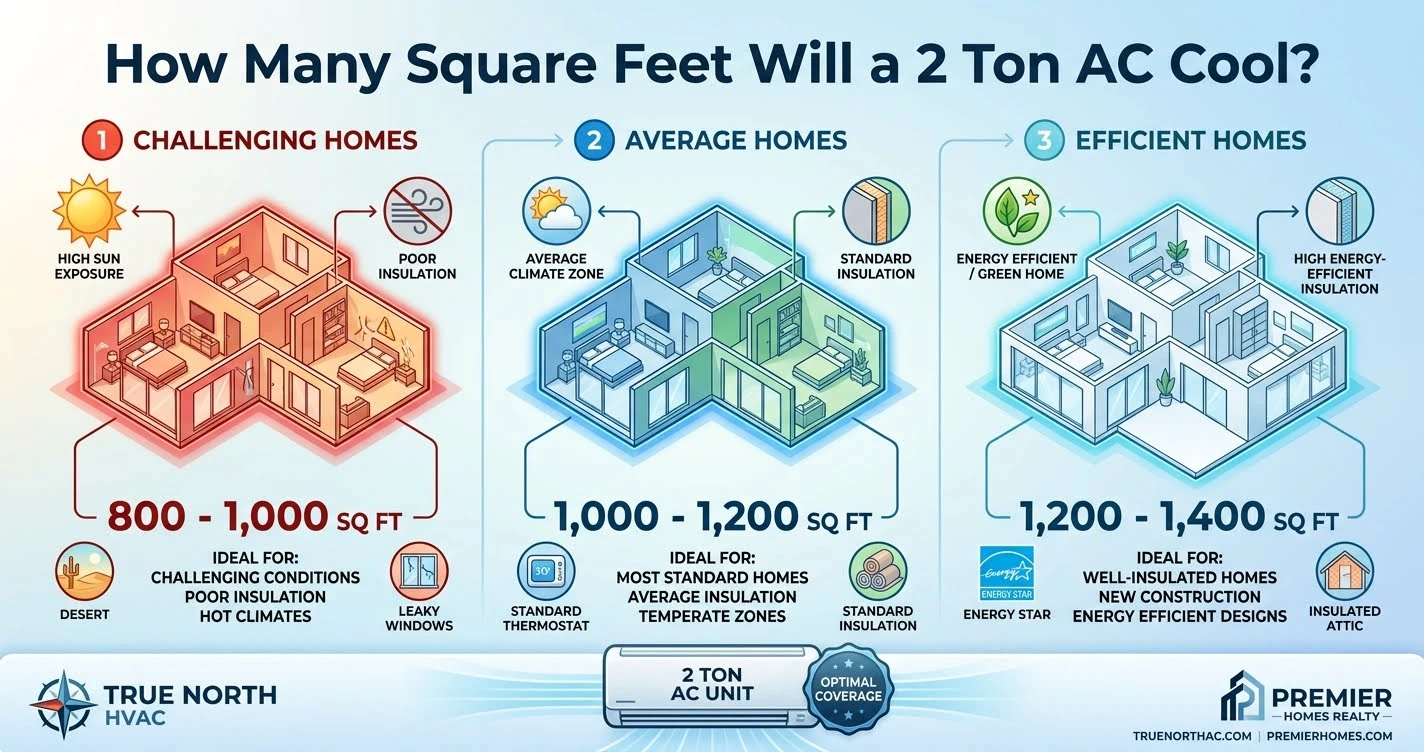
A 2-ton air conditioner can typically cool 800 to 1,200 square feet under favorable residential conditions. In a well-insulated home with standard ceilings, it may comfortably handle a space near the upper end of this range. However, rooms exposed to intense sunlight, high outdoor temperatures, poor insulation, or high ceilings may require more cooling capacity. Carrier gives a typical range of 1,000 to 1,200 square feet for a 2-ton residential AC unit. Source
A 2-ton AC provides approximately 24,000 BTUs of cooling capacity per hour. This makes it suitable for certain medium-sized rooms, open-plan living spaces, apartments, and smaller homes, depending on their cooling requirements.
In this guide, you will learn how much area a 2-ton AC can cool, how to calculate your room size, what factors affect cooling performance, and how to determine whether a 2-ton unit is the right choice for your home.
What Is a 2 Ton Air Conditioner?
A 2-ton air conditioner is an HVAC unit with a nominal cooling capacity of 24,000 BTUs per hour. The word “ton” refers to cooling capacity, not the physical weight of the equipment.
In air conditioning, one ton equals 12,000 BTUs per hour. Therefore, a 2-ton system provides twice the nominal cooling capacity of a 1-ton unit.
The basic calculation is:
2 tons × 12,000 BTUs = 24,000 BTUs per hour
This capacity measures how much heat the AC can remove under specified operating conditions. The actual cooling performance can vary with outdoor temperature, installation quality, airflow, and the specific model.
How Many Square Feet Will a 2 Ton AC Cool?
A 2-ton AC generally cools approximately 800 to 1,200 square feet in many residential settings. The best estimate depends on the building’s insulation, ceiling height, climate, windows, and heat exposure.
| Space or condition | Approximate area to consider |
|---|---|
| Well-insulated home with moderate heat exposure | 1,000–1,200 sq. ft. |
| Typical residential space | 800–1,200 sq. ft. |
| Poorly insulated or very hot space | May be considerably less |
| Room with high ceilings or strong afternoon sunlight | Requires an individual cooling assessment |
These figures are general planning estimates, not guaranteed coverage limits. A professional cooling-load calculation is more reliable than selecting an AC based on square footage alone. Source: Carrier
How Much Area Can a 2 Ton AC Cool in Different Conditions?
The same 2-ton AC may perform differently in two rooms with identical floor areas.
- Well-insulated room: Insulation reduces heat entering the room, helping the AC maintain a comfortable temperature.
- Room with large windows: Direct sunlight can increase the cooling load, especially during the afternoon.
- Top-floor room: A roof exposed to intense sunshine may transfer substantial heat indoors.
- Open-plan living area: Connected hallways, dining areas, and adjoining rooms can increase the amount of space the unit must cool.
- Hot and humid climate: High outdoor temperatures and humidity can increase cooling demands.
For these reasons, measure the area first, then consider the conditions that affect heat entering the space.
How to Calculate the Square Footage of Your Room
Before choosing a 2-ton air conditioner, calculate the total floor area you want to cool.
For a rectangular or square room, use this formula:
Square footage = Length × Width
Measure both dimensions in feet and multiply them together.
Example 1: A 20 × 40 Foot Room
Suppose your room is 20 feet long and 40 feet wide.
Calculation:
20 × 40 = 800 square feet
The room measures 800 square feet. A 2-ton AC may be suitable under moderate conditions, but a cooling-load assessment will help confirm whether it has sufficient capacity.
Example 2: A 25 × 40 Foot Room
Suppose your living area measures 25 feet by 40 feet.
Calculation:
25 × 40 = 1,000 square feet
The room measures 1,000 square feet. This falls within the typical coverage range for many 2-ton residential AC systems.
Example 3: A 30 × 40 Foot Room
Suppose the space measures 30 feet long and 40 feet wide.
Calculation:
30 × 40 = 1,200 square feet
The room measures 1,200 square feet. A 2-ton unit may handle this area in a suitably insulated home, but it could struggle if the room has substantial heat gain or is located in a very hot climate.
What If the Room Has an Irregular Shape?
Divide the room into smaller rectangles, calculate the area of each section, and add the results.
For example, if a room contains two rectangular sections measuring 400 and 250 square feet:
400 + 250 = 650 square feet
The total floor area is 650 square feet.
Remember to calculate only the area you intend to cool. If doors remain open to other rooms, those connected spaces may also affect the cooling load.
How Many BTUs Does a 2 Ton AC Have?
A 2-ton air conditioner provides approximately 24,000 BTUs per hour of nominal cooling capacity.
| AC capacity | Cooling capacity |
|---|---|
| 0.5 ton | 6,000 BTU/h |
| 1 ton | 12,000 BTU/h |
| 1.5 tons | 18,000 BTU/h |
| 2 tons | 24,000 BTU/h |
| 2.5 tons | 30,000 BTU/h |
| 3 tons | 36,000 BTU/h |
| 4 tons | 48,000 BTU/h |
BTU capacity is a useful starting point when comparing AC systems. However, two units with the same nominal tonnage may have different efficiency ratings and operating performance.
Is a 2 Ton AC Enough for Your Home?
A 2-ton AC can be enough for a smaller home or a large open room, but the correct choice depends on the total cooling load rather than the number of bedrooms alone.
Consider the following situations.
A 2 Ton AC for an 800 Square Foot Home
A 2-ton system may be sufficient for an 800-square-foot home with good insulation, standard ceilings, and limited heat exposure. In some conditions, a smaller unit might also meet the cooling requirements.
A 2 Ton AC for a 1,000 Square Foot Home
A 1,000-square-foot home is within the typical planning range for a 2-ton unit. Check whether the layout is open or divided into several rooms, because a single unit may not distribute cool air evenly throughout a home with many closed doors.
A 2 Ton AC for a 1,200 Square Foot Home
A 2-ton unit may work for a 1,200-square-foot home when insulation and other conditions are favorable. However, homes with large windows, high ceilings, poor air sealing, or intense solar exposure may need a different size.
A 2 Ton AC for a 1,500 Square Foot Home
A 2-ton AC may be undersized for a 1,500-square-foot home in many ordinary residential conditions. The unit could run for long periods without maintaining the desired temperature. A larger system or multiple properly sized units may be more appropriate, depending on the home’s layout and calculated heat load.
Factors That Affect How Much Area a 2 Ton AC Can Cool
Square footage is important, but it is only one part of choosing the correct air conditioner. The following factors can significantly affect the cooling capacity you need.
1. Climate and Outdoor Temperature
The hotter the outdoor environment, the more heat may enter your home. An AC that performs well in a mild climate may not provide the same comfort in an area with extremely hot summers.
If your home regularly experiences very high outdoor temperatures, have the unit sized for local conditions instead of relying on a general square-footage estimate.
2. Insulation Quality
Good insulation helps slow the movement of heat through walls, ceilings, and roofs. It can reduce the amount of work required from your air conditioner.
Poor insulation allows more outdoor heat to enter, potentially reducing the floor area that a 2-ton system can cool effectively.
3. Ceiling Height
Many quick sizing estimates assume standard ceiling heights. A room with a 12-foot ceiling has more air volume than a room with an 8-foot ceiling covering the same floor area.
Ceiling height is not the only consideration, but unusually tall ceilings can change the cooling requirements.
4. Windows and Sunlight
Large windows can let considerable solar heat into a room. Windows facing strong afternoon sunlight may increase the cooling load, especially when they have little external shade.
Curtains, blinds, suitable glazing, and external shading may help reduce unwanted heat gain.
5. Number of People in the Room
People release heat into the surrounding space. A crowded family room, office, or gathering area may need more cooling than a room of the same size that is rarely occupied.
6. Appliances and Other Heat Sources
Ovens, computers, televisions, lighting, and other appliances can add heat to a room. Kitchens often have particularly high cooling demands because of cooking equipment.
7. Room Layout and Airflow
A single AC unit may cool an open room effectively but struggle to distribute air through several separate rooms. Walls, closed doors, poor placement, and blocked air outlets can create uneven temperatures.
The unit’s location and the movement of air through the space are important when planning installation.
2 Ton AC vs. Other AC Sizes
Comparing different capacities can help you understand whether a 2-ton unit is the most suitable option.
| AC size | Nominal cooling capacity | General residential planning range |
|---|---|---|
| 1 ton | 12,000 BTU/h | Smaller rooms or spaces |
| 1.5 tons | 18,000 BTU/h | Small to medium-sized spaces |
| 2 tons | 24,000 BTU/h | Often around 800–1,200 sq. ft. |
| 2.5 tons | 30,000 BTU/h | Medium-sized homes or larger spaces |
| 3 tons | 36,000 BTU/h | Larger residential spaces |
The ranges overlap because insulation, climate, and building design can change the required capacity. Do not automatically choose the largest unit available.
What Happens If Your 2 Ton AC Is Too Small?
An undersized air conditioner may struggle to keep a room comfortable during the hottest part of the day.
Common signs include:
- The AC runs for long periods but the room remains warm.
- The desired temperature is difficult to maintain during hot weather.
- Rooms farther from the unit remain noticeably warmer.
- Cooling performance falls when several people occupy the space.
- The unit cannot keep up when sunlight or cooking adds substantial heat.
These symptoms can also result from dirty filters, low airflow, refrigerant problems, poor installation, or other faults. Have the system inspected before assuming that the AC is too small.
What Happens If Your 2 Ton AC Is Too Large?
A larger AC is not always better. An oversized system may cool the air near the thermostat quickly and shut off before it has operated long enough to remove sufficient moisture.
Potential problems include:
- Frequent on-and-off cycling
- Uneven temperatures
- Reduced humidity control in some systems
- Unnecessary purchase and installation costs
- Less comfortable operation
Correct sizing helps balance temperature control, humidity management, comfort, and operating efficiency.
How to Choose the Right 2 Ton AC for Your Space
Use these steps when selecting an air conditioner.
- Measure the floor area. Multiply the length by the width for each section of the space.
- Check the ceiling height. Note whether it is significantly higher than standard.
- Evaluate insulation. Consider the roof, exterior walls, windows, and gaps around doors.
- Assess sunlight exposure. Identify windows and walls that receive strong direct sunlight.
- Consider occupancy and appliances. Include people and heat-producing equipment that regularly occupy the space.
- Review the unit specifications. Compare cooling capacity and efficiency ratings rather than relying on tonnage alone.
- Request a cooling-load calculation. For a whole-home system, ask a qualified HVAC professional to calculate the load using an appropriate method, such as ACCA Manual J where applicable.
These steps provide a more reliable starting point than selecting a unit solely by the size of the home.
Frequently Asked Questions
How many square feet will a 2 ton AC cool?
A 2-ton AC typically cools around 800 to 1,200 square feet in many residential settings. The actual area depends on climate, insulation, ceiling height, sunlight, windows, and room layout.
Is a 2 ton AC enough for 1,000 square feet?
Often, yes. A 2-ton AC may be suitable for a 1,000-square-foot home with average or good insulation and standard ceiling heights. A professional assessment can confirm whether the unit will meet the cooling demand.
Can a 2 ton AC cool 1,200 square feet?
Yes, under favorable conditions. However, a 1,200-square-foot home with poor insulation, high ceilings, large sun-facing windows, or extreme outdoor temperatures may require more cooling capacity.
How many BTUs are in a 2 ton AC?
A 2-ton air conditioner has a nominal cooling capacity of 24,000 BTUs per hour.
Can a 2 ton AC cool a large living room?
It can cool a large living room if the room’s cooling load is within the unit’s capacity. Measure the floor area and consider ceiling height, windows, sunlight, and adjoining spaces before deciding.
Is a 2 ton AC suitable for a bedroom?
A 2-ton AC may be more capacity than a typical bedroom needs. Its suitability depends on the bedroom’s dimensions and heat load. A smaller, correctly sized unit may provide better comfort and humidity control.
Does a 2 ton inverter AC cool more square feet than a non-inverter AC?
Not necessarily. Inverter technology allows a compatible compressor to vary its output, but the unit’s rated cooling capacity still matters. Two 2-ton models may have different efficiency and operating characteristics, yet neither should be assumed to cool a larger area simply because it is an inverter model.
Will a 2 ton AC reduce electricity bills?
It may operate efficiently when correctly sized and properly maintained. Electricity use depends on the model’s efficiency, operating hours, temperature settings, outdoor conditions, installation, and the building’s cooling load. Tonnage alone cannot determine the electricity bill.
Should I buy a bigger AC if my room gets very hot?
Not automatically. First check the insulation, air leaks, filters, airflow, and installation. If the system still cannot meet the cooling demand, a professional load calculation can determine whether a larger unit is needed.
Conclusion
A 2-ton air conditioner typically cools approximately 800 to 1,200 square feet, with the exact coverage depending on the home and local climate. Its nominal capacity is 24,000 BTUs per hour, making it a potential option for smaller homes, open-plan living spaces, and medium-sized areas.
Before buying a 2-ton AC, calculate your room’s square footage and consider insulation, ceiling height, windows, sunlight, occupancy, and airflow. For the most reliable result, have a qualified HVAC professional assess the cooling load. Choosing the correct capacity can help maintain comfortable temperatures, manage humidity, and avoid unnecessary energy use.



Pingback: How Many Feet in a Hundred Yards?