

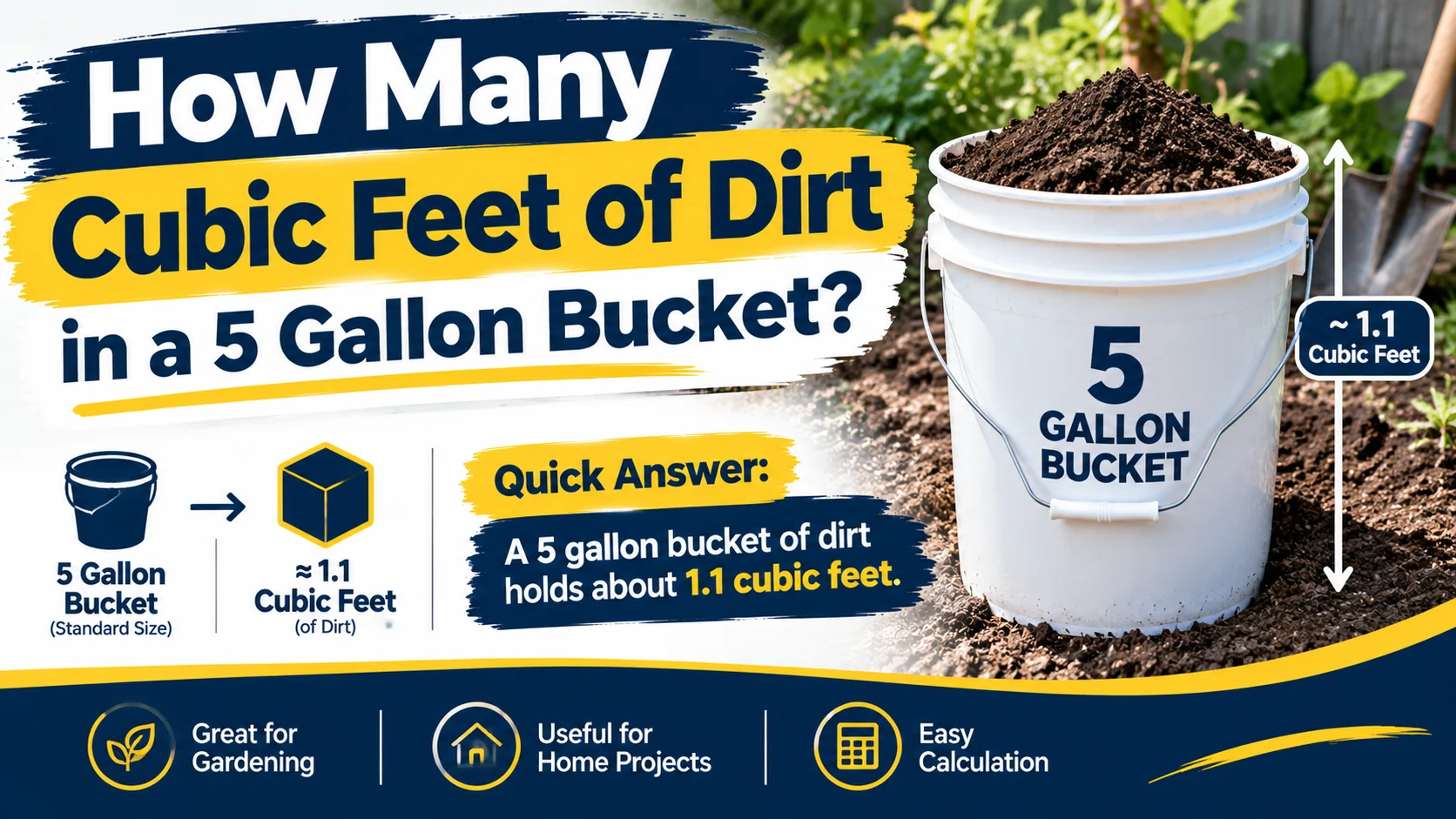
If you are wondering how many cubic feet of dirt are in a 5-gallon bucket, a standard 5-gallon U.S. bucket holds approximately 0.67 cubic feet of material when filled to its stated capacity.
The calculation is based on the standard relationship between gallons and cubic feet. One cubic foot contains approximately 7.48 U.S. gallons, so:
5 gallons ÷ 7.48 = 0.668 cubic feet
Rounded to two decimal places:
5 gallons ≈ 0.67 cubic feet
This measurement is useful when moving garden soil, topsoil, compost, mulch, sand, gravel, or other bulk materials in buckets. However, the actual amount of dirt you can put into a bucket depends on how full the bucket is, the bucket’s actual capacity, and how the material is packed.
How Many Cubic Feet Are in a 5-Gallon Bucket?
A full 5-gallon U.S. bucket contains approximately 0.67 cubic feet of volume.
The basic conversion is:
1 cubic foot ≈ 7.48 gallons
Therefore:
5 ÷ 7.48 = 0.668 cubic feet
So you can use:
5-gallon bucket ≈ 0.67 cubic feet
The U.S. Geological Survey lists one cubic foot as approximately 7.4805 gallons.
Quick Answer
| Bucket Capacity | Approximate Cubic Feet |
|---|---|
| 1 gallon | 0.134 cu ft |
| 2 gallons | 0.267 cu ft |
| 3 gallons | 0.401 cu ft |
| 4 gallons | 0.535 cu ft |
| 5 gallons | 0.668 cu ft |
| 6 gallons | 0.802 cu ft |
| 10 gallons | 1.337 cu ft |
These figures are volume conversions. They do not tell you the weight of the dirt because different soils have different densities.
How to Calculate Cubic Feet in a 5-Gallon Bucket
The easiest way to calculate the volume is to convert gallons to cubic feet.
The formula is:
Cubic feet = Gallons ÷ 7.4805
For a 5-gallon bucket:
Cubic feet = 5 ÷ 7.4805
Cubic feet ≈ 0.6684
Rounded:
0.67 cubic feet
The important point is that a gallon measures volume, and a cubic foot also measures volume. The conversion does not depend on whether the bucket contains water, soil, sand, or another material.
The material’s weight changes, but the container’s volume does not.
Is a 5-Gallon Bucket Really 0.67 Cubic Feet?
For a bucket with a true capacity of exactly 5 U.S. gallons, yes, its volume is approximately 0.67 cubic feet.
However, there is an important practical distinction.
A bucket sold or described as a “5-gallon bucket” may not hold exactly 5 gallons when you measure its physical dimensions. The advertised capacity may refer to a nominal size, and the usable fill level can vary.
In addition, when using the bucket for dirt, you may not fill it completely to the rim.
For example:
- Completely filled = approximately 0.67 cu ft
- Filled to 90% = approximately 0.60 cu ft
- Filled to 80% = approximately 0.53 cu ft
- Filled to 75% = approximately 0.50 cu ft
- Half full = approximately 0.33 cu ft
This distinction becomes important when estimating how many bucket loads are required for a landscaping project.
5-Gallon Bucket Dirt Volume Chart
The following table shows approximate cubic feet based on different fill levels of a 5-gallon bucket.
| Fill Level | Gallons of Material | Approx. Cubic Feet |
|---|---|---|
| 100% | 5.00 gal | 0.67 cu ft |
| 90% | 4.50 gal | 0.60 cu ft |
| 80% | 4.00 gal | 0.53 cu ft |
| 75% | 3.75 gal | 0.50 cu ft |
| 50% | 2.50 gal | 0.33 cu ft |
| 25% | 1.25 gal | 0.17 cu ft |
For planning purposes, 0.67 cubic feet per completely filled 5-gallon bucket is a useful conversion.
If you typically leave some space at the top, use the actual fill level rather than assuming every bucket contains 0.67 cubic feet.
How Many 5-Gallon Buckets Are in One Cubic Foot?
To determine how many 5-gallon buckets make one cubic foot, divide the gallons in one cubic foot by 5:
7.4805 ÷ 5 = 1.4961
Therefore:
1 cubic foot ≈ 1.5 full 5-gallon buckets
This is an especially useful conversion when moving dirt.
Quick Reference
| Cubic Feet | Approx. 5-Gallon Buckets |
|---|---|
| 0.5 cu ft | 0.75 bucket |
| 0.67 cu ft | 1 bucket |
| 1 cu ft | 1.5 buckets |
| 2 cu ft | 3 buckets |
| 3 cu ft | 4.5 buckets |
| 4 cu ft | 6 buckets |
| 5 cu ft | 7.5 buckets |
| 10 cu ft | 15 buckets |
| 20 cu ft | 30 buckets |
| 27 cu ft | 40.4 buckets |
Because one cubic yard equals 27 cubic feet, a cubic yard of material would require approximately 40.4 full 5-gallon bucket loads.
In real work, the number may be higher if buckets are not filled completely.
How Many 5-Gallon Buckets of Dirt Are in a Cubic Yard?
One cubic yard contains:
27 cubic feet
A full 5-gallon bucket contains approximately:
0.668 cubic feet
Therefore:
27 ÷ 0.668 ≈ 40.4 buckets
So:
1 cubic yard of dirt ≈ 40–41 full 5-gallon buckets
This is a theoretical volume conversion.
If you are moving soil by hand and only fill each bucket to 80–90% capacity, you will need more trips.
Cubic Yard to Bucket Chart
| Material Volume | Approx. 5-Gallon Buckets |
|---|---|
| 1 cu ft | 1.5 buckets |
| 2 cu ft | 3 buckets |
| 5 cu ft | 7.5 buckets |
| 10 cu ft | 15 buckets |
| 15 cu ft | 22.5 buckets |
| 20 cu ft | 30 buckets |
| 25 cu ft | 37.5 buckets |
| 27 cu ft / 1 yd³ | 40.4 buckets |
| 2 yd³ | 80.8 buckets |
| 3 yd³ | 121.2 buckets |
| 5 yd³ | 202 buckets |
How Much Dirt Does a 5-Gallon Bucket Hold?
In terms of volume, a 5-gallon bucket holds approximately:
- 5 U.S. gallons
- 0.668 cubic feet
- 0.02476 cubic yards
- 18.93 liters
- 1,155 cubic inches
- 0.01893 cubic meters
The U.S. Geological Survey gives 1 gallon as approximately 3.785 liters and one cubic foot as approximately 0.02832 cubic meters.
5-Gallon Bucket Conversion Table
| Unit | 5-Gallon Bucket |
|---|---|
| U.S. gallons | 5 gal |
| Cubic feet | 0.668 cu ft |
| Cubic yards | 0.0248 yd³ |
| Liters | 18.93 L |
| Cubic inches | 1,155 in³ |
| Cubic meters | 0.01893 m³ |
How Much Does a 5-Gallon Bucket of Dirt Weigh?
This question is different from asking how many cubic feet are in the bucket.
Volume and weight are not the same thing.
A 5-gallon bucket always has approximately 0.67 cubic feet of volume if it is actually filled to its 5-gallon capacity. But its weight can vary substantially depending on the material.
For example, the weight can be affected by:
- Soil type
- Moisture content
- Organic matter
- Sand content
- Clay content
- Compaction
- Gravel or rocks
- How tightly the bucket is packed
Therefore, you should not use a fixed weight to calculate cubic feet unless you know the material’s density.
Volume vs. Weight
| Measurement | What It Tells You |
|---|---|
| Gallons | Volume |
| Cubic feet | Volume |
| Cubic yards | Volume |
| Pounds | Weight |
| Kilograms | Weight |
A 5-gallon bucket of wet clay soil can weigh much more than a 5-gallon bucket of dry, lightweight potting mix, even though both occupy approximately the same volume.
How Many 5-Gallon Buckets of Dirt Do You Need?
You can calculate the number of buckets required if you know the total amount of soil needed.
Use this formula:
Number of buckets = Total cubic feet ÷ 0.668
For example, suppose you need 10 cubic feet of soil:
10 ÷ 0.668 ≈ 14.97
So you need approximately:
15 full 5-gallon buckets
Bucket Calculation Examples
| Soil Needed | Approx. Buckets |
|---|---|
| 1 cu ft | 1.5 |
| 2 cu ft | 3 |
| 3 cu ft | 4.5 |
| 4 cu ft | 6 |
| 5 cu ft | 7.5 |
| 10 cu ft | 15 |
| 15 cu ft | 22.5 |
| 20 cu ft | 30 |
| 27 cu ft | 40.4 |
| 50 cu ft | 74.8 |
Since you cannot make half a physical trip, round up to the next whole bucket load when planning the work.
How Many Buckets for a Raised Garden Bed?
Suppose you have a raised garden bed measuring:
4 feet × 8 feet × 1 foot
Calculate the volume:
4 × 8 × 1 = 32 cubic feet
Now convert cubic feet to 5-gallon buckets:
32 ÷ 0.668 ≈ 47.9
So you would need approximately:
48 full 5-gallon buckets
This is a theoretical calculation assuming every bucket is filled to its full 5-gallon capacity.
If the buckets are only filled to 80%, the number of trips will be higher.
How Many Buckets for a 4×4 Garden Bed?
Consider a 4×4-foot raised bed that is 1 foot deep.
4 × 4 × 1 = 16 cubic feet
Now divide by 0.668:
16 ÷ 0.668 ≈ 23.95
So:
Approximately 24 full 5-gallon buckets
would be required.
Common Raised-Bed Examples
| Garden Bed | Depth | Volume | Approx. 5-Gallon Buckets |
|---|---|---|---|
| 2×4 ft | 1 ft | 8 cu ft | 12 buckets |
| 3×6 ft | 1 ft | 18 cu ft | 27 buckets |
| 4×4 ft | 1 ft | 16 cu ft | 24 buckets |
| 4×8 ft | 1 ft | 32 cu ft | 48 buckets |
| 4×8 ft | 2 ft | 64 cu ft | 96 buckets |
| 5×10 ft | 1 ft | 50 cu ft | 75 buckets |
These calculations assume rectangular beds and full 5-gallon bucket loads.
How Many Buckets of Dirt Are in a Bag of Soil?
This depends on the bag’s volume.
For example, if a bag contains 1 cubic foot of soil:
1 ÷ 0.668 ≈ 1.5 buckets
So one cubic-foot bag contains approximately 1½ five-gallon buckets of material.
A 2-cubic-foot bag contains:
2 ÷ 0.668 ≈ 3 buckets
A 3-cubic-foot bag contains:
3 ÷ 0.668 ≈ 4.5 buckets
Bag-to-Bucket Conversion
| Bag Size | Approx. 5-Gallon Buckets |
|---|---|
| 0.5 cu ft | 0.75 bucket |
| 0.75 cu ft | 1.12 buckets |
| 1 cu ft | 1.5 buckets |
| 1.5 cu ft | 2.25 buckets |
| 2 cu ft | 3 buckets |
| 2.5 cu ft | 3.74 buckets |
| 3 cu ft | 4.49 buckets |
This can help you compare bagged soil with bulk soil or estimate how many trips are needed to transport a certain amount.
How Many 5-Gallon Buckets Equal a Cubic Yard?
A cubic yard contains 27 cubic feet.
Since each full 5-gallon bucket contains about 0.668 cubic feet:
27 ÷ 0.668 ≈ 40.4
Therefore:
1 cubic yard ≈ 40.4 full 5-gallon buckets
In practical terms, you can think of a cubic yard as approximately 41 full buckets.
If you are moving dirt manually, however, the actual number of trips may be higher because you may not fill each bucket to the top.
How Many Cubic Feet Are 10 5-Gallon Buckets?
If each bucket contains 5 gallons:
10 × 0.668 = 6.68 cubic feet
Therefore:
10 full 5-gallon buckets ≈ 6.68 cubic feet
Similarly:
| Number of Buckets | Approx. Cubic Feet |
|---|---|
| 1 | 0.67 |
| 5 | 3.34 |
| 10 | 6.68 |
| 15 | 10.03 |
| 20 | 13.37 |
| 25 | 16.71 |
| 30 | 20.05 |
| 40 | 26.74 |
| 50 | 33.42 |
| 100 | 66.84 |
How Many 5-Gallon Buckets Are in 2 Cubic Yards?
Two cubic yards contain:
2 × 27 = 54 cubic feet
Then:
54 ÷ 0.668 ≈ 80.8
Therefore:
2 cubic yards ≈ 81 full 5-gallon buckets
For larger landscaping projects, this demonstrates why using a wheelbarrow, trailer, or delivery service may be more efficient than moving soil one 5-gallon bucket at a time.
Does Dirt Type Change the Cubic Feet in the Bucket?
No, not if the bucket actually contains the same volume.
A full 5-gallon bucket has a volume of approximately 0.67 cubic feet regardless of whether it contains:
- Topsoil
- Garden soil
- Potting mix
- Compost
- Sand
- Gravel
- Mulch
What changes is the weight and sometimes how much material settles inside the bucket.
For example, loose soil may contain more air spaces than compacted soil. After handling or watering, the material can settle.
This is why volume estimates should be based on the amount of material actually occupying the container rather than its weight.
Dirt vs. Soil: Does the Terminology Matter?
For volume calculations, “dirt” and “soil” can be treated the same way if they occupy the same volume.
However, in gardening and landscaping, different soil products have different characteristics.
You may encounter:
- Topsoil
- Garden soil
- Potting mix
- Compost
- Fill dirt
- Sandy soil
- Clay soil
These materials can have dramatically different weights and purposes.
For example, potting mix is usually much lighter than wet clay. Therefore, knowing that you have one 5-gallon bucket tells you the approximate volume, not the exact weight or quality of the material.
How to Measure Dirt With a 5-Gallon Bucket
If you want a practical way to measure soil without a cubic-foot container, a 5-gallon bucket can act as a convenient reference.
Step 1: Identify the Bucket Capacity
Make sure the bucket is actually rated for approximately 5 U.S. gallons.
Step 2: Fill the Bucket
Fill it consistently to the same level each time.
Step 3: Avoid Major Differences in Packing
If one bucket is loosely filled and another is heavily compacted, the amount of material represented by each load may differ.
Step 4: Count the Loads
If you need approximately 10 cubic feet:
10 ÷ 0.668 ≈ 15 buckets
So you would plan for approximately 15 full bucket loads.
Step 5: Add a Practical Allowance
For landscaping, it can be useful to account for settling, uneven filling, and material left behind in the bucket.
Common Mistakes When Calculating 5-Gallon Bucket Volume
Mistake 1: Assuming 5 Gallons Equals 5 Cubic Feet
It does not.
A 5-gallon bucket contains only about:
0.67 cubic feet
Five gallons and five cubic feet are very different volumes.
Mistake 2: Confusing Weight With Volume
A bucket of wet soil may weigh much more than a bucket of dry soil, but both can occupy the same volume.
Mistake 3: Assuming Every Bucket Is Filled Completely
A bucket loaded 75% full does not contain the full 0.67 cubic feet.
Mistake 4: Ignoring Compaction and Settling
Loose soil can settle after being moved or watered. If you need a precise material quantity, account for the actual condition of the soil.
Mistake 5: Forgetting the Difference Between U.S. and Imperial Gallons
The calculation above uses the U.S. gallon, which is the standard assumption for a typical 5-gallon bucket sold in the United States.
Mistake 6: Using Weight to Estimate Cubic Feet Without Density
There is no universal pounds-to-cubic-feet conversion for dirt because soil density varies.
5-Gallon Bucket vs. Cubic Foot vs. Cubic Yard
These are all volume measurements, but they represent different quantities.
| Unit | Approximate Equivalent |
|---|---|
| 1 U.S. gallon | 0.134 cu ft |
| 5 U.S. gallons | 0.668 cu ft |
| 1 cubic foot | 7.48 gal |
| 1 cubic yard | 27 cu ft |
| 1 cubic yard | 202 gal |
| 1 cubic yard | About 40.4 five-gallon buckets |
One cubic yard contains approximately 202 gallons because:
27 × 7.4805 ≈ 201.97 gallons
That makes the 5-gallon bucket conversion straightforward:
201.97 ÷ 5 ≈ 40.4 buckets
Quick 5-Gallon Bucket Conversion Chart
For quick reference:
| 5-Gallon Buckets | Cubic Feet |
|---|---|
| 1 | 0.67 |
| 2 | 1.34 |
| 3 | 2.01 |
| 4 | 2.67 |
| 5 | 3.34 |
| 6 | 4.01 |
| 8 | 5.35 |
| 10 | 6.68 |
| 12 | 8.02 |
| 15 | 10.03 |
| 20 | 13.37 |
| 25 | 16.71 |
| 30 | 20.05 |
| 40 | 26.74 |
| 41 | 27.41 |
| 50 | 33.42 |
| 100 | 66.84 |
Values are rounded, so small differences may appear when multiplying or converting between units.
Frequently Asked Questions
How many cubic feet of dirt are in a 5-gallon bucket?
A full 5-gallon U.S. bucket holds approximately 0.67 cubic feet of dirt by volume.
How many 5-gallon buckets make 1 cubic foot?
Approximately 1.5 full 5-gallon buckets make one cubic foot.
How many 5-gallon buckets are in a cubic yard of dirt?
One cubic yard contains 27 cubic feet, which equals approximately 40.4 full 5-gallon buckets.
In practical terms, plan on about 41 full buckets.
How many cubic feet are in 10 five-gallon buckets?
Ten full 5-gallon buckets contain approximately 6.68 cubic feet.
How many cubic feet are in 20 five-gallon buckets?
Twenty full 5-gallon buckets contain approximately 13.37 cubic feet.
How much does a 5-gallon bucket of dirt weigh?
There is no single answer. Weight depends on soil type, moisture, density, organic matter, and compaction. A volume conversion cannot determine the exact weight without knowing the material’s density.
Is a 5-gallon bucket exactly 0.67 cubic feet?
A true 5-U.S.-gallon volume is approximately 0.668 cubic feet. A commercially labeled “5-gallon” bucket may have slightly different physical dimensions or usable fill capacity, so actual measurements can vary.
How many gallons are in a cubic foot?
One cubic foot contains approximately 7.48 U.S. gallons.
How many cubic yards are in a 5-gallon bucket?
A full 5-gallon bucket contains approximately:
0.668 ÷ 27 ≈ 0.0248 cubic yards
So one bucket is about 0.025 cubic yards.
How many liters are in a 5-gallon bucket?
Five U.S. gallons equal approximately 18.93 liters because one U.S. gallon is about 3.785 liters.
Can I use this calculation for mulch, sand, and gravel?
Yes. The volume conversion is the same for any material. A 5-gallon volume is approximately 0.67 cubic feet whether the bucket contains soil, mulch, sand, gravel, or another material. The weight will differ substantially between materials.
Final Answer
So, how many cubic feet of dirt are in a 5-gallon bucket?
A full 5-gallon U.S. bucket contains approximately 0.67 cubic feet of dirt.
The calculation is:
5 gallons ÷ 7.4805 gallons per cubic foot = 0.668 cubic feet
Rounded:
5 gallons ≈ 0.67 cubic feet
For practical calculations:
- 1 bucket ≈ 0.67 cubic feet
- 1 cubic foot ≈ 1.5 buckets
- 10 buckets ≈ 6.68 cubic feet
- 20 buckets ≈ 13.37 cubic feet
- 1 cubic yard ≈ 40.4 full 5-gallon buckets
Remember that these figures describe volume, not weight. The weight of a bucket of dirt depends on its moisture, density, soil type, and how tightly it is packed.



Pingback: How Many Square Feet in a 12x12 Room? Complete Guide