

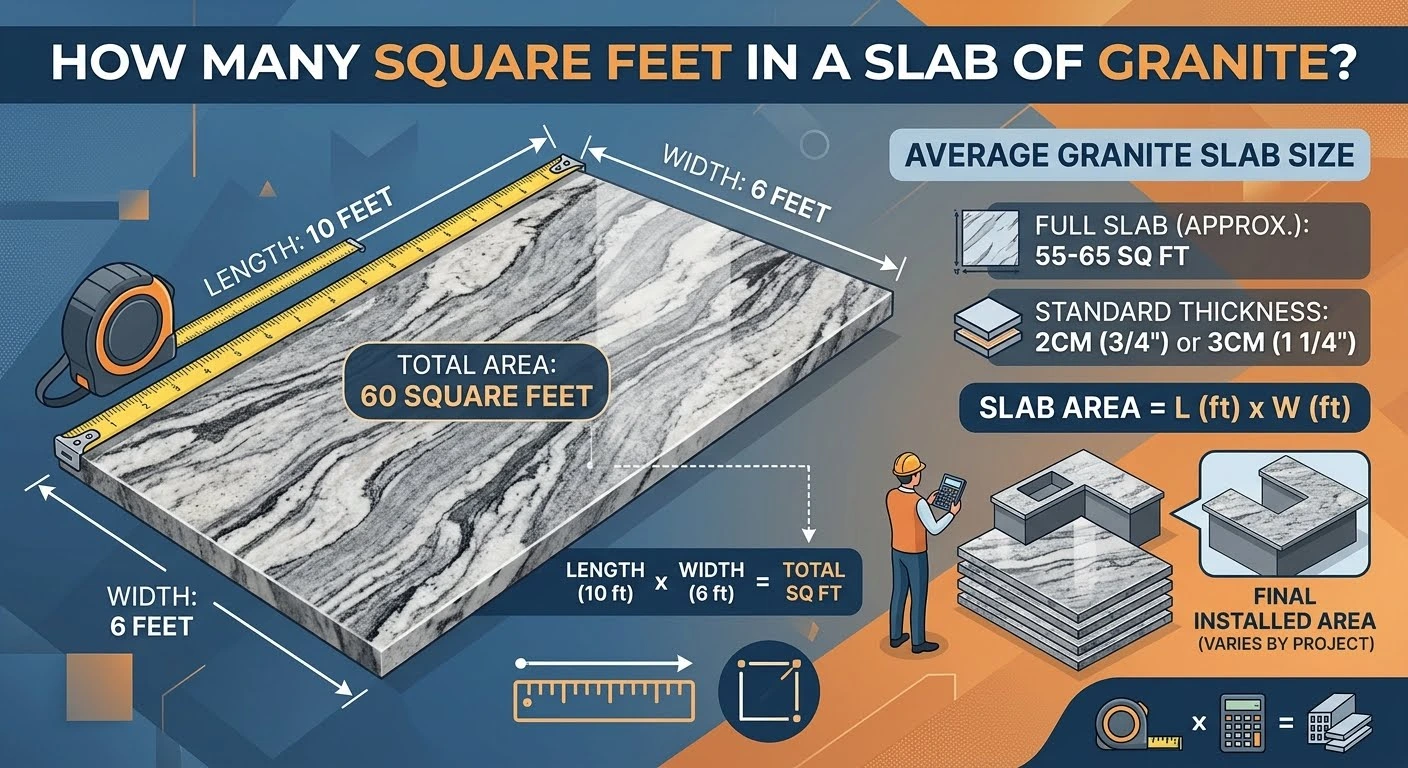
Granite is a popular material for kitchen countertops, bathroom vanities, islands, and other home improvement projects because of its natural appearance and durability. If you are planning to install granite, one important question is: how many square feet in a slab of granite?
A typical granite slab may contain approximately 45 to 60 square feet, although some slabs are smaller or considerably larger. The exact amount depends on the slab’s length and width, which vary by supplier, quarry, and stone type.
For example, a granite slab measuring 10 feet long and 5 feet wide contains 50 square feet. A slab measuring 9 feet long and 5 feet wide contains 45 square feet.
However, the total square footage of a slab is not always the same as the amount of usable countertop material. Cutouts for sinks and cooktops, natural cracks, irregular edges, and the layout of your countertop can affect how much granite you can use.
In this guide, you will learn common granite slab sizes, how to calculate square footage, how much granite a kitchen may need, and how to estimate the material required for your project.
How Many Square Feet Are in a Slab of Granite?
A granite slab does not have one universal size. Many commonly available slabs contain around 45 to 60 square feet, but actual dimensions can vary considerably.
Here are some example slab dimensions and their square footage:
| Granite Slab Length | Granite Slab Width | Total Area |
|---|---|---|
| 8 ft | 4 ft | 32 sq ft |
| 9 ft | 5 ft | 45 sq ft |
| 10 ft | 5 ft | 50 sq ft |
| 10 ft | 6 ft | 60 sq ft |
| 11 ft | 6 ft | 66 sq ft |
| 12 ft | 6 ft | 72 sq ft |
These are illustrative dimensions, not guaranteed standard sizes. Always confirm the actual dimensions of the slab with your stone supplier before purchasing.
Quick answer: A typical granite slab may have approximately 45–60 square feet, but the actual area must be calculated from its length and width.
What Is a Granite Slab?
A granite slab is a large, flat piece of natural stone cut from a larger block of granite. It is commonly used for countertops, backsplashes, bathroom surfaces, fireplace surrounds, and other architectural applications.
Granite is available in different colors, patterns, finishes, and thicknesses. Because it is a natural material, each slab can have a unique appearance.
The slab’s square footage describes the area of its surface. Its thickness is a separate measurement that affects weight, appearance, fabrication, and installation requirements.
For example, two granite slabs can each contain 50 square feet even if one is 2 centimeters thick and the other is 3 centimeters thick.
How to Calculate Square Feet in a Granite Slab
Calculating the square footage of a granite slab is straightforward if you know its length and width.
Use this formula:
Square feet = Length in feet × Width in feet
For example, suppose a granite slab measures 10 feet long and 5 feet wide.
Calculation:
10 × 5 = 50 square feet
The slab contains 50 square feet of surface area.
Example 1: A 9 × 5-Foot Granite Slab
Length = 9 feet
Width = 5 feet
Calculation:
9 × 5 = 45 square feet
The slab contains 45 square feet.
Example 2: A 10 × 6-Foot Granite Slab
Length = 10 feet
Width = 6 feet
Calculation:
10 × 6 = 60 square feet
The slab contains 60 square feet.
Example 3: A 12 × 6-Foot Granite Slab
Length = 12 feet
Width = 6 feet
Calculation:
12 × 6 = 72 square feet
The slab contains 72 square feet.
These examples assume the slab is rectangular. If the slab has irregular edges or defects, its usable area may be less than the calculated area.
Granite Slab Size Chart
Use this reference chart to estimate the surface area of a rectangular granite slab.
| Slab Length | 4-Foot Width | 5-Foot Width | 6-Foot Width |
|---|---|---|---|
| 8 feet | 32 sq ft | 40 sq ft | 48 sq ft |
| 9 feet | 36 sq ft | 45 sq ft | 54 sq ft |
| 10 feet | 40 sq ft | 50 sq ft | 60 sq ft |
| 11 feet | 44 sq ft | 55 sq ft | 66 sq ft |
| 12 feet | 48 sq ft | 60 sq ft | 72 sq ft |
This chart is useful for preliminary planning, but actual granite slabs can have different dimensions. Check the supplier’s measurements rather than assuming your slab matches a chart.
How Many Square Feet of Granite Do You Need for a Kitchen?
The amount of granite needed for a kitchen depends on the size and layout of the countertops. A small kitchen may require considerably less stone than a large kitchen with an island and additional preparation areas.
For a rough estimate, consider these hypothetical countertop layouts:
| Kitchen Countertop Area | Example Dimensions | Square Feet |
|---|---|---|
| Small countertop section | 8 × 2 ft | 16 sq ft |
| Medium countertop section | 10 × 2 ft | 20 sq ft |
| Long countertop section | 12 × 2 ft | 24 sq ft |
| Kitchen island | 6 × 3 ft | 18 sq ft |
| Large island | 8 × 4 ft | 32 sq ft |
These figures describe the surface area of each rectangular section. They do not include additional material that may be needed for backsplashes, edge details, seams, or fabrication waste.
Example: Granite for a Small Kitchen
Suppose your kitchen has two countertop sections:
- Section 1: 8 × 2 feet = 16 square feet
- Section 2: 6 × 2 feet = 12 square feet
Total countertop area:
16 + 12 = 28 square feet
The countertops require 28 square feet of finished surface area before accounting for cutouts, fabrication, and layout requirements.
Example: Granite for a Kitchen With an Island
Suppose your kitchen has two countertop sections and an island:
- Main counter: 12 × 2 feet = 24 square feet
- Second counter: 8 × 2 feet = 16 square feet
- Island: 6 × 3 feet = 18 square feet
Total area:
24 + 16 + 18 = 58 square feet
The total countertop surface area is 58 square feet.
Although one large slab with 60 square feet might appear sufficient based on area alone, it may not work because the pieces must fit within the slab’s actual dimensions. The fabricator must also account for cutouts, seams, defects, and the direction of the stone pattern.
Can One Granite Slab Cover an Entire Kitchen?
Sometimes, but not always.
A single slab may be enough for a small kitchen, depending on the countertop dimensions and slab layout. Larger kitchens may need two or more slabs, especially if they include a large island, long countertop runs, or surfaces with complex shapes.
The total square footage is only one part of the calculation. A fabricator also needs to determine how each countertop piece can be cut from the slab.
For example, a kitchen may require 45 square feet of countertop surface, and the slab may contain 50 square feet. That does not guarantee the slab can produce all the required pieces. The arrangement of the pieces, cutouts, and usable edges matters.
Before buying granite, provide the fabricator with measurements or a countertop template so they can estimate the number of slabs required.
How Much Granite Is Needed for a 10 × 10 Kitchen?
A 10 × 10-foot kitchen has a floor area of 100 square feet, but that does not mean you need 100 square feet of granite.
Granite is typically installed on selected countertop surfaces rather than across the entire kitchen floor.
For example, if the kitchen has two countertop runs measuring 10 × 2 feet and 6 × 2 feet:
First countertop:
10 × 2 = 20 square feet
Second countertop:
6 × 2 = 12 square feet
Total countertop area:
20 + 12 = 32 square feet
This example requires 32 square feet of countertop surface before additional fabrication considerations.
The actual amount depends on the kitchen layout, cabinet arrangement, island size, and any backsplash material included in the project.
Does Granite Thickness Affect Square Footage?
Granite thickness does not change the surface area of a slab. Length and width determine square footage.
However, thickness affects the stone’s weight, appearance, edge fabrication, and installation requirements.
Common nominal granite thicknesses include:
| Granite Thickness | Approximate Metric Equivalent |
|---|---|
| 2 cm | 0.79 inches |
| 3 cm | 1.18 inches |
Actual measurements and available thicknesses vary by supplier and product.
A 10 × 5-foot slab has 50 square feet of surface area whether it is 2 cm or 3 cm thick. The thicker slab contains more stone volume and weighs more.
Some countertop designs use built-up or laminated edges to create the appearance of a thicker surface. Ask your fabricator how the selected slab will be finished and supported.
How Much Does a Granite Slab Weigh?
Granite is a dense natural stone, so even a single slab can be heavy. Its weight depends on its dimensions, thickness, and density.
For preliminary planning, granite is often estimated at approximately 18–20 pounds per square foot for a slab around 3 cm thick. A slab around 2 cm thick may weigh roughly 12–14 pounds per square foot.
These are estimates, not specifications for every granite product.
For example, a 50-square-foot slab at an assumed weight of 19 pounds per square foot would weigh approximately:
50 × 19 = 950 pounds
That is nearly half a ton.
The actual weight should be confirmed with the supplier or fabricator. Granite slabs require appropriate equipment, handling procedures, and support during transportation and installation.
How Much Extra Granite Should You Allow for Waste?
Granite countertop projects can require extra material because stone must be cut to match the countertop layout. Waste can result from sink cutouts, cooktop openings, edge trimming, natural defects, and the shape of the slab.
There is no single waste percentage that works for every project. A simple rectangular layout may be easier to fabricate than a kitchen with multiple corners, a large island, or a patterned stone that needs to be aligned.
For an early estimate, you can calculate a hypothetical 10% allowance:
Required countertop area = 50 square feet
Allowance:
50 × 0.10 = 5 square feet
Preliminary total:
50 + 5 = 55 square feet
This provides an example of how an allowance affects the estimate, but it does not guarantee that a 55-square-foot slab will fit the project. Slab dimensions and cutting layouts determine whether the pieces can be produced.
For an accurate estimate, ask your fabricator to calculate the slab layout before ordering.
Granite Slab vs. Granite Tile: What Is the Difference?
Granite slabs and granite tiles are both used for home surfaces, but they differ in size and installation.
| Feature | Granite Slab | Granite Tile |
|---|---|---|
| Size | Large, supplier-specific dimensions | Smaller, often standardized pieces |
| Seams | May reduce visible seams | More grout or joints are usually visible |
| Fabrication | Usually requires professional cutting | Individual tiles can be easier to handle |
| Typical applications | Countertops, islands, large surfaces | Floors, walls, backsplashes, selected counters |
| Material planning | Based on slab dimensions and cutting layout | Based on tile coverage and layout |
A slab may provide a more continuous stone pattern, but it can cost more to purchase, transport, fabricate, and install. Tiles can be easier to fit into some designs, although they produce more joints.
The best choice depends on the project, budget, appearance, and installation requirements.
Common Mistakes When Estimating Granite Slab Square Footage
Confusing Slab Area With Countertop Area
The slab’s total square footage is not necessarily the usable countertop area. The shape and arrangement of the required pieces can affect how much stone is usable.
Ignoring the Slab’s Actual Dimensions
Do not assume every granite slab is 10 × 5 feet. Measure the specific slab or request its exact dimensions from the supplier.
Forgetting the Kitchen Island
An island can add a significant amount of countertop area. Measure it separately and include it in the total.
Overlooking Cutouts and Seams
Sink openings, cooktops, corners, and seams can affect the fabrication plan. Discuss these details with the installer before placing an order.
Assuming Thickness Changes Square Footage
Thickness affects weight and volume, but square footage is calculated using length and width. A thicker slab of the same dimensions still has the same surface area.
Ordering Only by Square-Foot Total
A slab can have enough total area but still be unsuitable for the required layout. Confirm that the slab dimensions and stone pattern can accommodate all the pieces.
FAQs
How many square feet are in a standard granite slab?
There is no single standard size for every supplier. Many commonly available slabs contain approximately 45–60 square feet, but smaller and larger slabs are also available. Confirm the dimensions of the specific slab before purchasing.
How big is a 50-square-foot granite slab?
A rectangular slab measuring 10 feet long and 5 feet wide contains 50 square feet. Other combinations of length and width can also produce 50 square feet.
How many square feet are in a 10 × 5 granite slab?
A 10 × 5-foot rectangular granite slab contains 50 square feet.
How many granite slabs do I need for a kitchen?
The number depends on the total countertop area, slab dimensions, island size, cutouts, seams, and fabrication layout. A small kitchen may fit within one slab, while a larger or more complex kitchen may require two or more. A fabricator can determine the number from a countertop template.
Is 40 square feet of granite enough for a kitchen?
It may be enough for a small kitchen or a limited countertop layout. However, the slab must have suitable dimensions to accommodate all countertop sections, and additional material may be needed for fabrication.
How many square feet of granite do I need for a 10 × 10 kitchen?
The kitchen’s floor area is 100 square feet, but the granite requirement depends on the countertop dimensions. For example, countertop sections measuring 10 × 2 feet and 6 × 2 feet total 32 square feet.
Does granite slab thickness change its square footage?
No. Square footage depends on the slab’s length and width. Thickness affects weight, volume, and fabrication requirements, not surface area.
How do you calculate granite slab square footage?
Multiply the slab’s length in feet by its width in feet.
For example:
10 feet × 5 feet = 50 square feet.
For an irregular slab, a simple rectangular calculation may overstate the usable area. Ask the supplier or fabricator for the usable dimensions.
Is a larger granite slab always better?
Not necessarily. A larger slab may reduce seams or make it easier to cut large pieces, but it can cost more and may be harder to transport and install. Choose a slab based on the countertop layout, pattern, budget, and fabrication requirements.
Conclusion
So, how many square feet are in a slab of granite? Many commonly available granite slabs contain approximately 45 to 60 square feet, although the exact amount depends on the slab’s dimensions.
To calculate the area, multiply the length in feet by the width in feet. A 10 × 5-foot slab, for example, contains 50 square feet.
If you are planning a granite countertop, remember that the slab’s total area is not the same as the usable finished surface. Cutouts, seams, natural defects, and the arrangement of countertop pieces can affect how much material you need.
For the most accurate estimate, measure every countertop section, include the island and backsplash if applicable, and ask your granite fabricator to confirm the slab layout before purchasing.



Pingback: How Many Cubic Feet Are in a Bag of Mulch?
Pingback: How Many Square Feet Will a 2 Ton AC Cool?