

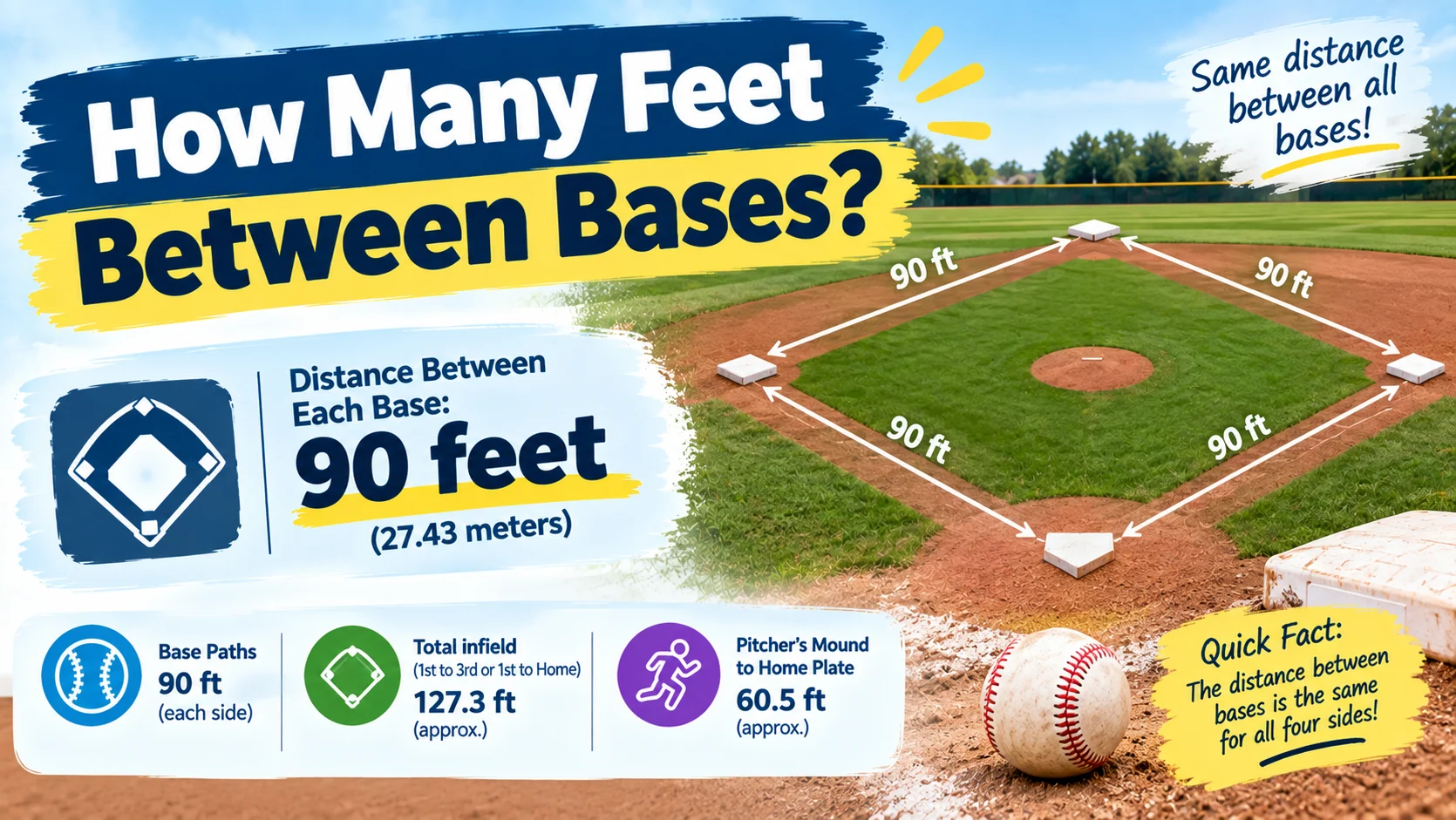
If you are wondering how many feet are between bases in baseball, the standard distance is 90 feet in Major League Baseball.
The baseball diamond is designed as a square with 90 feet between the designated base measurements, creating the familiar 90-foot basepaths used in professional baseball. MLB describes the infield as a square measuring 90 feet on each side.
However, there is an important detail that often gets overlooked: 90 feet is not exactly the physical edge-to-edge distance between the bases. MLB measures the 90-foot dimensions from specific reference points on the bases and home plate. Because MLB increased first, second, and third bases from 15 inches to 18 inches in 2023, the physical gaps between the bases became slightly shorter even though the official 90-foot measurements remained unchanged.
For most people, the simple answer is:
There are 90 feet between bases in a standard professional baseball diamond.
How Many Feet Are Between Baseball Bases?
In professional baseball, the standard base distance is 90 feet.
The four bases form a diamond:
- Home plate
- First base
- Second base
- Third base
Each side of the diamond is based on a 90-foot measurement. MLB’s field-dimension guidance describes the infield as a square with 90-foot sides.
The basic layout is:
Home → First = 90 feet
First → Second = 90 feet
Second → Third = 90 feet
Third → Home = 90 feet
This gives baseball its traditional 90-foot basepath.
Quick Answer: Distance Between Bases
| Basepath | Standard Measurement |
|---|---|
| Home to first | 90 ft |
| First to second | 90 ft |
| Second to third | 90 ft |
| Third to home | 90 ft |
| Home to second, straight-line diagonal | 127 ft 3⅜ in |
| First to third, straight-line diagonal | 127 ft 3⅜ in |
| Complete trip around all four bases | 360 ft |
The 127-foot-3⅜-inch diagonal follows from the geometry of a square with 90-foot sides and is also specified in MLB field-dimension guidance.
Why Are Baseball Bases 90 Feet Apart?
The 90-foot distance became the standard as baseball developed during the 19th century.
MLB’s historical explanation notes that the 1857 Baseball Convention established the familiar 90-foot distance between basepaths. Earlier rules had used less precise measurements based on “paces.”
The 90-foot measurement eventually became one of the defining dimensions of the modern baseball diamond.
Today, when people say that baseball bases are 90 feet apart, they are referring to the official field measurement rather than necessarily describing the exact empty space between the physical edges of the bags.
Are Bases Actually 90 Feet Apart?
This is where the answer gets more interesting.
Officially, the base measurements are 90 feet apart.
But the physical distance from one base bag to another is not exactly 90 feet.
MLB explains that the official 90-foot measurement is taken between specific reference points. For example, the measurement from home plate to first and third is taken from the back tip of home plate to the back corners of first and third base. From first and third to second, the measurement is taken from the back corner of the corner base to the center of second base.
This means the physical open space between the bags is slightly shorter.
With Today’s 18-Inch Bases
Since 2023, MLB’s first, second, and third bases have measured 18 inches square, compared with the traditional 15-inch bases.
As a result:
- Home to first physical distance: about 87 feet
- Home to third physical distance: about 87 feet
- First to second physical distance: about 87 feet 9 inches
- Second to third physical distance: about 87 feet 9 inches
Yet the official field measurements remain based on the 90-foot dimensions.
So the best simple answer remains 90 feet, but the actual space from the edge of one bag to another is somewhat shorter.
How Far Is Home Plate to First Base?
The standard MLB measurement is 90 feet from the back tip of home plate to the back corner of first base.
With the current 18-inch first base, MLB explains that the physical distance between the bases is approximately:
87 feet
The official measurement, however, remains:
90 feet
This distinction is important if you are measuring a field physically rather than simply learning the official dimensions.
How Far Is First Base to Second Base?
The official base measurement is:
90 feet
However, because first base is 18 inches wide, the actual open space between the physical bags is approximately:
87 feet 9 inches
MLB identifies a 4.5-inch reduction in the physical distance between first and second compared with the old 15-inch bases.
The same applies to second base and third base.
How Far Is Second Base to Third Base?
The official distance is:
90 feet
The current physical distance between the bags is approximately:
87 feet 9 inches
The reason is that second and third bases are now 18 inches square, while the official positioning measurements remain unchanged.
How Far Is Third Base to Home Plate?
The official measurement is:
90 feet
With the current larger third base, the physical edge-to-edge distance is approximately:
87 feet
So home-to-third is treated similarly to home-to-first.
How Many Feet Is It Around All the Bases?
If a runner touches all four bases and returns to home, the standard basepath distance is:
90 + 90 + 90 + 90 = 360 feet
Therefore, one complete circuit around the baseball diamond is commonly described as:
360 feet
That is equivalent to:
120 yards
because:
360 ÷ 3 = 120 yards
It is also approximately:
109.73 meters
This is the theoretical basepath distance based on the 90-foot measurements. A runner’s actual path can differ because runners do not necessarily travel in a perfectly straight line between the bases.
How Far Is It From Home Plate to Second Base?
Home plate to second base is a diagonal across the baseball diamond.
Because the diamond is based on a square with 90-foot sides, the diagonal can be calculated using the Pythagorean theorem:
Diagonal = √(90² + 90²)
= √(8,100 + 8,100)
= √16,200
≈ 127.28 feet
This equals approximately:
127 feet 3⅜ inches
MLB’s field-dimension guidance gives the distance from the back point of home plate to second base as 127 feet 3⅜ inches.
How Far Is First Base to Third Base?
First base and third base are also diagonally opposite corners of the baseball diamond.
Therefore, the straight-line distance is also approximately:
127 feet 3⅜ inches
The calculation is:
√(90² + 90²) ≈ 127.28 feet
So:
| Measurement | Distance |
|---|---|
| Home to first | 90 ft official measurement |
| First to second | 90 ft official measurement |
| Second to third | 90 ft official measurement |
| Third to home | 90 ft official measurement |
| Home to second diagonal | 127 ft 3⅜ in |
| First to third diagonal | 127 ft 3⅜ in |
How Many Yards Are Between Baseball Bases?
Since:
1 yard = 3 feet
and the standard base measurement is 90 feet:
90 ÷ 3 = 30 yards
Therefore:
There are 30 yards between bases.
A baseball diamond has four 30-yard sides based on the standard 90-foot dimensions.
This also explains why a complete trip around the bases is:
30 × 4 = 120 yards
How Many Meters Are Between Baseball Bases?
To convert 90 feet to meters:
90 × 0.3048 = 27.432 meters
Therefore:
90 feet = 27.432 meters
Rounded to two decimal places:
90 feet ≈ 27.43 meters
The complete 360-foot trip around the bases is:
360 × 0.3048 = 109.728 meters
So a runner traveling the standard 90-foot basepath around all four bases covers approximately 109.73 meters.
Baseball Base Distance in Different Units
| Measurement | Equivalent |
|---|---|
| 90 feet | 90 ft |
| Yards | 30 yd |
| Meters | 27.432 m |
| Inches | 1,080 in |
| Centimeters | 2,743.2 cm |
| Millimeters | 27,432 mm |
These conversions are based on the exact relationship between feet and metric units.
How Far Apart Are Baseball Bases in Little League?
Youth baseball does not necessarily use the same 90-foot base distance as Major League Baseball.
For example, Little League fields commonly use a 60-foot basepath for the standard Little League diamond.
That is substantially shorter than the 90-foot professional distance.
The exact dimensions depend on the baseball organization and age division, so it is important to identify the specific rule set before laying out a youth field.
60-Foot Basepath
For a 60-foot basepath:
60 × 4 = 240 feet
A runner completing the entire diamond would therefore cover a theoretical 240 feet around the four bases.
Comparison
| Baseball Level/Field | Base Distance |
|---|---|
| MLB | 90 ft |
| Little League standard diamond | 60 ft |
| Other youth divisions | Varies |
| College baseball | Generally 90 ft |
| High school baseball | Generally 90 ft |
Rules can vary by organization and division, so field construction should always follow the applicable rulebook.
How Far Apart Are Baseball Bases in High School Baseball?
High school baseball generally uses 90-foot basepaths, the same basic base distance used in professional baseball.
However, field dimensions and facility specifications can vary by governing organization and level of play.
If you are building or marking a high school field, use the applicable state association or governing body’s current specifications rather than assuming every youth field uses exactly the same dimensions.
How Far Apart Are Baseball Bases in College Baseball?
College baseball uses the familiar 90-foot base distance.
The diamond therefore has the same basic 90-foot basepath measurement as professional baseball.
The major difference for field construction may come from other dimensions, rules, fences, and facility requirements rather than the basic distance between bases.
How Far Is the Pitcher’s Mound From Home Plate?
The pitching distance is often confused with the distance between bases.
The distance from the pitcher’s plate to the back point of home plate in MLB is:
60 feet 6 inches
That is different from the:
90 feet between the bases
MLB specifies the pitching distance as 60 feet 6 inches.
So:
| Baseball Measurement | Distance |
|---|---|
| Base to base | 90 ft official measurement |
| Pitcher’s plate to home | 60 ft 6 in |
| Home to second | 127 ft 3⅜ in |
| Complete trip around bases | 360 ft |
These measurements are all part of the geometry of the baseball diamond but describe different distances.
Why Did Baseball Choose 90 Feet Between Bases?
The 90-foot standard developed during the evolution of baseball in the 19th century.
MLB’s historical account explains that the 1857 Baseball Convention was the first major point at which the 90-foot distance between basepaths was established. Before that, earlier rules described distances using “paces,” which created ambiguity.
The 90-foot measurement became an enduring part of baseball’s field design.
It provides a diamond large enough to create meaningful differences between:
- Hitting
- Throwing
- Running
- Fielding
- Stealing
- Defensive positioning
Why Are Bases 18 Inches Now?
Beginning in 2023, MLB increased first, second, and third bases from 15 inches square to 18 inches square. Home plate remained unchanged.
The change was primarily intended to give players more room around the bases and help reduce collisions and injuries.
The larger bases also slightly reduced the physical distance between the bags:
- Home to first/third: reduced by 3 inches
- First to second: reduced by 4.5 inches
- Second to third: reduced by 4.5 inches
However, the official 90-foot field measurements were not changed.
How Large Is a Baseball Diamond?
If you imagine the base locations as the corners of a square, each side is 90 feet.
Therefore, the basic diamond dimensions are:
90 feet × 90 feet
The area of this square is:
90 × 90 = 8,100 square feet
So the square formed by the four base reference points has an area of approximately:
8,100 square feet
This does not mean the entire baseball field contains only 8,100 square feet. The outfield extends far beyond the infield diamond.
Baseball Base Distance Compared With Other Sports
A 90-foot baseball basepath can be easier to understand when compared with familiar distances.
| Distance | Approximate Length |
|---|---|
| Baseball basepath | 90 ft |
| Pitcher’s plate to home | 60 ft 6 in |
| Basketball court length | 94 ft |
| Soccer penalty area width | 44 yd |
| American football field width | 160 ft |
| Baseball full base circuit | 360 ft |
A single 90-foot basepath is almost the same length as an NBA basketball court, which is 94 feet long.
How Long Does It Take to Run 90 Feet?
The time required to run 90 feet depends on the athlete’s speed, starting position, reaction time, and running technique.
For example, if someone could maintain a speed of 20 feet per second:
90 ÷ 20 = 4.5 seconds
At 25 feet per second:
90 ÷ 25 = 3.6 seconds
These are mathematical examples rather than typical baseball performance benchmarks.
In actual baseball, the batter starts moving as the ball is hit, and professional timing systems account for specific start and finish points.
MLB’s Statcast system uses 90-foot running splits as a standardized distance for analyzing baserunning performance.
Does a Runner Actually Run Exactly 90 Feet?
Not necessarily.
The 90-foot figure is the standardized field measurement, but a runner’s actual route can be longer or shorter depending on the play.
For example:
- A runner may round a base.
- A runner may take a wider turn.
- A runner may slide.
- A runner may stop or change direction.
- A runner may take an aggressive lead.
MLB’s Statcast 90-foot splits are standardized measurements rather than a claim that every runner physically travels exactly 90 feet during every play.
Common Mistakes About Baseball Base Distance
Mistake 1: Thinking Every Baseball Field Has 90-Foot Bases
Not every baseball field uses a 90-foot basepath.
Professional baseball uses the 90-foot standard, while youth fields can use shorter dimensions.
Mistake 2: Assuming the Physical Gap Is Exactly 90 Feet
The official measurement is 90 feet, but the physical edge-to-edge gap between today’s larger bases is shorter.
Mistake 3: Confusing Base Distance With Pitching Distance
Bases are 90 feet apart, while the pitcher’s plate is 60 feet 6 inches from the back point of home plate in MLB.
Mistake 4: Forgetting the Larger Bases
Since 2023, MLB bases are 18 inches square instead of 15 inches. This reduced the physical gap between bases slightly.
Mistake 5: Assuming the Diamond Is a Perfect 90-Foot Square Everywhere
The 90-foot measurement describes the standardized base layout. Field construction also includes home plate, base dimensions, pitching area, foul lines, and other specifications.
FAQs
How many feet are between bases in baseball?
The standard professional baseball base distance is 90 feet.
Are MLB bases exactly 90 feet apart?
The official field measurement is 90 feet, but the physical edge-to-edge distance between the larger 18-inch bases is shorter. MLB explains that the 90-foot measurement is taken between specific reference points on the bases and home plate.
How many feet is it from home to first base?
The official measurement is 90 feet. With today’s 18-inch bases, the physical gap between home plate and first base is approximately 87 feet.
How many feet is it from first to second base?
The official base measurement is 90 feet. The physical distance between the current 18-inch bases is approximately 87 feet 9 inches.
How many feet is it from second to third base?
The official measurement is 90 feet, while the physical gap between the current bags is approximately 87 feet 9 inches.
How many feet is it from third base to home?
The official measurement is 90 feet, while the physical gap created by the current base dimensions is approximately 87 feet.
How many feet are all four bases around?
Using four 90-foot basepaths:
90 × 4 = 360 feet
So the traditional full basepath distance is 360 feet.
How many yards are between baseball bases?
Ninety feet equals 30 yards.
How many meters are between baseball bases?
Ninety feet equals 27.432 meters, or approximately 27.43 meters.
How far is home plate from second base?
The diagonal distance from the back point of home plate to second base is approximately 127 feet 3⅜ inches.
How far is the pitcher’s mound from home plate?
In MLB, the pitcher’s plate is 60 feet 6 inches from the back point of home plate.
How far apart are Little League bases?
A standard Little League diamond uses a 60-foot basepath, which is significantly shorter than the 90-foot professional baseball basepath. Specific youth divisions can have different dimensions.
Final Answer: How Many Feet Between Bases?
So, how many feet are between bases in baseball?
The standard professional baseball measurement is:
90 feet between bases
The four basepaths are:
- Home to first: 90 feet
- First to second: 90 feet
- Second to third: 90 feet
- Third to home: 90 feet
That creates a traditional total of:
90 × 4 = 360 feet around the bases
However, there is a useful technical distinction. MLB currently uses 18-inch bases, so the actual physical space between the edges of the bags is slightly shorter than 90 feet. MLB’s official measurements still use the 90-foot reference points, so 90 feet remains the standard answer.
For comparison, the diagonal from home plate to second base is approximately 127 feet 3⅜ inches, while the pitcher’s plate is 60 feet 6 inches from the back point of home plate.



Pingback: How Many Square Feet Is a Hockey Rink? Complete Size Guide