

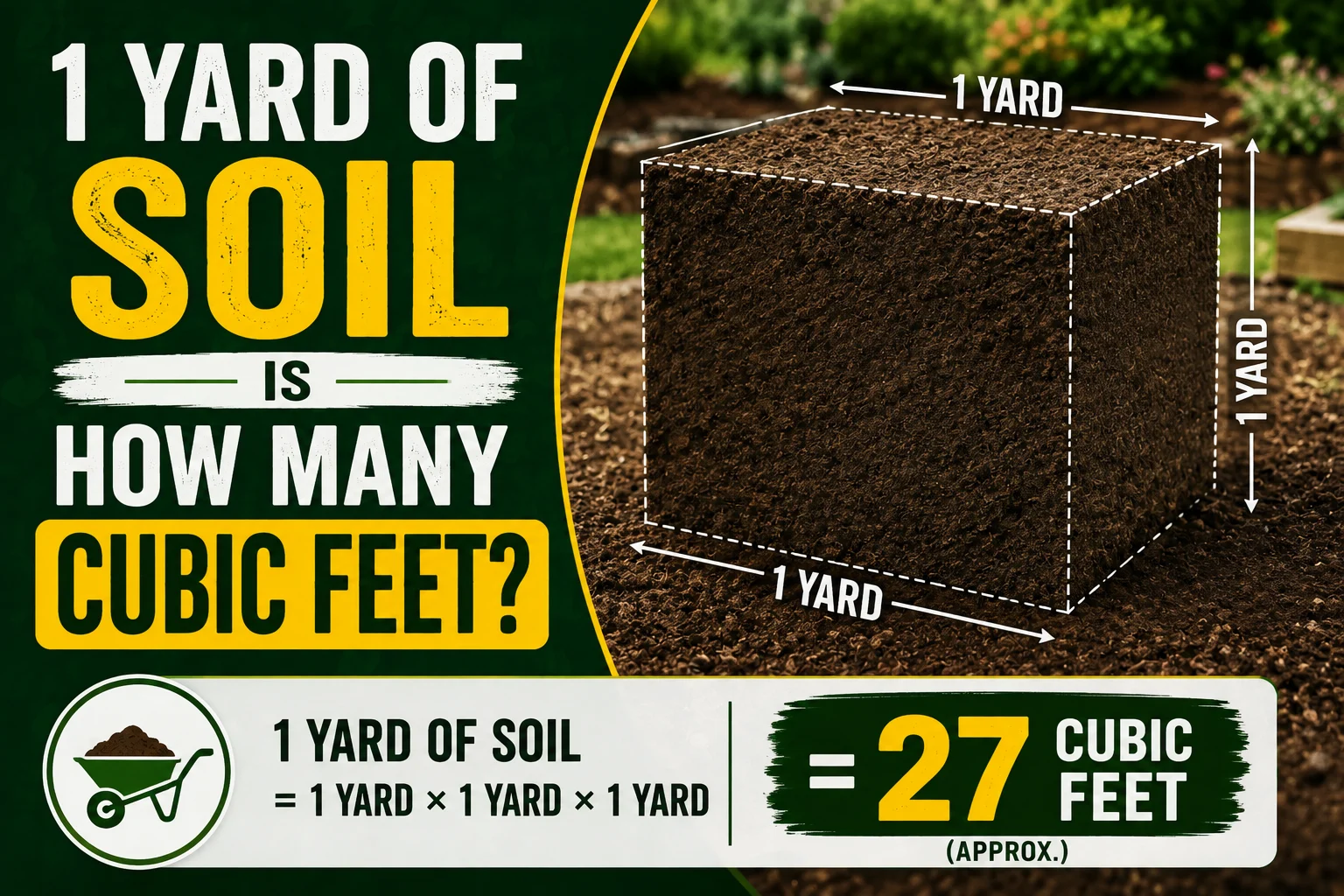
If you’re buying soil for a garden, lawn, flower bed, raised bed, or landscaping project, you may wonder: 1 yard of soil is how many cubic feet?
The answer is:
1 cubic yard of soil = 27 cubic feet
A cubic yard is a unit of volume, not length or area. Since one yard equals three feet, a cubic yard is calculated by multiplying three feet by three feet by three feet:
3 ft × 3 ft × 3 ft = 27 cubic feet
Therefore:
1 cubic yard of soil contains exactly 27 cubic feet of soil.
This conversion applies to soil, topsoil, garden soil, compost, mulch, gravel, and many other materials when they are measured by volume.
Quick Answer: 1 Yard of Soil in Cubic Feet
1 cubic yard = 27 cubic feet
The formula is:
1 yd³ = 3 ft × 3 ft × 3 ft
1 yd³ = 27 ft³
So if a landscaping supplier says you’re buying 1 yard of soil, they generally mean 1 cubic yard, which contains 27 cubic feet.
| Cubic Yards | Cubic Feet |
|---|---|
| 0.25 yd³ | 6.75 ft³ |
| 0.5 yd³ | 13.5 ft³ |
| 0.75 yd³ | 20.25 ft³ |
| 1 yd³ | 27 ft³ |
| 1.5 yd³ | 40.5 ft³ |
| 2 yd³ | 54 ft³ |
| 3 yd³ | 81 ft³ |
| 4 yd³ | 108 ft³ |
| 5 yd³ | 135 ft³ |
What Is a Cubic Yard of Soil?
A cubic yard measures volume.
Imagine a box that measures:
- 3 feet long
- 3 feet wide
- 3 feet high
The volume is:
3 × 3 × 3 = 27 cubic feet
That entire box represents:
1 cubic yard
So when a landscaping company sells soil by the “yard,” it usually means a cubic yard.
This distinction is important because yard can also be used as a linear measurement. In soil and landscaping, however, “one yard of soil” normally refers to one cubic yard.
Why Is a Cubic Yard 27 Cubic Feet?
The calculation comes from the basic conversion:
1 yard = 3 feet
Because volume has three dimensions, you multiply the conversion three times:
3 × 3 × 3 = 27
Therefore:
1 cubic yard = 27 cubic feet
This is an exact mathematical conversion.
How to Calculate Cubic Feet of Soil
If you know the length, width, and depth of your garden or landscaping area, you can calculate how much soil you need.
Use this formula:
Length × Width × Depth = Cubic Feet
Make sure all three measurements are in feet.
For example, suppose a garden bed is:
- 10 feet long
- 5 feet wide
- 1 foot deep
Calculate:
10 × 5 × 1 = 50 cubic feet
You need 50 cubic feet of soil.
To convert that to cubic yards:
50 ÷ 27 ≈ 1.85 cubic yards
So you’d need approximately 1.85 cubic yards of soil.
How Many Cubic Feet Are in 2 Yards of Soil?
Since:
1 cubic yard = 27 cubic feet
multiply by 2:
2 × 27 = 54 cubic feet
Therefore:
2 cubic yards of soil = 54 cubic feet
How Many Cubic Feet Are in 3 Yards of Soil?
Calculate:
3 × 27 = 81
Therefore:
3 cubic yards = 81 cubic feet
How Many Cubic Feet Are in 5 Yards of Soil?
Calculate:
5 × 27 = 135
Therefore:
5 cubic yards = 135 cubic feet
This can be useful when estimating the volume of soil needed for larger landscaping projects.
How Many Cubic Feet Are in Half a Yard of Soil?
Half a cubic yard is:
0.5 × 27 = 13.5
Therefore:
½ cubic yard = 13.5 cubic feet
How Many Cubic Feet Are in a Quarter Yard of Soil?
Calculate:
27 ÷ 4 = 6.75
Therefore:
¼ cubic yard = 6.75 cubic feet
Cubic Yard to Cubic Feet Conversion Chart
Use this chart for quick reference:
| Cubic Yards of Soil | Cubic Feet |
|---|---|
| 0.1 | 2.7 |
| 0.25 | 6.75 |
| 0.5 | 13.5 |
| 0.75 | 20.25 |
| 1 | 27 |
| 1.25 | 33.75 |
| 1.5 | 40.5 |
| 2 | 54 |
| 2.5 | 67.5 |
| 3 | 81 |
| 4 | 108 |
| 5 | 135 |
| 10 | 270 |
The key number to remember is:
1 cubic yard = 27 cubic feet
How Much Area Does 1 Cubic Yard of Soil Cover?
The answer depends on the depth of the soil.
One cubic yard contains 27 cubic feet.
To determine the coverage area, divide 27 by the desired depth in feet.
At 1-inch depth
1 inch = 1/12 foot.
27 ÷ 1/12 = 324 square feet
So one cubic yard covers approximately:
324 square feet at 1 inch deep
At 2-inch depth
2 inches = 2/12 foot.
27 ÷ 2/12 = 162 square feet
So:
1 cubic yard covers about 162 square feet at 2 inches deep.
At 3-inch depth
3 inches = 0.25 foot.
27 ÷ 0.25 = 108 square feet
So:
1 cubic yard covers about 108 square feet at 3 inches deep.
At 4-inch depth
4 inches = 1/3 foot.
27 ÷ 1/3 = 81 square feet
So:
1 cubic yard covers about 81 square feet at 4 inches deep.
At 6-inch depth
6 inches = 0.5 foot.
27 ÷ 0.5 = 54 square feet
So:
1 cubic yard covers about 54 square feet at 6 inches deep.
Soil Coverage Chart for 1 Cubic Yard
| Soil Depth | Approximate Coverage |
|---|---|
| 1 inch | 324 sq. ft. |
| 2 inches | 162 sq. ft. |
| 3 inches | 108 sq. ft. |
| 4 inches | 81 sq. ft. |
| 5 inches | 64.8 sq. ft. |
| 6 inches | 54 sq. ft. |
| 8 inches | 40.5 sq. ft. |
| 12 inches | 27 sq. ft. |
This assumes exactly 27 cubic feet of material and doesn’t account for settling or other project-specific factors.
How Many Bags of Soil Are in One Cubic Yard?
Bag sizes vary, so there isn’t one universal answer.
For example, if each bag contains 1 cubic foot:
27 ÷ 1 = 27 bags
So you’d need:
27 one-cubic-foot bags
If each bag contains 2 cubic feet:
27 ÷ 2 = 13.5 bags
You’d need to purchase 14 bags to have enough material.
If each bag contains 1.5 cubic feet:
27 ÷ 1.5 = 18 bags
Therefore:
18 bags of 1.5 cubic feet each = 1 cubic yard
Bagged Soil vs. Bulk Soil
Soil can generally be purchased in bags or delivered in bulk.
Bagged Soil
Bagged soil is convenient for:
- Small gardens
- Containers
- Raised beds
- Small landscaping projects
You can easily calculate the total volume by adding the cubic-foot capacity of each bag.
Bulk Soil
Bulk soil is often sold by:
Cubic yard
Bulk delivery can make more sense for larger projects because purchasing dozens or hundreds of bags can become inconvenient.
How Many Bags Equal One Cubic Yard?
Here’s a quick guide:
| Bag Size | Bags per Cubic Yard |
|---|---|
| 0.5 cubic ft | 54 bags |
| 1 cubic ft | 27 bags |
| 1.5 cubic ft | 18 bags |
| 2 cubic ft | 13.5 bags |
| 2.5 cubic ft | 10.8 bags |
| 3 cubic ft | 9 bags |
Because you can’t usually purchase half a bag, round up to the next whole bag when necessary.
How Much Does a Cubic Yard of Soil Weigh?
The weight of soil varies significantly.
Factors include:
- Soil type
- Moisture content
- Organic matter
- Density
- Composition
- Compaction
A cubic yard of dry soil can weigh considerably less than a cubic yard of wet soil.
For this reason, it’s better not to assume that every cubic yard has the same weight.
If you’re arranging delivery or using a trailer, check the supplier’s estimated weight for the specific soil product.
Is a Yard of Soil the Same as a Yard of Dirt?
In casual conversation, people may use “soil” and “dirt” interchangeably.
In landscaping, however, products can be quite different.
Topsoil
Topsoil is generally the upper layer of soil and is often used for:
- Lawns
- Planting
- Landscaping
- Filling low areas
Garden Soil
Garden soil is formulated for growing plants and may contain organic matter or other amendments.
Potting Soil
Potting soil is designed for containers and isn’t simply ordinary ground soil.
Fill Dirt
Fill dirt is typically used for filling and grading rather than growing plants.
The volume conversion remains the same:
1 cubic yard = 27 cubic feet
But the material itself can have different properties and weights.
How Much Soil Do You Need for a Garden Bed?
Suppose you have a garden bed measuring:
12 feet × 8 feet
and you want:
6 inches of soil
First convert 6 inches to feet:
6 ÷ 12 = 0.5 foot
Then calculate:
12 × 8 × 0.5 = 48 cubic feet
Now convert to cubic yards:
48 ÷ 27 ≈ 1.78 cubic yards
You would therefore need approximately 1.78 cubic yards of soil.
If purchasing bulk soil, you might order around 1.8 cubic yards, depending on supplier practices and whether you need extra material for settling.
How to Calculate Soil for a Raised Bed
Raised beds are another common application.
Suppose your raised bed is:
- 4 feet long
- 8 feet wide
- 1 foot deep
Calculate:
4 × 8 × 1 = 32 cubic feet
Then:
32 ÷ 27 ≈ 1.19 cubic yards
So the bed requires approximately:
1.19 cubic yards of soil
If buying bags, you can compare that figure with the volume of individual bags.
Should You Buy Extra Soil?
In many landscaping projects, it can be sensible to allow for some extra material.
Soil may:
- Settle
- Compact
- Spill during installation
- Require leveling
- Be displaced by plants or edging
The appropriate amount of extra soil depends on the project.
For a carefully measured project, a small additional amount may be enough. For irregular areas or projects where settling is expected, you may want a larger allowance.
Avoid buying substantially more than necessary simply because soil is inexpensive; excess material still needs to be stored or disposed of.
Cubic Feet vs. Square Feet
This distinction is extremely important when buying soil.
Cubic feet
Measure volume.
Example:
27 cubic feet of soil
Square feet
Measure area.
Example:
100 square feet of garden bed
You need both area and depth to determine how many cubic feet of soil are required.
For example:
100 sq. ft. × 0.25 ft depth = 25 cubic feet
Then:
25 ÷ 27 ≈ 0.93 cubic yards
So approximately 0.93 cubic yard of soil would be needed.
Cubic Yard vs. Linear Yard
A linear yard measures length:
1 yard = 3 feet
A cubic yard measures volume:
1 cubic yard = 27 cubic feet
When purchasing soil, mulch, compost, or gravel, suppliers generally use cubic yards because these materials occupy three-dimensional space.
Common Mistakes When Buying Soil
1. Forgetting the Word “Cubic”
One yard of length isn’t the same as one cubic yard of soil.
2. Confusing Square Feet With Cubic Feet
Square feet measure area, while cubic feet measure volume.
3. Ignoring Soil Depth
A 300-square-foot garden doesn’t tell you how much soil you need until you know how deep you want the soil.
4. Assuming Every Bag Is the Same Size
Always check the bag’s volume in cubic feet.
5. Ignoring Settling
Loose soil can settle after installation, especially after rain or watering.
6. Assuming Weight Is Constant
Soil weight varies considerably depending on moisture and composition.
Simple Soil Volume Formula
You can use this formula for almost any rectangular garden bed:
Cubic Feet = Length × Width × Depth
If depth is measured in inches:
Cubic Feet = Length × Width × Depth in inches ÷ 12
For example:
10 × 10 × 6 ÷ 12 = 50 cubic feet
Then convert to cubic yards:
50 ÷ 27 ≈ 1.85 cubic yards
FAQs
How many cubic feet are in 1 yard of soil?
One cubic yard of soil contains exactly 27 cubic feet.
Is one yard of soil the same as one cubic yard?
When landscaping suppliers say “one yard of soil,” they typically mean one cubic yard.
How many cubic feet are in half a yard of soil?
Half a cubic yard contains 13.5 cubic feet.
How many cubic feet are in 2 yards of soil?
Two cubic yards contain 54 cubic feet.
How many bags of soil equal one cubic yard?
It depends on bag size. For example, 27 one-cubic-foot bags equal one cubic yard.
How much area does one cubic yard of soil cover?
It depends on depth. One cubic yard covers approximately 324 square feet at 1 inch deep, 162 square feet at 2 inches, 108 square feet at 3 inches, or 81 square feet at 4 inches.
How do I calculate how much soil I need?
Multiply the area’s length × width × depth to find cubic feet, then divide by 27 to convert cubic feet to cubic yards.
Is a cubic yard the same as 27 cubic feet?
Yes. 1 cubic yard = 27 cubic feet.
Does wet soil weigh more than dry soil?
Yes. Water adds weight, so wet soil can be considerably heavier than dry or relatively dry soil.
Can I use this conversion for mulch and compost?
Yes. The volume conversion is the same: 1 cubic yard = 27 cubic feet. However, different materials have different weights and coverage characteristics.
Conclusion
So, 1 yard of soil is how many cubic feet?
The exact answer is:
1 cubic yard of soil = 27 cubic feet
The calculation is based on the fact that:
1 yard = 3 feet
Because a cubic yard has three dimensions:
3 × 3 × 3 = 27 cubic feet
Therefore, one cubic yard contains 27 cubic feet of soil.
For landscaping projects, remember that the amount of area one cubic yard covers depends on how deeply you spread it. At 1 inch deep, one cubic yard covers approximately 324 square feet. At 3 inches deep, it covers about 108 square feet, while at 6 inches deep, it covers about 54 square feet.
To calculate your own soil requirement, use:
Length × Width × Depth = Cubic Feet
Then:
Cubic Feet ÷ 27 = Cubic Yards
Whether you’re filling a raised garden bed, improving a lawn, creating a flower bed, or planning a larger landscaping project, knowing that one cubic yard equals 27 cubic feet makes it much easier to estimate how much soil to buy.



Pingback: How Many Feet of Intestines Do We Have? Complete Guide
Pingback: How Many Feet Is 300 Square Feet? Complete Guide