

Choosing the right heating system is essential for keeping your home comfortable during cold weather. If you’re considering a 30,000 BTU heater, furnace, or mini-split heat pump, one of the first questions you may have is how much space it can heat effectively. Understanding the relationship between BTUs and square footage can help you select a system that meets your heating needs without wasting energy.
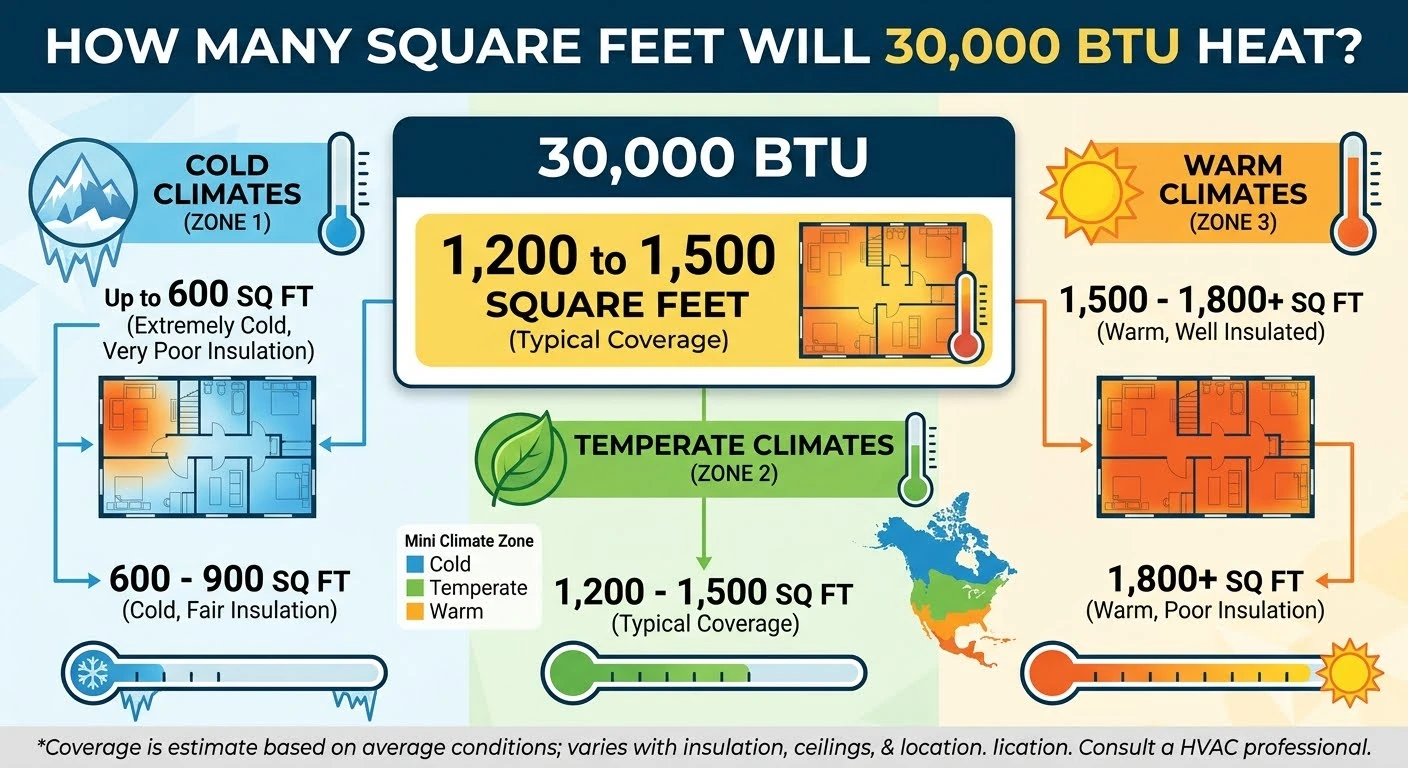
A 30,000 BTU heater can typically heat approximately 750 to 1,500 square feet, depending on insulation, climate, ceiling height, window quality, and the type of heating system. In a well-insulated home in a mild climate, it may heat a larger area, while a poorly insulated home in a very cold region may require more heating capacity.
In this guide, you’ll learn how much space 30,000 BTU can heat, how to estimate your heating requirements, and which factors influence the performance of your heating system.
How Many Square Feet Will 30,000 BTU Heat?
A 30,000 BTU heating system can generally heat 750 to 1,500 square feet under typical residential conditions. However, this is an estimate rather than a guaranteed coverage range.
BTU stands for British thermal unit, a measurement of heat energy. Heating systems use BTUs to describe how much heat they can produce or deliver over a specific period. For heating equipment, the rating is commonly expressed as BTU per hour (BTU/h).
The actual square footage a 30,000 BTU system can heat depends on how quickly the building loses heat.
For example:
- 750 square feet: May be suitable for a space with high heating demand, such as a poorly insulated home in a cold climate.
- 1,000 square feet: A reasonable preliminary estimate for a moderately insulated space.
- 1,200 square feet: May be suitable for a reasonably insulated home in a moderate climate.
- 1,500 square feet: May be achievable in a well-insulated home in a milder climate.
These examples are starting points for planning, not sizing guarantees. A heating load calculation is the best way to determine the capacity needed for a particular building.
What Does 30,000 BTU Mean for Heating?
BTU stands for British thermal unit. It measures the amount of energy required to raise the temperature of one pound of water by one degree Fahrenheit under defined conditions.
In heating systems, the BTU rating indicates the amount of heat the equipment produces or delivers over time.
A system rated at 30,000 BTU/h can provide 30,000 BTUs of heat per hour at its rated operating conditions.
However, not all heating systems deliver their rated fuel input as usable heat. For example, a gas furnace with an input rating of 30,000 BTU/h will typically have a lower heat output depending on its efficiency. An electric resistance heater or heat pump has different performance characteristics.
This distinction matters when comparing heaters because the usable heating output—not simply the advertised number—is what helps determine the area the equipment can heat.
How to Estimate the Square Footage 30,000 BTU Can Heat
A simple way to estimate heating requirements is to use a rough BTU-per-square-foot guideline. This method is useful for preliminary planning, but it does not replace a professional heating load calculation.
For a basic estimate, assume a space needs between 20 and 40 BTU per square foot per hour.
The formula is:
Heated area = Available heating output ÷ BTU required per square foot
For a 30,000 BTU/h system:
| Estimated heating requirement | Approximate area |
|---|---|
| 20 BTU per sq ft | 1,500 sq ft |
| 25 BTU per sq ft | 1,200 sq ft |
| 30 BTU per sq ft | 1,000 sq ft |
| 40 BTU per sq ft | 750 sq ft |
These figures illustrate how different heating requirements affect estimated coverage.
A home in a mild climate with good insulation may need less heat per square foot. A drafty building with limited insulation in a cold climate may need considerably more.
Also, use the equipment’s actual heating output in this calculation whenever possible, rather than its fuel-input rating.
Factors That Affect How Much Space 30,000 BTU Can Heat
The heating capacity required for a home depends on several important factors. Two buildings with the same square footage may need very different heating systems.
1. Climate and Outdoor Temperature
Climate is one of the most important factors in heating performance.
Homes in regions with mild winters generally need less heating capacity than homes exposed to freezing temperatures for extended periods.
For example, a 30,000 BTU/h system may be sufficient for a relatively large, well-insulated home in a mild climate. In a colder region, the same system may be better suited to a smaller area.
When evaluating a heat pump, check its heating capacity at the outdoor temperatures your area commonly experiences. Heat pumps can lose capacity as temperatures fall, depending on the model.
2. Insulation Quality
Insulation slows the transfer of heat through walls, roofs, floors, and ceilings. Good insulation helps a building retain heat, allowing a heater to maintain a comfortable indoor temperature with less energy.
A well-insulated 1,300-square-foot home may require less heating than a poorly insulated 900-square-foot building.
To improve heating performance, consider:
- Insulating the attic and exterior walls.
- Sealing air leaks around windows and doors.
- Improving weatherstripping.
- Insulating floors above unheated spaces.
- Addressing major drafts and gaps.
Improving insulation may reduce heating costs and help your existing equipment maintain comfortable temperatures.
3. Ceiling Height
Standard square-foot estimates often assume typical residential ceiling heights. Higher ceilings increase the volume of air in a room and can change the heating load.
For example, a 1,000-square-foot home with 8-foot ceilings contains approximately 8,000 cubic feet of indoor air. With 12-foot ceilings, the same floor area contains 12,000 cubic feet.
The taller space may need more heating capacity, particularly if heat accumulates near the ceiling or the building has significant air leakage.
Ceiling height is especially important in workshops, warehouses, garages, and rooms with vaulted ceilings.
4. Windows and Doors
Windows and exterior doors can contribute significantly to heat loss, particularly when they are old, poorly sealed, or single-glazed.
A house with large windows may require more heating than a similarly sized house with fewer or better-insulated windows.
To improve performance, seal drafts, maintain door weatherstripping, and consider suitable window upgrades where practical.
5. Building Layout and Open Floor Plans
A heating system’s rated capacity does not guarantee even temperatures throughout a building.
An open-plan home may allow warm air to circulate more easily than a property divided into many closed rooms. A single wall-mounted mini-split, for example, may heat the room where it is installed effectively but struggle to distribute heat to distant bedrooms behind closed doors.
The location of the heater, airflow, room arrangement, and ductwork all influence the practical coverage area.
Can a 30,000 BTU Mini-Split Heat a Whole House?
A 30,000 BTU mini-split heat pump may be capable of heating a substantial portion of a home, depending on the building’s heating load and the system’s rated performance.
In a well-insulated home, it might serve approximately 1,000 to 1,500 square feet. In a colder climate or a building with substantial heat loss, its effective coverage may be lower.
However, a single-zone mini-split generally heats the area it can reach through natural air circulation. It may not distribute heat evenly to every room in a home with several separated bedrooms or floors.
Before purchasing a mini-split, check:
- The manufacturer’s rated heating capacity.
- The heating capacity at low outdoor temperatures.
- The system’s operating temperature range.
- Whether the unit is single-zone or multi-zone.
- The manufacturer’s recommended sizing requirements.
- Whether additional heating is needed in distant rooms.
A properly sized system can improve comfort and efficiency. An oversized or undersized unit may fail to deliver the results you expect.
Is 30,000 BTU Enough to Heat a Garage?
A 30,000 BTU/h heater can be suitable for many garages, but the appropriate size depends on the garage’s dimensions, insulation, ceiling height, climate, and desired indoor temperature.
For example, a 30-by-40-foot garage has 1,200 square feet of floor area. A 30,000 BTU/h heater might work well if the garage is insulated and the outdoor conditions are moderate.
However, a garage with an uninsulated metal roof, drafty doors, and very cold outdoor temperatures may require more capacity.
When heating a garage, consider the following:
- Insulate the walls and ceiling.
- Seal gaps around garage doors.
- Choose equipment approved for the garage environment.
- Maintain the clearances required by the manufacturer.
- Ensure proper ventilation and safe installation for fuel-burning heaters.
Never operate an unvented fuel-burning heater in an enclosed area unless it is specifically approved for that application and all manufacturer and safety requirements are met. Carbon monoxide can be deadly.
How Much Does It Cost to Run a 30,000 BTU Heater?
The operating cost of a 30,000 BTU heater depends on its energy source, efficiency, local fuel or electricity prices, and how often it runs.
A heater rated at 30,000 BTU/h provides a maximum rated heat output or input, depending on how the manufacturer specifies its rating. If it operates continuously at that rate, the energy consumption can be estimated.
Since 1 kWh equals approximately 3,412 BTUs, 30,000 BTU/h corresponds to about 8.79 kW of thermal energy.
For an electric resistance heater delivering 30,000 BTU/h, the electricity consumption would be approximately 8.79 kW at full output. Its hourly cost can be estimated by multiplying 8.79 by your electricity price per kWh.
For a heat pump, the electricity needed to deliver the same amount of heat can be substantially lower because it transfers heat rather than generating all of it through electrical resistance. Actual performance varies with outdoor temperature and the equipment’s efficiency.
For a gas furnace, fuel use depends on its input rating and efficiency.
Your actual bill will also depend on thermostat settings, insulation, outdoor temperature, and operating time. Many systems cycle on and off or vary their output instead of running continuously at full capacity.
How Does 30,000 BTU Compare With Other Heating Sizes?
Comparing common heating capacities can help you understand whether a 30,000 BTU system is appropriate for your home.
| Heating capacity | Rough estimated coverage |
|---|---|
| 10,000 BTU/h | 250–500 sq ft |
| 15,000 BTU/h | 375–750 sq ft |
| 18,000 BTU/h | 450–900 sq ft |
| 24,000 BTU/h | 600–1,200 sq ft |
| 30,000 BTU/h | 750–1,500 sq ft |
| 36,000 BTU/h | 900–1,800 sq ft |
These ranges use a rough planning assumption of 20–40 BTU per square foot per hour. They are not manufacturer ratings or guaranteed coverage figures, and they should not be used as a substitute for a heating load calculation.
When comparing heating systems, make sure you are comparing usable heat output rather than mixing input and output ratings.
Frequently Asked Questions
1. How many square feet will 30,000 BTU heat?
A 30,000 BTU/h heating system may heat approximately 750 to 1,500 square feet under a rough residential sizing guideline. The actual area depends on climate, insulation, ceiling height, air leakage, and equipment performance.
2. Will 30,000 BTU heat a 1,000-square-foot house?
It may. At a heating requirement of 30 BTU per square foot per hour, a 1,000-square-foot home would need approximately 30,000 BTU/h. A professional load calculation is needed to confirm the actual requirement.
3. Can 30,000 BTU heat 1,500 square feet?
It may be sufficient for a well-insulated home in a mild climate that needs around 20 BTU per square foot per hour. A home in a colder climate or with poor insulation may require more heating capacity.
4. Is a 30,000 BTU heater powerful enough for a garage?
It can be, particularly for an insulated garage of moderate size. The right capacity depends on the garage’s dimensions, insulation, air leakage, climate, and intended use.
5. How many BTUs do I need to heat 1,200 square feet?
Using a rough estimate of 20–40 BTU per square foot per hour, a 1,200-square-foot space may require approximately 24,000–48,000 BTU/h. The actual requirement should be determined from the building’s heating load.
6. Does a 30,000 BTU mini-split heat as much space as a 30,000 BTU gas furnace?
Not necessarily. Their rated capacities may describe different things, and their performance depends on efficiency, operating conditions, and how heat is distributed. Compare the actual heating output and manufacturer performance data.
7. Is a higher BTU heater always better?
No. A heater that is too large for the space may cycle frequently, create temperature swings, or operate less efficiently. Proper sizing helps maintain comfort while controlling energy use.
8. How can I make a 30,000 BTU heater work more efficiently?
Improve insulation, seal air leaks, maintain filters and equipment, use a suitable thermostat setting, and ensure heat can circulate throughout the space. Follow the manufacturer’s maintenance instructions and arrange professional servicing when needed.
Conclusion
A 30,000 BTU/h heating system can typically heat around 750 to 1,500 square feet, depending on insulation, climate, ceiling height, air leakage, and the type of equipment. A well-insulated home in a mild climate may need less heating per square foot, while a drafty building in a cold region may need considerably more capacity. Before choosing a heater, check its actual heat output and consider a professional heating load calculation. This will help you select a system that delivers reliable comfort without unnecessary energy use.



Pingback: How Many Feet Is One Acre of Land? Complete Measurement Guide