

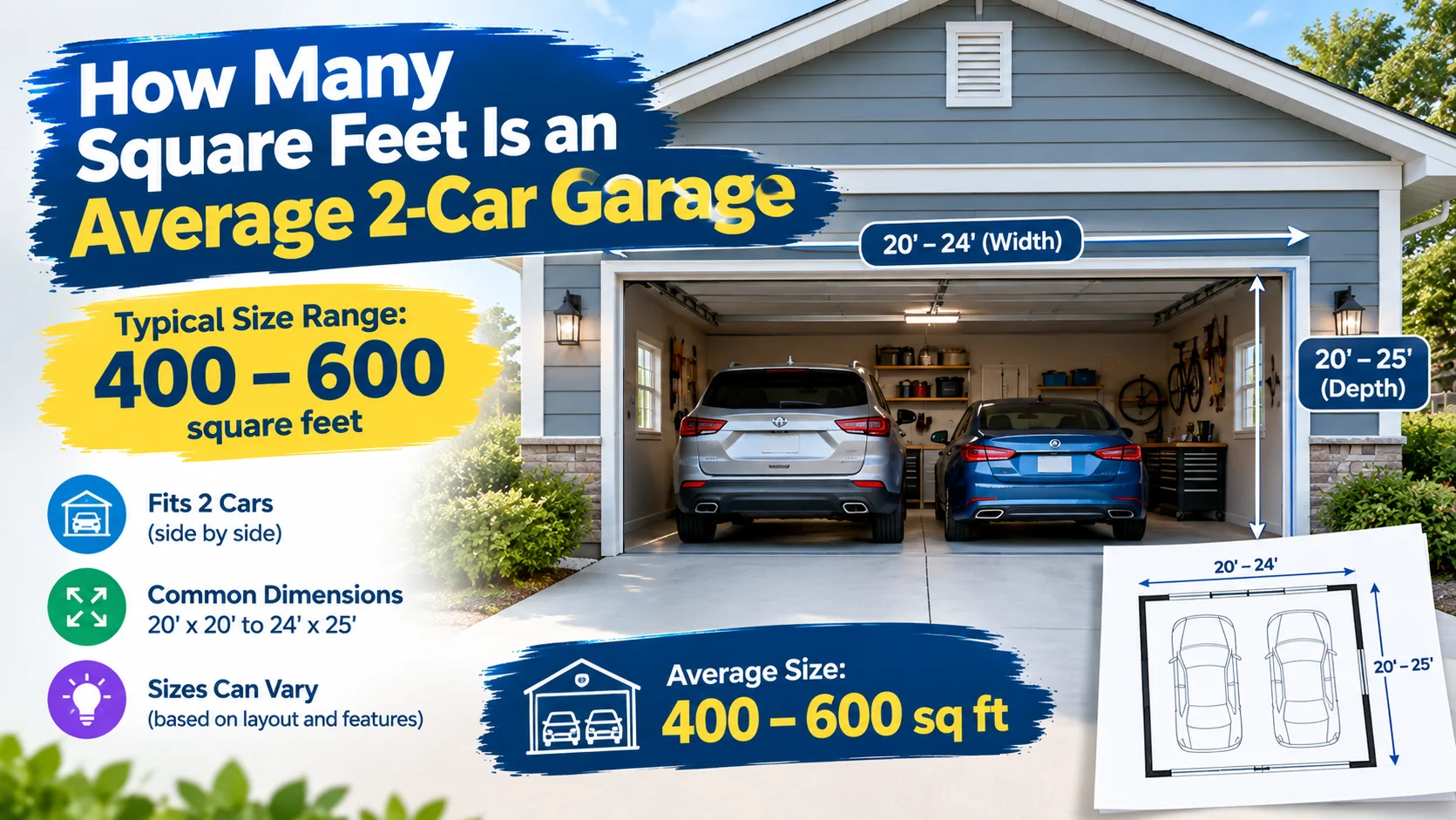
If you’re wondering how many square feet is an average 2-car garage, there isn’t one universal size. A common two-car garage is around 24 feet by 24 feet, which provides 576 square feet of floor area. Current garage-size guides also list smaller configurations such as 20 × 20 feet and larger options such as 24 × 28 or 24 × 30 feet.
Another current industry guide lists 18 × 20 feet, or about 360 square feet, as an average two-car garage size, showing why the term “average” can vary depending on whether the measurement is intended as a tight parking-only space or a more comfortable garage with storage.
For most homeowners, about 400–600 square feet is a useful range for a standard two-car garage, while around 576 square feet (24 × 24 feet) is a popular reference size.
Quick Answer: How Many Square Feet Is a 2-Car Garage?
A typical two-car garage can range from approximately 360 to 900 square feet, depending on its dimensions and intended use.
For a practical residential garage, common sizes include:
| Garage Dimensions | Square Feet | General Use |
|---|---|---|
| 18 × 20 ft | 360 sq ft | Compact parking |
| 20 × 20 ft | 400 sq ft | Small 2-car garage |
| 20 × 22 ft | 440 sq ft | Compact with extra depth |
| 22 × 22 ft | 484 sq ft | Moderate |
| 22 × 24 ft | 528 sq ft | Comfortable |
| 24 × 24 ft | 576 sq ft | Popular 2-car size |
| 24 × 28 ft | 672 sq ft | More storage |
| 24 × 30 ft | 720 sq ft | Spacious |
| 30 × 30 ft | 900 sq ft | Very large |
Current garage-sizing guidance identifies 24 × 24 feet as a common two-car configuration, while also noting that larger garages are increasingly useful for today’s larger vehicles and additional storage.
What Is the Average Size of a 2-Car Garage?
The answer depends on how “average” is defined.
One current garage-sizing guide gives 18 × 20 feet, or 360 square feet, as an average two-car garage.
Another current guide describes 24 × 24 feet, or approximately 576 square feet, as the most common size for a two-car garage.
The difference comes down to how much space is expected around the vehicles.
An 18 × 20-foot garage may work for two smaller or midsize vehicles but leaves limited room for storage.
A 24 × 24-foot garage provides considerably more flexibility for:
- Two vehicles
- Opening car doors
- Shelving
- Tools
- Bicycles
- Lawn equipment
- Storage bins
- A workbench
Therefore, if you’re looking for a practical planning figure rather than a strict statistical average, about 576 square feet is a useful benchmark for a comfortable two-car garage.
How Do You Calculate Garage Square Footage?
Calculating the square footage of a rectangular garage is simple:
Square feet = Length × Width
For example, a garage that measures 24 feet wide by 24 feet deep is:
24 × 24 = 576 square feet
Therefore:
24 × 24 garage = 576 sq ft
Another example:
20 × 20 = 400 sq ft
So a 20 × 20-foot garage contains 400 square feet.
More Examples
| Length | Width | Calculation | Area |
|---|---|---|---|
| 18 ft | 20 ft | 18 × 20 | 360 sq ft |
| 20 ft | 20 ft | 20 × 20 | 400 sq ft |
| 20 ft | 22 ft | 20 × 22 | 440 sq ft |
| 22 ft | 22 ft | 22 × 22 | 484 sq ft |
| 22 ft | 24 ft | 22 × 24 | 528 sq ft |
| 24 ft | 24 ft | 24 × 24 | 576 sq ft |
| 24 ft | 28 ft | 24 × 28 | 672 sq ft |
| 24 ft | 30 ft | 24 × 30 | 720 sq ft |
| 30 ft | 30 ft | 30 × 30 | 900 sq ft |
Is a 20 × 20 Garage Big Enough for 2 Cars?
A 20 × 20-foot garage has 400 square feet.
It can accommodate two cars, but it is relatively compact.
Current garage-sizing guidance identifies 20 × 20 feet as a practical minimum-size configuration for a two-car garage, while noting that this size leaves little room for storage.
A 20 × 20 garage may work well when:
- Both vehicles are relatively compact
- You primarily need parking
- You have little storage
- You don’t need a workshop
- You don’t need large shelving units
However, the available space can become tight when both vehicles are larger SUVs or trucks.
Is a 24 × 24 Garage Big Enough for 2 Cars?
Yes. A 24 × 24-foot garage provides 576 square feet and is one of the most commonly cited two-car garage configurations.
Compared with a 20 × 20 garage:
576 − 400 = 176 square feet
So a 24 × 24 garage provides 176 more square feet.
That additional space can make a noticeable difference.
You may have enough room for:
- Two cars
- Wall-mounted shelving
- Storage cabinets
- Bicycles
- Tools
- A small workbench
- Seasonal decorations
- Lawn equipment
The exact amount of usable space depends on the interior dimensions, wall thickness, door placement, and vehicle sizes.
Is a 24 × 30 Garage Big Enough for 2 Cars?
A 24 × 30 garage provides:
24 × 30 = 720 square feet
That’s substantially larger than a 24 × 24 garage.
The additional 144 square feet can be used for:
- Deep storage
- A workshop
- Free-standing shelving
- A workbench
- Exercise equipment
- Bicycles
- Motorcycles
- Lawn equipment
A 24 × 30 garage can be particularly useful if you want the garage to serve purposes beyond parking.
Common 2-Car Garage Dimensions
There are many possible configurations.
18 × 20 Feet
18 × 20 = 360 sq ft
This is a relatively compact two-car garage. It may work for parking two appropriately sized vehicles but provides limited extra space.
20 × 20 Feet
20 × 20 = 400 sq ft
This is often considered a compact two-car garage. It works best when storage needs are limited.
20 × 22 Feet
20 × 22 = 440 sq ft
The extra two feet of depth provides somewhat more flexibility.
22 × 22 Feet
22 × 22 = 484 sq ft
This offers more room than a 20 × 20 garage without becoming especially large.
24 × 24 Feet
24 × 24 = 576 sq ft
This is a popular comfortable size for two vehicles and additional storage.
24 × 28 Feet
24 × 28 = 672 sq ft
The additional depth creates more room for storage, tools, or a workbench.
24 × 30 Feet
24 × 30 = 720 sq ft
This is a spacious two-car garage suitable for homeowners who want parking plus substantial storage or workspace.
30 × 30 Feet
30 × 30 = 900 sq ft
This is considerably larger than a basic two-car garage and can accommodate extensive storage, a workshop, or other uses.
How Much Space Does Each Car Need?
The required garage size depends partly on vehicle dimensions.
A compact car needs less space than a large pickup truck or full-size SUV.
A current garage-sizing guide notes that many cars are roughly 6–7 feet wide, while sedans are commonly around 15 feet long, SUVs around 16 feet, and some trucks can reach approximately 20 feet in length.
But vehicle dimensions aren’t the only consideration.
You also need room to:
- Open doors
- Walk between vehicles
- Open the trunk or hatch
- Move around the front and rear
- Access storage
- Enter and exit the garage safely
How Much Space Should Be Between Two Cars?
Simply fitting two vehicles inside the garage does not necessarily mean the garage is comfortable.
You need some clearance between the vehicles and between the vehicles and walls.
A current garage-sizing guide suggests allowing roughly 2–3 feet between vehicles to make opening doors easier.
This is one reason why a garage designed around the absolute minimum dimensions can feel cramped.
A few extra feet of width can significantly improve everyday usability.
How Many Square Feet Is a 2-Car Garage With Storage?
If you want both parking and storage, 500–700 square feet can be a useful planning range.
For example:
20 × 20 Feet
400 sq ft
Mostly parking with limited storage.
22 × 24 Feet
528 sq ft
Two cars plus moderate wall storage.
24 × 24 Feet
576 sq ft
Two cars plus shelving, cabinets, bikes, and tools.
24 × 28 Feet
672 sq ft
Two cars plus considerably more storage or workspace.
24 × 30 Feet
720 sq ft
Two cars plus a substantial workshop or storage area.
The best size depends on what you expect to keep in the garage.
How Many Square Feet Is a 2-Car Garage With a Workshop?
If you want a dedicated workshop, consider a garage larger than the minimum parking size.
A 24 × 24-foot garage provides 576 square feet, but two vehicles can consume much of that floor area.
A 24 × 28-foot garage provides 672 square feet, while a 24 × 30-foot garage provides 720 square feet.
The extra depth can be especially useful because it allows you to park cars toward the front while keeping workbenches and storage toward the back.
2-Car Garage Size Comparison
| Garage Size | Area | Parking | Storage | Workshop Potential |
|---|---|---|---|---|
| 18 × 20 | 360 sq ft | Compact | Limited | Very limited |
| 20 × 20 | 400 sq ft | Good | Limited | Limited |
| 20 × 22 | 440 sq ft | Good | Some | Limited |
| 22 × 22 | 484 sq ft | Good | Moderate | Small |
| 22 × 24 | 528 sq ft | Comfortable | Moderate | Small |
| 24 × 24 | 576 sq ft | Comfortable | Good | Moderate |
| 24 × 28 | 672 sq ft | Comfortable | Very good | Good |
| 24 × 30 | 720 sq ft | Comfortable | Very good | Good |
| 30 × 30 | 900 sq ft | Very spacious | Excellent | Excellent |
These are practical comparisons rather than building-code classifications.
How Big Is a 2-Car Garage in Square Meters?
To convert square feet to square meters, use:
Square meters = Square feet × 0.092903
For a 24 × 24 garage:
576 × 0.092903 ≈ 53.51 square meters
Therefore:
576 square feet ≈ 53.5 square meters
Here are several common conversions:
| Garage Size | Square Feet | Approx. Square Meters |
|---|---|---|
| 18 × 20 | 360 | 33.45 m² |
| 20 × 20 | 400 | 37.16 m² |
| 20 × 22 | 440 | 40.88 m² |
| 22 × 22 | 484 | 44.97 m² |
| 22 × 24 | 528 | 49.05 m² |
| 24 × 24 | 576 | 53.51 m² |
| 24 × 28 | 672 | 62.43 m² |
| 24 × 30 | 720 | 66.89 m² |
| 30 × 30 | 900 | 83.61 m² |
2-Car Garage: Interior vs. Exterior Dimensions
One important consideration is whether the advertised dimensions refer to the interior or exterior of the garage.
For example, a garage advertised as 24 × 24 feet may not have a full 24 × 24 feet of usable interior floor area if those dimensions are measured to the outside of the walls.
Wall thickness, framing, insulation, drywall, and other construction materials reduce interior dimensions.
When you’re planning:
- Flooring
- Storage
- Vehicles
- Shelving
- Cabinets
- Workbenches
use the actual interior dimensions whenever possible.
Attached vs. Detached 2-Car Garage
A two-car garage can be attached to the house or built as a separate structure.
Attached Garage
An attached garage shares at least one wall with the house.
Potential advantages include:
- Convenient access to the home
- Easier movement between house and garage
- Less exposure to weather
- Potentially lower construction complexity
Detached Garage
A detached garage is a separate building.
It can provide:
- More flexibility in placement
- Greater separation between living and workshop areas
- Additional privacy
- More design options
The square footage calculation is the same either way.
For example:
24 × 24 = 576 square feet
Whether the garage is attached or detached, the rectangular floor area is 576 square feet.
Does Garage Door Size Affect Garage Square Footage?
The garage door itself does not change the mathematical floor area, but its dimensions affect how efficiently you can use the space.
A two-car garage may use:
- One large double garage door
- Two individual garage doors
A current garage-sizing source notes that a common double garage door is around 16 feet wide by 7 feet high, although larger custom doors are available.
Door placement also affects:
- Vehicle maneuvering
- Wall storage
- Shelving
- Cabinet placement
- Interior circulation
How Much Flooring Do You Need for a 2-Car Garage?
If your garage is 24 × 24 feet:
24 × 24 = 576 square feet
So you have approximately 576 square feet of floor area.
If you’re installing flooring and want to allow 10% for cuts and waste:
576 × 1.10 = 633.6 square feet
You would therefore plan on approximately 634 square feet of flooring material, subject to the manufacturer’s installation recommendations and the actual shape of the space.
For a 20 × 20 garage:
400 × 1.10 = 440 square feet
So approximately 440 square feet of flooring would provide a 10% allowance.
The actual amount should be based on the product, installation pattern, and measured floor area.
How Much Concrete Is Needed for a 2-Car Garage?
The square footage gives you the starting point, but concrete quantity also requires slab thickness.
For example, a 24 × 24 garage has:
576 square feet
If the slab were 4 inches thick:
4 inches = 1/3 foot
Volume:
576 × 1/3 = 192 cubic feet
Convert cubic feet to cubic yards:
192 ÷ 27 ≈ 7.11 cubic yards
So a hypothetical 24 × 24-foot slab at 4 inches thick would contain approximately 7.11 cubic yards of concrete before accounting for grading, thickened edges, footings, waste, or other construction requirements.
Actual slab specifications should come from the building plans and local requirements rather than using a generic thickness assumption.
How Much Does a 2-Car Garage Cost to Build?
Garage construction cost varies widely based on location, materials, attached versus detached construction, foundation requirements, finishes, electrical work, permits, and other features.
Current 2026 cost data from Angi puts professional garage construction at around $50 per square foot on average, with simple attached garages potentially around $30 per square foot and higher-end detached garages reaching about $120 per square foot.
Using $50 per square foot only as a rough illustration:
400-Square-Foot Garage
400 × $50 = $20,000
576-Square-Foot Garage
576 × $50 = $28,800
720-Square-Foot Garage
720 × $50 = $36,000
These are simple mathematical examples, not quotes. Actual construction costs can differ substantially.
Current cost guides also emphasize that materials, location, garage type, finishes, permits, and site conditions can significantly change the final price.
What Is the Minimum Size for a 2-Car Garage?
A 20 × 20-foot garage, or 400 square feet, is often cited as a practical minimum for two vehicles.
However, minimum does not necessarily mean comfortable.
A 20 × 20 garage can leave limited room for:
- Storage
- Large SUVs
- Pickup trucks
- Workbenches
- Bicycles
- Lawn equipment
Current sizing guidance specifically notes that 20 × 20 feet leaves little room for storage.
If you’re building from scratch, it may be worthwhile to consider whether spending additional money for a larger footprint would make the garage significantly more useful over its lifetime.
What Is a Good Size for a 2-Car Garage?
For many homeowners, 24 × 24 feet, or 576 square feet, is a practical starting point.
It provides more room than a 20 × 20 garage while remaining a common residential configuration.
If you want substantial storage or a workshop, consider:
- 24 × 28 = 672 sq ft
- 24 × 30 = 720 sq ft
- 30 × 30 = 900 sq ft
The ideal size depends on your vehicles and how you plan to use the space.
How Many Cars Fit in a 2-Car Garage?
A two-car garage is designed primarily for two vehicles, but the actual fit depends on vehicle dimensions.
Two compact cars can generally use space more efficiently than two full-size pickup trucks.
Before finalizing garage dimensions, measure:
- Vehicle width
- Vehicle length
- Side mirrors
- Door-opening clearance
- Trunk or hatch clearance
- Walking space
- Storage requirements
Don’t design the garage around the exact dimensions of the vehicles. Leave sufficient clearance for everyday use.
How Much Storage Space Should You Leave?
If you want a garage that functions as both a parking area and storage space, consider storage before deciding on the dimensions.
Common garage storage includes:
- Shelving
- Cabinets
- Toolboxes
- Bicycles
- Sports equipment
- Lawn equipment
- Holiday decorations
- Gardening tools
- Tires
- Household supplies
Wall-mounted storage can preserve floor space.
Ceiling-mounted storage can also be useful, provided the structure and installation are appropriate for the intended loads.
Should You Build a Bigger 2-Car Garage?
A larger garage may make sense if you expect to use it for more than parking.
Consider additional space if you want:
- A workshop
- Home gym equipment
- Multiple bicycles
- Motorcycles
- Large storage cabinets
- Freezers
- Lawn equipment
- A hobby area
- Extra walking space
- Larger vehicles
The cost of adding space during initial construction may be easier to justify than trying to expand a finished garage later.
Common Mistakes When Choosing a 2-Car Garage Size
Mistake 1: Building Only for Today’s Vehicles
Vehicle ownership can change over time.
A garage that fits two compact cars today may become cramped if you later purchase a large SUV or pickup.
Mistake 2: Ignoring Door Clearance
You need enough room to open vehicle doors without hitting walls or another vehicle.
Mistake 3: Forgetting Storage
Many homeowners underestimate how much garage space is consumed by tools, bicycles, boxes, equipment, and seasonal items.
Mistake 4: Using Exterior Measurements as Interior Space
Wall thickness can reduce usable interior dimensions.
Mistake 5: Choosing the Minimum Size Without Considering Future Needs
A 20 × 20 garage may technically fit two cars but provide little flexibility.
Mistake 6: Forgetting Workbench and Shelving Depth
Storage systems can extend 18–24 inches or more into the garage, reducing parking and walking clearance.
Mistake 7: Not Checking Local Building Requirements
Garage dimensions, setbacks, fire separation, doors, foundations, electrical work, and other requirements can be governed by local codes and regulations.
Always verify requirements with the appropriate local building authority before construction.
FAQs
How many square feet is an average 2-car garage?
A two-car garage commonly falls somewhere between 400 and 600 square feet, although sizes vary. A frequently used comfortable reference size is 24 × 24 feet, or 576 square feet. Current sources also list 18 × 20 feet (360 sq ft) as an average configuration, illustrating the variation in what is considered “average.”
Is 400 square feet enough for a 2-car garage?
A 20 × 20-foot, 400-square-foot garage can fit two vehicles, but it provides limited extra space for storage. It is best suited to smaller vehicles and homeowners with modest storage requirements.
Is 500 square feet enough for a 2-car garage?
Yes. A garage around 500 square feet can provide two-car parking with more flexibility than a 400-square-foot garage. A 22 × 22-foot garage, for example, provides 484 square feet.
Is 576 square feet a good size for a 2-car garage?
Yes. A 24 × 24-foot garage provides 576 square feet and is a commonly cited two-car garage size.
What are the dimensions of a 576-square-foot garage?
A common configuration is:
24 feet × 24 feet = 576 square feet
Other dimensions could produce the same area, but 24 × 24 is a common two-car configuration.
Is a 24 × 24 garage big enough for two SUVs?
It can be, but the answer depends on the exact SUV dimensions and the desired door-opening, walking, and storage clearance. Larger vehicles may make a 24 × 24 garage feel crowded.
Is a 20 × 20 garage big enough for two trucks?
It may be too tight for two large pickup trucks, especially if you want storage or comfortable door clearance. A larger width and/or depth may be more practical.
How many square feet is a 24 × 24 garage?
A 24 × 24-foot garage has:
24 × 24 = 576 square feet
How many square feet is a 20 × 20 garage?
A 20 × 20-foot garage has:
20 × 20 = 400 square feet
How many square feet is a 24 × 30 garage?
A 24 × 30-foot garage has:
24 × 30 = 720 square feet
How many square feet is a 30 × 30 garage?
A 30 × 30-foot garage has:
30 × 30 = 900 square feet
What is the most common 2-car garage size?
A 24 × 24-foot garage, or approximately 576 square feet, is widely cited as a common two-car garage size.
What is the minimum size for a two-car garage?
A 20 × 20-foot garage, or 400 square feet, is commonly cited as a practical minimum, but it leaves limited room for storage and may feel tight with larger vehicles.
Final Answer: How Many Square Feet Is an Average 2-Car Garage?
So, how many square feet is an average 2-car garage?
A practical answer is that a typical two-car garage is often around 400–600 square feet, while 24 × 24 feet, or 576 square feet, is a commonly cited comfortable size.
For comparison:
- 18 × 20 ft = 360 sq ft
- 20 × 20 ft = 400 sq ft
- 20 × 22 ft = 440 sq ft
- 22 × 22 ft = 484 sq ft
- 22 × 24 ft = 528 sq ft
- 24 × 24 ft = 576 sq ft
- 24 × 28 ft = 672 sq ft
- 24 × 30 ft = 720 sq ft
- 30 × 30 ft = 900 sq ft
If your main goal is simply parking two smaller vehicles, around 400–500 square feet may work. If you want comfortable parking plus storage, about 576 square feet is a useful benchmark. If you want a workshop, extensive storage, or room for larger vehicles, 650–900+ square feet may be more appropriate.
Ultimately, the best size is determined by your vehicles, storage needs, available property, budget, and intended use of the garage.



Pingback: How Many Feet Is 30 Stories? Complete Building Height Guide