
Weighing 500 grams is a common task in cooking, baking, grocery shopping, shipping, and everyday household activities. Whether you want to measure ingredients for a recipe, estimate the weight of a package, or understand how heavy 500 grams feels, knowing a few simple comparisons can make the measurement easier.
500 grams equals 0.5 kilograms, approximately 17.64 ounces, or about 1.10 pounds. It is also equal to half a kilogram, making it a familiar measurement for food products, household items, and small packages.
But what does 500 grams actually look like? Depending on the material, it could be a package of flour, a half-kilogram bag of rice, or several small objects combined. The size of an object does not determine its weight because different materials have different densities.
In this complete guide, you will learn what weighs approximately 500 grams, how to measure 500 grams without a scale, how to convert this weight into other units, and how to use this measurement in everyday situations.
How Much Is 500 Grams?
Five hundred grams is equal to half a kilogram. The gram is a metric unit of mass commonly used for food, small objects, and everyday measurements.
Here are the most useful conversions for 500 grams.
| Measurement unit | Equivalent |
|---|---|
| Grams | 500 g |
| Kilograms | 0.5 kg |
| Milligrams | 500,000 mg |
| Ounces | Approximately 17.64 oz |
| Pounds | Approximately 1.102 lb |
| Metric tonnes | 0.0005 tonnes |
| Water volume equivalent | Approximately 500 mL |
For everyday use, you can remember that 500 grams is half a kilogram and slightly more than one pound.
The water-volume comparison applies approximately to pure water under ordinary conditions. Other materials, such as flour, sugar, oil, and rice, have different densities, so 500 grams of these ingredients will not necessarily occupy 500 milliliters.
What Does 500 Grams Look Like?
One of the easiest ways to understand 500 grams is to compare it with familiar objects. The following examples can help you visualize the weight, although actual weights vary by product, size, and manufacturer.
1. A Half-Kilogram Bag of Rice
<AsyncImage query=”500 gram bag of uncooked white rice on kitchen counter” aspectRatio=”5:4″ width=”100%” />
A bag of rice labeled 500 grams is a direct example of this weight. Rice is commonly packaged in different quantities, including 500-gram and 1-kilogram bags.
If you have a 1-kilogram bag, half of its contents by mass equals 500 grams. For the most accurate comparison, check the package’s net weight.
2. A 500-Gram Package of Flour
<AsyncImage query=”500 gram bag of all purpose flour on kitchen counter” aspectRatio=”5:4″ width=”100%” />
A 500-gram package of flour is another familiar example, particularly for baking. Flour may appear to occupy a relatively large amount of space compared with a dense object of the same mass.
This is because flour contains small particles and air spaces. Its volume changes depending on how it is packed, which is why weighing flour is often more reliable than measuring it by cups.
3. A 500-Milliliter Bottle of Water
<AsyncImage query=”500 ml clear plastic bottle filled with water isolated white background” aspectRatio=”5:4″ width=”100%” />
A 500-milliliter bottle filled with water contains approximately 500 grams of water, excluding the bottle itself.
This comparison is especially useful because many bottled-water products use a 500 mL size. However, the total bottle weight will be greater than 500 grams once the container is included.
4. A Half-Kilogram Package of Sugar
<AsyncImage query=”500 gram package of granulated white sugar on white background” aspectRatio=”5:4″ width=”100%” />
A 500-gram package of granulated sugar provides another easy reference. Sugar is commonly sold in packages of several sizes, so check the label rather than estimating the weight from the package’s appearance.
Half of a 1-kilogram package of sugar weighs 500 grams if the contents are divided evenly by mass.
5. A Small Loaf of Bread
<AsyncImage query=”small loaf of bread on wooden kitchen board” aspectRatio=”5:4″ width=”100%” />
Some small loaves of bread weigh around 500 grams. However, bread weights vary considerably depending on the recipe, loaf size, moisture content, and packaging.
A loaf labeled 500 grams can help you visualize the measurement, but an unlabeled loaf should not be assumed to have that exact weight.
6. A Half-Kilogram Package of Butter or Margarine
<AsyncImage query=”500 gram block of butter wrapped in paper on kitchen counter” aspectRatio=”5:4″ width=”100%” />
Butter and margarine are sometimes sold in packages weighing 500 grams. This is a useful reference for cooking because recipes often require butter to be measured accurately.
Remember that package sizes differ by country and brand, so check the net weight printed on the wrapper.
How to Weigh 500 Grams Without a Scale
You can estimate 500 grams without a weighing scale by using products with known weights. However, the accuracy of these methods depends on how consistently the items can be divided.
Method 1: Use a Labeled Package
Find an unopened product that clearly states a net weight of 500 grams.
Examples include certain packages of rice, flour, sugar, or other groceries. This is one of the simplest ways to identify a 500-gram quantity without performing any calculations.
Method 2: Divide a 1-Kilogram Package in Half
One kilogram equals 1,000 grams.
Therefore:
1,000 ÷ 2 = 500 grams
If you have a package containing exactly 1 kilogram of an ingredient, half of its contents by mass equals 500 grams.
Dividing the package visually may not be precise, especially with irregular or compacted ingredients. Use a scale if accuracy matters.
Method 3: Measure Water by Volume
Water provides a useful comparison because 1 milliliter of water has a mass of approximately 1 gram under ordinary conditions.
Therefore:
500 mL of water weighs approximately 500 grams.
To use this method, measure 500 milliliters of water with a graduated measuring jug. The weight of the jug or bottle must be excluded if you want to measure the water alone.
Method 4: Combine Smaller Quantities
You can combine smaller portions with known weights to reach 500 grams.
For example:
- Five 100-gram portions equal 500 grams.
- Two 250-gram portions equal 500 grams.
- Ten 50-gram portions equal 500 grams.
This method works best when each portion has a verified weight.
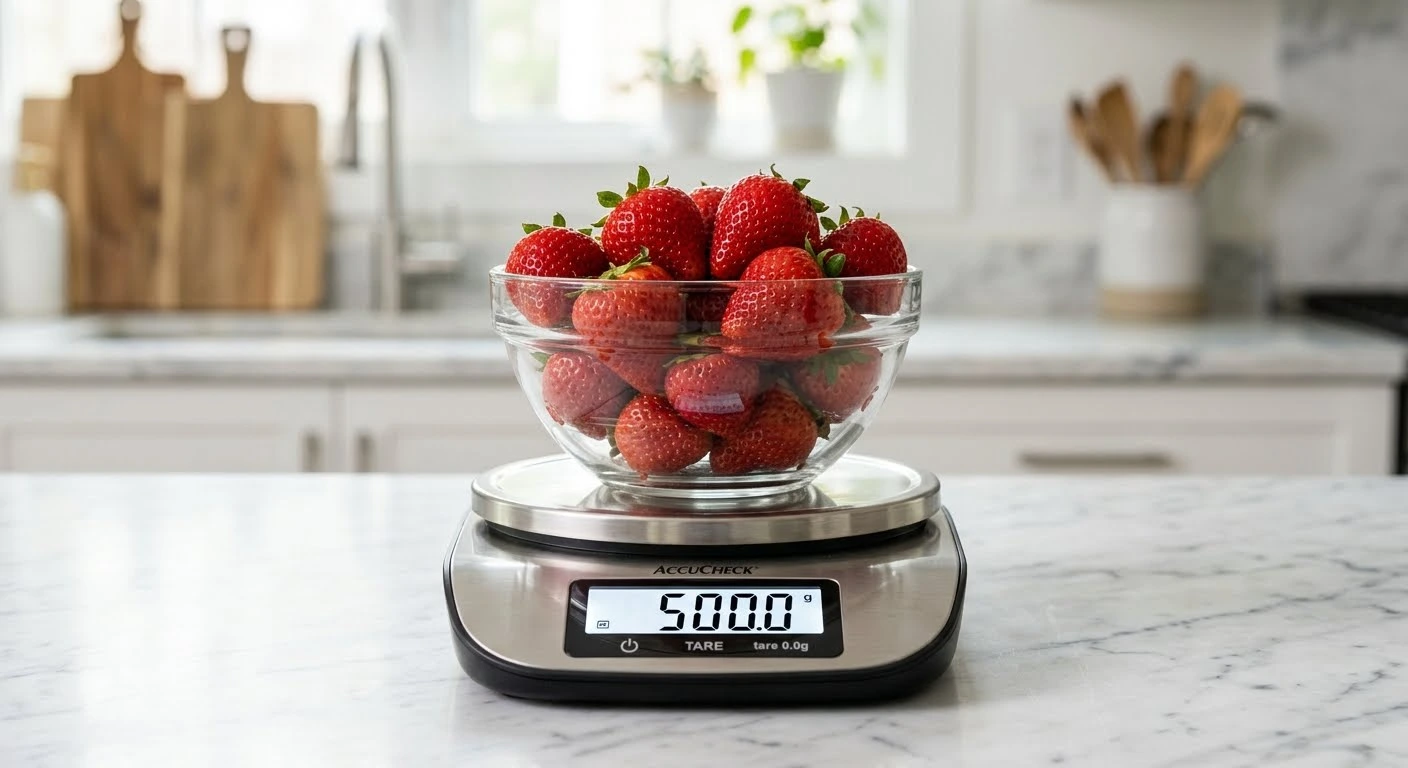
Method 5: Use a Digital Kitchen Scale
A digital kitchen scale is the most reliable way to measure 500 grams.
- Place the scale on a flat, stable surface.
- Switch it on and select grams (g).
- Place an empty bowl or container on the scale.
- Press the tare button to reset the display to zero.
- Add the ingredient until the display reaches 500 grams.
If you add too much, remove a small amount until the display returns to the desired weight.
How Much Is 500 Grams in Pounds and Ounces?
Converting grams into pounds and ounces helps when following recipes or instructions that use imperial units.
500 Grams in Pounds
One pound equals approximately 453.592 grams.
To convert 500 grams into pounds:
500 ÷ 453.592 = approximately 1.1023 pounds
Therefore, 500 grams equals approximately 1.10 pounds.
500 Grams in Ounces
One avoirdupois ounce equals approximately 28.3495 grams.
To convert 500 grams into ounces:
500 ÷ 28.3495 = approximately 17.64 ounces
Therefore, 500 grams equals approximately 17.64 ounces.
Here is a quick comparison:
| Grams | Pounds | Ounces |
|---|---|---|
| 100 g | 0.22 lb | 3.53 oz |
| 250 g | 0.55 lb | 8.82 oz |
| 500 g | 1.10 lb | 17.64 oz |
| 750 g | 1.65 lb | 26.46 oz |
| 1,000 g | 2.20 lb | 35.27 oz |
These figures use standard avoirdupois weight units, which are commonly used for food and household products.
How Much Is 500 Grams in Kilograms and Milligrams?
The metric system makes it easy to convert grams into kilograms and milligrams.
Grams to Kilograms
One kilogram contains 1,000 grams.
Formula:
Kilograms = Grams ÷ 1,000
Calculation:
500 ÷ 1,000 = 0.5 kilograms
Therefore, 500 grams equals 0.5 kg.
Grams to Milligrams
One gram contains 1,000 milligrams.
Formula:
Milligrams = Grams × 1,000
Calculation:
500 × 1,000 = 500,000 milligrams
Therefore, 500 grams equals 500,000 mg.
These conversions are helpful when reading product labels, working with metric measurements, or completing educational calculations.
Is 500 Grams Heavy?
For many everyday objects, 500 grams is considered a relatively light weight. It is easy for most adults to hold in one hand, although how heavy something feels depends on its shape, size, and how it is carried.
Consider these examples:
- A 500-gram bag of rice is generally easy to carry.
- A 500 mL bottle of water contains approximately 500 grams of water, plus the bottle’s weight.
- A compact metal object weighing 500 grams may feel heavier than a large bag of flour because the metal occupies less space.
- A soft package weighing 500 grams may feel different from a rigid object of the same mass.
The key point is that two objects can have the same mass but look completely different in size. This happens because materials have different densities.
Why Is Measuring 500 Grams Important?
Measuring 500 grams is useful in many everyday activities.
Cooking and Baking
Recipes frequently use grams to specify ingredients such as flour, sugar, meat, rice, and butter. Measuring ingredients by weight helps make recipes more consistent.
For example, if a recipe calls for 500 grams of flour, weighing the flour is generally more accurate than estimating the amount with a measuring cup.
Grocery Shopping
Many grocery products are sold in 500-gram packages. Knowing this measurement helps you compare product quantities and prices.
For example, if one package contains 500 grams and another contains 1 kilogram, the second package contains twice as much product.
Nutrition and Portion Control
Food labels sometimes list calories, protein, carbohydrates, fat, and other nutrients per 100 grams. A 500-gram quantity represents five 100-gram portions.
If a food contains 200 calories per 100 grams, then 500 grams contains approximately:
200 × 5 = 1,000 calories.
The actual nutritional intake depends on the food’s measured weight and the accuracy of its nutrition label.
Shipping and Packaging
Small parcels and products may be weighed in grams. Accurate measurements help with inventory, packaging, and shipping estimates.
However, postage charges may also depend on package dimensions, destination, and the shipping provider’s rules.
Science and Education
Five hundred grams is a useful quantity for classroom demonstrations involving mass, unit conversion, and basic measurement.
It can also help students understand the relationship between grams and kilograms.
Common Mistakes When Measuring 500 Grams
Avoid these common errors when measuring 500 grams:
- Confusing grams with milliliters: These units measure different properties. They are approximately equivalent only for water under ordinary conditions.
- Assuming half a container always equals 500 grams: This is true only when the original contents weigh 1 kilogram and the division is even by mass.
- Ignoring packaging: Net weight refers to the contents, while gross weight includes the packaging.
- Using cups for every ingredient: Flour, sugar, rice, and oil have different densities, so the same volume can have different masses.
- Mixing up ounces and fluid ounces: Ounces generally measure mass or weight, while fluid ounces measure volume.
- Relying on appearance alone: Packages that look similar may contain different quantities.
For accurate measurements, particularly when baking or preparing ingredients for a specific recipe, use a digital scale.
FAQs
1. How much is 500 grams in pounds?
Five hundred grams equals approximately 1.102 pounds, or about 1.10 pounds.
2. How many ounces are in 500 grams?
Five hundred grams equals approximately 17.64 ounces.
3. Is 500 grams the same as half a kilogram?
Yes. One kilogram equals 1,000 grams, so 500 grams is exactly half a kilogram.
4. What household items weigh approximately 500 grams?
A labeled 500-gram package of rice, flour, sugar, or butter is a useful example. A 500 mL quantity of water also weighs approximately 500 grams, excluding its container.
5. How can I measure 500 grams without a scale?
You can use a labeled 500-gram package, divide a known 1-kilogram quantity into two equal portions, or measure approximately 500 mL of water. These methods are estimates unless the quantities are verified.
6. How many milliliters are in 500 grams?
The answer depends on the substance. For water, 500 grams is approximately 500 milliliters. For flour, oil, sugar, and other materials, the volume differs because their densities are different.
7. How many cups are in 500 grams?
There is no universal cup conversion for 500 grams because cups measure volume and grams measure mass. For water, 500 grams is approximately 2.11 U.S. cups. For flour and other ingredients, the number of cups will differ.
8. Is 500 grams more than one pound?
Yes. One pound equals approximately 453.6 grams. Therefore, 500 grams is about 46.4 grams more than one pound.
9. How many 100-gram portions are in 500 grams?
There are five 100-gram portions in 500 grams because 500 ÷ 100 = 5.
10. How do I weigh exactly 500 grams?
Place an empty container on a digital scale, press tare to reset the display to zero, and gradually add the material until the scale reads 500 grams.
Conclusion
Weighing 500 grams becomes much easier when you understand the metric system and compare the measurement with familiar objects. Five hundred grams equals half a kilogram, approximately 17.64 ounces, or about 1.10 pounds. A labeled half-kilogram package of rice, flour, or sugar is a useful reference, while 500 milliliters of water weighs approximately 500 grams.
For the most accurate result, use a digital scale and remember to exclude the container’s weight when measuring the contents alone. Whether you are cooking, shopping, preparing a package, or learning unit conversions, knowing how to measure 500 grams is a practical everyday skill.