
If you’re planning a roof replacement, estimating roofing materials, or purchasing shingles for a construction project, you may be wondering: how many square feet does one square of shingles cover?
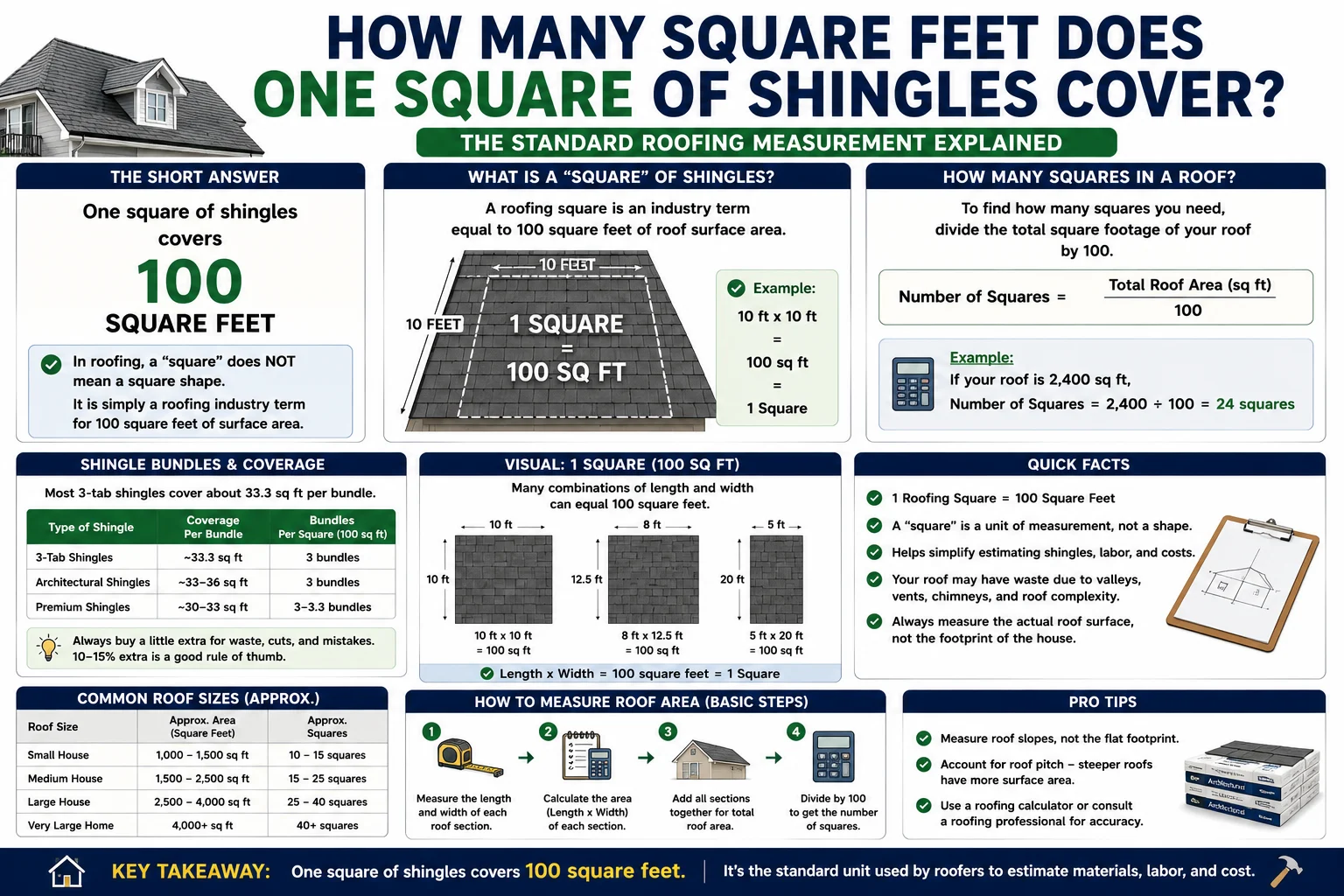
The answer is simple but important. In roofing terminology, one “square” equals 100 square feet of roof coverage. Roofers, contractors, and suppliers use this standard measurement to estimate materials, labor, and project costs.
Understanding roofing squares can help you avoid overbuying or underbuying shingles. It also makes it easier to compare roofing quotes, calculate material needs, and budget for a roofing project.
In this guide, you’ll learn exactly how much area one square of shingles covers, how roofing squares are calculated, how many bundles are needed, and the factors that can affect your final estimate.
Quick Answer: How Many Square Feet Does One Square of Shingles Cover?
A roofing square is a standardized roofing measurement.
One square of shingles covers:
1 roofing square=100 square feet
Answer: One square of shingles covers 100 square feet of roof area.
For example:
- 1 square = 100 sq ft
- 10 squares = 1,000 sq ft
- 20 squares = 2,000 sq ft
- 30 squares = 3,000 sq ft
This measurement is used throughout the roofing industry.
What Is a Square in Roofing?
A roofing square is not an actual square-shaped section of roof.
Instead, it is a unit of measurement used to simplify roofing calculations.
Rather than discussing thousands of square feet, contractors often refer to roof size in “squares.”
For example:
- A 2,000-square-foot roof equals 20 squares.
- A 3,500-square-foot roof equals 35 squares.
Using squares makes material estimates easier and more efficient.
How Many Square Feet Does One Square of Shingles Cover?
The roofing industry defines one square as exactly 100 square feet.
This standard applies to:
- Asphalt shingles
- Architectural shingles
- Composite shingles
- Wood shingles
- Many other roofing products
Regardless of the material, one roofing square generally refers to 100 square feet of coverage.
Standard Coverage
Coverage is calculated based on finished roof area.
Example:
A roof section measuring:
- 10 feet × 10 feet
Equals:
10×10=100
Therefore:
- 100 square feet = 1 roofing square
Why Roofers Use Squares
Roofers use squares because roofs can become very large.
Instead of saying:
- 2,700 square feet
They often say:
- 27 squares
This terminology improves communication between suppliers, contractors, and homeowners.
How Many Bundles Are in a Square of Shingles?
Many homeowners confuse roofing squares with shingle bundles.
In most cases:
| Roofing Material | Bundles per Square |
|---|---|
| Standard Asphalt Shingles | 3 Bundles |
| Architectural Shingles | 3–4 Bundles |
| Premium Shingles | 4–5 Bundles |
A common rule is:
Three bundles of standard asphalt shingles equal one square.
However, manufacturers vary, so always verify packaging information.
Roofing Square Coverage Chart
The chart below shows common roof sizes and required squares.
| Roof Area (Sq Ft) | Roofing Squares Needed |
|---|---|
| 100 | 1 |
| 500 | 5 |
| 1,000 | 10 |
| 1,500 | 15 |
| 2,000 | 20 |
| 2,500 | 25 |
| 3,000 | 30 |
This chart assumes no waste factor.
How to Calculate Roofing Squares Needed
Estimating roofing squares is straightforward when you know the roof dimensions.
Step 1: Measure Roof Area
Measure:
- Length
- Width
For each roof section.
Complex roofs may require measuring multiple sections separately.
Step 2: Calculate Square Footage
Use the formula:
Area=Length×Width
Example:
40 feet × 30 feet
40×30=1200
Total area:
1,200 square feet
Step 3: Convert to Roofing Squares
Divide total square footage by 100.
Formula:
Squares=100Square Feet
Example:
1,200 ÷ 100 = 12
You need approximately:
12 roofing squares
Factors That Affect Shingle Coverage
Several factors influence how many shingles you’ll actually need.
Roof Pitch
Steeper roofs have more actual surface area than their footprint suggests.
Higher roof pitch typically requires:
- More materials
- Additional labor
Roof Complexity
Complex roofs include:
- Valleys
- Dormers
- Multiple ridges
- Hips
These features increase cutting and waste.
Waste Factor
Waste occurs from:
- Trimming
- Cutting
- Installation errors
- Future repairs
Typical waste allowances:
| Roof Type | Waste Factor |
|---|---|
| Simple Roof | 10% |
| Moderate Roof | 12–15% |
| Complex Roof | 15–20% |
Most contractors add at least 10% extra shingles.
Shingle Type
Different shingles have varying coverage rates.
Premium products may require:
- More bundles
- Different installation methods
Always review manufacturer specifications.
Real-World Roofing Examples
Let’s look at practical examples.
Example 1: Small Garage Roof
Roof size:
800 square feet
Calculation:
800 ÷ 100 = 8 squares
Add 10% waste:
8.8 squares
Round up to:
9 squares
Example 2: Average Home Roof
Roof size:
2,200 square feet
Calculation:
2,200 ÷ 100 = 22 squares
Add 10% waste:
24.2 squares
Round up to:
25 squares
Example 3: Large House Roof
Roof size:
3,500 square feet
Calculation:
3,500 ÷ 100 = 35 squares
Add 15% waste:
40.25 squares
Round up to:
41 squares
Benefits of Understanding Roofing Squares
Knowing roofing squares offers several advantages.
More Accurate Budgeting
You can estimate:
- Material costs
- Labor costs
- Project timelines
Easier Quote Comparisons
Contractors often quote projects by the square.
Understanding the terminology helps compare bids fairly.
Reduced Material Waste
Accurate estimates prevent excessive leftovers.
Better Project Planning
Knowing coverage requirements helps avoid delays caused by material shortages.
Common Mistakes When Estimating Shingles
Avoid these common errors.
Forgetting Roof Pitch
Many DIY estimators only measure the home’s footprint.
Steep roofs require more shingles.
Ignoring Waste
Ordering exactly enough shingles often results in shortages.
Always include waste factors.
Confusing Bundles and Squares
Remember:
- One square = 100 square feet
- One square often equals three bundles
They are not the same measurement.
Overlooking Roof Features
Dormers, skylights, and valleys can increase material needs.
Expert Tips for Accurate Roofing Estimates
Measure Twice
Verify all roof dimensions before ordering materials.
Add Extra Material
Most professionals recommend at least 10% additional shingles.
Check Manufacturer Coverage
Coverage can vary between products.
Keep Spare Shingles
Future repairs become easier when matching shingles are available.
Consult Roofing Professionals
Complex roof designs often benefit from professional measurements.
Conclusion
So, how many square feet does one square of shingles cover? The answer is 100 square feet. A roofing square is the standard measurement used throughout the roofing industry to estimate materials, labor, and project costs.
Whether you’re replacing a roof, planning a new construction project, or comparing contractor estimates, understanding roofing squares can save time and money. By calculating your roof area, accounting for waste, and understanding bundle requirements, you can make more accurate roofing decisions and avoid costly material shortages.
FAQs
1. How many square feet does one square of shingles cover?
One roofing square covers 100 square feet of roof area.
2. How many bundles are in one square of shingles?
Most standard asphalt shingles require three bundles per square, though some products vary.
3. How do I calculate roofing squares?
Divide the total roof square footage by 100.
4. Should I add extra shingles for waste?
Yes. Most roofing projects require an additional 10% to 15% for waste and cutting.
5. Does roof pitch affect shingle coverage?
Yes. Steeper roofs have greater surface area and typically require more shingles than flat roofs with the same footprint.
Discover More Articles
How Many Feet Is a Square Acre?
How Many Feet Is a Pickleball Court?
How Many Feet in 3 Acres?