

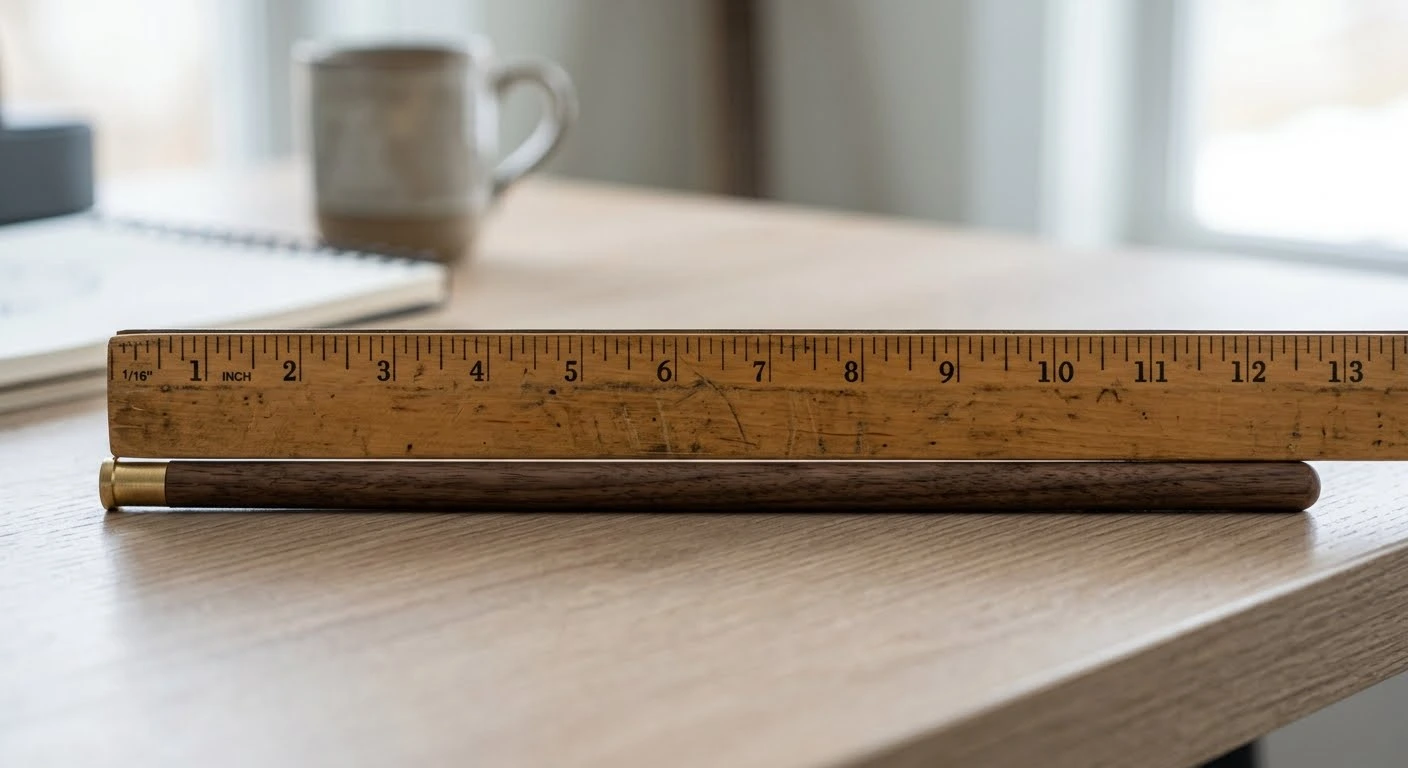
Measuring 13 inches is useful when checking the size of household objects, measuring furniture, choosing a screen, working on DIY projects, or converting measurements for school and construction. But how long is 13 inches, and what everyday objects can help you visualize this measurement?
13 inches equals 1 foot and 1 inch, 33.02 centimeters, or approximately 0.33 meters. It is slightly longer than a standard 12-inch ruler and about the length of a large laptop or a typical sheet of paper’s longer side plus a little extra, depending on the paper size.
If you do not have a ruler or measuring tape nearby, comparing 13 inches with familiar objects can help you estimate the length. In this guide, you will learn how to measure 13 inches accurately, convert it into other units, and identify common objects that are approximately 13 inches long.
How Long Is 13 Inches?
Thirteen inches is a length measurement in the imperial system. It is one inch longer than a standard foot, which contains 12 inches.
Here are the most useful conversions for 13 inches:
| Measurement unit | Equivalent |
|---|---|
| Inches | 13 inches |
| Feet | 1.0833 feet |
| Feet and inches | 1 foot 1 inch |
| Centimeters | 33.02 cm |
| Millimeters | 330.2 mm |
| Meters | 0.3302 m |
| Yards | 0.3611 yards |
For everyday use, you can remember that 13 inches is approximately 33 centimeters.
This measurement is useful when checking the dimensions of small furniture, electronic devices, craft materials, packages, and other objects.
How to Measure 13 Inches With a Ruler
The easiest way to measure 13 inches is with a ruler or measuring tape that uses inches.
Follow these steps:
- Place the ruler or measuring tape along the object you want to measure.
- Align the zero mark with the starting edge of the object.
- Extend the ruler or tape until you reach the 13-inch mark.
- Check that the ruler or tape is straight and follows the intended measurement line.
- Read the measurement at the object’s ending edge.
If you have a standard 12-inch ruler, measure the first 12 inches and then add another inch. The total length will be 13 inches.
For longer objects, a measuring tape is often more convenient because it allows you to measure without repositioning a short ruler.
Important tip: Always begin at the zero mark rather than the physical edge of a ruler. Some rulers have a small gap between the edge and the zero mark, which can cause inaccurate measurements.
How to Measure 13 Inches Without a Ruler
If you do not have a ruler, you can estimate 13 inches using familiar objects or measurements you already know.
1. Use a Standard 12-Inch Ruler
A standard ruler is exactly 12 inches long in its marked measurement range. Add one more inch to reach 13 inches.
This is one of the most straightforward ways to visualize the length.
2. Use a Measuring Tape
If you have a retractable measuring tape, pull it out until the measurement reaches 13 inches. Measuring tapes are useful for checking furniture, boxes, shelves, and other household items.
3. Use a Known Object as a Reference
A laptop, cutting board, or other household object may be close to 13 inches in one dimension. However, object sizes vary, so use these comparisons only for rough estimates.
4. Convert Centimeters to Inches
If you have a metric ruler, measure approximately 33 centimeters.
Since one inch equals 2.54 centimeters:
13 × 2.54 = 33.02 centimeters
Therefore, 33.02 centimeters is exactly equivalent to 13 inches.
7 Common Objects That Are Approximately 13 Inches Long
Everyday objects can help you understand the size of 13 inches. The following examples are approximate because product dimensions vary.
1. A Large Laptop
<AsyncImage query=”13 inch laptop open on desk side profile full device” aspectRatio=”5:4″ width=”100%” />
Some laptops are marketed as 13-inch models. However, this usually refers to the screen’s diagonal measurement, not the laptop’s total length or width.
A laptop with a 13-inch screen may have a body width or depth that is quite different from 13 inches. Check its specifications if you need an accurate physical measurement.
2. A Standard 12-Inch Ruler Plus One Inch
<AsyncImage query=”12 inch ruler on white background with one inch marked beyond ruler” aspectRatio=”5:4″ width=”100%” />
A 12-inch ruler is a practical reference for estimating 13 inches. Simply add one extra inch to the ruler’s measurement.
This method is more reliable than estimating from an object whose size you do not know.
3. A Sheet of Letter-Size Paper
<AsyncImage query=”US letter size white paper sheet portrait on clean desk with ruler” aspectRatio=”5:4″ width=”100%” />
U.S. letter-size paper measures 11 inches by 8.5 inches. Its longer side is 2 inches shorter than 13 inches.
Imagine placing two extra inches alongside the 11-inch edge. The combined length would be 13 inches.
4. A Small Cutting Board
<AsyncImage query=”small rectangular wooden kitchen cutting board isolated on white background” aspectRatio=”5:4″ width=”100%” />
Some small kitchen cutting boards measure around 13 inches in length. Others are significantly shorter or longer, depending on their design.
If you use a cutting board as a visual reference, remember that it is only an estimate unless you know its dimensions.
5. A Tablet or Electronic Device
<AsyncImage query=”large tablet device with screen on clean white desk” aspectRatio=”5:4″ width=”100%” />
Some large tablets have screens measuring around 13 inches diagonally. As with laptops, screen size does not mean the device is 13 inches long from edge to edge.
The outer dimensions depend on the screen shape, bezels, and device design.
6. A Small Cushion
<AsyncImage query=”small rectangular decorative cushion on neutral sofa” aspectRatio=”5:4″ width=”100%” />
A small cushion may measure approximately 13 inches along one side. Cushion sizes vary, however, and soft materials can compress or change shape.
This comparison is useful for visualizing the length but not for precise measuring.
7. A Short Wooden Board
<AsyncImage query=”short rectangular wooden board isolated on plain workshop background” aspectRatio=”5:4″ width=”100%” />
A short piece of wood cut to 13 inches provides a clear physical example of the measurement.
If you work on a DIY project, marking and cutting a board to exactly 13 inches with a tape measure can also help you create a reusable reference piece.
How Much Is 13 Inches in Feet?
There are 12 inches in one foot. To convert 13 inches into feet, divide by 12.
Formula:
Feet = Inches ÷ 12
Calculation:
13 ÷ 12 = 1.0833 feet
Therefore, 13 inches equals approximately 1.083 feet, or 1 foot and 1 inch.
For practical purposes, the feet-and-inches format is usually easier to understand than the decimal value.
For example, if a shelf is 13 inches deep, you can describe it as 1 foot 1 inch deep.
How Much Is 13 Inches in Centimeters?
To convert inches into centimeters, multiply the number of inches by 2.54.
Formula:
Centimeters = Inches × 2.54
Calculation:
13 × 2.54 = 33.02 centimeters
Therefore, 13 inches equals 33.02 centimeters.
This conversion is particularly helpful when using metric measuring tools or comparing products sold in countries that use centimeters and millimeters.
For a quick estimate, you can round 33.02 centimeters to 33 centimeters. For precise work, retain the full value.
How Much Is 13 Inches in Millimeters?
One inch equals 25.4 millimeters. To convert 13 inches to millimeters, multiply 13 by 25.4.
13 × 25.4 = 330.2 millimeters
Therefore, 13 inches equals 330.2 mm.
Millimeters are useful for detailed work involving woodworking, metal components, mechanical parts, and small product dimensions.
If a project requires a measurement of exactly 13 inches, use 330.2 mm rather than rounding to 330 mm when that small difference matters.
Is 13 Inches Considered Long?
Whether 13 inches is long depends on what you are measuring.
For a small household item, 13 inches may be relatively long. For a laptop, shelf, or cutting board, it is a moderate dimension. For a table, door, or room, it is comparatively short.
Here are a few comparisons:
- Compared with a 12-inch ruler: 13 inches is one inch longer.
- Compared with a foot: 13 inches is one inch longer than a foot.
- Compared with a 10-inch object: 13 inches is three inches longer.
- Compared with 30 centimeters: 13 inches is 3.02 centimeters longer.
- Compared with a yard: 13 inches is much shorter than a yard, which contains 36 inches.
These comparisons make it easier to visualize the measurement without having to perform a new conversion every time.
Common Uses for Measuring 13 Inches
A 13-inch measurement can be useful in several situations.
Home Improvement
You may need to measure a shelf, cabinet depth, drawer, decorative item, or space between fixtures. A tape measure helps confirm that an item fits before you install or purchase it.
Electronics
Laptop and tablet screens are often advertised using diagonal measurements. If you are buying a device, distinguish between screen size and the product’s overall physical dimensions.
Crafting and DIY Projects
Thirteen inches may be used when cutting wood, fabric, paper, or other materials. Mark the measurement carefully and double-check before cutting.
Packaging and Shipping
Measuring a package helps determine whether it fits a box or storage space. Remember that shipping providers may consider length, width, height, and weight rather than one dimension alone.
School and Educational Activities
Converting 13 inches into feet, centimeters, or millimeters is a useful exercise for learning measurement systems and unit conversion.
Tips for Measuring 13 Inches Accurately
Use these practical tips to avoid measurement errors:
- Start at zero: Align the zero mark with the beginning of the object.
- Keep the tool straight: A ruler or tape that bends or runs diagonally may produce an incorrect measurement.
- Check the units: Make sure you are reading inches rather than centimeters.
- Measure the correct dimension: For electronic screens, diagonal size may differ from width or height.
- Avoid estimating when precision matters: Use a ruler or measuring tape for cutting, installation, and fitting.
- Double-check the result: Repeat the measurement if the dimensions are important to your project.
Accurate measuring saves time and reduces the risk of buying an incorrectly sized product or cutting material too short.
Frequently Asked Questions
1. How long is 13 inches in feet?
Thirteen inches equals 1 foot and 1 inch, or approximately 1.0833 feet.
2. How many centimeters are in 13 inches?
There are 33.02 centimeters in 13 inches. The calculation is 13 × 2.54 = 33.02.
3. How many millimeters are in 13 inches?
Thirteen inches equals 330.2 millimeters because one inch equals 25.4 millimeters.
4. How can I measure 13 inches without a ruler?
You can estimate the length using a familiar object with known dimensions or measure approximately 33 centimeters with a metric ruler. For an accurate result, use a measuring tool rather than relying on an object’s appearance.
5. Is a 13-inch laptop actually 13 inches long?
Not necessarily. A laptop’s advertised screen size is usually measured diagonally across the display. Its overall width, depth, and height are different measurements.
6. Is 13 inches bigger than one foot?
Yes. One foot equals 12 inches, so 13 inches is one inch longer than a foot.
7. What household objects are about 13 inches long?
Some small cutting boards, wooden boards, and other household objects may measure around 13 inches. A standard 12-inch ruler plus one additional inch is a more dependable reference.
8. How do I convert 13 inches into yards?
There are 36 inches in one yard. Divide 13 by 36:
13 ÷ 36 = approximately 0.3611 yards.
9. Is 33 centimeters the same as 13 inches?
Not exactly. Thirty-three centimeters equals approximately 12.99 inches, while 13 inches equals exactly 33.02 centimeters. The difference is small enough for many everyday estimates but may matter in precise work.
Conclusion
Measuring 13 inches is straightforward when you understand the basic conversions and use a reliable reference. Thirteen inches equals 1 foot and 1 inch, 33.02 centimeters, or 330.2 millimeters. A standard 12-inch ruler with one additional inch is an easy way to visualize this length.
Although household items such as laptops, cutting boards, and small wooden boards can help you estimate 13 inches, their dimensions vary. For DIY projects, furniture measurements, and other tasks requiring accuracy, use a ruler or measuring tape and confirm that you are reading the correct units.

Pingback: Weighing 100 Grams: What Objects Weigh 100 Grams?