

Crow’s feet are the fine lines and wrinkles that appear around the outer corners of the eyes, especially when smiling or squinting. If you’re considering Dysport to soften these lines, understanding typical treatment amounts, expected results, costs, and safety considerations can help you prepare for a consultation.
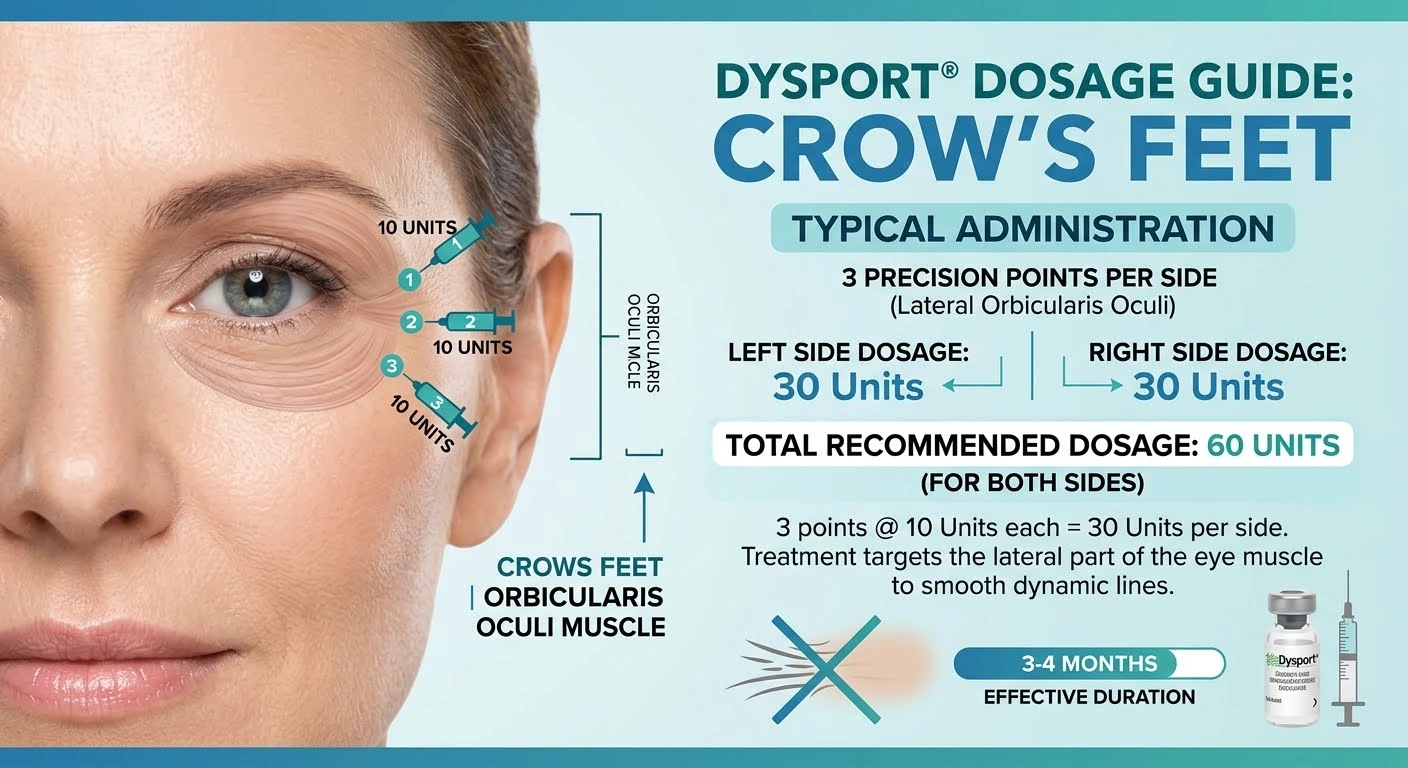
Dysport dosing for crow’s feet varies by individual and country. In some countries, the product information recommends 30 Dysport units per side, or 60 units for both sides combined. However, approved uses and dosing recommendations differ by region, and this amount should not be treated as a universal prescription. <Cite refs={[“turn853569search0″,”turn853569search1”]}/>
Dysport is a prescription botulinum toxin type A treatment that temporarily reduces muscle activity. It can soften dynamic wrinkles caused by repeated facial expressions. The appropriate treatment plan depends on the strength of the muscles around your eyes, wrinkle severity, facial anatomy, medical history, and the applicable product labeling.
In this guide, you’ll learn how Dysport is used for crow’s feet, how long results last, what affects treatment decisions, and which safety precautions to understand before getting injections.
How Many Units of Dysport Are Used for Crow’s Feet?
Dysport dosing for crow’s feet depends on the patient’s anatomy, the severity of the wrinkles, and the country’s approved prescribing information.
In countries where Dysport is approved for lateral canthal lines, the product information may recommend:
- 30 units per side for the outer corners of the eyes.
- 60 units total when treating both sides.
- Three injection points per side in the specified treatment protocol.
These figures come from product information for particular markets and should not be assumed to apply everywhere. In the United States, the FDA-approved cosmetic indication for Dysport is glabellar lines between the eyebrows, rather than crow’s feet. Treatment of crow’s feet with Dysport there is an off-label use. <Cite refs={[“turn853569search0″,”turn853569search4”]}/>
A qualified medical injector should determine the appropriate treatment plan according to local regulations, the product information, your facial anatomy, and your treatment goals.
Does Each Eye Need the Same Amount?
Not necessarily. Although many treatment protocols use symmetrical dosing, facial muscles are not always equally strong on both sides.
A clinician may consider differences in muscle activity, wrinkle patterns, facial asymmetry, previous treatment response, and the desired degree of movement. The goal is to improve the appearance of wrinkles while preserving a natural-looking expression and protecting eye function.
Do not use a general online dosage as instructions for self-injection or as a substitute for an individualized medical assessment.
What Are Crow’s Feet, and How Does Dysport Work?
Crow’s feet are wrinkles around the outer corners of the eyes. They often become more noticeable when you smile, laugh, squint, or spend time in the sun.
These lines develop through a combination of repeated muscle movement, natural aging, collagen and elastin changes, and environmental factors.
Dysport contains abobotulinumtoxinA, a botulinum toxin type A product. It temporarily reduces the release of acetylcholine at the neuromuscular junction, decreasing the activity of the targeted muscles.
When the muscles responsible for dynamic wrinkles contract less strongly, the skin above them may appear smoother during facial expressions.
Dysport does not directly replace lost collagen, remove excess skin, or fill deep wrinkles. Lines that remain visible when your face is completely relaxed may need a different or additional treatment approach.
What Factors Affect Dysport Dosing for Crow’s Feet?
The amount selected for an individual depends on several factors.
1. Muscle Strength
People with stronger muscles around the eyes may have more pronounced wrinkles during smiling. Muscle strength is one factor a qualified injector considers when planning treatment.
2. Wrinkle Severity
Fine lines that appear only during a broad smile differ from deeper lines that remain visible at rest. The severity and distribution of wrinkles can influence the treatment strategy.
3. Facial Anatomy
The position and activity of the muscles around the eyes vary between individuals. The injector must consider the surrounding muscles and structures to reduce the risk of unwanted effects.
4. Desired Appearance
Some people prefer a noticeable reduction in wrinkles while maintaining natural movement. Others may want a more pronounced reduction in muscle activity. Treatment goals should be discussed before the procedure.
5. Previous Treatments
Your response to previous botulinum toxin treatments, the timing of your last injection, and any adverse effects can affect future treatment decisions.
6. Medical History
Eye conditions, previous facial procedures, neuromuscular disorders, medications, and prior reactions to botulinum toxin may affect whether treatment is appropriate.
How Long Does Dysport Take to Work for Crow’s Feet?
Dysport does not usually produce its full cosmetic effect immediately.
Some people begin noticing changes within a few days, but the timing and degree of improvement vary. The clinician may recommend a follow-up assessment to evaluate the result.
The general treatment timeline may look like this:
| Time after treatment | What to expect |
|---|---|
| First 24 hours | Injection-site redness, tenderness, or small bumps may occur |
| First few days | Early changes in muscle activity may become noticeable |
| Around 1–2 weeks | The cosmetic effect can become easier to assess |
| Following weeks | Wrinkle-softening effects may continue for several weeks |
| Around 3–4 months | The effect may gradually diminish, although duration varies |
These are general expectations, not a guarantee of when your individual results will appear. Follow the aftercare instructions provided by your treating clinician.
How Long Do Dysport Results for Crow’s Feet Last?
Dysport results are temporary. Many people notice improvement for approximately three to four months, although some experience a shorter or longer duration.
The longevity of results depends on muscle activity, dose, treatment area, individual response, and the specific product protocol.
Repeated treatments may be considered after the effect has sufficiently worn off and a qualified clinician has reassessed the area. Treatment intervals should follow the applicable prescribing information and professional guidance. Do not seek injections more frequently simply because you want results to last longer.
Is Dysport Effective for Crow’s Feet?
Clinical research has found that botulinum toxin type A can improve the appearance of lateral canthal lines, commonly known as crow’s feet. A published dose-ranging study evaluated Dysport for these wrinkles and reported improvement compared with placebo. <Cite refs={[“turn853569search5″,”turn853569search8”]}/>
However, results vary. Dysport is generally more suited to dynamic wrinkles caused by muscle movement than to deep lines caused primarily by changes in skin texture or volume.
A clinician can assess whether Dysport alone is likely to meet your expectations or whether other approaches, such as sun protection, skincare, or other professionally administered treatments, may be more appropriate.
Dysport vs. Botox for Crow’s Feet
Dysport and Botox are both botulinum toxin type A products, but they have different formulations, product labeling, and unit measurements.
| Feature | Dysport | Botox Cosmetic |
|---|---|---|
| Active ingredient | AbobotulinumtoxinA | OnabotulinumtoxinA |
| Crow’s feet approval in the United States | Not an FDA-approved cosmetic indication | FDA-approved cosmetic indication |
| Unit measurements | Product-specific | Product-specific |
| Typical duration | Often around 3–4 months, with individual variation | Often around 3–4 months, with individual variation |
| Treatment plan | Depends on anatomy, local labeling, and clinician assessment | Depends on anatomy, approved labeling, and clinician assessment |
Important: Dysport units and Botox units are not interchangeable and must not be converted using a simple universal ratio. Each product has its own dosing guidance. <Cite refs={[“turn853569search4″,”turn853569search3”]}/>
The best choice depends on your treatment goals, medical history, clinician’s experience, local approvals, and the product’s suitability for your circumstances.
What Are the Risks and Side Effects of Dysport for Crow’s Feet?
Dysport injections can cause side effects, even when administered by an experienced professional.
Possible effects include:
- Redness, swelling, tenderness, or bruising at injection sites.
- Headache or temporary discomfort.
- Unwanted weakness in nearby muscles.
- Eyelid or eyebrow changes, depending on the treatment area.
- Dry eyes or changes in blinking.
- Temporary asymmetry or an unnatural-looking smile.
Botulinum toxin products also carry a warning about the possibility of toxin effects spreading beyond the injection site. Rare but serious symptoms can include difficulty swallowing, speaking, or breathing, or generalized muscle weakness. Seek urgent medical care if these occur. <Cite refs={[“turn853569search4″,”turn853569search6”]}/>
Because injections around the eyes require careful anatomical knowledge, treatment should be performed by a qualified medical professional with appropriate training and experience.
Who Should Avoid Dysport or Seek Medical Advice First?
Dysport may not be appropriate for everyone. Before treatment, disclose your medical history, allergies, medications, and any previous botulinum toxin injections.
Additional assessment is particularly important if you:
- Have a neuromuscular disorder.
- Have existing eyelid drooping or certain eye conditions.
- Have an infection or inflammation at the intended injection site.
- Have previously experienced a serious reaction to a botulinum toxin product.
- Are pregnant or breastfeeding.
- Take medications that may affect neuromuscular transmission.
These circumstances do not all carry the same level of risk, and some require individualized assessment rather than automatic exclusion. Your clinician can determine whether treatment should be avoided, delayed, or approached with additional precautions.
How Much Does Dysport for Crow’s Feet Cost?
The cost of Dysport for crow’s feet varies by country, clinic, provider experience, treatment area, and pricing method.
Some clinics charge per unit, while others charge a fixed amount for the treatment area or session. The number of units used, the clinic’s fees, and whether additional areas are treated can affect the final price.
When comparing prices, ask the clinic:
- Whether the quoted price includes both eyes.
- Which Dysport product and dosing protocol are being used.
- Whether the injector is appropriately qualified.
- Whether a follow-up assessment is included.
- What the clinic’s policy is if an adverse effect occurs.
Avoid choosing a provider based solely on the lowest advertised price. Proper product handling, medical assessment, and injection technique are important safety considerations.
Frequently Asked Questions
1. How many units of Dysport are used for crow’s feet on both sides?
In some countries, product information recommends 30 Dysport units per side, totaling 60 units for both sides. Recommendations differ by market, and Dysport is not FDA-approved specifically for crow’s feet in the United States. A qualified clinician should determine the appropriate plan. <Cite refs={[“turn853569search0″,”turn853569search4”]}/>
2. Is 30 units of Dysport enough for crow’s feet?
Thirty units may refer to one side under certain approved protocols, rather than both eyes combined. Whether a particular amount is appropriate depends on the applicable product information and individual assessment.
3. Is Dysport FDA-approved for crow’s feet?
In the United States, Dysport’s FDA-approved cosmetic indication is the temporary improvement of moderate to severe glabellar lines between the eyebrows in adults under 65. Crow’s feet treatment is not included in that approved cosmetic indication. Other countries may have different approved indications. <Cite refs={[“turn853569search4″,”turn853569search0”]}/>
4. How quickly does Dysport work for crow’s feet?
Some people notice changes within a few days. The effect develops over time, and a clinician may assess the result around two weeks after treatment.
5. How long does Dysport last around the eyes?
Results often last around three to four months, but individual duration varies. The effect gradually wears off as muscle activity returns.
6. Can Dysport completely remove crow’s feet?
Dysport can soften dynamic wrinkles, but it may not eliminate every line. Wrinkles caused by sun damage, skin texture, or age-related changes may remain visible, particularly when the face is relaxed.
7. Can Dysport cause drooping eyelids?
Unwanted eyelid or eyebrow changes are possible with botulinum toxin treatments. Proper assessment, product-specific dosing, and injection technique help reduce risk but cannot eliminate it.
8. Can Dysport and Botox units be used interchangeably?
No. Their units measure product-specific biological activity and are not directly interchangeable. A clinician should use the dosing guidance for the exact product being administered. <Cite refs={[“turn853569search4″,”turn853569search3”]}/>
Conclusion
Dysport can help soften crow’s feet by temporarily reducing the muscle activity responsible for dynamic wrinkles. In some countries, the product information recommends 30 units per side, or 60 units for both sides, but approved uses and dosing recommendations vary. The correct treatment plan depends on your facial anatomy, wrinkle severity, medical history, and local prescribing guidance. Consult a qualified medical professional to discuss the benefits, risks, and expected results before proceeding with treatment.



Pingback: How Many Square Feet Will 30,000 BTU Heat? Complete Heating Guide