

A yard of concrete is a common measurement used in construction, driveway projects, patios, sidewalks, and foundations. If you are planning to pour concrete, you may wonder how many feet a yard of concrete covers and how much space it can fill.
One cubic yard of concrete equals 27 cubic feet. This measurement describes volume, not length or surface area. The actual area a yard of concrete covers depends on how thick you pour it. For example, one cubic yard can cover 108 square feet at 3 inches thick or 81 square feet at 4 inches thick.
Understanding these measurements helps you estimate the amount of concrete needed for your project, avoid ordering too much or too little, and manage your construction budget more effectively.
In this guide, you will learn how many cubic feet are in a yard of concrete, how much area it covers at different thicknesses, and how to calculate the amount you need.
How Many Cubic Feet Are in a Yard of Concrete?
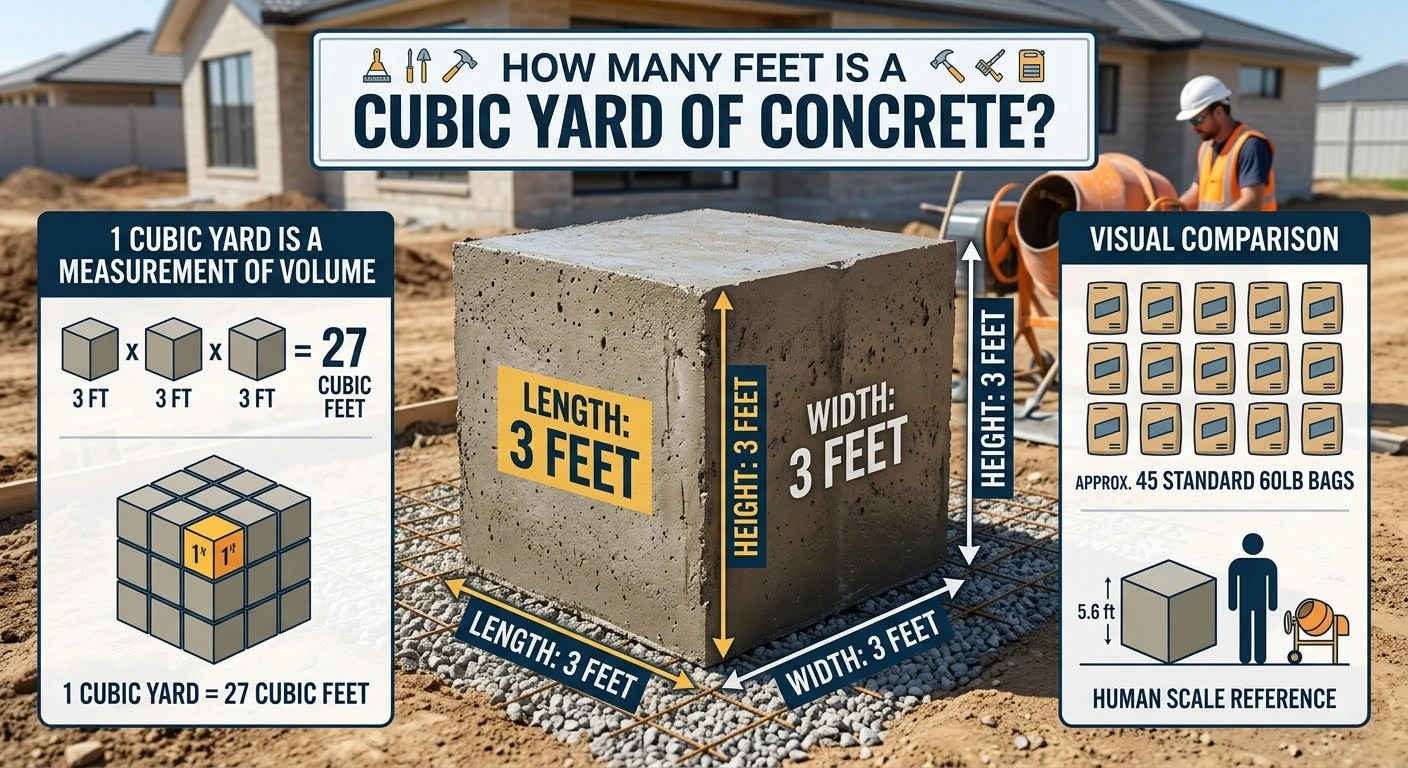
One cubic yard of concrete contains 27 cubic feet.
A cubic yard is a three-dimensional measurement that represents a space measuring 3 feet long, 3 feet wide, and 3 feet high.
The calculation is straightforward:
3 feet × 3 feet × 3 feet = 27 cubic feet
Therefore, if you order one cubic yard of ready-mix concrete, you are ordering enough concrete to fill a volume of 27 cubic feet.
Keep in mind that a cubic yard measures volume rather than length. You cannot convert a cubic yard directly into a fixed number of linear feet or square feet without knowing the width and thickness of the concrete.
Is a Yard of Concrete the Same as 3 Feet?
No. A yard of length equals 3 feet, but a cubic yard of concrete represents volume.
These measurements are different:
- 1 linear yard: 3 feet of length.
- 1 square yard: 9 square feet of area.
- 1 cubic yard: 27 cubic feet of volume.
For concrete projects, contractors generally order concrete by the cubic yard because they need to fill a three-dimensional space.
For example, a concrete slab measuring 9 feet long, 3 feet wide, and 1 foot thick has a volume of 27 cubic feet, which equals 1 cubic yard.
Understanding this distinction is essential when estimating concrete for a slab, walkway, patio, or foundation.
How Many Square Feet Does a Yard of Concrete Cover?
One cubic yard of concrete can cover different amounts of surface area depending on the slab’s thickness.
The thicker the concrete, the less surface area one cubic yard will cover. Thinner concrete spreads over a larger area.
Here is a quick reference table:
| Concrete Thickness | Approximate Coverage per Cubic Yard |
|---|---|
| 2 inches | 162 square feet |
| 3 inches | 108 square feet |
| 4 inches | 81 square feet |
| 5 inches | 64.8 square feet |
| 6 inches | 54 square feet |
| 8 inches | 40.5 square feet |
| 12 inches | 27 square feet |
These figures are theoretical estimates for a level surface. Actual coverage may be lower because of uneven ground, variations in thickness, spillage, and waste.
How to Calculate Concrete Coverage
To estimate the surface area covered by one cubic yard of concrete, use this formula:
Coverage in square feet = 27 cubic feet ÷ thickness in feet
First, convert the thickness from inches to feet by dividing it by 12.
For example, for a 4-inch-thick slab:
- Convert 4 inches to feet: 4 ÷ 12 = 0.333 feet.
- Divide 27 by 0.333.
- The result is approximately 81 square feet.
Therefore, one cubic yard of concrete covers approximately 81 square feet at a thickness of 4 inches.
How Many Feet Is a Yard of Concrete for Different Projects?
The amount of surface area a yard of concrete covers varies by project. Here are some practical examples.
Concrete Patios
A patio measuring 9 feet by 9 feet has an area of 81 square feet.
At 4 inches thick, this patio requires:
81 × (4 ÷ 12) = 27 cubic feet
Since 27 cubic feet equals one cubic yard, the theoretical requirement is 1 cubic yard of concrete.
For a real project, consider ordering a little extra to account for uneven ground and waste.
Concrete Sidewalks
Suppose you are building a sidewalk that is 3 feet wide, 30 feet long, and 4 inches thick.
First, calculate the area:
3 × 30 = 90 square feet
Next, calculate the volume:
90 × (4 ÷ 12) = 30 cubic feet
Convert cubic feet to cubic yards:
30 ÷ 27 = 1.11 cubic yards
You would need approximately 1.11 cubic yards of concrete before adding any allowance for waste or site conditions.
Concrete Driveways
Driveways often require a thicker slab than small walkways, depending on the expected vehicle loads, soil conditions, reinforcement, and local building requirements.
For example, a driveway measuring 10 feet by 20 feet with a thickness of 6 inches has an area of 200 square feet.
Calculate the volume:
200 × (6 ÷ 12) = 100 cubic feet
Convert to cubic yards:
100 ÷ 27 = 3.70 cubic yards
The theoretical amount is approximately 3.70 cubic yards of concrete. The final order should account for the driveway’s design, base preparation, and any extra material needed.
Concrete Foundations
Foundation requirements depend on the foundation type, dimensions, soil conditions, and structural design.
For example, a rectangular section measuring 6 feet long, 3 feet wide, and 1 foot thick contains:
6 × 3 × 1 = 18 cubic feet
Convert to cubic yards:
18 ÷ 27 = 0.67 cubic yards
This section would require approximately 0.67 cubic yards of concrete, excluding waste and other site-specific factors.
How to Calculate How Much Concrete You Need
You can calculate the concrete required for most rectangular slabs by following three simple steps.
Step 1: Measure the Length and Width
Measure the project area in feet. If your measurements are in inches, divide each measurement by 12 to convert it to feet.
For example, a slab that is 12 feet long and 10 feet wide has an area of:
12 × 10 = 120 square feet
Step 2: Convert Thickness to Feet
Divide the concrete thickness in inches by 12.
Examples:
- 3 inches = 0.25 feet
- 4 inches = approximately 0.333 feet
- 6 inches = 0.5 feet
- 8 inches = approximately 0.667 feet
Step 3: Calculate Cubic Yards
Use this formula:
Cubic yards = Length × Width × Thickness in feet ÷ 27
For a slab measuring 12 feet long, 10 feet wide, and 4 inches thick:
12 × 10 × (4 ÷ 12) = 40 cubic feet
Then divide by 27:
40 ÷ 27 = 1.48 cubic yards
The slab requires approximately 1.48 cubic yards of concrete before allowing for waste.
For many projects, a modest extra allowance may be appropriate, but the amount depends on the accuracy of measurements and the condition of the site. Avoid adding a fixed percentage without considering the project’s specific needs.
Cubic Feet to Cubic Yards Conversion Table
Use this table to convert common concrete volumes.
| Cubic Feet | Cubic Yards |
|---|---|
| 1 | 0.037 |
| 9 | 0.333 |
| 18 | 0.667 |
| 27 | 1 |
| 36 | 1.333 |
| 54 | 2 |
| 81 | 3 |
| 108 | 4 |
| 135 | 5 |
| 270 | 10 |
To convert cubic feet to cubic yards, divide the number of cubic feet by 27.
To convert cubic yards to cubic feet, multiply the number of cubic yards by 27.
For example, 54 cubic feet ÷ 27 = 2 cubic yards.
What Factors Affect Concrete Coverage?
Although one cubic yard always equals 27 cubic feet, the amount of surface area covered by that volume can change based on several factors.
Thickness of the Concrete
Thickness is one of the biggest factors affecting coverage. A 4-inch slab covers approximately 81 square feet per cubic yard, while a 6-inch slab covers about 54 square feet.
Uneven Ground
If the ground is sloped or uneven, some sections may require more concrete than others. Proper excavation and base preparation can improve the accuracy of your estimate.
Spillage and Waste
Concrete can be lost during transportation, pouring, leveling, or cleanup. Small projects with complicated shapes may also require additional material.
Project Design
Curved walkways, irregular patios, steps, footings, and thickened slab edges can make calculations more complicated than those for a simple rectangular slab.
Concrete Requirements
The thickness and strength of concrete should be appropriate for the intended use. A walkway, garage floor, driveway, and structural foundation may have different design requirements.
FAQs
1. How many cubic feet are in one yard of concrete?
One cubic yard of concrete equals 27 cubic feet. This is calculated by multiplying 3 feet × 3 feet × 3 feet.
2. How many square feet will one yard of concrete cover?
Coverage depends on thickness. One cubic yard covers approximately 108 square feet at 3 inches thick, 81 square feet at 4 inches thick, and 54 square feet at 6 inches thick.
3. How many feet long is a yard of concrete?
A yard of length equals 3 linear feet. However, when buying concrete, a cubic yard is a volume measurement equal to 27 cubic feet, not simply 3 feet of length.
4. How many cubic yards of concrete do I need for a 10-by-10 slab?
A 10-by-10-foot slab has an area of 100 square feet. At 4 inches thick, it requires approximately 100 × (4 ÷ 12) ÷ 27 = 1.23 cubic yards, before allowing for waste or uneven ground.
5. How many square feet does a yard of concrete cover at 6 inches thick?
One cubic yard covers approximately 54 square feet at 6 inches thick, assuming a uniform slab thickness.
6. Is one yard of concrete enough for a small patio?
It may be enough for a small patio, depending on the patio’s dimensions and thickness. For example, one cubic yard can theoretically cover an 81-square-foot patio at 4 inches thick.
7. Should I order extra concrete?
You may need extra concrete to account for measurement errors, uneven ground, and spillage. Measure carefully and discuss an appropriate allowance with your concrete supplier or contractor before placing the order.
Conclusion
One cubic yard of concrete equals 27 cubic feet, but the number of square feet it covers depends on the thickness of the pour. At 4 inches thick, one yard covers approximately 81 square feet; at 6 inches thick, it covers about 54 square feet. To estimate the amount required for your project, multiply the length, width, and thickness in feet, then divide the result by 27. Accurate measurements and proper site preparation help prevent shortages and unnecessary costs when pouring concrete.



Pingback: How Many Feet Is a 20 Yard Dumpster? Dimensions and Size Guide