

If you’re replacing an old washer or trying to determine what size washing machine you need, one of the most important specifications to understand is cubic-foot capacity.
So, how many cubic feet is a standard washing machine?
A typical full-size residential washing machine has a capacity of approximately 4.5 to 5.0 cubic feet. However, washing machines come in many sizes, from compact models around 1.5–2.5 cubic feet to extra-large machines exceeding 5 cubic feet.
For many households, a washer in the 4.0–5.0 cubic-foot range provides a practical balance between capacity and physical size.
It’s important to understand that cubic feet refers to the washer’s drum capacity, not the outside dimensions of the appliance.
Quick Answer: How Many Cubic Feet Is a Standard Washing Machine?
A standard full-size washing machine typically holds around:
4.5 to 5.0 cubic feet
However, there is no single official capacity that every standard washer must have.
Here’s a general guide:
| Washing Machine Type | Typical Capacity |
|---|---|
| Compact washer | 1.5–2.5 cu. ft. |
| Small/medium washer | 2.5–3.5 cu. ft. |
| Standard full-size washer | 4.0–5.0 cu. ft. |
| Large-capacity washer | 5.0–5.5 cu. ft. |
| Extra-large washer | 5.5+ cu. ft. |
A 4.5-cubic-foot washer is a useful example of a common full-size capacity.
What Does Cubic Feet Mean in a Washing Machine?
Cubic feet is a measurement of volume.
In a washing machine, it describes how much space is available inside the drum for clothing.
For example:
4.5 cubic feet
means the washer’s interior drum has a nominal volume of approximately 4.5 cubic feet.
A larger cubic-foot capacity generally means you can wash more clothing in a single load.
However, you shouldn’t fill the drum completely solid with clothing. Clothes need room to move through the water and detergent for effective cleaning.
What Is the Average Washing Machine Capacity?
For modern full-size household washers, capacity commonly falls somewhere around:
4.0 to 5.0 cubic feet
A capacity around 4.5 cubic feet is often considered a good middle ground.
The exact capacity depends on:
- Front-load or top-load design
- Washer model
- Manufacturer
- Drum design
- Agitator or impeller
- Compact versus full-size construction
Some modern large-capacity washers are considerably larger.
Washing Machine Capacity by Size
The following chart gives a general idea of washer capacity:
| Washer Capacity | General Size | Best For |
|---|---|---|
| 1.5–2.5 cu. ft. | Compact | 1 person, apartments |
| 2.5–3.5 cu. ft. | Small/medium | 1–2 people |
| 3.5–4.0 cu. ft. | Medium | Small families |
| 4.0–5.0 cu. ft. | Full-size | Most households |
| 5.0–5.5 cu. ft. | Large | Larger families |
| 5.5+ cu. ft. | Extra-large | Large households, bulky loads |
These categories are approximate rather than strict industry classifications.
How Many Cubic Feet Is a 4.5-Cubic-Foot Washing Machine?
A 4.5-cubic-foot washer has:
4.5 cubic feet of drum capacity
To understand that in cubic inches:
4.5 × 1,728 = 7,776 cubic inches
because:
1 cubic foot = 1,728 cubic inches
Therefore:
4.5 cubic feet = 7,776 cubic inches
This doesn’t mean the washer’s exterior measures 4.5 cubic feet. The number describes the approximate interior volume available in the drum.
How Many Cubic Feet Is a 5.0-Cubic-Foot Washing Machine?
A 5.0-cubic-foot washer has an internal capacity of approximately:
5 cubic feet
In cubic inches:
5 × 1,728 = 8,640 cubic inches
Therefore:
5 cubic feet = 8,640 cubic inches
A 5-cubic-foot washer can generally handle larger laundry loads than a 4-cubic-foot machine.
Is 4.5 Cubic Feet a Large Washing Machine?
A 4.5-cubic-foot washer is generally considered a full-size, fairly spacious household washer.
It is large enough for many everyday laundry needs and can accommodate substantial loads.
It’s particularly useful for households that regularly wash:
- Adult clothing
- Children’s clothing
- Towels
- Bedding
- Jeans
- Sweatshirts
- Sheets
Whether 4.5 cubic feet is “large” for you depends on your household size and laundry habits.
Is 4.0 Cubic Feet Enough for a Washing Machine?
For many households, yes.
A 4.0-cubic-foot washer provides a useful amount of capacity without being as large as some extra-capacity models.
It can be suitable for:
- Individuals
- Couples
- Small families
- Regular clothing loads
- Towels and sheets
If you frequently wash bulky comforters or very large loads, a larger washer may be more convenient.
Is 5.0 Cubic Feet Enough for a Family?
For many families, a 5-cubic-foot washer provides plenty of capacity.
It can reduce the number of loads needed when compared with smaller machines.
However, capacity requirements depend on:
- Number of people in the household
- How often you do laundry
- Clothing volume
- Bedding requirements
- Towel usage
- Personal laundry habits
A household that does laundry frequently may not need a very large washer.
How Many Clothes Can a 4.5 Cubic-Foot Washer Hold?
Cubic-foot capacity doesn’t translate perfectly into a specific number of shirts, pants, or other garments because clothing varies considerably in:
- Weight
- Fabric thickness
- Size
- Shape
- Moisture content
As a general rule, a 4.5-cubic-foot washer is designed for large household loads, but you should follow the manufacturer’s loading recommendations.
Don’t pack clothes tightly into the drum.
A washer needs sufficient space for clothing to move freely during the wash cycle.
How Many Pounds of Laundry Can a Washing Machine Hold?
Capacity and weight are related but aren’t identical.
A washer’s cubic-foot rating describes volume, while a laundry weight rating describes mass.
For example, two loads might weigh the same but occupy different amounts of space if one consists of thick towels and the other consists of lightweight shirts.
Therefore:
Cubic feet ≠ pounds of laundry
When loading your machine, follow the manufacturer’s instructions rather than trying to fill the drum based solely on weight.
Can a Standard Washing Machine Wash a King-Size Comforter?
Many full-size washers can handle large bedding, but whether a particular machine can safely wash a king-size comforter depends on:
- Washer capacity
- Comforter thickness
- Filling material
- Drum dimensions
- Manufacturer instructions
A 4.5–5.0+ cubic-foot washer generally provides more room for bulky bedding than a compact washer.
However, don’t force a comforter into the drum.
If the item is compressed tightly and cannot move freely, it may not clean properly and can place additional stress on the machine.
Always check the washer manufacturer’s recommendations for oversized bedding.
How Many Cubic Feet Is a Compact Washing Machine?
Compact washing machines commonly have capacities around:
1.5 to 2.5 cubic feet
They’re designed for situations where space is limited.
Compact washers can be useful for:
- Apartments
- Small homes
- RVs
- Condos
- Laundry closets
Their smaller drums naturally hold less laundry per cycle than full-size machines.
How Many Cubic Feet Is a Portable Washing Machine?
Portable washers vary considerably, but many have capacities around:
1.0 to 2.5 cubic feet
Some portable machines are smaller than conventional full-size washers because they’re designed for:
- Temporary housing
- Apartments
- Small spaces
- Travel
- Limited laundry requirements
When shopping for a portable washer, check both the capacity and the machine’s physical dimensions.
Front-Load vs. Top-Load Washing Machine Capacity
Both front-load and top-load washers are available in a wide range of capacities.
Front-Load Washers
Front-load models commonly offer:
- Large drum capacity
- Efficient use of vertical space
- Good access for loading
- Ability to stack with a compatible dryer
Top-Load Washers
Top-load models can also provide substantial capacity.
They may use:
- Traditional agitators
- Low-profile agitators
- Impellers
The presence of an agitator can affect the usable space inside the drum.
Therefore, don’t assume that two washers with identical cubic-foot ratings will feel exactly the same when loading bulky items.
What Is the Difference Between Washer Capacity and Washer Dimensions?
This is one of the most important things to understand when shopping for a washer.
Capacity
Capacity describes the approximate interior volume of the drum.
It’s measured in:
cubic feet
Dimensions
Dimensions describe the washer’s physical exterior size.
They’re typically listed as:
- Width
- Height
- Depth
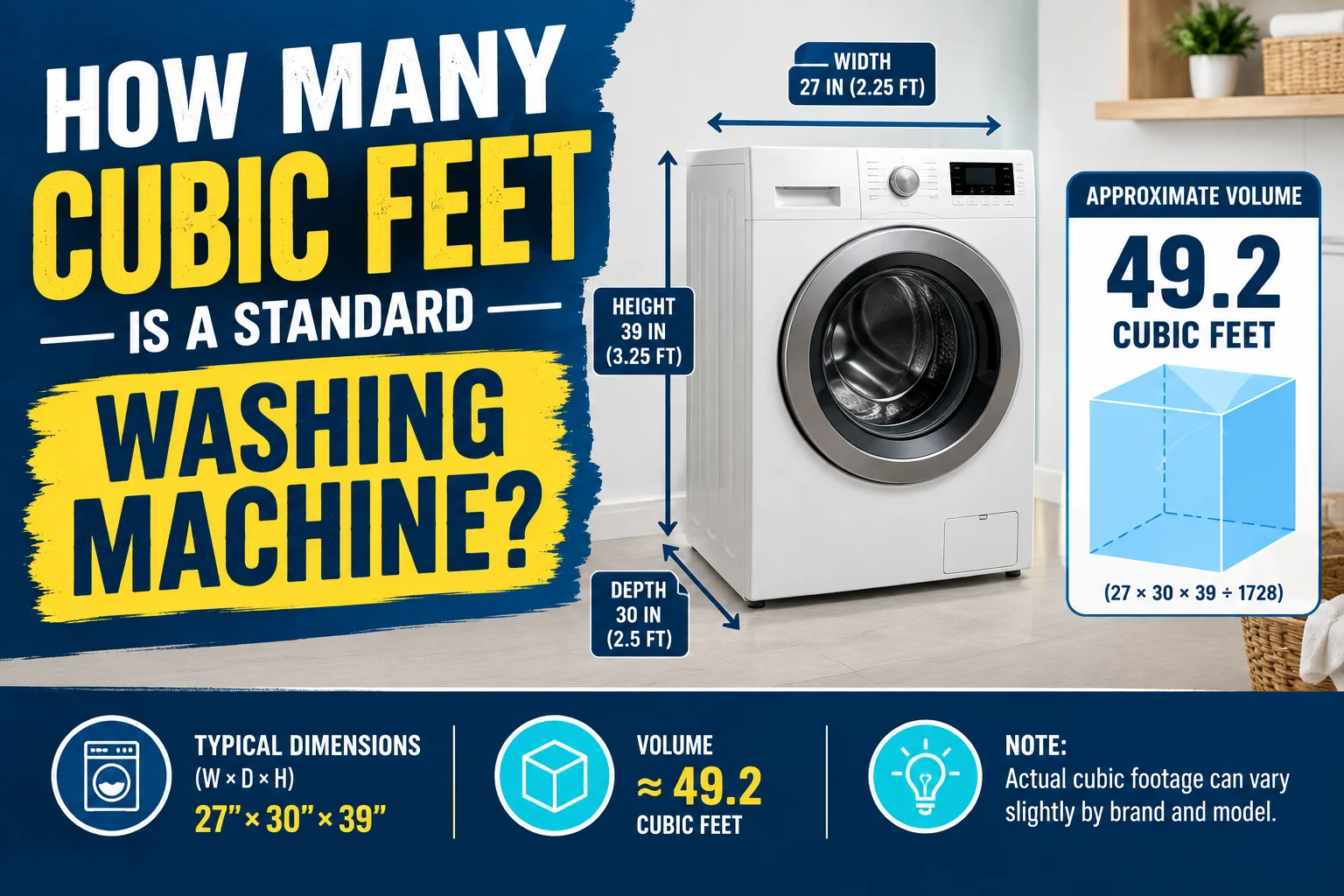
A washer might have a capacity of 4.5 cubic feet while having exterior dimensions of roughly 27 inches wide, around 39–40 inches high, and roughly 30 inches deep.
Actual dimensions vary substantially by model.
How Big Is a Standard Washing Machine?
A full-size residential washer is commonly around:
27 inches wide
Height and depth vary by design, but many full-size machines are roughly:
- 27 inches wide
- 38–40 inches high
- 27–34 inches deep
These are general ranges, not universal dimensions.
Before purchasing a washer, measure your available space carefully.
Don’t forget to account for:
- Door clearance
- Water connections
- Drain hose
- Power connection
- Ventilation requirements where applicable
- Space needed to open the lid or door
How to Calculate Cubic Feet of a Washing Machine
If the manufacturer’s capacity isn’t available, you can estimate the drum volume from its dimensions.
For a simple rectangular volume calculation:
Volume = Length × Width × Height
However, washing-machine drums are generally cylindrical rather than rectangular, so a cylindrical approximation is more appropriate.
The formula for a cylinder is:
V = πr²h
where:
- V = volume
- r = radius
- h = drum depth
For example, suppose a drum has an approximate diameter of 26 inches and a depth of 20 inches.
Radius:
26 ÷ 2 = 13 inches
Volume:
π × 13² × 20 ≈ 10,619 cubic inches
Convert to cubic feet:
10,619 ÷ 1,728 ≈ 6.15 cubic feet
This is only a theoretical geometric estimate. The actual usable capacity can be lower because the drum isn’t necessarily a perfect cylinder and manufacturers measure capacity using specific methods.
Therefore, the manufacturer’s stated capacity is the better number to use.
How Many Cubic Feet Should a Washing Machine Be?
The right capacity depends primarily on your household and laundry habits.
1 Person
A compact or small washer around 2.0–3.0 cubic feet may be sufficient.
2 People
A machine around 3.0–4.0 cubic feet can work well for many couples.
3–4 People
A 4.0–5.0 cubic-foot washer is often a practical choice.
5+ People
A 4.5–5.5+ cubic-foot washer may provide greater convenience.
These are general recommendations. Someone who washes laundry every day may need less capacity than a smaller household that washes several large loads at once.
What Size Washing Machine Do I Need?
Instead of choosing based solely on household size, consider how you actually do laundry.
Ask yourself:
- How many loads do you wash each week?
- Do you frequently wash blankets?
- Do you wash king-size bedding?
- Do you prefer fewer, larger loads?
- How much space do you have?
- Is the washer going into a closet?
- Do you need a stackable washer?
- What is your available budget?
If you regularly wash bulky items, prioritizing a larger drum can be beneficial.
If space is limited, a compact washer may be the better choice.
Does a Larger Washing Machine Use More Water?
Not necessarily.
Modern washing machines use different technologies and cycles to manage water consumption.
A larger-capacity washer doesn’t automatically mean that every load uses proportionally more water.
Water consumption depends on factors such as:
- Washer design
- Load size
- Selected cycle
- Water level
- Efficiency technology
- Manufacturer settings
Check the appliance’s energy and water-use information when comparing models.
Is a Bigger Washing Machine Better?
Not always.
A larger washer can be useful because it allows you to wash bigger loads and bulky items.
But a larger model may also:
- Take up more space
- Cost more
- Be heavier
- Require more installation space
- Be unnecessary for a small household
The best washer is the one that matches your available space, laundry volume, and typical load sizes.
Common Washing Machine Capacity Sizes
For quick reference:
Small Washer
2.0–3.0 cubic feet
Medium Washer
3.0–4.0 cubic feet
Standard Full-Size Washer
4.0–5.0 cubic feet
Large Washer
5.0–5.5 cubic feet
Extra-Large Washer
5.5+ cubic feet
These ranges are approximate and can overlap depending on manufacturer terminology.
Washing Machine Capacity Conversion Chart
| Cubic Feet | Approx. Cubic Inches |
|---|---|
| 1.5 cu. ft. | 2,592 cu. in. |
| 2.0 cu. ft. | 3,456 cu. in. |
| 2.5 cu. ft. | 4,320 cu. in. |
| 3.0 cu. ft. | 5,184 cu. in. |
| 3.5 cu. ft. | 6,048 cu. in. |
| 4.0 cu. ft. | 6,912 cu. in. |
| 4.5 cu. ft. | 7,776 cu. in. |
| 5.0 cu. ft. | 8,640 cu. in. |
| 5.5 cu. ft. | 9,504 cu. in. |
| 6.0 cu. ft. | 10,368 cu. in. |
The conversion is:
Cubic inches = Cubic feet × 1,728
FAQs
How many cubic feet is a standard washing machine?
A typical full-size residential washing machine is around 4.0–5.0 cubic feet, with approximately 4.5 cubic feet being a useful example of a standard full-size capacity.
Is 4.5 cubic feet a good washer size?
Yes. A 4.5-cubic-foot washer provides substantial capacity and is suitable for many households and larger laundry loads.
Is a 5-cubic-foot washer considered large?
Yes. A 5-cubic-foot washer is generally considered a large-capacity full-size household washer.
What is the average washer capacity?
Many full-size residential washers fall around 4.0–5.0 cubic feet, although capacities vary by model.
How many cubic feet is a small washing machine?
Small and compact washers can range from approximately 1.5 to 3.0 cubic feet.
How many cubic feet is a large washing machine?
Large washers commonly have capacities of around 5.0 cubic feet or more.
What size washer do I need for a family of four?
A washer around 4.0–5.0 cubic feet is often a practical choice for a four-person household, depending on laundry habits.
Can a 4.5-cubic-foot washer wash a comforter?
Many can handle bulky bedding, but always check the manufacturer’s recommendations for the specific washer and comforter.
Does cubic feet mean the outside size of the washer?
No. Cubic feet generally refers to the washer’s interior drum capacity, while the exterior dimensions are listed separately as width, height, and depth.
How many cubic feet is 4.5 cubic feet in cubic inches?
4.5 cubic feet equals 7,776 cubic inches.
Is a 3.5-cubic-foot washer big enough?
It can be sufficient for individuals, couples, or smaller households. However, people who frequently wash bulky bedding may prefer a larger capacity.
Conclusion
So, how many cubic feet is a standard washing machine?
A typical full-size residential washing machine generally has a capacity of around 4.0 to 5.0 cubic feet, with 4.5 cubic feet being a useful reference point for a standard full-size washer.
The right capacity depends on your household size, laundry habits, available space, and the types of items you regularly wash.
As a general guide:
- 1.5–2.5 cu. ft. — Compact
- 2.5–3.5 cu. ft. — Small to medium
- 4.0–5.0 cu. ft. — Standard full-size
- 5.0–5.5 cu. ft. — Large
- 5.5+ cu. ft. — Extra-large
Remember that washer capacity and physical dimensions are different measurements. A washer’s cubic-foot rating tells you approximately how much laundry the drum can accommodate, while its width, height, and depth determine whether it will physically fit in your laundry area.
For most households looking for a versatile full-size machine, a washer around 4.5–5.0 cubic feet offers a practical combination of capacity and convenience.



Pingback: 1 Acre Is Equal to How Many Square Feet? Complete Guide