
If you’ve ever shopped for potting mix or garden soil, you’ve probably seen bags labeled in quarts and wondered exactly how much soil you’re getting. One of the most common questions gardeners ask is: how many cubic feet is 40 quarts of soil?
The simple answer is:
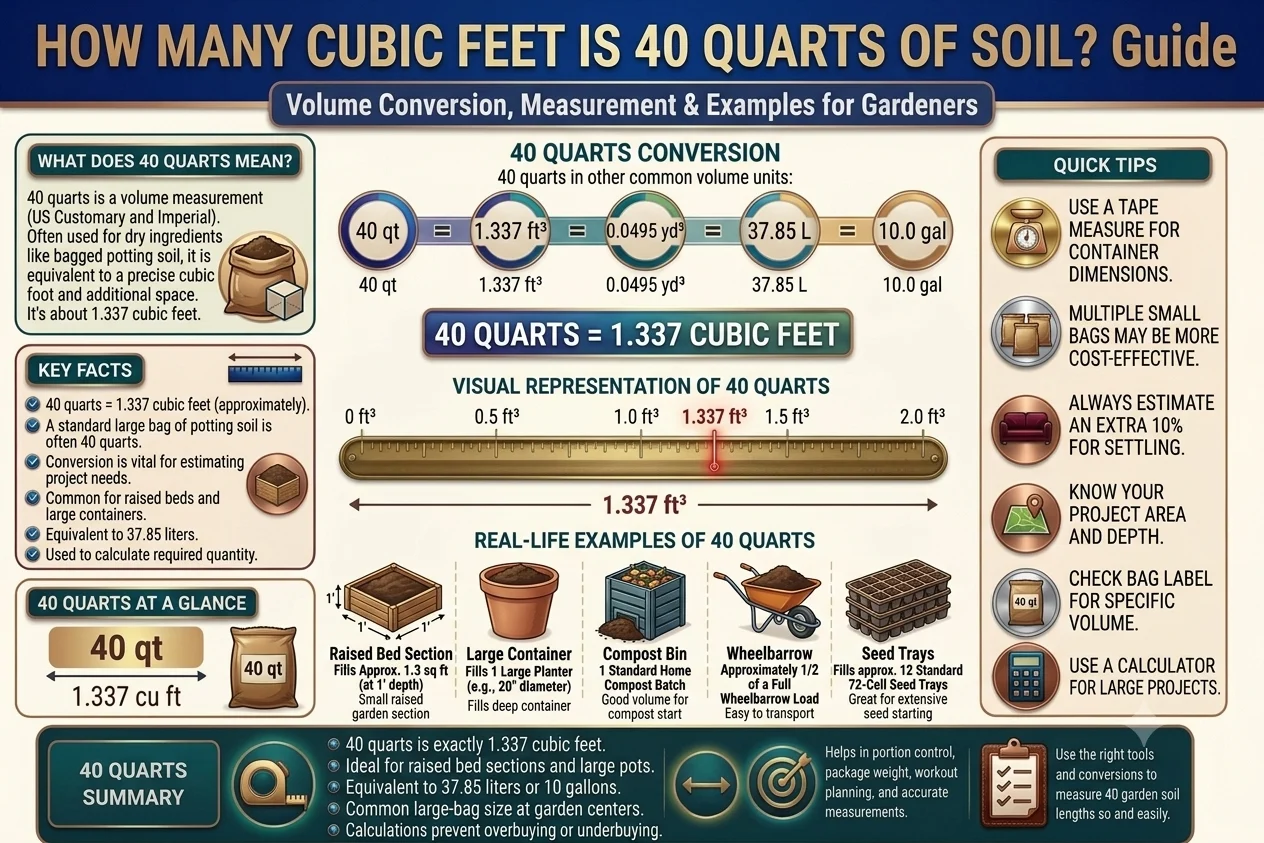
40 quarts of soil equals approximately 1.34 cubic feet.
This conversion is helpful when planning container gardens, filling raised beds, buying potting mix, or comparing soil bag sizes. Since many gardening projects use cubic feet while soil bags are often sold in quarts, understanding this conversion can save both time and money.
In this guide, you’ll learn the exact conversion, practical examples, soil coverage estimates, and expert tips for calculating your soil needs accurately.
Quick Answer: How Many Cubic Feet Is 40 Quarts of Soil?
The exact conversion is:
40 quarts≈1.34 cubic feet
Since:
- 1 cubic foot = approximately 29.92 quarts
The calculation becomes:
40 ÷ 29.92 = 1.337 cubic feet
Most garden centers round this to:
1.3 to 1.34 cubic feet
For gardening purposes, it’s safe to consider a 40-quart bag of soil as containing about 1⅓ cubic feet.
Understanding Quarts and Cubic Feet
Before converting soil volumes, it’s important to understand the measurements involved.
What Is a Quart?
A quart is a unit of volume commonly used in the United States.
You’ll often see quarts used to measure:
- Potting soil
- Compost
- Mulch
- Liquids
- Garden amendments
Many retail soil products are sold in:
- 8-quart bags
- 16-quart bags
- 25-quart bags
- 40-quart bags
- 60-quart bags
What Is a Cubic Foot?
A cubic foot measures volume in a three-dimensional space.
A space measuring:
- 1 foot long
- 1 foot wide
- 1 foot deep
Contains exactly:
1 cubic foot
Landscape projects, raised beds, and soil calculators commonly use cubic feet because it makes estimating larger volumes easier.
How to Convert 40 Quarts of Soil to Cubic Feet
Understanding the formula helps when converting other soil bag sizes.
Conversion Formula
The standard formula is:
Cubic Feet=29.92Quarts
Step-by-Step Calculation
For a 40-quart bag:
Step 1:
40 quarts
Step 2:
Divide by 29.92
Step 3:
40 ÷ 29.92 = 1.337
Step 4:
Round to 1.34
Final answer:
40 quarts = approximately 1.34 cubic feet
This conversion works for potting soil, compost, garden soil, and most soil-based products.
40 Quarts of Soil Conversion Chart
Here is a handy reference chart for common soil bag sizes.
| Soil Volume (Quarts) | Cubic Feet |
|---|---|
| 8 qt | 0.27 cu ft |
| 16 qt | 0.53 cu ft |
| 20 qt | 0.67 cu ft |
| 25 qt | 0.84 cu ft |
| 32 qt | 1.07 cu ft |
| 40 qt | 1.34 cu ft |
| 50 qt | 1.67 cu ft |
| 60 qt | 2.01 cu ft |
| 75 qt | 2.51 cu ft |
| 100 qt | 3.34 cu ft |
Many gardeners keep this chart handy when comparing products at nurseries and garden centers.
What Can 40 Quarts of Soil Fill?
One of the most practical questions is how much planting space a 40-quart bag can actually fill.
Flower Pots
A 40-quart bag can typically fill:
- Four to five 12-inch pots
- Two to three 16-inch pots
- One large decorative planter
Actual capacity depends on pot depth and shape.
Raised Garden Beds
A 40-quart bag contains approximately 1.34 cubic feet.
For a raised bed measuring:
- 4 feet long
- 2 feet wide
- 6 inches deep
Required volume:
4 × 2 × 0.5 = 4 cubic feet
You’ll need approximately:
4 ÷ 1.34 = 3 bags
Planters and Containers
Many patio planters require:
- 0.5 to 1 cubic foot of soil
A 40-quart bag can fill:
- One large planter
- Several medium containers
- Multiple hanging baskets
This makes it one of the most popular bag sizes for container gardening.
Why Soil Bags Are Measured in Quarts
Many gardeners wonder why soil manufacturers use quarts instead of cubic feet.
There are several reasons:
Easier Packaging
Smaller bag sizes are easier to label using quarts.
Consumer Familiarity
Many homeowners are familiar with quart measurements from household products.
Better Product Comparison
Potting soils, seed-starting mixes, and specialty blends are often sold in smaller quantities where quart measurements make more sense.
However, landscapers and contractors typically prefer cubic feet or cubic yards for larger projects.
Common Soil Bag Sizes Compared
Here is how popular bag sizes compare.
| Bag Size | Cubic Feet |
|---|---|
| 8 qt | 0.27 cu ft |
| 16 qt | 0.53 cu ft |
| 25 qt | 0.84 cu ft |
| 40 qt | 1.34 cu ft |
| 60 qt | 2.01 cu ft |
| 80 qt | 2.67 cu ft |
The 40-quart bag sits in the middle range, offering a balance between portability and volume.
How Much Does 40 Quarts of Soil Weigh?
Weight varies significantly based on soil type and moisture content.
A 40-quart bag may weigh:
| Soil Type | Approximate Weight |
|---|---|
| Dry Potting Mix | 15–25 lbs |
| Moist Potting Soil | 20–35 lbs |
| Garden Soil | 30–45 lbs |
| Compost Blend | 25–50 lbs |
Always check the label if transportation is a concern.
Weight is often more important than volume when carrying bags manually.
Real-World Gardening Examples
Understanding practical applications makes soil volume easier to estimate.
Example 1: Vegetable Container Garden
A gardener wants to fill:
- Four 10-gallon containers
Total soil needed:
About 5.3 cubic feet
Required bags:
5.3 ÷ 1.34 = approximately 4 bags
Example 2: Small Raised Bed
Dimensions:
- 4 ft × 4 ft × 6 in
Volume:
8 cubic feet
Bags needed:
8 ÷ 1.34 = approximately 6 bags
Example 3: Decorative Patio Planters
Three large planters require:
3 cubic feet
Required bags:
3 ÷ 1.34 = approximately 3 bags
These examples help estimate soil purchases more accurately.
Common Mistakes When Buying Soil
Many gardeners buy too much or too little soil due to simple errors.
Confusing Weight and Volume
A heavier bag does not necessarily contain more soil volume.
Always check the quart or cubic-foot measurement.
Ignoring Container Shape
Round containers often require more soil than expected.
Measure dimensions carefully.
Not Accounting for Soil Settlement
Fresh potting mix settles over time.
Consider purchasing slightly more than calculated.
Mixing Measurement Units
Combining quarts, gallons, cubic feet, and cubic yards can cause calculation mistakes.
Stick to one unit system whenever possible.
Expert Tips for Estimating Soil Needs
Measure Before You Shop
Calculate container volume before buying soil.
Buy Extra for Top-Offs
Plants often require additional soil throughout the growing season.
Use Soil Calculators
Online calculators can improve accuracy for raised beds and large containers.
Keep Conversion Numbers Handy
Remember:
- 40 quarts = 1.34 cubic feet
- 60 quarts = 2 cubic feet
- 80 quarts = 2.67 cubic feet
These conversions simplify garden planning.
Conclusion
So, how many cubic feet is 40 quarts of soil? The answer is approximately 1.34 cubic feet. This simple conversion is essential for container gardening, raised-bed projects, landscaping, and comparing soil products at garden centers.
By understanding that a 40-quart bag of soil equals about 1⅓ cubic feet, you can estimate soil needs more accurately, avoid overbuying, and ensure your gardening projects have the right amount of growing medium. Whether you’re filling flower pots, vegetable containers, or raised beds, this conversion provides a reliable foundation for smarter garden planning.
FAQs
1. How many cubic feet is 40 quarts of soil?
Forty quarts of soil equals approximately 1.34 cubic feet.
2. Is a 40-quart bag enough for a raised bed?
For small raised beds, yes. Larger beds often require multiple bags depending on dimensions and depth.
3. How many gallons is 40 quarts?
Since 4 quarts equal 1 gallon:
40 quarts = 10 gallons.
4. How many 40-quart bags are in one cubic yard?
One cubic yard contains 27 cubic feet.
27 ÷ 1.34 = approximately 20 bags.
5. Is all 40-quart soil packaged the same?
Volume is the same, but weight varies based on moisture content and soil composition.
Discover More Articles
How Many Miles Is 35000 Feet?
How Many Sq Feet Is a 3 Car Garage?
How Many Feet of Garland for a 9ft Tree?