

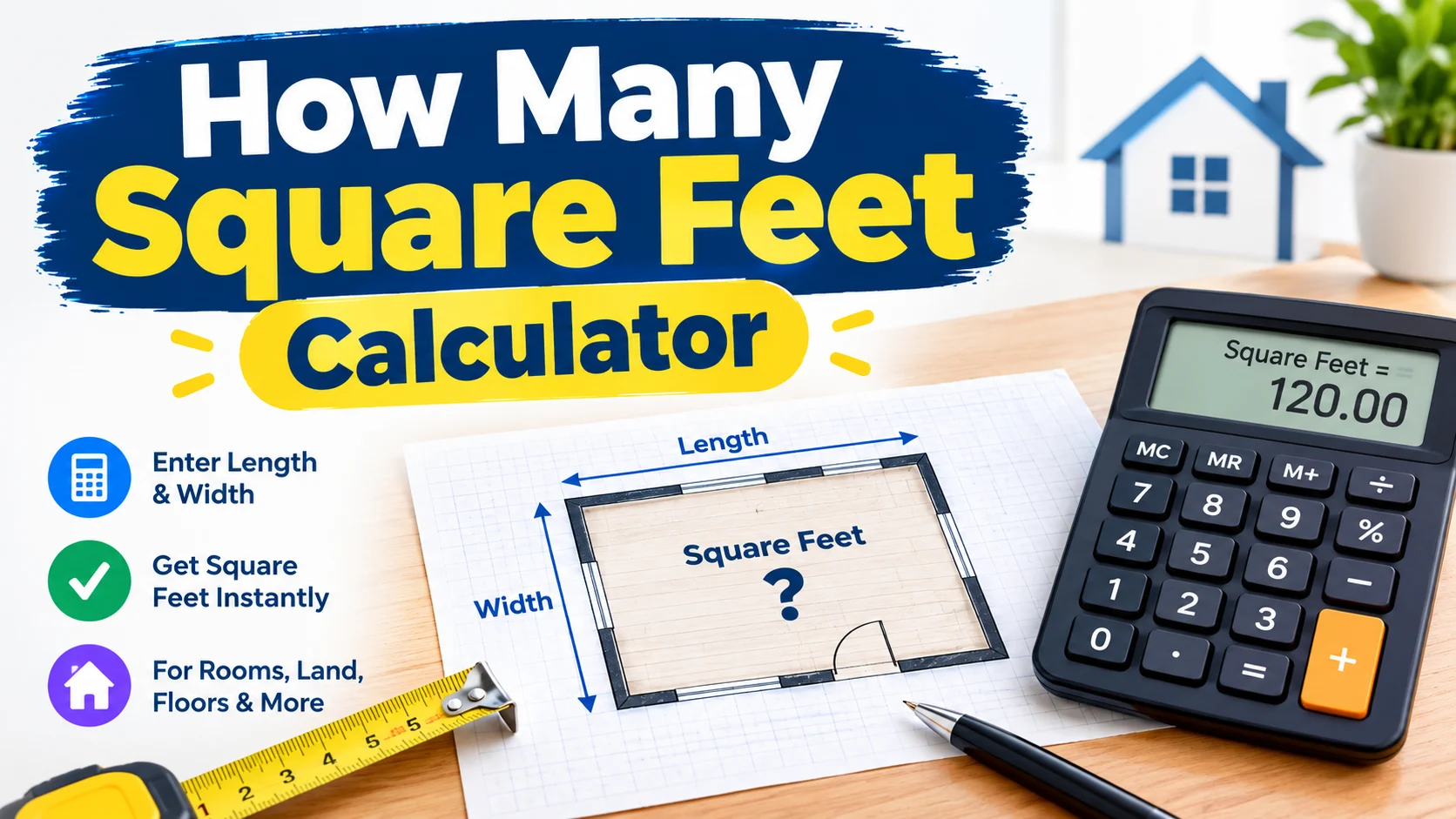
A square feet calculator helps you determine the area of a room, floor, wall, yard, garage, property, or other rectangular space. The basic calculation is simple:
Square feet = Length × Width
For example, if a room is 12 feet long and 10 feet wide:
12 × 10 = 120 square feet
So, a 12 × 10-foot room has 120 square feet of floor area. This is the standard formula used by square-footage calculators for rectangular spaces.
For irregular spaces, you can divide the area into smaller rectangles or other simple shapes, calculate each section separately, and then add the results together.
Square Feet Calculator
Use the following formula to calculate square footage:
Length (feet) × Width (feet) = Square Feet
Quick Square Footage Examples
| Length | Width | Square Feet |
|---|---|---|
| 5 ft | 5 ft | 25 sq ft |
| 8 ft | 10 ft | 80 sq ft |
| 10 ft | 10 ft | 100 sq ft |
| 10 ft | 12 ft | 120 sq ft |
| 12 ft | 12 ft | 144 sq ft |
| 12 ft | 15 ft | 180 sq ft |
| 15 ft | 20 ft | 300 sq ft |
| 20 ft | 20 ft | 400 sq ft |
| 20 ft | 30 ft | 600 sq ft |
| 30 ft | 30 ft | 900 sq ft |
| 40 ft | 50 ft | 2,000 sq ft |
What Is Square Footage?
Square footage is a measurement of area expressed in square feet.
One square foot is the area of a square measuring 1 foot by 1 foot.
So:
1 sq ft = 1 ft × 1 ft
Square footage tells you how much two-dimensional surface an area covers. It is commonly used for:
- Rooms
- Houses
- Apartments
- Garages
- Offices
- Patios
- Yards
- Floors
- Walls
- Roofing areas
- Flooring projects
- Tile projects
- Construction projects
- Real estate
The important point is that square feet measure area, not distance. A measurement such as 20 feet describes length, while 20 × 20 feet describes an area of 400 square feet.
How Does a Square Feet Calculator Work?
A basic square footage calculator uses the rectangle-area formula:
Area = Length × Width
When both measurements are provided in feet, the result is square feet.
For example:
Length = 15 feet
Width = 12 feet
Therefore:
15 × 12 = 180 square feet
The calculator returns 180 sq ft.
Both measurements need to use the same unit before multiplying. If one measurement is in feet and the other is in inches, convert them first.
How to Calculate Square Feet Step by Step
Calculating square footage manually takes only a few steps.
Step 1: Measure the Length
Measure the longest side of the rectangular area.
For example:
Length = 16 feet
Step 2: Measure the Width
Measure the side perpendicular to the length.
For example:
Width = 12 feet
Step 3: Multiply the Measurements
Use:
16 × 12 = 192
Step 4: Add the Unit
The answer is:
192 square feet
Therefore, a 16 × 12-foot room has 192 square feet.
Square Footage Formula
The standard formula is:
Square Feet = Length in Feet × Width in Feet
In mathematical notation:
A = L × W
Where:
- A = area in square feet
- L = length in feet
- W = width in feet
This formula applies to rectangular and square areas.
Example
A patio measures 20 feet by 15 feet.
20 × 15 = 300 sq ft
Therefore, the patio has 300 square feet.
How Many Square Feet Is a 10 × 10 Room?
A 10 × 10-foot room has:
10 × 10 = 100 square feet
So:
10 × 10 = 100 sq ft
This is one of the most common square-footage examples.
How Many Square Feet Is a 10 × 12 Room?
A 10 × 12-foot room has:
10 × 12 = 120 square feet
Therefore:
10 × 12 = 120 sq ft
How Many Square Feet Is a 12 × 12 Room?
A 12 × 12-foot room has:
12 × 12 = 144 square feet
Therefore:
12 × 12 = 144 sq ft
How Many Square Feet Is a 15 × 20 Room?
A 15 × 20-foot area has:
15 × 20 = 300 square feet
Therefore:
15 × 20 = 300 sq ft
How Many Square Feet Is a 20 × 20 Area?
A 20 × 20-foot area has:
20 × 20 = 400 square feet
Therefore:
20 × 20 = 400 sq ft
This size is commonly encountered when calculating garages, rooms, workshops, patios, and other rectangular areas.
How Many Square Feet Is a 20 × 30 Area?
A 20 × 30-foot area has:
20 × 30 = 600 square feet
Therefore:
20 × 30 = 600 sq ft
How Many Square Feet Is a 30 × 40 Area?
A 30 × 40-foot area has:
30 × 40 = 1,200 square feet
Therefore:
30 × 40 = 1,200 sq ft
Square Feet Calculator for Rooms
A square footage calculator is particularly useful when measuring rooms.
For a rectangular room:
Room area = Length × Width
For example, suppose your bedroom measures:
- Length: 14 feet
- Width: 12 feet
Calculation:
14 × 12 = 168 square feet
Your bedroom therefore contains 168 square feet of floor area.
Common Room Sizes
| Room Dimensions | Square Feet |
|---|---|
| 8 × 10 ft | 80 sq ft |
| 9 × 10 ft | 90 sq ft |
| 10 × 10 ft | 100 sq ft |
| 10 × 12 ft | 120 sq ft |
| 10 × 14 ft | 140 sq ft |
| 12 × 12 ft | 144 sq ft |
| 12 × 14 ft | 168 sq ft |
| 12 × 15 ft | 180 sq ft |
| 14 × 16 ft | 224 sq ft |
| 15 × 20 ft | 300 sq ft |
| 20 × 20 ft | 400 sq ft |
How to Calculate Square Feet With Feet and Inches
Measurements are not always whole numbers.
You might measure a room as:
12 feet 6 inches
You cannot simply enter 12.6 feet because 6 inches is 0.5 feet, not 0.6 feet.
To convert inches to decimal feet:
Inches ÷ 12 = Decimal feet
For 6 inches:
6 ÷ 12 = 0.5 feet
Therefore:
12 ft 6 in = 12.5 feet
This conversion is important for accurate square-foot calculations.
Example: 12 ft 6 in × 10 ft
Convert 12 feet 6 inches:
12 + 6/12 = 12.5 feet
Then:
12.5 × 10 = 125 square feet
So the area is 125 sq ft.
Another Example
Suppose a room measures:
15 ft 6 in × 12 ft 3 in
Convert both:
15 ft 6 in:
15 + 6/12 = 15.5 ft
12 ft 3 in:
12 + 3/12 = 12.25 ft
Now multiply:
15.5 × 12.25 = 189.875 sq ft
Rounded:
189.88 square feet
How to Calculate Square Feet From Inches
If both dimensions are measured entirely in inches, you can calculate the area in square inches and then convert it to square feet.
There are:
12 inches × 12 inches = 144 square inches
in one square foot.
Therefore:
Square feet = Square inches ÷ 144
Example
A surface is 120 inches long and 96 inches wide.
First calculate square inches:
120 × 96 = 11,520 square inches
Then:
11,520 ÷ 144 = 80 square feet
Therefore, the area is 80 sq ft.
How to Calculate Square Feet From Meters
If your measurements are in meters, you can either calculate the area in square meters and convert it, or convert the dimensions to feet first.
One square foot equals approximately 0.092903 square meters.
To convert square feet to square meters:
Square meters = Square feet × 0.092903
To convert square meters to square feet:
Square feet = Square meters × 10.7639
Example
Suppose a room is:
5 meters × 4 meters
First calculate square meters:
5 × 4 = 20 m²
Convert to square feet:
20 × 10.7639 ≈ 215.28 sq ft
So a 5 × 4-meter room is approximately 215.28 square feet.
Square Feet to Square Meters Conversion Chart
| Square Feet | Square Meters |
|---|---|
| 50 sq ft | 4.65 m² |
| 100 sq ft | 9.29 m² |
| 150 sq ft | 13.94 m² |
| 200 sq ft | 18.58 m² |
| 250 sq ft | 23.23 m² |
| 300 sq ft | 27.87 m² |
| 400 sq ft | 37.16 m² |
| 500 sq ft | 46.45 m² |
| 600 sq ft | 55.74 m² |
| 700 sq ft | 65.03 m² |
| 800 sq ft | 74.32 m² |
| 900 sq ft | 83.61 m² |
| 1,000 sq ft | 92.90 m² |
| 1,500 sq ft | 139.35 m² |
| 2,000 sq ft | 185.81 m² |
Square Feet to Square Yards
Square yards are another common area measurement.
Since:
1 yard = 3 feet
a square yard is:
3 × 3 = 9 square feet
Therefore:
Square yards = Square feet ÷ 9
And:
Square feet = Square yards × 9
Examples
100 sq ft ÷ 9 = 11.11 sq yd
500 sq ft ÷ 9 = 55.56 sq yd
1,000 sq ft ÷ 9 = 111.11 sq yd
This conversion is particularly useful when comparing flooring or carpet measurements.
Square Feet to Square Inches
There are exactly 144 square inches in one square foot.
Therefore:
Square inches = Square feet × 144
For example:
100 × 144 = 14,400 square inches
So:
100 sq ft = 14,400 sq in
How to Calculate Square Feet of an L-Shaped Room
An L-shaped room cannot be calculated accurately by simply multiplying its maximum length by its maximum width because that would include the missing portion of the L.
Instead, divide the room into two or more rectangles.
Example
Suppose an L-shaped room can be divided into:
- Rectangle A: 15 × 10 feet
- Rectangle B: 8 × 6 feet
Calculate each section.
Rectangle A:
15 × 10 = 150 sq ft
Rectangle B:
8 × 6 = 48 sq ft
Add them:
150 + 48 = 198 sq ft
Therefore, the L-shaped room has 198 square feet.
Breaking irregular spaces into smaller shapes is the standard approach for square-foot calculations.
How to Calculate Square Feet of an Irregular Room
If a room is not a simple rectangle:
- Draw a rough floor plan.
- Divide the space into rectangles, triangles, or other simple shapes.
- Measure every required dimension.
- Calculate each section.
- Add the areas together.
- Subtract areas that are cut out or excluded.
For example, an irregular room might consist of three rectangular sections.
If the sections are:
- 100 sq ft
- 75 sq ft
- 50 sq ft
then:
100 + 75 + 50 = 225 sq ft
The total area is 225 square feet.
How to Calculate the Square Feet of a Triangle
For a triangular area, use:
Area = ½ × Base × Height
For example, if a triangular section has:
- Base = 20 feet
- Height = 10 feet
then:
½ × 20 × 10 = 100 square feet
So the triangular area is 100 sq ft.
This can be useful for irregular yards, landscaping areas, triangular rooms, and other non-rectangular spaces.
How to Calculate the Square Feet of a Circle
For a circular area, use:
Area = π × radius²
If the radius is 10 feet:
3.14159 × 10² = 314.16 square feet
Therefore, the circle has approximately 314.16 square feet.
If you know the diameter instead, divide it by 2 to find the radius.
How to Calculate Square Feet of a House
To estimate the floor area of a house, calculate each rectangular section separately.
For example:
| Area | Square Feet |
|---|---|
| Living room | 250 |
| Kitchen | 150 |
| Bedroom 1 | 140 |
| Bedroom 2 | 130 |
| Bedroom 3 | 120 |
| Bathrooms | 100 |
| Hallways/entry | 110 |
| Total | 1,000 sq ft |
The total is:
250 + 150 + 140 + 130 + 120 + 100 + 110 = 1,000 square feet
For an actual property measurement, however, use the applicable local or industry measurement standard rather than assuming every enclosed or exterior area is included.
How to Calculate Square Feet for Flooring
Square footage is one of the most important calculations when buying flooring.
First calculate the actual floor area.
For example:
Room = 20 × 15 feet
20 × 15 = 300 sq ft
The theoretical flooring requirement is therefore 300 square feet.
However, you may need additional material for:
- Cutting
- Pattern matching
- Damaged pieces
- Installation mistakes
- Irregular room shapes
A common planning approach is to add around 5–10% for flooring waste, although the appropriate allowance depends on the material and installation pattern.
Example With 10% Extra
Base area:
300 sq ft
Add 10%:
300 × 1.10 = 330 sq ft
You would therefore plan for approximately 330 square feet of flooring material.
Always follow the manufacturer’s or installer’s recommended waste allowance.
How to Calculate Square Feet for Tile
Tile projects use the same basic area calculation.
Suppose a bathroom floor is:
10 × 8 feet
Area:
10 × 8 = 80 sq ft
If you add 10% for cuts and breakage:
80 × 1.10 = 88 sq ft
You would plan for approximately 88 square feet of tile.
For diagonal, complex, or highly patterned installations, additional waste may be appropriate.
How to Calculate Square Feet for Carpet
Calculate the room area first.
For a:
15 × 20-foot room
Area:
15 × 20 = 300 sq ft
If carpet is priced by square yard:
300 ÷ 9 = 33.33 square yards
So 300 square feet is approximately 33.33 square yards.
Carpet installation may require additional material depending on roll width, seams, room shape, and pattern matching.
How to Calculate Square Feet for Paint
Square footage for painting walls is different from floor square footage.
You need the wall surface area, which depends on:
- Room length
- Room width
- Ceiling height
- Doors
- Windows
For a rectangular room, the approximate wall area is:
Wall area = 2 × (Length + Width) × Height
Example
A room is:
- 12 ft long
- 10 ft wide
- 8 ft high
Calculate:
2 × (12 + 10) × 8
2 × 22 × 8 = 352 sq ft
The approximate total wall area is 352 square feet before subtracting doors and windows.
Square Footage vs. Linear Feet
These terms are easy to confuse.
Linear feet measure distance in one dimension.
Square feet measure area in two dimensions.
For example:
- 20 linear feet = a length of 20 feet
- 20 × 10 feet = 200 square feet
You cannot convert linear feet to square feet without knowing another dimension.
For example, if you have 20 linear feet of material that is 3 feet wide:
20 × 3 = 60 square feet
So the material covers 60 square feet.
Square Feet vs. Cubic Feet
Square feet measure area.
Cubic feet measure volume.
For example:
A floor measuring 20 × 10 feet has:
20 × 10 = 200 sq ft
If the same area has a 1-foot depth, its volume is:
20 × 10 × 1 = 200 cubic feet
Therefore:
- Square feet = two-dimensional area
- Cubic feet = three-dimensional volume
This distinction matters when calculating concrete, soil, gravel, insulation, and other materials.
How Much Extra Material Should You Buy?
The correct allowance depends on the project.
For flooring and tile, a common planning range is approximately 5–10% extra, although complicated patterns or unusual layouts may require more.
The basic formula is:
Order quantity = Area × (1 + Waste Percentage)
For 500 square feet with a 10% allowance:
500 × 1.10 = 550 sq ft
For 1,000 square feet with a 10% allowance:
1,000 × 1.10 = 1,100 sq ft
This extra material is not part of the actual square footage of the room. It is an allowance for installation.
Common Square Footage Calculations
Here are some frequently searched measurements:
| Dimensions | Square Feet |
|---|---|
| 5 × 10 | 50 |
| 8 × 10 | 80 |
| 10 × 10 | 100 |
| 10 × 12 | 120 |
| 10 × 15 | 150 |
| 12 × 12 | 144 |
| 12 × 15 | 180 |
| 12 × 20 | 240 |
| 15 × 15 | 225 |
| 15 × 20 | 300 |
| 16 × 20 | 320 |
| 20 × 20 | 400 |
| 20 × 30 | 600 |
| 24 × 24 | 576 |
| 24 × 30 | 720 |
| 30 × 30 | 900 |
| 30 × 40 | 1,200 |
| 40 × 50 | 2,000 |
| 50 × 50 | 2,500 |
| 50 × 100 | 5,000 |
Square Feet Calculator for Multiple Rooms
If a house has multiple rectangular rooms, calculate each room individually.
For example:
Living Room
20 × 15 = 300 sq ft
Kitchen
12 × 10 = 120 sq ft
Bedroom
14 × 12 = 168 sq ft
Office
10 × 10 = 100 sq ft
Total:
300 + 120 + 168 + 100 = 688 sq ft
Therefore, these four spaces contain 688 square feet.
This method is more reliable than trying to estimate the entire irregular floor plan as one large rectangle.
How Accurate Should a Square Footage Measurement Be?
The required accuracy depends on what you’re using the calculation for.
For a rough furniture layout, an estimate may be sufficient.
For flooring, tile, or landscaping, careful measurements are important because small errors can affect material quantities.
For real estate, appraisal, legal, construction, or permitting purposes, follow the applicable measurement standard and use qualified professionals when required.
A calculator can perform the mathematics accurately, but it cannot correct inaccurate measurements.
Common Mistakes When Calculating Square Feet
Mistake 1: Multiplying the Wrong Dimensions
Make sure you measure the actual length and width of the area.
Mistake 2: Mixing Feet and Inches
Don’t multiply 12.5 feet by 10 inches.
Convert everything to the same unit first.
Mistake 3: Treating 12 Feet 6 Inches as 12.6 Feet
This is incorrect.
12 ft 6 in = 12.5 ft
because:
6 ÷ 12 = 0.5
Mistake 4: Forgetting Irregular Sections
An L-shaped room needs to be divided into smaller sections.
Mistake 5: Including Areas You Don’t Need
If you’re calculating flooring, focus on the actual floor surface to be covered.
Mistake 6: Forgetting Waste
The calculated area is not necessarily the amount of material you should order.
Mistake 7: Confusing Square Feet With Linear Feet
Area requires two dimensions.
FAQs
How do I calculate square feet?
Multiply the length by the width, with both measurements expressed in feet.
Square feet = Length × Width
For example:
12 × 10 = 120 sq ft
This is the standard rectangular-area formula.
What is the formula for square feet?
The formula is:
Area = Length × Width
When both dimensions are in feet, the result is square feet.
How many square feet is 10 × 10?
A 10 × 10-foot area is 100 square feet.
How many square feet is 12 × 12?
A 12 × 12-foot area is 144 square feet.
How many square feet is 20 × 20?
A 20 × 20-foot area is 400 square feet.
How many square feet is 20 × 30?
A 20 × 30-foot area is 600 square feet.
How do I calculate square feet if the room is L-shaped?
Divide the L-shaped room into rectangles. Calculate the square footage of each rectangle and add the results together.
How do I calculate square feet with feet and inches?
Convert the inches to feet by dividing the inches by 12.
For example:
6 inches ÷ 12 = 0.5 feet
Therefore:
12 ft 6 in = 12.5 ft
Then multiply the converted dimensions.
How many square feet are in one square yard?
There are 9 square feet in one square yard.
1 sq yd = 9 sq ft
How many square feet are in one square meter?
One square meter is approximately 10.764 square feet.
Can I calculate square footage for a circle?
Yes. For a circle, use:
Area = π × radius²
Can I use a square footage calculator for a wall?
Yes. Calculate the wall’s length × height to determine its surface area. Subtract doors and windows if you’re estimating paint or another wall covering.
Does square footage include walls?
That depends on the measurement standard being used. For a basic floor-area calculation, square footage represents the area of the floor or other surface being measured. Real-estate and construction measurement conventions can differ, so don’t assume every published square-foot figure uses the same definition.
How much extra flooring should I buy?
A common starting point is 5–10% above the measured floor area, but the appropriate allowance depends on the material, room shape, installation pattern, and manufacturer’s recommendations.
Final Answer: How Many Square Feet Calculator?
A square feet calculator uses a simple formula to determine the area of a rectangular space:
Square Feet = Length × Width
For example:
10 ft × 12 ft = 120 sq ft
The same principle works for rooms, garages, patios, floors, yards, walls, and other rectangular surfaces.
For irregular spaces, divide the area into smaller rectangles or other simple shapes, calculate each section, and add the results.
For accurate results:
- Measure the length.
- Measure the width.
- Make sure both measurements use the same unit.
- Convert feet and inches correctly.
- Multiply length by width.
- Divide irregular spaces into smaller sections.
- Add an appropriate material allowance when purchasing flooring, tile, or similar products.
The most important formula to remember is:
Length × Width = Square Feet
Once you know that formula, you can calculate the square footage of almost any simple rectangular space quickly and accurately.


Pingback: How Many Square Feet Is an Average 2-Car Garage? Complete Guide