

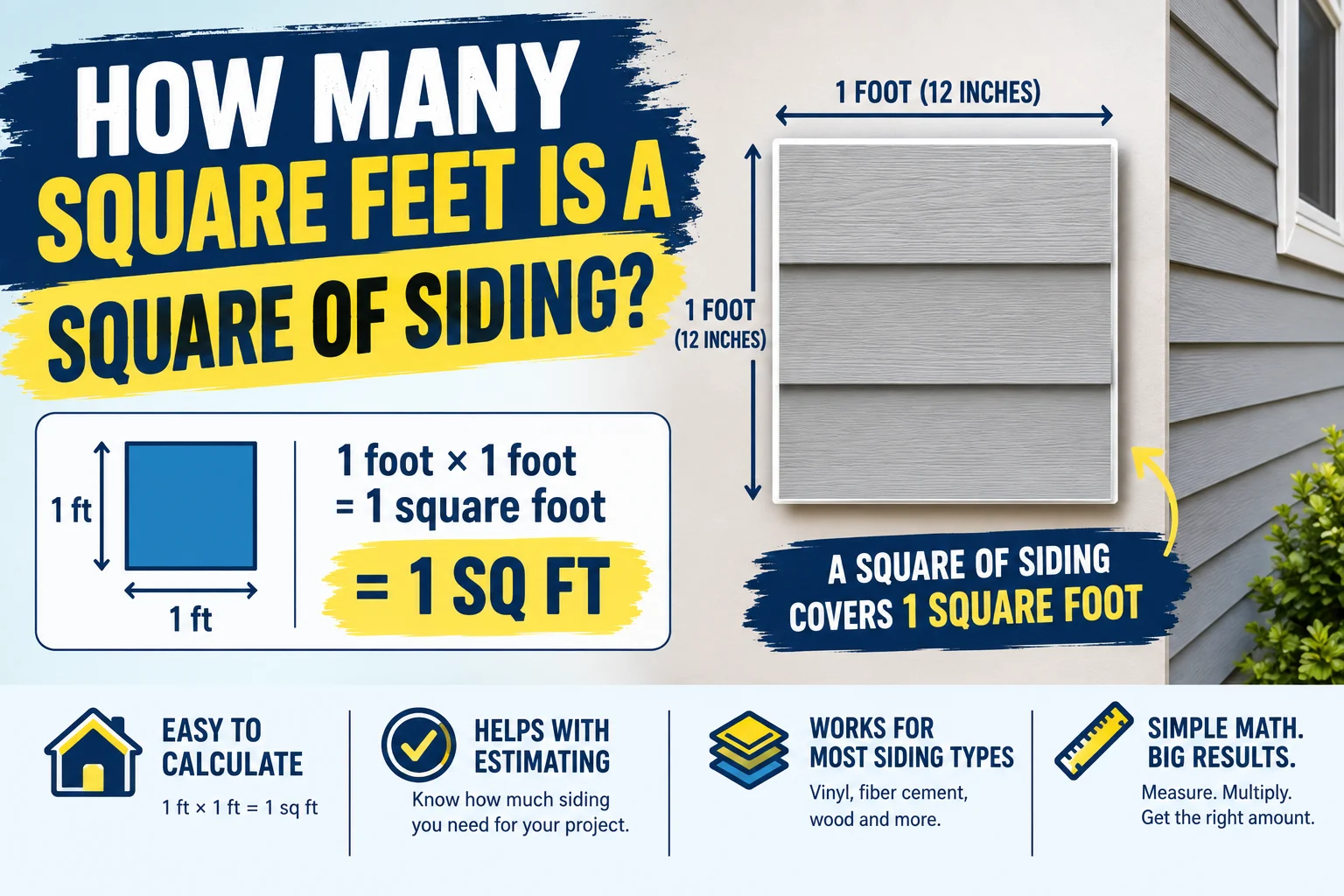
If you’re planning a siding project, one of the first measurements you’ll encounter is a “square” of siding. But what exactly does a square mean, and how many square feet does it cover?
The standard answer is:
1 square of siding = 100 square feet
Unlike some building-material measurements, a siding square is simply a unit used to describe 100 square feet of siding coverage.
For example:
- 1 square = 100 sq. ft.
- 2 squares = 200 sq. ft.
- 5 squares = 500 sq. ft.
- 10 squares = 1,000 sq. ft.
- 20 squares = 2,000 sq. ft.
However, when purchasing siding, you usually need to account for waste, cutting, trimming, corners, openings, and the manufacturer’s stated coverage. The amount of material you buy may therefore be greater than the exact wall area.
Quick Answer
One square of siding covers 100 square feet.
The basic formula is:
Number of siding squares = Total siding area ÷ 100
For example, if your home’s exterior requires 2,400 square feet of siding:
2,400 ÷ 100 = 24 squares
You would need a base estimate of 24 squares before adding an appropriate waste allowance.
If you add 10% for waste:
2,400 × 1.10 = 2,640 square feet
Then:
2,640 ÷ 100 = 26.4 squares
You would generally round up to the appropriate purchasing quantity, depending on how the siding is sold.
What Is a Square of Siding?
A square is a traditional construction measurement used for certain exterior building materials.
For siding:
1 square = 100 square feet of coverage
It doesn’t necessarily mean the siding comes as one 10-foot × 10-foot piece.
Instead, “square” describes the total coverage area represented by the material.
For example:
10 ft × 10 ft = 100 sq. ft.
Therefore, that area represents:
1 siding square
Likewise:
20 ft × 5 ft = 100 sq. ft.
That is also one square of siding coverage.
How Many Square Feet Are in 1 Square of Siding?
The exact conversion is:
1 siding square = 100 square feet
This is the key number to remember when estimating siding.
| Siding Squares | Square Feet |
|---|---|
| 0.5 square | 50 sq. ft. |
| 1 square | 100 sq. ft. |
| 2 squares | 200 sq. ft. |
| 3 squares | 300 sq. ft. |
| 4 squares | 400 sq. ft. |
| 5 squares | 500 sq. ft. |
| 10 squares | 1,000 sq. ft. |
| 15 squares | 1,500 sq. ft. |
| 20 squares | 2,000 sq. ft. |
| 25 squares | 2,500 sq. ft. |
| 30 squares | 3,000 sq. ft. |
The formula is:
Square Feet = Number of Squares × 100
How Many Squares of Siding Do I Need?
To estimate how many siding squares you need, first determine the total exterior wall area that will receive siding.
Then divide the area by 100.
Formula
Siding Squares = Siding Area ÷ 100
For example, suppose your house has:
2,000 square feet of siding area
Then:
2,000 ÷ 100 = 20 squares
So the basic estimate is:
20 squares of siding
But you shouldn’t necessarily order exactly 20 squares.
You’ll usually need additional material for waste and cuts.
How to Calculate the Square Feet of Siding
Calculating the siding area is relatively straightforward if the exterior walls are simple rectangles.
Use:
Area = Length × Height
For example, suppose one wall is:
- 40 feet long
- 10 feet high
Calculate:
40 × 10 = 400 square feet
That wall contains approximately 400 square feet of surface area.
If the house has four walls with similar dimensions, calculate each wall separately and then add them together.
Example: Calculating Siding for a House
Imagine a rectangular house with four exterior walls:
- Front: 40 × 10 = 400 sq. ft.
- Back: 40 × 10 = 400 sq. ft.
- Side 1: 30 × 10 = 300 sq. ft.
- Side 2: 30 × 10 = 300 sq. ft.
Total wall area:
400 + 400 + 300 + 300 = 1,400 square feet
Now convert to siding squares:
1,400 ÷ 100 = 14 squares
So the basic siding requirement is:
14 squares
Before ordering, you would then account for windows, doors, gables, waste, and other project-specific factors.
Should You Subtract Windows and Doors?
Usually, yes, when calculating the actual siding coverage.
Doors and windows don’t need siding over their openings, so their areas can be subtracted from the gross wall area.
For example:
Gross wall area
2,000 sq. ft.
Windows
200 sq. ft.
Doors
80 sq. ft.
Subtract:
2,000 − 200 − 80 = 1,720 square feet
Then convert:
1,720 ÷ 100 = 17.2 squares
So the net siding area is approximately:
17.2 squares
However, don’t automatically eliminate all material corresponding to openings from your purchase estimate. Cutting patterns, starter strips, trim, gables, and other components can affect actual material requirements.
How Much Waste Should You Add?
Siding installation creates waste because panels and pieces need to be cut around:
- Windows
- Doors
- Corners
- Rooflines
- Gables
- Vents
- Utility penetrations
- Irregular wall shapes
A commonly used planning allowance is around 10%, although the appropriate amount can vary depending on the siding type, house design, installer, and layout.
For a simple rectangular project, 5% may sometimes be adequate. Complex homes with numerous angles and gables can require more.
Example
Suppose your calculated siding area is:
2,000 square feet
Add 10%:
2,000 × 1.10 = 2,200 square feet
Convert to squares:
2,200 ÷ 100 = 22 squares
So you would plan for approximately:
22 squares
rather than exactly 20.
Is 10% Waste Always Enough?
No.
A waste allowance is only an estimate.
The appropriate amount depends on:
- House shape
- Siding profile
- Panel length
- Wall dimensions
- Number of windows
- Number of doors
- Number of corners
- Gables
- Dormers
- Roof angles
- Installer experience
- Manufacturer’s installation recommendations
A very simple rectangular building may produce relatively little waste, while a house with multiple rooflines and architectural details can produce significantly more.
For an accurate estimate, follow the siding manufacturer’s estimating instructions or have a siding contractor calculate the material requirement.
How Many Siding Squares Are in a Typical House?
There isn’t one standard amount because houses vary considerably in size.
As a rough example, a house might require:
| Approx. Siding Area | Basic Siding Requirement |
|---|---|
| 1,000 sq. ft. | 10 squares |
| 1,200 sq. ft. | 12 squares |
| 1,500 sq. ft. | 15 squares |
| 1,800 sq. ft. | 18 squares |
| 2,000 sq. ft. | 20 squares |
| 2,500 sq. ft. | 25 squares |
| 3,000 sq. ft. | 30 squares |
| 3,500 sq. ft. | 35 squares |
| 4,000 sq. ft. | 40 squares |
These figures represent the siding surface area, not necessarily the home’s interior floor area.
That’s an important distinction.
Does a 2,000-Square-Foot House Need 20 Squares of Siding?
Not necessarily.
A home’s advertised size usually refers to its interior floor area, while siding covers the exterior wall surface.
A 2,000-square-foot house could require significantly more or less than 2,000 square feet of siding depending on:
- Number of stories
- Wall height
- House shape
- Roof design
- Garage
- Windows
- Doors
- Gables
- Architectural features
For example, a two-story 2,000-square-foot house has a very different exterior wall area from a sprawling single-story 2,000-square-foot house.
Therefore:
Don’t use interior house square footage as your siding square-foot estimate.
Does One Box of Siding Equal One Square?
Not necessarily.
This is another common source of confusion.
A square refers to 100 square feet of coverage.
A box, carton, or bundle refers to the quantity packaged by the manufacturer.
Different siding products can have different coverage per package.
For example, one manufacturer might package enough material to cover approximately one square, while another product may cover a different amount.
Always check the product label or manufacturer’s specifications for:
Coverage per carton/bundle
Then calculate how many packages you need.
How Many Panels Are in a Square of Siding?
There isn’t one universal number.
The number of panels required depends on:
- Panel length
- Panel height
- Siding profile
- Manufacturer
- Exposure
- Installation method
For example, if a siding panel has a coverage area of 12 square feet, approximately:
100 ÷ 12 ≈ 8.33 panels
would theoretically cover one square.
But real installation requires overlapping, cutting, and waste, so you shouldn’t use this theoretical number as a purchasing formula without checking the product’s actual coverage.
Vinyl Siding: How Many Square Feet Is a Square?
Vinyl siding uses the same basic square measurement:
1 square = 100 square feet of coverage
However, vinyl siding is often sold in cartons or boxes containing a specified number of panels.
The actual coverage per carton varies by product.
For example, if a carton covers 2 squares:
2 × 100 = 200 square feet
If another carton covers 1.5 squares:
1.5 × 100 = 150 square feet
Always use the manufacturer’s stated coverage rather than assuming every carton has the same amount.
Fiber Cement Siding: How Many Square Feet Is a Square?
Fiber cement siding can also be measured in squares.
1 square = 100 square feet
However, fiber cement products may be sold as:
- Individual boards
- Panels
- Sheets
- Boxes
- Bundles
Coverage varies according to product dimensions and installation exposure.
For fiber cement siding, carefully check the manufacturer’s coverage information because the nominal board dimensions aren’t necessarily the same as the actual exposed coverage.
Engineered Wood Siding and Other Materials
Engineered wood siding, composite siding, and other siding products can also be estimated in squares.
The basic conversion remains:
1 square = 100 square feet
What changes is how the material is packaged and installed.
For accurate ordering, calculate:
- Total wall area
- Openings to subtract
- Gable and irregular areas
- Product-specific coverage
- Waste
- Trim and accessory requirements
How Many Squares of Siding for a 1,500-Square-Foot House?
You cannot determine the exact siding requirement from the house’s interior area alone.
But if the actual siding surface area is 1,500 square feet:
1,500 ÷ 100 = 15 squares
With 10% waste:
1,500 × 1.10 = 1,650 square feet
Then:
1,650 ÷ 100 = 16.5 squares
So you’d plan for approximately 16.5 squares of coverage, then round up according to how the product is sold.
How Many Squares of Siding for a 2,000-Square-Foot House?
Again, if the actual exterior siding area is 2,000 square feet:
2,000 ÷ 100 = 20 squares
With 10% waste:
2,000 × 1.10 = 2,200 square feet
Therefore:
2,200 ÷ 100 = 22 squares
So the estimate would be approximately:
22 squares including a 10% allowance
But remember that a 2,000-square-foot house doesn’t necessarily have 2,000 square feet of siding.
How Many Squares of Siding for a 2,500-Square-Foot House?
If the actual siding surface area is 2,500 square feet:
2,500 ÷ 100 = 25 squares
With 10% waste:
2,500 × 1.10 = 2,750 square feet
Then:
2,750 ÷ 100 = 27.5 squares
You’d therefore plan for about 27.5 squares of coverage, subject to rounding and product packaging.
How to Calculate Siding for Gable Ends
Gable ends are more complicated because they’re usually triangular.
The area of a triangle is:
Area = ½ × Base × Height
For example, suppose a gable is:
- 30 feet wide
- 8 feet high
Calculate:
½ × 30 × 8 = 120 square feet
Therefore, the gable contains approximately:
120 square feet
If you have two identical gables:
120 × 2 = 240 square feet
This area can then be added to the rectangular wall areas before calculating total siding requirements.
Example of a Complete Siding Estimate
Suppose a house has the following exterior areas:
Front wall
400 sq. ft.
Back wall
400 sq. ft.
Two side walls
600 sq. ft.
Two gables
240 sq. ft.
Total:
400 + 400 + 600 + 240 = 1,640 square feet
Suppose windows and doors account for:
200 square feet
Net area:
1,640 − 200 = 1,440 square feet
Convert to squares:
1,440 ÷ 100 = 14.4 squares
Add 10% waste:
1,440 × 1.10 = 1,584 square feet
Convert:
1,584 ÷ 100 = 15.84 squares
You would then round up according to the manufacturer’s packaging requirements.
Siding Squares vs. Roofing Squares
The word square is used for both siding and roofing, which can cause confusion.
For both applications:
1 square = 100 square feet
But that doesn’t mean siding and roofing are interchangeable.
Roofing squares describe the area of the roof surface, while siding squares describe the wall surface covered by siding.
The estimating methods are also different because roofs involve:
- Roof pitch
- Ridges
- Valleys
- Eaves
- Hips
- Flashing
- Underlayment
Siding estimates focus primarily on vertical wall surfaces, openings, gables, corners, and siding exposure.
Does Siding Coverage Include Overlap?
This depends on the product’s stated coverage.
Siding panels often overlap during installation. Because of this, the nominal dimensions of a panel don’t necessarily represent its actual exposed coverage.
For example, a panel might physically measure a certain length and width, but part of its surface is hidden underneath another panel.
Therefore, when calculating how much material you’ll need, use the manufacturer’s coverage or exposure specifications rather than simply multiplying the panel’s overall dimensions.
What Is the Difference Between Siding Area and Siding Coverage?
These terms are related but important.
Siding area
The amount of wall surface that needs to be covered.
Siding coverage
The amount of wall surface a particular product or package actually covers when installed.
For example:
- Wall area = 1,000 sq. ft.
- Product coverage = 100 sq. ft. per square
Basic requirement:
1,000 ÷ 100 = 10 squares
After waste, you may need more material.
Siding Estimation Formula
The basic formula is:
Siding Squares = Net Siding Area ÷ 100
To include waste:
Required Squares = Net Siding Area × (1 + Waste Percentage) ÷ 100
For 10% waste:
Required Squares = Net Area × 1.10 ÷ 100
For example:
1,800 × 1.10 ÷ 100 = 19.8 squares
You would round up as necessary.
Siding Square Calculator
You can use this simple calculation:
Step 1: Measure each wall
Length × Height = Wall Area
Step 2: Calculate gables
½ × Base × Height = Gable Area
Step 3: Add all exterior areas
Total Gross Area = Walls + Gables + Other Siding Areas
Step 4: Subtract major openings
Net Area = Gross Area − Windows − Doors
Step 5: Add waste
Net Area × 1.05 to 1.15
The exact allowance depends on the project.
Step 6: Convert to squares
Adjusted Area ÷ 100 = Siding Squares
Step 7: Round up
Round according to the product’s packaging and supplier requirements.
How Many Square Feet Does 10 Squares of Siding Cover?
Since:
1 square = 100 square feet
then:
10 × 100 = 1,000 square feet
Therefore:
10 squares of siding cover 1,000 square feet.
Similarly:
15 squares = 1,500 sq. ft.
20 squares = 2,000 sq. ft.
25 squares = 2,500 sq. ft.
30 squares = 3,000 sq. ft.
How Many Square Feet Does 20 Squares of Siding Cover?
Calculate:
20 × 100 = 2,000 square feet
Therefore:
20 squares of siding = 2,000 square feet of coverage
This is before considering whether the manufacturer’s product has specific coverage limitations or whether additional material is needed for waste.
How Many Square Feet Does 30 Squares of Siding Cover?
Calculate:
30 × 100 = 3,000 square feet
Therefore:
30 squares = 3,000 square feet
If you’re estimating a project that requires 3,000 square feet of net siding area, you would likely need more than 30 squares after accounting for waste.
Common Mistakes When Buying Siding
1. Confusing House Square Footage With Siding Area
A home’s interior square footage doesn’t directly tell you how much siding is required.
2. Forgetting Waste
Cutting and installation can create material waste.
3. Ignoring Gables
Triangular gable sections can add significant siding area.
4. Forgetting the Garage
An attached garage may have exterior walls requiring siding.
5. Assuming Every Package Covers One Square
Coverage varies by product and manufacturer.
6. Ignoring Product Exposure
The installed exposure can differ from the material’s nominal dimensions.
7. Ordering Exact Quantities
Ordering exactly the calculated amount can leave you short if cuts or damaged pieces occur.
FAQs
How many square feet is a square of siding?
One square of siding equals 100 square feet of coverage.
How many square feet are in 10 squares of siding?
Ten squares equal:
10 × 100 = 1,000 square feet.
How many squares of siding do I need for 2,000 square feet?
If 2,000 square feet is the actual siding area, you need 20 squares before waste. With 10% waste, the estimate becomes 22 squares.
Is a square of siding the same as 100 square feet?
Yes. In standard siding terminology, one square represents 100 square feet of coverage.
Does one box of siding equal one square?
Not necessarily. Packages vary by manufacturer and product. Always check the package’s stated coverage.
How much extra siding should I buy?
A common planning allowance is around 5–15%, depending on the complexity of the house and siding product. More complicated projects may require a larger allowance.
Do I subtract windows and doors when calculating siding?
Yes, their areas can generally be subtracted from the gross wall area when determining net siding coverage. However, the overall material order should also account for cuts, waste, and installation requirements.
Is siding measured the same way as roofing?
Both commonly use the term square, with one square representing 100 square feet. However, the surfaces and estimating methods are different.
How do I calculate siding squares?
Measure the exterior wall areas, add gables and other areas, subtract openings, add an appropriate waste allowance, and divide the result by 100.
Can I estimate siding based on my home’s square footage?
Not accurately. Interior floor area and exterior wall area are different measurements. You need the dimensions of the exterior walls and other areas being sided.
Conclusion
So, how many square feet is a square of siding?
The simple answer is:
1 square of siding = 100 square feet
This is the standard unit used when estimating siding materials. If your project has 2,000 square feet of actual siding surface, the basic calculation is:
2,000 ÷ 100 = 20 squares
However, you shouldn’t stop at that number. A real siding project may require additional material because of cutting, overlapping, gables, windows, doors, corners, irregular walls, and installation waste.
A practical siding estimate usually involves these steps:
- Measure all exterior walls.
- Calculate rectangular and triangular areas.
- Add the areas together.
- Subtract major openings such as doors and windows.
- Add an appropriate waste allowance.
- Divide the adjusted area by 100.
- Round up according to the product’s packaging requirements.
Remember that one square always represents 100 square feet of siding coverage, but the number of cartons, bundles, or panels required to provide that coverage varies between products.
For an accurate material order, use the manufacturer’s stated coverage and installation instructions rather than relying solely on a generic square-foot calculation.



Pingback: How Many Feet Are in 1 Acre of Land?