
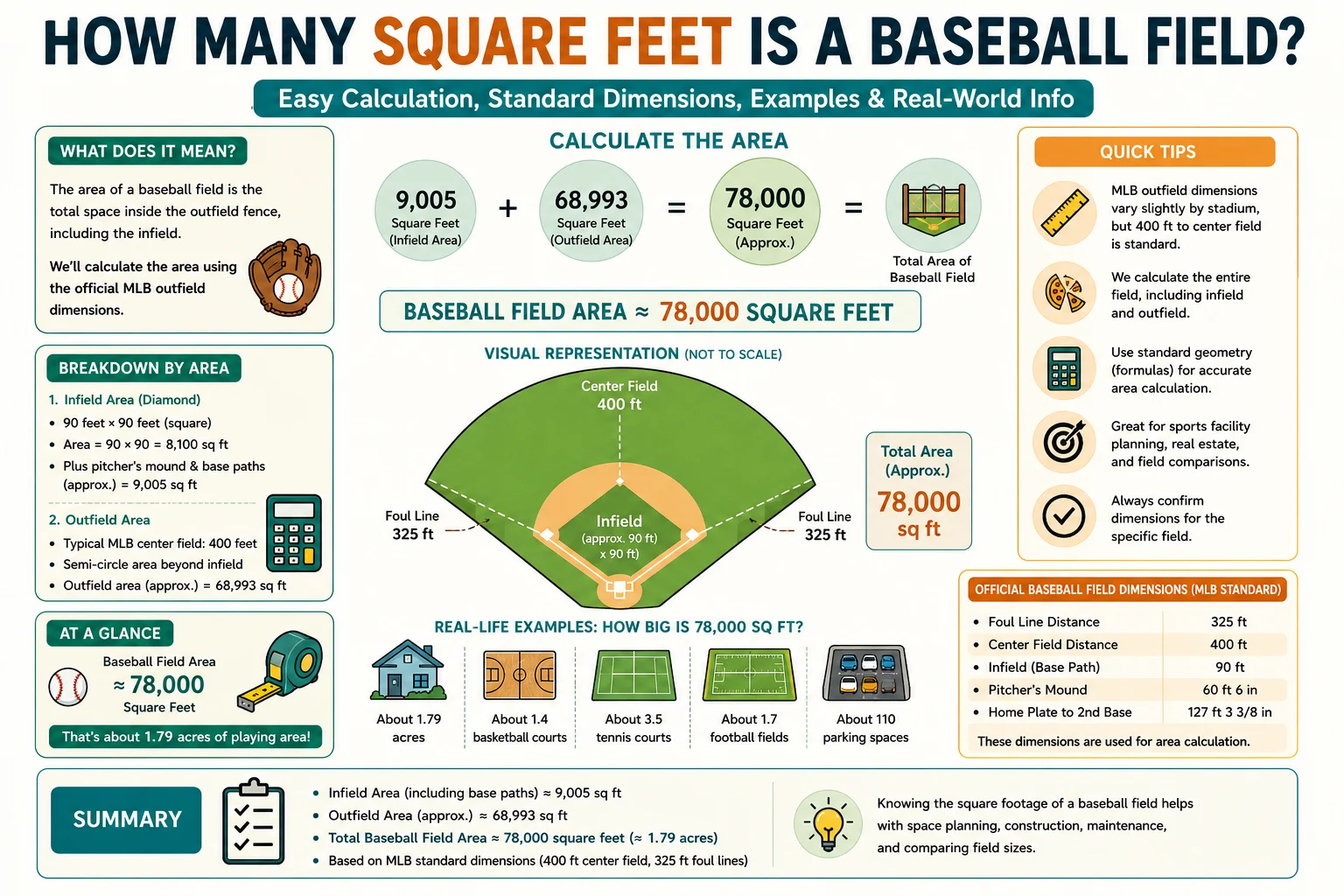
If you have ever wondered how many square feet is a baseball field, the answer depends on the level of play and the field layout. On average, a full baseball field covers between 90,000 and 125,000 square feet or more.
Professional baseball fields are much larger than many people realize because they include:
- The infield
- Outfield
- Foul territory
- Dugouts
- Bullpens
- Warning tracks
A standard Major League Baseball field often sits on about 2 to 3 acres of land.
Understanding baseball field dimensions is useful for coaches, athletes, land planners, schools, and sports fans. In this guide, you will learn how baseball field square footage is calculated, how sizes vary by league, and how baseball fields compare to other sports fields.
Understanding Baseball Field Dimensions
A baseball field is not a perfect rectangle like a basketball or football field. Its unusual shape makes square footage calculations more complex.
The field includes two main sections:
- The infield
- The outfield
The Infield
The infield is often called the baseball diamond.
It includes:
- Home plate
- First base
- Second base
- Third base
- Pitcher’s mound
The diamond shape forms a square.
Professional baseball base paths measure:
- 90 feet between bases
The Outfield
The outfield extends beyond the infield and usually forms a curved shape.
Outfield fence distances vary widely depending on the stadium.
Typical MLB distances include:
- Left field: 310–340 feet
- Center field: 390–420 feet
- Right field: 310–350 feet
Because every stadium differs slightly, total square footage changes from one field to another.
How Many Square Feet Is a Baseball Field?
There is no single exact answer because baseball fields vary in size.
However, most full-size baseball fields cover roughly:
- 90,000 to 125,000 square feet
Some professional stadiums exceed this range due to large foul territories and deeper outfields.
Average Baseball Field Area
Here is a simple breakdown:
| Field Section | Approximate Square Feet |
|---|---|
| Infield | 13,000–15,000 sq ft |
| Outfield | 70,000–100,000 sq ft |
| Foul Territory | 10,000–20,000 sq ft |
| Total Field Area | 90,000–125,000+ sq ft |
A baseball field can easily occupy more than two acres of land.
Acres Conversion
Since land planners often use acres, here is the conversion:
1 acre=43,560 square feet
If a baseball field measures 100,000 square feet:
43560100000≈2.3 acres
That equals approximately 2.3 acres.
Baseball Diamond Measurements Explained
The baseball diamond is the heart of the field.
Base Paths
In Major League Baseball:
- Each base is 90 feet apart
This creates a square-shaped infield.
Infield Area Formula
The area of the baseball diamond can be estimated using the square area formula.
90×90=8100
The square itself covers about 8,100 square feet.
However, the actual dirt infield area is larger because it includes:
- Base cutouts
- Pitcher’s mound
- Baselines
- Grass edges
Pitcher’s Mound
The pitcher’s mound sits:
- 60 feet 6 inches from home plate
The mound diameter is:
- 18 feet
This area adds additional square footage to the infield.
Outfield Fence Distance
Outfield depth greatly affects total field size.
Fields with deeper center fields naturally require more land.
Calculating Baseball Field Square Footage
Calculating a baseball field’s area requires estimating irregular shapes.
Step 1: Measure the Infield
The infield is the easiest section to calculate.
Approximate infield size:
- 13,000 to 15,000 square feet
Step 2: Estimate the Outfield
Most outfields form a fan-like or semi-circular shape.
A simplified semi-circle formula helps estimate the area.
A=21πr2
If the average outfield radius is 400 feet:
A=21π(400)2
This produces an approximate outfield area over 250,000 square feet before adjustments.
Because baseball fields are irregular, planners usually use scaled drawings or surveying software for precision.
Step 3: Add Foul Territory
Foul territory adds significant extra space.
Some stadiums have large foul areas for:
- Player safety
- Seating design
- Stadium layout
Baseball Field Size by League
Field dimensions change depending on age level and league rules.
Major League Baseball Fields
Professional MLB fields are the largest.
Typical characteristics include:
- 90-foot base paths
- 400-foot center fields
- Large seating areas
- Extensive foul territory
Total field size often exceeds:
- 100,000 square feet
College Baseball Fields
College fields use dimensions close to MLB standards.
However, outfield fences may be slightly shorter.
Average size:
- 85,000–110,000 square feet
High School Baseball Fields
High school fields are smaller than professional parks but still substantial.
Typical size:
- 70,000–100,000 square feet
Little League Fields
Little League fields are much smaller.
Common dimensions include:
- 60-foot base paths
- 200-foot outfield fences
These fields may cover:
- 30,000–50,000 square feet
Baseball Field Size Comparison Chart
Here is how baseball fields compare to other sports areas.
| Sports Area | Approximate Square Feet |
|---|---|
| Baseball Field | 90,000–125,000+ |
| Football Field | 57,600 |
| Soccer Field | 70,000–110,000 |
| Basketball Court | 4,700 |
| Tennis Court | 2,800 |
A baseball field is usually larger than a football field because of the extended outfield area.
Why Baseball Field Sizes Differ
Unlike basketball courts or football fields, baseball stadiums are not perfectly standardized.
Stadium Design Freedom
Professional baseball allows flexibility in outfield design.
This creates iconic stadium features such as:
- Green Monster at Fenway Park
- Deep center fields
- Unique wall angles
Available Land
Older stadiums often had limited city space, leading to unusual field shapes.
Modern stadiums usually have more flexibility.
Safety and Gameplay
Fence distance affects gameplay style.
Shorter fences increase home runs, while larger outfields favor speed and defense.
Common Uses Beyond Baseball
Baseball fields serve many community purposes.
Concerts
Large stadiums host:
- Music festivals
- Concert tours
- Entertainment events
Community Sports
Fields may also support:
- Softball
- Youth sports
- Training camps
Public Events
Some cities use baseball fields for:
- Fireworks shows
- Charity events
- Outdoor movie nights
Common Mistakes When Measuring a Baseball Field
Measuring baseball field area can become confusing.
Ignoring Foul Territory
Many people calculate only the playable area.
Foul territory can add thousands of square feet.
Assuming Every Field Is Identical
Baseball stadiums vary widely.
No two professional parks are exactly alike.
Measuring Only the Diamond
The infield represents only a small part of the total field area.
Most square footage comes from the outfield.
Tips for Planning or Building a Baseball Field
Building a baseball field requires careful planning.
Consider Drainage
Poor drainage can ruin turf quality.
Many modern fields use underground drainage systems.
Plan for Extra Space
Additional space is needed for:
- Dugouts
- Bleachers
- Bullpens
- Walkways
- Parking
Choose Grass or Turf
Natural grass provides traditional aesthetics.
Artificial turf reduces maintenance and handles heavy use better.
Real-World Examples of Baseball Field Sizes
Different MLB stadiums vary dramatically.
| Stadium Type | Approximate Area |
|---|---|
| Small MLB Park | 90,000 sq ft |
| Average MLB Park | 100,000–120,000 sq ft |
| Large MLB Park | 130,000+ sq ft |
This variety is part of what makes baseball unique compared to other sports.
Conclusion
So, how many square feet is a baseball field?
Most baseball fields cover between 90,000 and 125,000 square feet, though exact dimensions vary by league, stadium design, and outfield depth.
Professional baseball fields are massive spaces that include:
- Infields
- Outfields
- Foul territory
- Dugouts
- Seating support areas
Understanding baseball field square footage helps with:
- Sports planning
- Land development
- Facility construction
- Educational projects
- Field maintenance
Because baseball fields are not perfectly standardized, every field has its own unique dimensions and character.
Frequently Asked Questions
How many square feet is a professional baseball field?
A professional baseball field usually covers around 90,000 to 125,000 square feet or more.
How many acres is a baseball field?
Most baseball fields occupy about 2 to 3 acres.
Is a baseball field bigger than a football field?
Yes. Baseball fields are generally larger because of the extended outfield area.
What is the size of a Little League baseball field?
Little League fields commonly cover 30,000 to 50,000 square feet depending on layout.
Why are baseball fields different sizes?
Baseball allows flexible outfield dimensions, so stadiums vary based on design, land availability, and gameplay preferences.