

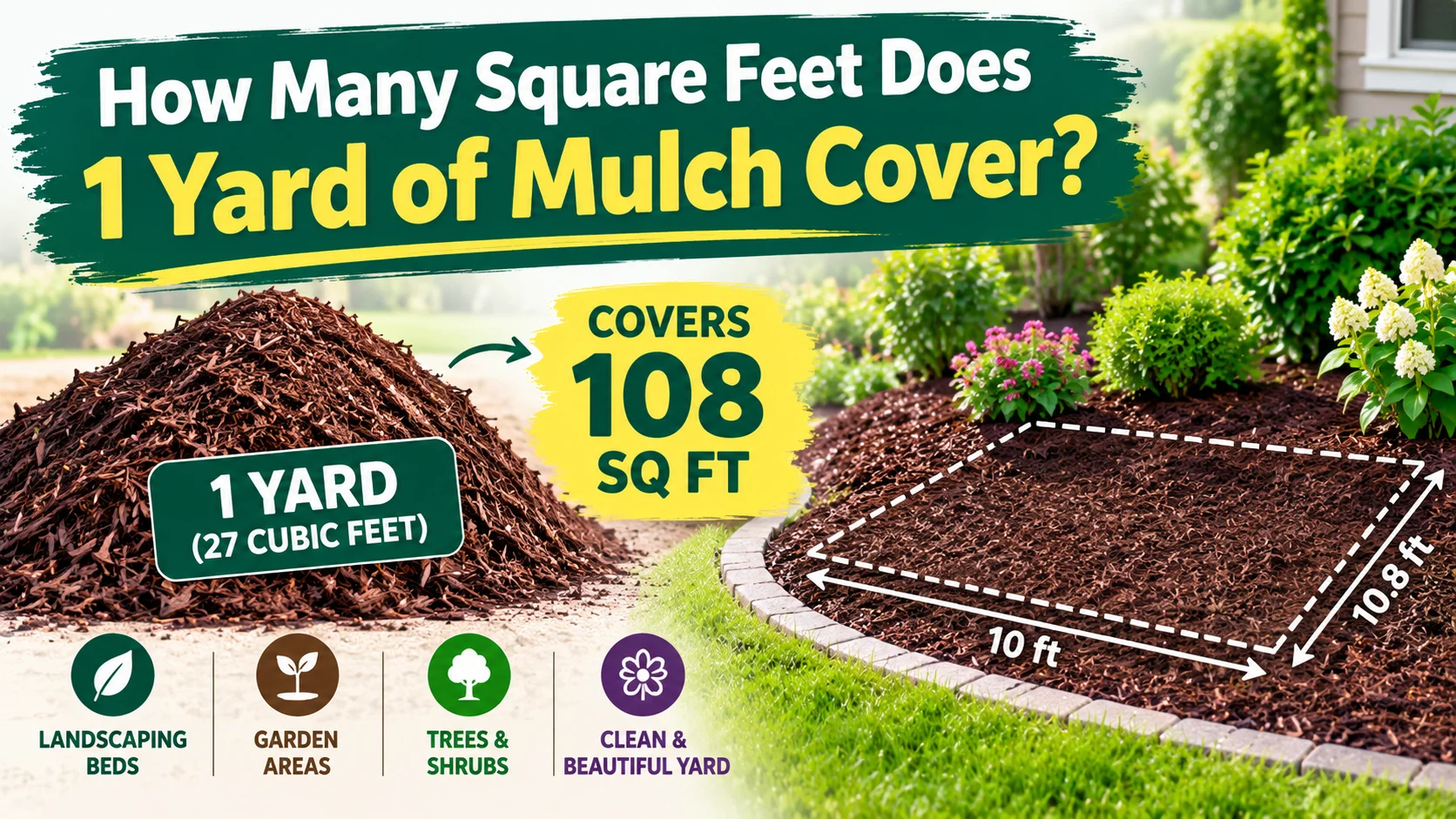
If you’re planning to refresh a flower bed, landscape around trees, or cover a garden with mulch, one of the most common questions is: how many square feet does 1 yard of mulch cover?
The answer depends primarily on how deep you spread the mulch. One cubic yard of mulch contains 27 cubic feet, but the number of square feet it covers changes with the depth of the layer.
At a typical 3-inch depth, one cubic yard of mulch covers about 108 square feet. At 2 inches deep, the same yard covers approximately 162 square feet, while at 4 inches deep it covers about 81 square feet.
Understanding this relationship can help you purchase enough mulch without ordering significantly more than you need. In this guide, you’ll learn how to calculate mulch coverage, determine the number of cubic yards required for your landscape, and choose an appropriate mulch depth.
Quick Answer: How Many Square Feet Does 1 Yard of Mulch Cover?
One cubic yard of mulch covers approximately 108 square feet when spread 3 inches deep.
Because mulch depth changes the coverage, here is a quick reference:
| Mulch Depth | Coverage From 1 Cubic Yard |
|---|---|
| 1 inch | 324 sq ft |
| 2 inches | 162 sq ft |
| 3 inches | 108 sq ft |
| 4 inches | 81 sq ft |
| 5 inches | 64.8 sq ft |
| 6 inches | 54 sq ft |
| 8 inches | 40.5 sq ft |
| 12 inches | 27 sq ft |
These figures assume exactly one cubic yard and a uniform application depth. Real-world coverage can vary because of settling, uneven ground, and how the mulch is distributed.
What Is a Yard of Mulch?
When landscaping suppliers sell mulch by the yard, they generally mean a cubic yard.
A cubic yard is a volume measurement.
It equals:
3 feet × 3 feet × 3 feet = 27 cubic feet
Therefore:
1 cubic yard of mulch = 27 cubic feet
The word “yard” can be confusing because a linear yard measures only length. When buying mulch, however, the yard normally refers to a cubic yard.
Linear Yard vs. Cubic Yard
A linear yard equals:
1 yard = 3 feet
A cubic yard equals:
1 cubic yard = 27 cubic feet
Mulch is sold by volume because you need to know how much material is required to cover a specific area at a specific depth.
How Do You Calculate Mulch Coverage?
The basic formula is:
Coverage in square feet = Volume in cubic feet ÷ Depth in feet
Since one cubic yard contains 27 cubic feet:
Coverage = 27 ÷ Depth in feet
If the depth is given in inches, you can use this convenient formula:
Coverage = 324 ÷ Mulch depth in inches
For example, at 3 inches:
324 ÷ 3 = 108 square feet
Therefore:
1 cubic yard of mulch covers 108 square feet at 3 inches deep.
How Many Square Feet Does 1 Yard of Mulch Cover at Different Depths?
Mulch is commonly spread at different depths depending on the landscaping application.
1 Inch Deep
At 1 inch:
324 ÷ 1 = 324 square feet
So one cubic yard can cover approximately 324 square feet.
However, a 1-inch layer may be too thin for many landscaping applications and can provide limited weed suppression.
2 Inches Deep
At 2 inches:
324 ÷ 2 = 162 square feet
Therefore, one yard of mulch covers approximately 162 square feet at 2 inches deep.
3 Inches Deep
At 3 inches:
324 ÷ 3 = 108 square feet
Therefore, one cubic yard covers approximately 108 square feet at 3 inches deep.
This is one of the most useful figures to remember when estimating mulch.
4 Inches Deep
At 4 inches:
324 ÷ 4 = 81 square feet
Therefore, one cubic yard covers approximately 81 square feet at 4 inches deep.
6 Inches Deep
At 6 inches:
324 ÷ 6 = 54 square feet
Therefore, one cubic yard covers approximately 54 square feet at 6 inches deep.
A 6-inch layer is substantially deeper than what is commonly needed for many decorative landscape beds.
Mulch Coverage Chart
Here is a simple mulch coverage chart for one cubic yard:
| Depth | Coverage |
|---|---|
| 1 inch | 324 sq ft |
| 1.5 inches | 216 sq ft |
| 2 inches | 162 sq ft |
| 2.5 inches | 129.6 sq ft |
| 3 inches | 108 sq ft |
| 3.5 inches | 92.6 sq ft |
| 4 inches | 81 sq ft |
| 5 inches | 64.8 sq ft |
| 6 inches | 54 sq ft |
| 8 inches | 40.5 sq ft |
| 10 inches | 32.4 sq ft |
| 12 inches | 27 sq ft |
This chart makes it easy to estimate coverage without performing the calculation each time.
How Much Mulch Do I Need?
To determine how many cubic yards of mulch you need, you need three measurements:
- Length of the area
- Width of the area
- Desired mulch depth
First calculate the area:
Length × Width = Square feet
Then use:
Cubic yards = Square feet × Depth in inches ÷ 324
This formula works when the area is measured in square feet and the mulch depth is measured in inches.
Example: 500 Square Feet at 3 Inches Deep
Suppose you have a landscaping area of 500 square feet and want to spread mulch 3 inches deep.
Use:
500 × 3 ÷ 324
1,500 ÷ 324 = 4.63 cubic yards
You need approximately 4.63 cubic yards of mulch.
Because mulch is normally purchased in whole or fractional cubic-yard quantities, you may need to round up according to your supplier’s available quantities.
Example: 1,000 Square Feet at 3 Inches Deep
For a 1,000-square-foot landscape bed:
1,000 × 3 ÷ 324
3,000 ÷ 324 = 9.26 cubic yards
So you need approximately 9.26 cubic yards of mulch at a 3-inch depth.
How Many Yards of Mulch for 100 Square Feet?
The amount depends on the desired depth.
| Area | 2-Inch Depth | 3-Inch Depth | 4-Inch Depth |
|---|---|---|---|
| 100 sq ft | 0.62 yd³ | 0.93 yd³ | 1.23 yd³ |
| 200 sq ft | 1.23 yd³ | 1.85 yd³ | 2.47 yd³ |
| 300 sq ft | 1.85 yd³ | 2.78 yd³ | 3.70 yd³ |
| 400 sq ft | 2.47 yd³ | 3.70 yd³ | 4.94 yd³ |
| 500 sq ft | 3.09 yd³ | 4.63 yd³ | 6.17 yd³ |
| 1,000 sq ft | 6.17 yd³ | 9.26 yd³ | 12.35 yd³ |
These are theoretical volumes. Actual material requirements can vary because of settling, uneven terrain, and application practices.
How Much Area Does 1 Yard of Mulch Cover at 2 Inches?
At a depth of 2 inches, one cubic yard covers approximately:
162 square feet
Calculation:
324 ÷ 2 = 162 square feet
A 2-inch layer can be useful when you want a relatively light mulch application.
How Much Area Does 1 Yard of Mulch Cover at 3 Inches?
At a depth of 3 inches, one cubic yard covers:
108 square feet
Calculation:
324 ÷ 3 = 108 square feet
For many landscaping projects, 3 inches provides a practical balance between coverage and material use.
How Much Area Does 1 Yard of Mulch Cover at 4 Inches?
At a depth of 4 inches, one cubic yard covers:
81 square feet
Calculation:
324 ÷ 4 = 81 square feet
A deeper layer uses more mulch per square foot, so the coverage decreases.
How Much Mulch Do I Need for a Flower Bed?
For a rectangular flower bed, measure the length and width.
For example, suppose your flower bed is:
20 feet long × 10 feet wide
Area:
20 × 10 = 200 square feet
If you want 3 inches of mulch:
200 × 3 ÷ 324 = 1.85 cubic yards
You would need approximately 1.85 cubic yards.
How Much Mulch Do I Need Around Trees?
Tree rings can be more difficult to calculate because they are often circular.
The area of a circle is:
Area = π × radius²
For example, suppose a circular tree ring has a diameter of 10 feet.
Radius:
10 ÷ 2 = 5 feet
Area:
3.1416 × 5² = 78.54 square feet
At 3 inches deep:
78.54 × 3 ÷ 324 ≈ 0.73 cubic yards
So the tree ring would require approximately 0.73 cubic yards of mulch.
When applying mulch around trees, avoid piling it tightly against the trunk. A mulch layer should not create a volcano-shaped mound around the tree trunk.
How Many Bags of Mulch Equal 1 Cubic Yard?
Bag sizes vary, so there is no single answer for every product.
A common bag size is 2 cubic feet.
Since:
1 cubic yard = 27 cubic feet
The calculation is:
27 ÷ 2 = 13.5 bags
So, approximately 13.5 two-cubic-foot bags equal one cubic yard.
Because bags are sold as whole units, you would need 14 bags to provide at least one cubic yard.
Other bag sizes require different calculations.
| Bag Size | Approx. Bags per Cubic Yard |
|---|---|
| 1 cu ft | 27 bags |
| 1.5 cu ft | 18 bags |
| 2 cu ft | 13.5 bags |
| 2.5 cu ft | 10.8 bags |
| 3 cu ft | 9 bags |
Always check the volume printed on the actual bag because package sizes vary by brand and product.
Bulk Mulch vs. Bagged Mulch
When you need only a small amount of mulch, bags can be convenient.
For larger landscaping projects, buying bulk mulch by the cubic yard is often more practical.
Bagged Mulch
Advantages include:
- Easy to transport
- Convenient for small projects
- Easy to store temporarily
- No need for a large delivery
Disadvantages include:
- More packaging
- More individual bags to handle
- Can become expensive for large areas
Bulk Mulch
Advantages include:
- Efficient for large projects
- Delivered in large quantities
- Less individual packaging
- Convenient for covering large landscape beds
Disadvantages include:
- Requires a suitable delivery location
- May require a wheelbarrow or other method to distribute it
- Minimum delivery quantities may apply
How Deep Should Mulch Be?
The ideal mulch depth depends on the material and application.
For many landscape beds, a layer around 2 to 4 inches is commonly used. However, the appropriate depth can vary by mulch type, plant material, climate, and local landscaping recommendations.
Too little mulch may provide limited benefits, while an excessively deep layer can interfere with water and air movement in the soil and may create problems around plants and trees.
For trees, shrubs, and perennial beds, avoid placing mulch directly against stems or trunks.
Does Mulch Settle Over Time?
Yes. Mulch can settle after installation, particularly after rain and normal decomposition.
Organic mulch also gradually breaks down and becomes incorporated into the soil.
This means a freshly installed 3-inch layer may not remain exactly 3 inches deep indefinitely.
How quickly mulch settles depends on:
- Mulch type
- Weather
- Rainfall
- Foot traffic
- Wind
- Decomposition
- Soil conditions
- Installation method
Because of this, landscape beds may need periodic top-ups.
Factors That Affect Mulch Coverage
The mathematical formulas provide an excellent estimate, but several real-world factors can affect actual coverage.
Mulch Type
Different materials have different particle sizes and densities.
Examples include:
- Wood chips
- Shredded bark
- Bark nuggets
- Colored wood mulch
- Compost-based mulch
- Pine straw
- Rubber mulch
Their appearance and settling behavior can differ.
Uneven Ground
If the soil surface is uneven, more mulch may be required to achieve a consistent visible depth.
Existing Mulch
If an old layer of mulch remains, you may not need to install a completely new 3- or 4-inch layer. Instead, you may simply need enough material to restore the desired depth.
Slopes
Sloped landscape beds can require additional material because mulch can move downhill over time.
Common Mulch Calculation Mistakes
Mistake 1: Confusing Cubic Yards With Square Yards
A cubic yard measures volume.
A square yard measures area.
They are not interchangeable.
Mistake 2: Ignoring Depth
The same cubic yard can cover 162 square feet at 2 inches but only 81 square feet at 4 inches.
Depth has a major impact on coverage.
Mistake 3: Measuring the Wrong Area
If a flower bed contains a house, tree, walkway, or other section that does not need mulch, subtract those areas from your total.
Mistake 4: Assuming Bagged and Bulk Mulch Are Equivalent
Always compare the actual volume printed on the bag with the bulk cubic-yard quantity.
Mistake 5: Applying Excessive Mulch Around Trees
More mulch is not always better. Avoid piling mulch against tree trunks or plant stems.
FAQs
How many square feet does 1 yard of mulch cover?
One cubic yard of mulch covers approximately 108 square feet at 3 inches deep. At 2 inches, it covers about 162 square feet, and at 4 inches, about 81 square feet.
How many square feet does 1 yard of mulch cover at 2 inches?
One cubic yard covers approximately 162 square feet at a 2-inch depth.
How many square feet does 1 yard of mulch cover at 3 inches?
One cubic yard covers approximately 108 square feet at 3 inches deep.
How many square feet does 1 yard of mulch cover at 4 inches?
One cubic yard covers approximately 81 square feet at 4 inches deep.
How many cubic feet are in a yard of mulch?
There are exactly 27 cubic feet in one cubic yard of mulch.
How many bags of mulch equal one yard?
It depends on the bag size. For example, a 2-cubic-foot bag contains 2 cubic feet, so 13.5 bags equal one cubic yard mathematically. In practice, you need 14 bags to reach or exceed one cubic yard.
How much mulch do I need for 1,000 square feet?
At 3 inches deep, 1,000 square feet requires approximately 9.26 cubic yards of mulch.
At 2 inches, it requires approximately 6.17 cubic yards.
At 4 inches, it requires approximately 12.35 cubic yards.
Is 3 inches of mulch too much?
A 3-inch layer is within the commonly used range for many landscape applications, but the appropriate depth depends on the mulch material and plants. Avoid piling mulch against tree trunks and plant stems.
Can I calculate mulch coverage using a calculator?
Yes. Use:
Cubic yards needed = Square feet × mulch depth in inches ÷ 324
For example, 500 square feet at 3 inches:
500 × 3 ÷ 324 = 4.63 cubic yards
Final Answer: How Many Square Feet Does 1 Yard of Mulch Cover?
So, how many square feet does 1 yard of mulch cover?
The answer depends on the depth.
One cubic yard of mulch covers approximately:
- 324 square feet at 1 inch deep
- 162 square feet at 2 inches deep
- 108 square feet at 3 inches deep
- 81 square feet at 4 inches deep
- 54 square feet at 6 inches deep
The most useful number for many landscaping estimates is 108 square feet per cubic yard at a 3-inch depth.
To calculate your own requirement, use:
Cubic yards = Square feet × depth in inches ÷ 324
For example, a 500-square-foot area requiring 3 inches of mulch needs:
500 × 3 ÷ 324 = 4.63 cubic yards
Conclusion
Knowing how many square feet 1 yard of mulch covers makes landscaping projects much easier to plan and budget. The key is remembering that one cubic yard contains 27 cubic feet, while its square-foot coverage depends entirely on application depth.
At 2 inches deep, one cubic yard covers about 162 square feet. At 3 inches, it covers 108 square feet, and at 4 inches, it covers approximately 81 square feet.
Before ordering mulch, measure the total area you want to cover and decide how deep you want the layer to be. Then use the cubic-yard formula to estimate your material requirement. For irregular beds, slopes, or areas with existing mulch, adjust the estimate based on actual site conditions.


Pingback: How Many BTUs Do I Need for 1,000 Square Feet?