
If you are installing a new air conditioning system, one of the most common questions is: “How many square feet per ton HVAC?”
Choosing the right HVAC size is extremely important. A unit that is too small may struggle to cool your home, while an oversized system can waste energy and increase utility bills.
Understanding HVAC tonnage helps homeowners select the right cooling capacity for comfort and efficiency.
This guide explains everything you need to know in simple language.
Quick Answer: HVAC Square Feet Per Ton
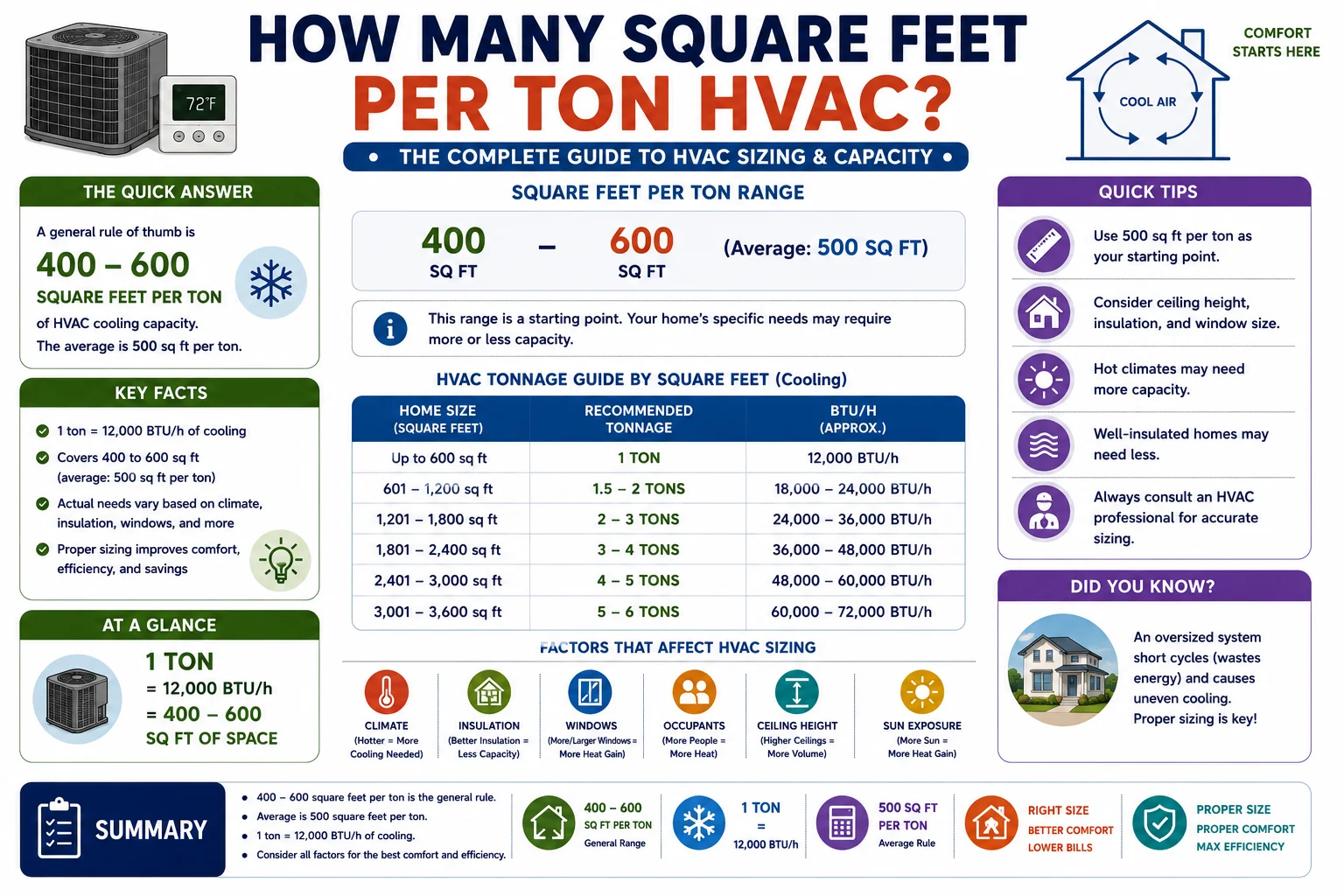
In general, 1 ton of HVAC can cool about 400 to 600 square feet.
However, the exact coverage depends on several factors, including:
- Climate
- Insulation
- Ceiling height
- Sun exposure
- Home layout
Most HVAC professionals use:
500–600 square feet per ton as a rough estimate.
What Does HVAC Tonnage Mean?
Many people think HVAC “tonnage” refers to weight, but it actually measures cooling capacity.
One HVAC Ton Equals
12,000 BTUs per hour
BTU stands for:
British Thermal Unit
It measures how much heat an air conditioner can remove from a home in one hour.
How Many Square Feet Per Ton HVAC (Detailed Explanation)
HVAC systems are sized based on how much space they can cool efficiently.
General HVAC Sizing Rule
| HVAC Size | Approximate Coverage |
|---|---|
| 1 ton | 400–600 sq ft |
| 1.5 ton | 600–900 sq ft |
| 2 ton | 900–1,200 sq ft |
| 3 ton | 1,500–1,800 sq ft |
| 4 ton | 2,000–2,400 sq ft |
| 5 ton | 2,500–3,000 sq ft |
These numbers are estimates, not exact rules.
HVAC Tonnage Chart by Home Size
Here’s a more detailed guide for residential homes.
| Home Size | Recommended HVAC Size |
|---|---|
| 600–900 sq ft | 1.5 ton |
| 900–1,200 sq ft | 2 ton |
| 1,200–1,500 sq ft | 2.5 ton |
| 1,500–1,800 sq ft | 3 ton |
| 1,800–2,100 sq ft | 3.5 ton |
| 2,100–2,400 sq ft | 4 ton |
How to Calculate HVAC Size for Your Home
There are simple ways to estimate HVAC tonnage.
Basic Formula
Square Feet ÷ 500 = Estimated Tons
Example:
2000÷500=4
So, a 2,000-square-foot home may need a 4-ton HVAC system.
BTUs and HVAC Ton Conversion
BTUs and tons are directly connected.
| HVAC Tons | BTUs |
|---|---|
| 1 ton | 12,000 BTUs |
| 2 ton | 24,000 BTUs |
| 3 ton | 36,000 BTUs |
| 4 ton | 48,000 BTUs |
| 5 ton | 60,000 BTUs |
This helps compare HVAC systems more easily.
Factors That Affect HVAC Sizing
Square footage alone is not enough.
Climate Zone
Hot climates require more cooling power.
Ceiling Height
High ceilings increase cooling needs.
Insulation
Well-insulated homes stay cooler longer.
Windows and Sunlight
Large windows increase heat gain.
Number of Occupants
More people generate more heat indoors.
Common HVAC Sizes Explained
1–2 Ton Units
Best for:
- Apartments
- Small homes
- Condos
2.5–3 Ton Units
Best for:
- Medium-sized homes
- Standard family houses
4–5 Ton Units
Best for:
- Large homes
- Open floor plans
- Hot climates
Signs Your HVAC System Is Too Small or Too Large
Improper sizing causes major problems.
HVAC Too Small
Signs include:
- Constant running
- Uneven cooling
- High indoor temperatures
- High energy bills
HVAC Too Large
Signs include:
- Short cycling
- Humidity problems
- Uneven comfort
- Higher operating costs
Energy Efficiency and Proper Sizing
A correctly sized HVAC system improves:
- Comfort
- Energy efficiency
- Air quality
- Equipment lifespan
Oversized or undersized systems wear out faster and cost more to operate.
Common Mistakes When Choosing HVAC Size
Many homeowners make sizing mistakes.
Relying Only on Square Footage
Other factors matter too.
Buying the Biggest Unit
Bigger is not always better.
Ignoring Insulation Quality
Poor insulation changes cooling requirements.
Skipping Professional Load Calculations
Professional HVAC contractors use:
- Manual J calculations
- Heat load analysis
- Airflow testing
for accurate sizing.
Expert Tips for HVAC Sizing
- Get a professional load calculation
- Upgrade insulation before replacing HVAC
- Seal air leaks around windows and doors
- Consider local climate conditions
- Compare energy efficiency ratings
Conclusion
So, how many square feet per ton HVAC?
👉 On average, 1 ton of HVAC can cool about 400 to 600 square feet.
However, proper HVAC sizing depends on much more than square footage alone.
Factors like:
- Climate
- Insulation
- Ceiling height
- Sun exposure
- Home layout
all affect the correct system size.
Choosing the right HVAC unit improves:
- Comfort
- Energy efficiency
- Indoor air quality
- Long-term savings
Before buying a system, it’s always smart to combine square-foot estimates with a professional HVAC calculation.
FAQs
1. How many square feet does a 3-ton HVAC unit cool?
A 3-ton HVAC system typically cools about 1,500 to 1,800 square feet.
2. Is 1 ton of HVAC enough for 1,000 square feet?
Usually not. Most 1,000-square-foot homes need around a 2-ton system.
3. What does HVAC tonnage mean?
HVAC tonnage measures cooling capacity, not weight. One ton equals 12,000 BTUs per hour.
4. Can an HVAC unit be too large?
Yes. Oversized systems can short-cycle, waste energy, and reduce humidity control.
5. How do professionals calculate HVAC size?
HVAC professionals use Manual J load calculations that consider insulation, windows, climate, and home layout.