

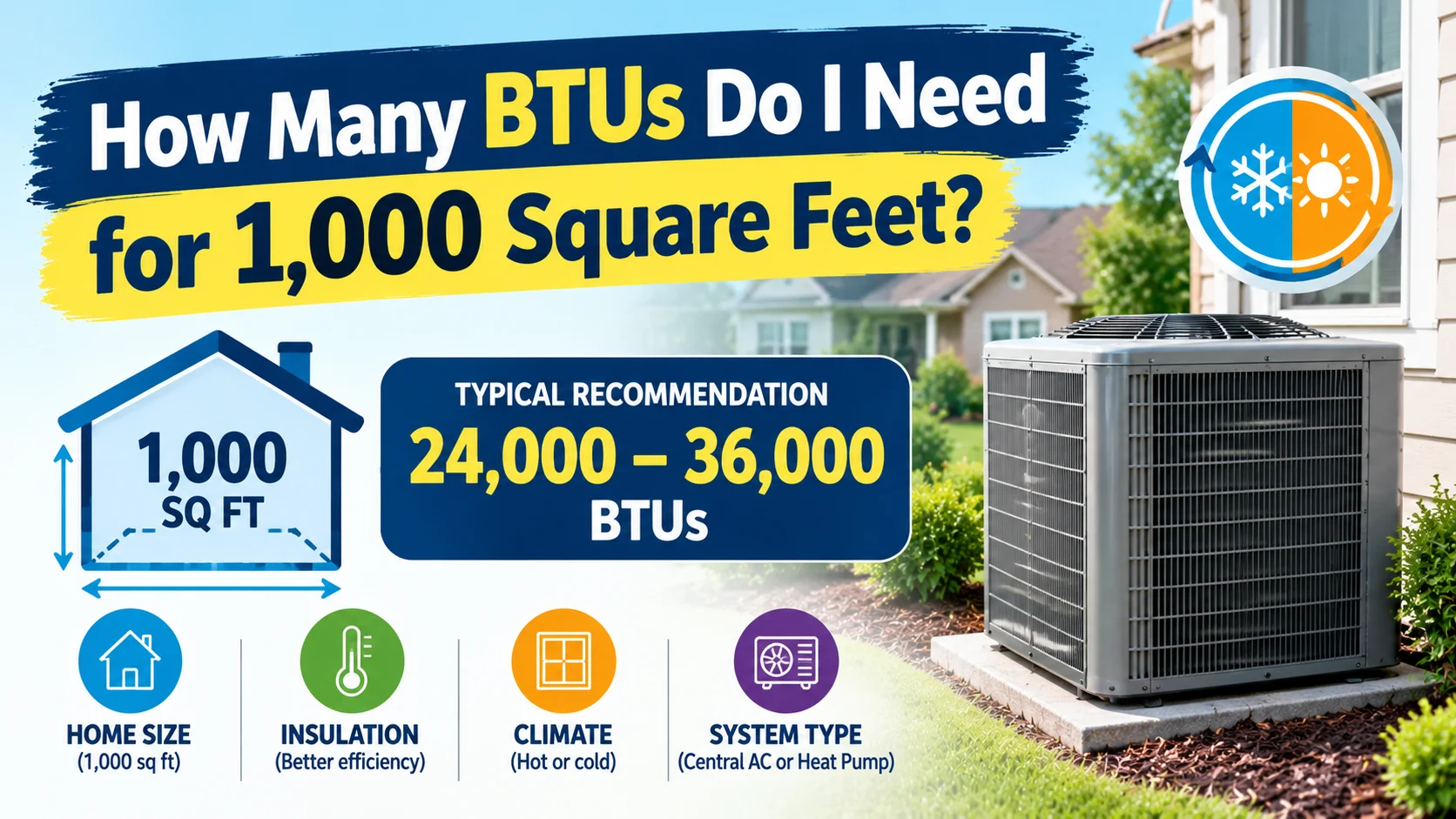
Choosing the right air conditioner for your home starts with understanding how many BTUs you need for 1,000 square feet. An air conditioner that is too small may run continuously without adequately cooling the space, while an oversized unit can cycle on and off too frequently, waste energy, and leave the room feeling humid.
For a typical 1,000-square-foot home, an air conditioner in the range of 18,000 to 24,000 BTUs is often considered a starting point. However, square footage alone is not enough to determine the correct size. Climate, insulation, ceiling height, windows, sunlight, occupancy, and the home’s layout can significantly change the cooling requirement.
A common rule of thumb is around 20 BTUs per square foot, which gives:
1,000 × 20 = 20,000 BTUs
That puts a typical 1,000-square-foot space around 20,000 BTUs, or roughly 1.7 tons of cooling capacity. In real-world installations, a load calculation should be used rather than relying solely on a square-footage rule.
Quick Answer: How Many BTUs Do I Need for 1,000 Square Feet?
For a typical 1,000-square-foot space, a reasonable starting range is approximately:
18,000–24,000 BTUs
A simple rule-of-thumb calculation is:
1,000 sq ft × 20 BTUs = 20,000 BTUs
So, about 20,000 BTUs is a useful starting estimate for average conditions.
| Space Size | Approximate BTU Range* | Approx. AC Size |
|---|---|---|
| 500 sq ft | 9,000–12,000 BTU | 0.75–1 ton |
| 750 sq ft | 13,500–18,000 BTU | 1.1–1.5 tons |
| 1,000 sq ft | 18,000–24,000 BTU | 1.5–2 tons |
| 1,250 sq ft | 22,500–30,000 BTU | 1.9–2.5 tons |
| 1,500 sq ft | 27,000–36,000 BTU | 2.25–3 tons |
| 2,000 sq ft | 36,000–48,000 BTU | 3–4 tons |
*These are rough estimates, not a substitute for a professional cooling-load calculation.
What Does BTU Mean?
BTU stands for British thermal unit. In air conditioning, BTUs describe how much heat an air conditioner can remove from a space over time.
A higher BTU rating generally means greater cooling capacity.
For example:
- 8,000 BTU = smaller cooling capacity
- 12,000 BTU = moderate cooling capacity
- 18,000 BTU = larger cooling capacity
- 24,000 BTU = still larger cooling capacity
- 36,000 BTU = approximately 3 tons
When shopping for an air conditioner, you’ll often see capacity listed in both BTUs and tons.
How Many BTUs Per Square Foot?
A commonly used rough estimate is approximately 18–25 BTUs per square foot, depending on the building and climate.
Using 20 BTUs per square foot:
1,000 × 20 = 20,000 BTUs
However, there is no universal BTU-per-square-foot number that works perfectly for every home.
A well-insulated home in a mild climate could need less cooling than a poorly insulated home in a very hot climate.
Factors such as:
- Climate
- Insulation
- Windows
- Ceiling height
- Sun exposure
- Number of occupants
- Appliances
- Air leakage
- Floor level
- Home orientation
can all affect the required cooling capacity.
BTU Calculation for a 1,000-Square-Foot Home
A basic estimating formula is:
Required BTUs = Square footage × BTUs per square foot
If we use 20 BTUs per square foot:
1,000 × 20 = 20,000 BTUs
Therefore, the basic estimate is:
20,000 BTUs
Because residential air conditioners are sold in standard capacity sizes, you may need to choose the nearest suitable available capacity rather than purchasing a unit rated at exactly 20,000 BTUs.
Is 18,000 BTU Enough for 1,000 Square Feet?
An 18,000-BTU air conditioner may be suitable for a 1,000-square-foot space under favorable conditions.
It can make sense when the home has:
- Good insulation
- Energy-efficient windows
- Moderate outdoor temperatures
- Average ceiling heights
- Limited direct sunlight
- Relatively low air leakage
However, 18,000 BTUs may be insufficient if the property is poorly insulated or located in a very hot climate.
An undersized unit may run for long periods without reaching the desired temperature.
Is 24,000 BTU Enough for 1,000 Square Feet?
A 24,000-BTU air conditioner can provide substantial cooling for a 1,000-square-foot space.
It may be appropriate when the space experiences:
- High outdoor temperatures
- Significant sun exposure
- Poor insulation
- High ceilings
- Many windows
- High occupancy
- Heat-producing appliances
However, bigger is not automatically better.
An oversized air conditioner can cool the air quickly without running long enough to remove sufficient humidity. It may also cycle frequently, which can reduce efficiency and comfort.
The goal is to select a capacity that matches the actual cooling load.
How Many Tons of AC Do I Need for 1,000 Square Feet?
Air-conditioner capacity is also commonly measured in tons.
One ton of air-conditioning capacity equals:
12,000 BTUs per hour
Therefore:
| AC Size | BTU Capacity |
|---|---|
| 0.5 ton | 6,000 BTU |
| 0.75 ton | 9,000 BTU |
| 1 ton | 12,000 BTU |
| 1.5 tons | 18,000 BTU |
| 2 tons | 24,000 BTU |
| 2.5 tons | 30,000 BTU |
| 3 tons | 36,000 BTU |
For 1,000 square feet, a rough estimate often falls between 1.5 and 2 tons, depending on the property’s cooling load.
Using the 20-BTU-per-square-foot estimate:
20,000 ÷ 12,000 = 1.67 tons
So the theoretical requirement is approximately 1.67 tons.
That does not mean you should automatically install a 2-ton unit. A professional load calculation is preferable for a permanent HVAC system.
Factors That Affect BTU Requirements
Square footage is only one part of the equation. Here are some of the most important factors that influence cooling requirements.
1. Climate
Your local climate has a major effect on cooling demand.
A 1,000-square-foot home in a mild climate may require considerably less cooling capacity than a similarly sized home in an extremely hot region.
Hotter outdoor temperatures increase the amount of heat that the air conditioner must remove.
2. Insulation
Good insulation reduces heat transfer through walls, ceilings, and other parts of the building envelope.
Poor insulation allows more outdoor heat to enter the home, increasing the cooling load.
A well-insulated 1,000-square-foot house may therefore need a smaller system than a poorly insulated house of the same size.
3. Windows
Windows can contribute significantly to heat gain.
Large windows, older single-pane windows, and windows exposed to strong sunlight can increase cooling requirements.
Energy-efficient windows and effective shading can reduce heat gain.
4. Ceiling Height
A 1,000-square-foot house with 8-foot ceilings does not contain the same amount of air as one with 12-foot ceilings.
For example:
1,000 × 8 = 8,000 cubic feet
while:
1,000 × 12 = 12,000 cubic feet
Higher ceilings can increase the volume that needs to be conditioned.
5. Sun Exposure
Rooms that receive strong direct sunlight can become significantly warmer.
A home with large west-facing windows may have a higher afternoon cooling load than a similar home with less solar exposure.
6. Number of Occupants
People produce heat.
A house occupied by several people can require more cooling than a similarly sized house with only one or two occupants.
7. Appliances
Ovens, refrigerators, computers, televisions, lighting, and other electrical equipment produce heat.
A kitchen-heavy space or home office can therefore have a higher cooling demand.
8. Air Leakage
Cracks around doors, windows, ducts, and other openings allow conditioned air to escape and outdoor air to enter.
Improving air sealing can reduce the cooling load and improve comfort.
1,000 Square Feet AC Size by Climate
A rough comparison can help illustrate why location matters.
| Conditions | Possible Starting Range |
|---|---|
| Mild climate, excellent insulation | 15,000–18,000 BTU |
| Moderate climate, average insulation | 18,000–21,000 BTU |
| Hot climate, average insulation | 21,000–24,000 BTU |
| Very hot climate or high heat gain | 24,000+ BTU |
These numbers are estimating ranges, not sizing requirements.
A professional HVAC contractor can calculate the actual load using the home’s construction characteristics and local climate data.
How Many BTUs for 1,000 Square Feet With High Ceilings?
High ceilings can increase the amount of air that needs to be conditioned.
Consider two 1,000-square-foot spaces:
8-foot ceiling:
1,000 × 8 = 8,000 cubic feet
12-foot ceiling:
1,000 × 12 = 12,000 cubic feet
The second space contains 50% more air volume.
However, HVAC sizing should not be based on room volume alone. Heat gain through the building envelope, infiltration, windows, insulation, solar exposure, and other factors also matter.
How Many BTUs for a 1,000-Square-Foot Apartment?
A 1,000-square-foot apartment can have different cooling requirements depending on its location within the building.
For example, an interior apartment surrounded by conditioned spaces may have a lower cooling load than a top-floor apartment beneath a hot roof.
A top-floor unit with:
- Poor roof insulation
- Large windows
- Direct sunlight
- High ceilings
may require considerably more cooling capacity.
An apartment on a lower floor with neighboring conditioned units may require less.
How Many BTUs for a 1,000-Square-Foot House?
For an average 1,000-square-foot house, around 18,000–24,000 BTUs is a reasonable starting range for preliminary estimates.
A simple midpoint estimate is:
1,000 × 20 = 20,000 BTUs
But the final equipment size should ideally be based on a proper cooling-load calculation.
This is especially important for a whole-house central air-conditioning system.
Portable and Window AC Sizing for 1,000 Square Feet
Portable and window air conditioners are often used differently from central HVAC systems.
A single small room air conditioner is generally not intended to cool an entire 1,000-square-foot home effectively.
For an open 1,000-square-foot area, a larger-capacity unit may be needed, but room layout, doors, walls, insulation, and airflow can prevent one unit from evenly cooling every space.
If the home contains several bedrooms separated by walls, a single room unit may cool the room where it is installed while leaving other rooms warmer.
For a multi-room home, a properly designed central, ductless, or multi-zone system may provide better temperature distribution.
Why Oversizing an Air Conditioner Can Be a Problem
It may seem logical to buy the biggest air conditioner possible, but oversizing can create problems.
An oversized system may:
- Reach the thermostat setting too quickly
- Cycle on and off frequently
- Remove less humidity
- Create uneven temperatures
- Increase equipment wear
- Reduce comfort
Cooling is not just about lowering temperature. Air conditioners also remove moisture from indoor air.
A correctly sized system generally has better opportunities to operate for longer, consistent cycles and control humidity.
Why an Undersized AC Can Be a Problem
An undersized system can also cause problems.
It may:
- Run continuously on hot days
- Struggle to reach the desired temperature
- Consume more energy
- Experience increased wear
- Provide inadequate cooling during peak conditions
If an air conditioner cannot keep up with the home’s heat gain, lowering the thermostat may not solve the problem.
How to Improve Cooling Without Increasing BTUs
Before automatically choosing a larger air conditioner, consider reducing the amount of heat entering the home.
Useful improvements include:
Improve Insulation
Better attic, wall, and floor insulation can reduce heat transfer.
Seal Air Leaks
Weatherstripping and caulking can reduce unwanted outdoor air infiltration.
Upgrade Windows
Energy-efficient windows can reduce solar and conductive heat gain.
Use Curtains or Blinds
Window coverings can reduce direct solar heating.
Maintain the HVAC System
Dirty filters, blocked airflow, and neglected equipment can reduce cooling performance.
Improve Ductwork
Leaky or poorly insulated ducts can waste conditioned air, particularly when ducts pass through hot attics or other unconditioned spaces.
Example: Calculating BTUs for 1,000 Square Feet
Suppose you have a 1,000-square-foot home with average insulation and moderate climate conditions.
Using a rough estimate of 20 BTUs per square foot:
1,000 × 20 = 20,000 BTUs
The estimated cooling requirement is:
20,000 BTUs per hour
In tons:
20,000 ÷ 12,000 = 1.67 tons
So the preliminary estimate is approximately:
20,000 BTU or 1.67 tons
The final equipment selection should then be based on the home’s actual cooling load and the available equipment sizes.
1,000 Square Feet BTU Chart
Here’s a quick reference:
| Estimated BTU per Sq Ft | BTUs for 1,000 Sq Ft |
|---|---|
| 15 BTU | 15,000 BTU |
| 18 BTU | 18,000 BTU |
| 20 BTU | 20,000 BTU |
| 22 BTU | 22,000 BTU |
| 24 BTU | 24,000 BTU |
| 25 BTU | 25,000 BTU |
| 30 BTU | 30,000 BTU |
This demonstrates why there is no single BTU number that applies to every 1,000-square-foot property.
Common Mistakes When Choosing BTUs
Mistake 1: Using Square Footage Alone
Square footage is useful for an initial estimate, but it does not tell you the complete cooling load.
Mistake 2: Always Choosing the Largest Unit
A larger air conditioner is not necessarily more efficient or comfortable.
Mistake 3: Ignoring Insulation
Two homes with identical floor areas can have very different cooling requirements because of differences in insulation and air leakage.
Mistake 4: Ignoring Windows
Large, sunny windows can substantially increase heat gain.
Mistake 5: Confusing BTU With Electrical Consumption
BTUs describe cooling capacity. They do not directly tell you how many watts of electricity an air conditioner will use.
Actual energy consumption depends on equipment efficiency, operating conditions, runtime, and other factors.
FAQs
How many BTUs do I need for 1,000 square feet?
A typical 1,000-square-foot space may need approximately 18,000–24,000 BTUs, with 20,000 BTUs being a useful rough estimate under average conditions.
Is 12,000 BTU enough for 1,000 square feet?
Usually, 12,000 BTUs is likely too small for a typical 1,000-square-foot home, although actual requirements depend on climate, insulation, windows, ceiling height, and other factors.
Is 18,000 BTU enough for 1,000 square feet?
It can be enough under favorable conditions, particularly with good insulation and moderate climate conditions. A load calculation is the best way to determine whether 18,000 BTUs is adequate.
Is 24,000 BTU too much for 1,000 square feet?
Not necessarily. A 24,000-BTU system may be appropriate for a 1,000-square-foot space with substantial heat gain. However, it can be oversized in a well-insulated home with a low cooling load.
How many tons of AC do I need for 1,000 square feet?
A rough estimate is around 1.5–2 tons, equivalent to approximately 18,000–24,000 BTUs. The correct size depends on the actual cooling load.
How many BTUs per square foot should I use?
For a rough estimate, approximately 18–25 BTUs per square foot can provide a starting range, but this should not replace a proper HVAC load calculation.
Can a 2-ton AC cool 1,000 square feet?
A 2-ton air conditioner provides 24,000 BTUs of nominal cooling capacity. It can cool 1,000 square feet effectively when the home’s cooling load is appropriate for that capacity.
Does a higher BTU AC cool faster?
A higher-capacity air conditioner can remove heat faster under suitable conditions, but installing a substantially oversized system is not automatically better. Proper sizing is important for both temperature control and humidity removal.
Final Answer
So, how many BTUs do I need for 1,000 square feet?
For a typical space, a reasonable preliminary estimate is:
18,000–24,000 BTUs
Using a simple 20-BTU-per-square-foot calculation:
1,000 × 20 = 20,000 BTUs
That equals approximately:
1.67 tons of cooling capacity
A 1.5-ton (18,000-BTU) system may work in favorable conditions, while a 2-ton (24,000-BTU) system may be appropriate when the home has greater heat gain.
However, the ideal size cannot be determined from square footage alone. Climate, insulation, windows, ceiling height, sun exposure, occupancy, air leakage, and building design all affect the actual cooling load.
Conclusion
When determining how many BTUs you need for 1,000 square feet, start with approximately 18,000–24,000 BTUs as a general estimating range. A simple calculation using 20 BTUs per square foot produces 20,000 BTUs, or about 1.67 tons.
For a permanent HVAC installation, however, avoid choosing equipment solely from a square-footage chart. A proper cooling-load calculation provides a much more reliable basis for equipment sizing and can help prevent the comfort and efficiency problems associated with both undersized and oversized air conditioners.



Pingback: How Many Cubic Feet in a 40 Foot Container?