

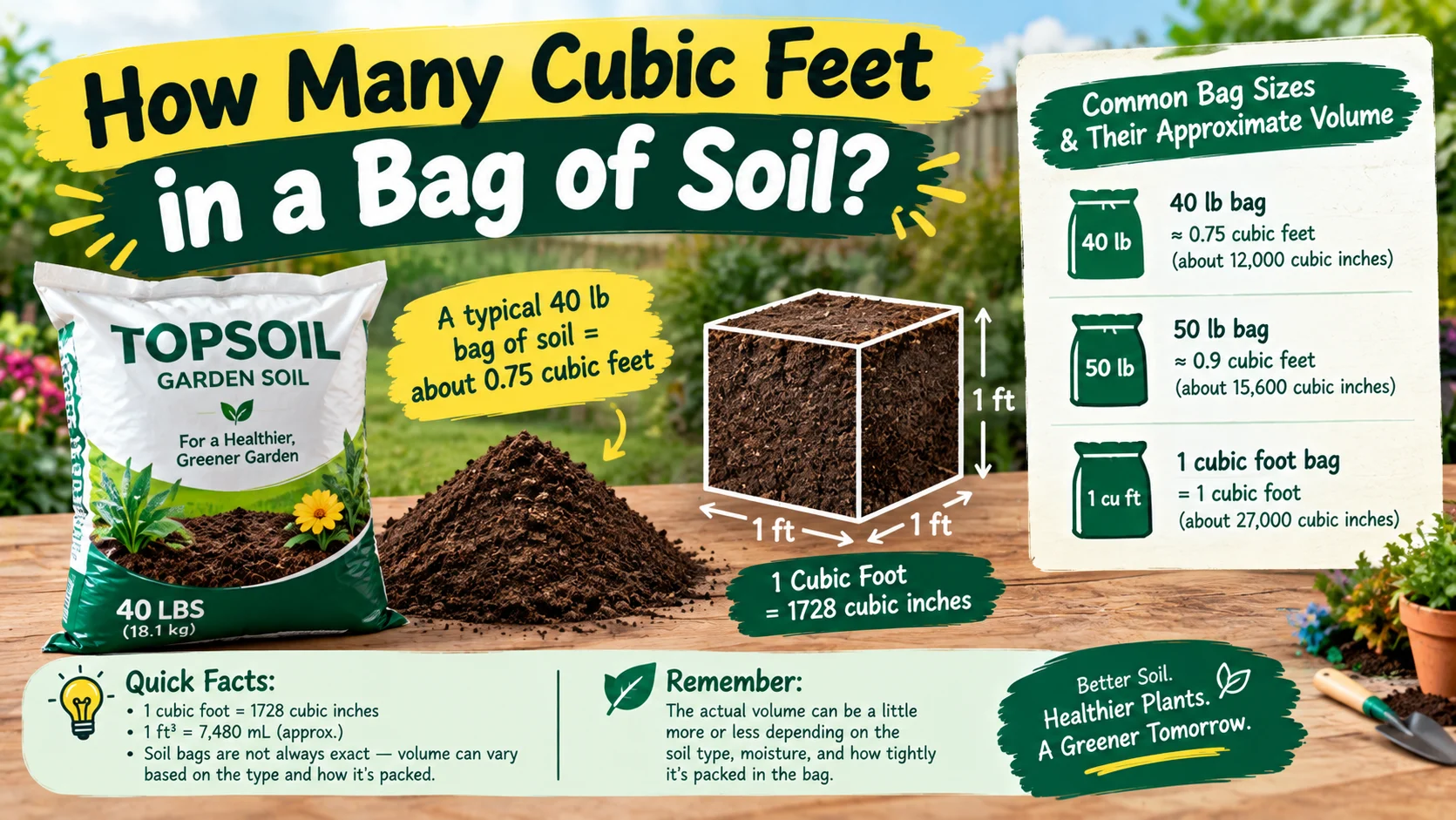
If you’re buying soil for a garden bed, lawn, planter, raised bed, or landscaping project, you may wonder, how many cubic feet are in a bag of soil?
The answer depends on the product. Soil bags are sold in different volumes, and bags sold by weight can contain different amounts of soil depending on moisture, density, and the type of material.
Common bag sizes include 0.75 cubic feet, 1 cubic foot, 1.5 cubic feet, 2 cubic feet, and 3 cubic feet. For example, some 40-pound topsoil bags contain about 0.75 cubic feet, while many garden soils are sold directly in 1.5- or 2-cubic-foot bags.
So, there is no single answer for every bag of soil. The most reliable method is to check the “bag capacity,” “dry volume,” or “cubic feet” printed on the package.
Quick Answer: How Many Cubic Feet Are in a Bag of Soil?
A typical bag of soil can contain anywhere from about 0.75 to 3 cubic feet, although other sizes are also available.
Here are some common sizes:
| Bag Size | Cubic Feet of Soil |
|---|---|
| Small bag | 0.5 cu ft |
| Typical 40-lb topsoil bag | 0.75 cu ft |
| Standard small bag | 1 cu ft |
| Medium bag | 1.5 cu ft |
| Large bag | 2 cu ft |
| Extra-large bag | 3 cu ft |
| Very large bag | 4 cu ft |
For example, Lowe’s lists a Timberline 40-pound topsoil bag at approximately 0.75 cubic feet, while Home Depot carries garden soil products in 1.5-, 2-, 3-, and 4-cubic-foot sizes.
The important point
Do not assume that a 40-pound or 50-pound bag always contains the same number of cubic feet.
Weight and volume are different measurements.
A wet, dense soil can weigh more than a dry, lightweight soil while occupying a similar volume. That’s why manufacturers commonly specify the actual volume on the bag.
What Does “Cubic Feet” Mean for Soil?
A cubic foot is a measurement of volume.
One cubic foot is a space measuring:
1 foot × 1 foot × 1 foot = 1 cubic foot
For soil, cubic feet tell you how much physical space the bag can fill.
For example:
- 1 bag labeled 1 cu ft = 1 cubic foot
- 2 bags labeled 1 cu ft = 2 cubic feet
- 4 bags labeled 0.75 cu ft = 3 cubic feet
- 10 bags labeled 1.5 cu ft = 15 cubic feet
This measurement is especially useful when calculating how much soil you need for a raised garden bed or planting area.
Common Bagged Soil Sizes
Different products come in different sizes. The following table gives a quick comparison.
| Soil Bag Size | Total Volume | Common Use |
|---|---|---|
| 0.5 cu ft | 0.5 cubic feet | Small pots and minor projects |
| 0.75 cu ft | 0.75 cubic feet | Lawn repair and small garden projects |
| 1 cu ft | 1 cubic foot | Garden beds and planters |
| 1.5 cu ft | 1.5 cubic feet | Raised beds and larger planting areas |
| 2 cu ft | 2 cubic feet | Large beds and landscaping |
| 3 cu ft | 3 cubic feet | Larger landscaping projects |
| 4 cu ft | 4 cubic feet | Large-volume gardening projects |
Retailers currently list soil products in several of these sizes. For example, Lowe’s lists products in 0.75, 1, 1.5, and 2 cubic feet, while Home Depot’s garden-soil listings include 1.5-, 2-, 3-, and 4-cubic-foot bags.
How Many Cubic Feet Is a 40-Pound Bag of Soil?
A 40-pound bag of soil does not have one universal cubic-foot volume.
For some common topsoil products, a 40-pound bag is approximately 0.75 cubic feet. Lowe’s product information for Timberline topsoil states that a 40-pound bag typically covers about 0.75 cubic feet.
However, weight-based bags can vary.
The volume depends on:
- Soil type
- Moisture content
- Density
- Organic matter
- Sand content
- Compost content
- Packaging specifications
Therefore, if you’re buying a 40-pound bag, look for its stated cubic-foot capacity rather than converting 40 pounds directly into cubic feet.
Example
If one 40-pound bag contains 0.75 cubic feet:
4 bags × 0.75 cu ft = 3 cubic feet
So four such bags provide approximately 3 cubic feet of soil.
How Many Cubic Feet Is a 50-Pound Bag of Soil?
A 50-pound bag also does not have a fixed cubic-foot volume.
For example, a BACCTO 50-pound potting-soil product is listed as approximately 1.5 cubic feet per bag.
Other 50-pound products may contain a different volume.
This demonstrates why pounds cannot reliably be converted to cubic feet without knowing the particular soil’s density or the manufacturer’s stated volume.
How Many Bags of Soil Equal 1 Cubic Foot?
This depends on the bag size.
| Bag Size | Bags Needed for 1 Cubic Foot |
|---|---|
| 0.5 cu ft | 2 bags |
| 0.75 cu ft | 1.33 bags |
| 1 cu ft | 1 bag |
| 1.5 cu ft | 0.67 bag |
| 2 cu ft | 0.5 bag |
| 3 cu ft | 0.33 bag |
For practical purchasing, you normally round up to a whole bag.
For example, if your project requires 1 cubic foot and the bags contain 0.75 cubic feet:
1 ÷ 0.75 = 1.33 bags
You would need 2 bags.
How to Calculate How Many Bags of Soil You Need
The basic calculation is simple.
Step 1: Calculate the volume of the area
For a rectangular or square garden bed:
Length × Width × Depth = Cubic Feet
Make sure all measurements are in feet.
Step 2: Divide by the bag volume
Total cubic feet needed ÷ cubic feet per bag = Number of bags
Step 3: Round up
You cannot normally purchase a fraction of a bag, so round the result up to the next whole bag.
Example
Suppose your raised bed measures:
- Length = 8 feet
- Width = 4 feet
- Depth = 1 foot
Calculate:
8 × 4 × 1 = 32 cubic feet
If each bag contains 2 cubic feet:
32 ÷ 2 = 16 bags
You would need 16 bags of 2-cubic-foot soil.
What If the Soil Depth Is Measured in Inches?
Many gardening projects specify soil depth in inches rather than feet.
You need to convert inches to feet first.
Common conversions
| Soil Depth | Feet |
|---|---|
| 1 inch | 0.0833 ft |
| 2 inches | 0.1667 ft |
| 3 inches | 0.25 ft |
| 4 inches | 0.3333 ft |
| 6 inches | 0.5 ft |
| 8 inches | 0.6667 ft |
| 12 inches | 1 ft |
| 18 inches | 1.5 ft |
| 24 inches | 2 ft |
Example: 10 × 10 Area at 3 Inches Deep
First convert 3 inches to feet:
3 ÷ 12 = 0.25 feet
Now calculate volume:
10 × 10 × 0.25 = 25 cubic feet
If your bags contain 2 cubic feet each:
25 ÷ 2 = 12.5 bags
You would need 13 bags.
How Much Area Does One Bag of Soil Cover?
Coverage depends on the depth at which you spread the soil.
The formula is:
Coverage area = Bag volume ÷ soil depth
When depth is in inches:
Coverage area = Bag volume × 12 ÷ depth in inches
For example, a 1-cubic-foot bag spread 1 inch deep covers:
1 × 12 ÷ 1 = 12 square feet
A 1-cubic-foot bag therefore covers approximately 12 square feet at a 1-inch depth.
Home Depot similarly gives coverage examples for different bag volumes, although actual coverage can vary by product and application.
Coverage Table
| Bag Size | 1-Inch Depth | 2-Inch Depth | 3-Inch Depth |
|---|---|---|---|
| 0.5 cu ft | 6 sq ft | 3 sq ft | 2 sq ft |
| 0.75 cu ft | 9 sq ft | 4.5 sq ft | 3 sq ft |
| 1 cu ft | 12 sq ft | 6 sq ft | 4 sq ft |
| 1.5 cu ft | 18 sq ft | 9 sq ft | 6 sq ft |
| 2 cu ft | 24 sq ft | 12 sq ft | 8 sq ft |
| 3 cu ft | 36 sq ft | 18 sq ft | 12 sq ft |
| 4 cu ft | 48 sq ft | 24 sq ft | 16 sq ft |
These are mathematical coverage estimates based on the stated bag volume. Actual coverage can differ because soil settles and manufacturers may provide product-specific coverage instructions.
How Many Bags of Soil Do I Need for a 4×4 Raised Bed?
A 4×4 raised bed has an area of:
4 × 4 = 16 square feet
If the bed is 1 foot deep:
4 × 4 × 1 = 16 cubic feet
Using different bag sizes
| Bag Size | Bags Needed for 16 cu ft |
|---|---|
| 0.75 cu ft | 22 bags |
| 1 cu ft | 16 bags |
| 1.5 cu ft | 11 bags |
| 2 cu ft | 8 bags |
| 3 cu ft | 6 bags |
The numbers are rounded up to whole bags.
If the bed is only 6 inches deep, the volume is half:
4 × 4 × 0.5 = 8 cubic feet
So eight 1-cubic-foot bags would be needed, or four 2-cubic-foot bags.
How Many Bags of Soil Do I Need for a 4×8 Raised Bed?
A 4×8 raised bed has:
4 × 8 = 32 square feet
At 1 foot deep:
4 × 8 × 1 = 32 cubic feet
Number of bags
| Bag Size | Bags Needed |
|---|---|
| 0.75 cu ft | 43 bags |
| 1 cu ft | 32 bags |
| 1.5 cu ft | 22 bags |
| 2 cu ft | 16 bags |
| 3 cu ft | 11 bags |
If the bed is 6 inches deep, you need 16 cubic feet instead.
For a 2-cubic-foot bag:
16 ÷ 2 = 8 bags
How Many Bags of Soil Do I Need for a 10×10 Area?
A 10×10 area contains:
10 × 10 = 100 square feet
The amount of soil depends on the depth.
At 1 inch deep
100 × 1/12 = 8.33 cubic feet
At 2 inches deep
100 × 2/12 = 16.67 cubic feet
At 3 inches deep
100 × 3/12 = 25 cubic feet
At 6 inches deep
100 × 6/12 = 50 cubic feet
Bags required
| Depth | Cubic Feet Needed | 1-cu-ft Bags | 1.5-cu-ft Bags | 2-cu-ft Bags |
|---|---|---|---|---|
| 1 inch | 8.33 | 9 | 6 | 5 |
| 2 inches | 16.67 | 17 | 12 | 9 |
| 3 inches | 25 | 25 | 17 | 13 |
| 6 inches | 50 | 50 | 34 | 25 |
| 12 inches | 100 | 100 | 67 | 50 |
This is a useful reference when planning garden beds, lawn topdressing, or other soil projects.
How Many Bags of Soil Are in a Cubic Yard?
One cubic yard contains:
27 cubic feet
The calculation is:
3 ft × 3 ft × 3 ft = 27 cubic feet
Therefore, the number of bags needed depends on the volume of each bag.
Cubic-yard conversion table
| Bag Size | Bags per Cubic Yard |
|---|---|
| 0.5 cu ft | 54 bags |
| 0.75 cu ft | 36 bags |
| 1 cu ft | 27 bags |
| 1.5 cu ft | 18 bags |
| 2 cu ft | 14 bags |
| 3 cu ft | 9 bags |
| 4 cu ft | 7 bags |
The figures are rounded up to whole bags where necessary.
For example, if each bag contains 0.75 cubic feet:
27 ÷ 0.75 = 36 bags
So 36 bags of 0.75-cubic-foot soil equal 27 cubic feet, or approximately one cubic yard.
Cubic Feet vs. Cubic Yards
Large landscaping projects are often measured in cubic yards rather than individual bags.
The conversion is:
1 cubic yard = 27 cubic feet
Therefore:
Cubic feet ÷ 27 = cubic yards
For example, if you need 54 cubic feet:
54 ÷ 27 = 2 cubic yards
Conversely:
2 × 27 = 54 cubic feet
This makes it easier to compare buying bagged soil with ordering bulk soil by the cubic yard.
How Many Cubic Feet Are in 10 Bags of Soil?
Again, the answer depends on bag size.
| Bag Size | 10 Bags Equal |
|---|---|
| 0.5 cu ft | 5 cu ft |
| 0.75 cu ft | 7.5 cu ft |
| 1 cu ft | 10 cu ft |
| 1.5 cu ft | 15 cu ft |
| 2 cu ft | 20 cu ft |
| 3 cu ft | 30 cu ft |
| 4 cu ft | 40 cu ft |
The formula is simply:
Number of bags × cubic feet per bag = total cubic feet
For example:
10 × 1.5 = 15 cubic feet
So ten 1.5-cubic-foot bags contain 15 cubic feet of soil.
How Many Cubic Feet Are in 20 Bags of Soil?
| Bag Size | 20 Bags Equal |
|---|---|
| 0.5 cu ft | 10 cu ft |
| 0.75 cu ft | 15 cu ft |
| 1 cu ft | 20 cu ft |
| 1.5 cu ft | 30 cu ft |
| 2 cu ft | 40 cu ft |
| 3 cu ft | 60 cu ft |
| 4 cu ft | 80 cu ft |
For example, 20 bags of 2-cubic-foot soil provide:
20 × 2 = 40 cubic feet
That equals approximately:
40 ÷ 27 = 1.48 cubic yards
Does Soil Weight Tell You the Cubic Feet?
Not by itself.
This is one of the most common mistakes when purchasing soil.
Suppose two bags both weigh 40 pounds. They may not necessarily contain the same volume of soil.
The reason is density.
A soil containing more sand or moisture can be heavier than a lighter, more organic mixture. Lowe’s notes that the volume of a 40-pound soil bag depends on the particular product, and customer/product information for some 40-pound topsoil products gives approximately 0.75 cubic feet.
Therefore:
40 pounds ≠ a fixed number of cubic feet
and:
50 pounds ≠ a fixed number of cubic feet
Always check the product label.
What Is the Difference Between Soil, Topsoil, Potting Soil, and Garden Soil?
Not every bag labeled “soil” is intended for the same purpose.
Topsoil
Topsoil is commonly used for:
- Filling low spots
- Lawn repair
- Landscaping
- Raising soil levels
- General outdoor projects
Garden soil
Garden soil is formulated for outdoor planting and garden beds. Some products include organic materials or nutrients.
Potting soil
Potting soil is designed for containers and planters. It is generally formulated differently from ordinary topsoil and may contain materials such as peat, compost, bark, perlite, or other components.
Raised-bed soil
Raised-bed products are designed specifically for garden beds and may be blended with topsoil or other materials.
Because different products have different densities and compositions, the cubic-foot label is more useful than the bag weight when calculating volume.
How Much Extra Soil Should You Buy?
When calculating soil for a project, your mathematical requirement may not perfectly match the amount you need to purchase.
Soil can settle after being placed in a bed or container.
For example, suppose your calculation says you need exactly 20 cubic feet.
Depending on the project, you might purchase a small amount more to account for:
- Settling
- Uneven ground
- Spillage
- Measurement differences
- Slight variations in bag fill
A modest extra amount can be useful, particularly for raised beds.
However, don’t automatically buy a large excess. Check the manufacturer’s stated volume and consider how much settling is expected for the particular soil product.
How to Calculate Soil for an Irregular Garden Bed
Not every garden bed is a perfect rectangle.
If the bed has an L-shape, divide it into smaller rectangles.
For example:
Section A: 8 × 4 × 1 = 32 cubic feet
Section B: 4 × 3 × 1 = 12 cubic feet
Total:
32 + 12 = 44 cubic feet
If your soil bags contain 2 cubic feet:
44 ÷ 2 = 22 bags
So you need approximately 22 bags.
For circular beds, use:
Volume = π × radius² × depth
Make sure all dimensions are converted to feet before calculating cubic feet.
Soil Bag Conversion Cheat Sheet
Here is a quick reference you can save:
| Quantity | Equivalent |
|---|---|
| 1 cubic foot | 1 cu ft |
| 1 cubic yard | 27 cu ft |
| 0.75 cu ft | 1 common small soil bag size |
| 1.5 cu ft | 1.5 cubic feet |
| 2 cu ft | 2 cubic feet |
| 3 cu ft | 3 cubic feet |
| 4 cu ft | 4 cubic feet |
Common multiplication examples
5 × 1.5-cu-ft bags = 7.5 cu ft
10 × 1.5-cu-ft bags = 15 cu ft
10 × 2-cu-ft bags = 20 cu ft
20 × 2-cu-ft bags = 40 cu ft
36 × 0.75-cu-ft bags = 27 cu ft = 1 cubic yard
Common Mistakes When Buying Soil
1. Assuming every bag has the same volume
A 40-pound bag can differ from another 40-pound bag.
Always check the product’s stated volume.
2. Confusing pounds with cubic feet
Pounds measure weight.
Cubic feet measure volume.
They are not interchangeable without additional information about density.
3. Forgetting to convert inches to feet
If your garden bed is 6 inches deep, don’t use 6 as the depth in a cubic-foot calculation.
Convert it:
6 ÷ 12 = 0.5 feet
4. Forgetting that a cubic yard contains 27 cubic feet
A cubic yard isn’t 9 cubic feet.
It is:
3 × 3 × 3 = 27 cubic feet
5. Buying based only on bag weight
The weight printed on the bag isn’t the best measurement for calculating how much space the soil will fill.
Look for the volume listed as cubic feet or dry volume.
Frequently Asked Questions
How many cubic feet are in a normal bag of soil?
There is no universal bag size. Common sizes include 0.75, 1, 1.5, 2, and 3 cubic feet. A typical 40-pound topsoil bag may contain about 0.75 cubic feet, while many garden soils are sold in 1.5- or 2-cubic-foot bags.
How many cubic feet is a 40-lb bag of soil?
A common 40-pound topsoil bag contains approximately 0.75 cubic feet, but this varies by product. Check the manufacturer’s stated volume for the exact bag.



Pingback: How Many Feet Is a Story Building? Complete Guide