

If you’re buying a home, planning a new garage, remodeling your property, or simply trying to understand garage dimensions, you may be wondering: how many square feet is a 2-car garage?
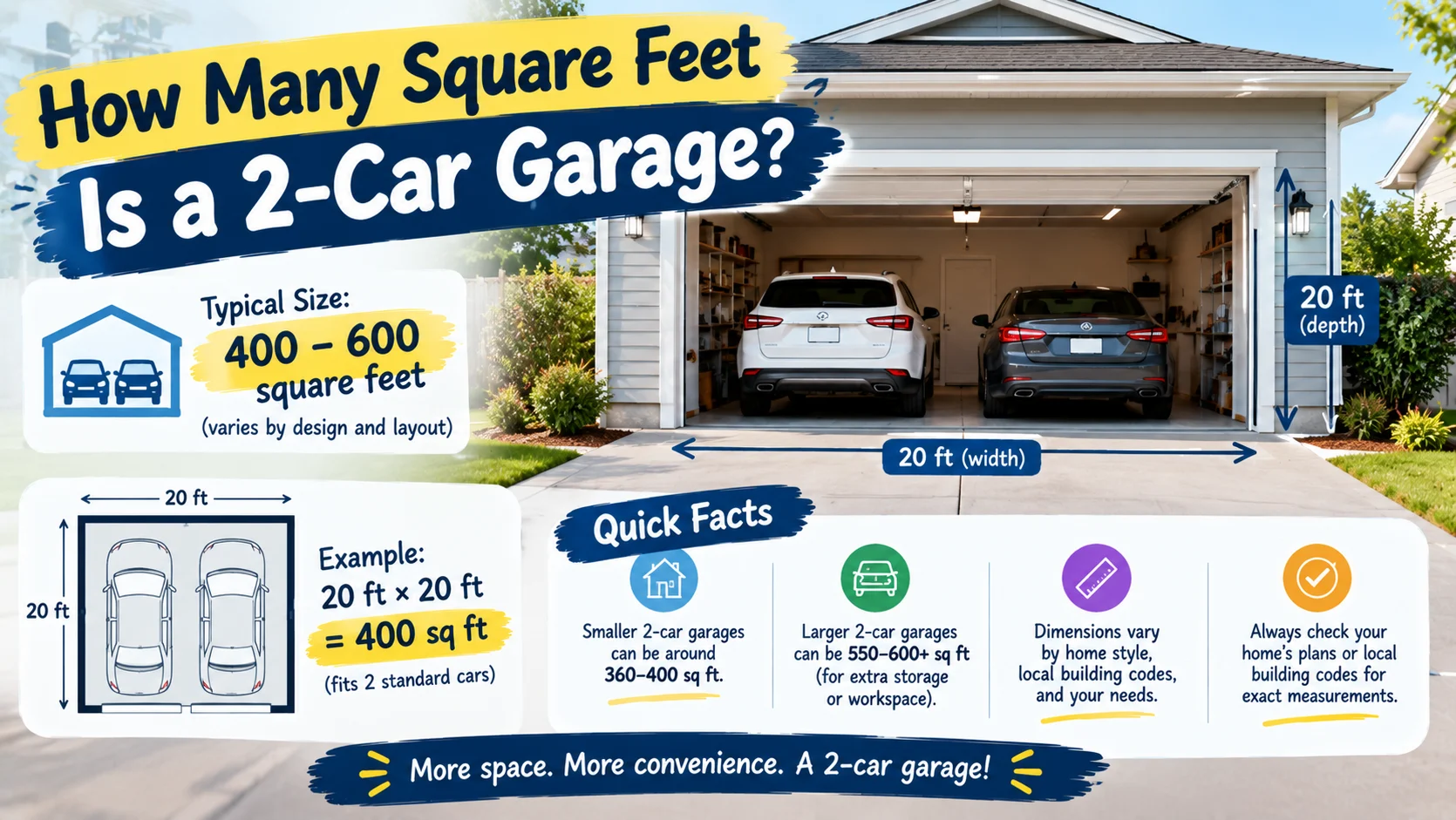
A typical 2-car garage is usually between 400 and 576 square feet, depending on its dimensions. A 20 × 20-foot garage has 400 square feet, while a 24 × 24-foot garage has 576 square feet. Larger two-car garages can provide 600, 700, or even 900 square feet when extra space is added for storage, workshops, or larger vehicles.
The most important thing to remember is that there isn’t one universal size for a two-car garage. The ideal square footage depends on the vehicles you own, available storage, walking space, garage-door configuration, and whether you want to use part of the garage as a workshop or utility area.
How Many Square Feet Is a 2-Car Garage?
A standard 2-car garage commonly provides about 400 to 576 square feet.
The basic calculation is:
Length × Width = Square Feet
For example:
20 × 20 = 400 square feet
and:
24 × 24 = 576 square feet
Common two-car garage dimensions include 20 × 20, 20 × 22, 22 × 22, and 24 × 24 feet. Larger configurations such as 24 × 28 and 24 × 30 feet provide additional room for storage and workspace.
Quick 2-Car Garage Size Chart
| Garage Dimensions | Square Feet | Typical Use |
|---|---|---|
| 18 × 20 ft | 360 sq ft | Compact/tight two-car layout |
| 20 × 20 ft | 400 sq ft | Minimum practical two-car garage |
| 20 × 22 ft | 440 sq ft | Two cars with extra depth |
| 22 × 22 ft | 484 sq ft | Two cars with modest clearance |
| 22 × 24 ft | 528 sq ft | More comfortable parking |
| 24 × 24 ft | 576 sq ft | Common comfortable size |
| 24 × 28 ft | 672 sq ft | Cars plus storage/workspace |
| 24 × 30 ft | 720 sq ft | Large vehicles and workshop |
| 30 × 30 ft | 900 sq ft | Oversized two-car garage |
The exact usable floor area can be somewhat smaller than the advertised dimensions when dimensions are measured from the exterior of the building rather than the finished interior. Walls, insulation, drywall, cabinets, and other permanent features reduce usable space.
What Is the Standard Size of a 2-Car Garage?
There is no single officially required “standard” size that applies to every two-car garage.
In residential construction, 20 × 20 feet is commonly treated as a compact or minimum practical size, while 24 × 24 feet is a common larger configuration that provides more comfortable clearance and storage.
A useful way to think about the sizes is:
- 20 × 20 feet: 400 sq ft
- 20 × 22 feet: 440 sq ft
- 22 × 22 feet: 484 sq ft
- 24 × 24 feet: 576 sq ft
- 24 × 28 feet: 672 sq ft
- 24 × 30 feet: 720 sq ft
The right size depends more on how you intend to use the garage than on the number “2” in “2-car garage.”
Is a 20 × 20 Garage Big Enough for 2 Cars?
A 20 × 20-foot garage has 400 square feet.
It can accommodate two vehicles, but it can feel tight, particularly with larger cars, SUVs, or pickup trucks.
A 20 × 20 layout leaves limited room for:
- Opening vehicle doors
- Walking between vehicles
- Shelving
- Bicycles
- Lawn equipment
- Trash or recycling bins
- Workbenches
- Tool storage
For two compact or midsize vehicles with minimal storage requirements, 400 square feet can work.
However, if you want your garage to function as both a parking area and storage space, adding several feet to the width or depth can make a significant difference.
Some current garage-dimension guides describe 20 × 20 as the smallest practical two-car configuration, while 24 × 24 provides considerably more usable space.
Is a 24 × 24 Garage Big Enough for 2 Cars?
Yes. A 24 × 24-foot garage contains 576 square feet.
Calculation:
24 × 24 = 576 square feet
This size provides 176 more square feet than a 20 × 20 garage.
Comparison:
576 − 400 = 176 square feet
That represents a substantial increase in floor area.
A 24 × 24 garage can provide room for:
- Two cars or SUVs
- Walking space around vehicles
- Wall-mounted storage
- Shelving
- Bicycles
- Tools
- Seasonal items
- A small workbench
For many homeowners, 24 × 24 is a practical size when they want more than simply enough room to park two cars. Several current garage guides identify 24 × 24 as a common or comfortable two-car configuration.
How Do You Calculate the Square Feet of a 2-Car Garage?
Calculating garage square footage is straightforward when the garage is rectangular.
Use:
Square footage = Length × Width
Both measurements should be in feet.
Example 1: 20 × 20 Garage
20 × 20 = 400 sq ft
Example 2: 22 × 22 Garage
22 × 22 = 484 sq ft
Example 3: 24 × 24 Garage
24 × 24 = 576 sq ft
Example 4: 24 × 30 Garage
24 × 30 = 720 sq ft
This formula gives you the floor area of the rectangle. It does not automatically tell you how much unobstructed space remains after walls, cabinets, vehicles, stairs, storage systems, or other features are included.
2-Car Garage Square Footage Comparison
The following table makes it easy to compare common sizes.
| Dimensions | Calculation | Square Feet |
|---|---|---|
| 20 × 20 | 20 × 20 | 400 |
| 20 × 22 | 20 × 22 | 440 |
| 20 × 24 | 20 × 24 | 480 |
| 22 × 22 | 22 × 22 | 484 |
| 22 × 24 | 22 × 24 | 528 |
| 24 × 24 | 24 × 24 | 576 |
| 24 × 26 | 24 × 26 | 624 |
| 24 × 28 | 24 × 28 | 672 |
| 24 × 30 | 24 × 30 | 720 |
| 28 × 28 | 28 × 28 | 784 |
| 30 × 30 | 30 × 30 | 900 |
This shows why asking only “How many square feet is a 2-car garage?” doesn’t have one exact answer.
A two-car garage could have 400 square feet or 700+ square feet, depending on its dimensions and intended use.
What Is the Average 2-Car Garage Size?
Many residential two-car garages fall somewhere around 20 to 24 feet wide and 20 to 24 feet deep, producing roughly 400 to 576 square feet.
A 24 × 24-foot garage provides 576 square feet and is frequently cited as a common comfortable configuration.
However, “average” should not be confused with a mandatory standard.
Garage dimensions vary based on:
- House design
- Lot size
- Local planning requirements
- Vehicle size
- Storage needs
- Construction budget
- Attached versus detached design
- Desired workshop area
If you are planning a new garage, measuring your actual vehicles and storage equipment is more useful than relying on an average number.
How Much Space Does Each Car Need?
A two-car garage needs more than simply the combined footprint of two cars.
You also need space for:
- Doors to open
- People to enter and exit
- Walking around vehicles
- Mirrors
- Garage walls
- Storage
- Equipment
For example, two cars may physically fit into a narrow garage, but that doesn’t mean the garage will be comfortable to use every day.
Width is especially important.
A garage that is only wide enough for the vehicles may leave very little room for opening doors without hitting another vehicle or a wall.
This is one reason a 22- or 24-foot-wide garage can feel considerably different from a 20-foot-wide garage.
How Wide Should a 2-Car Garage Be?
Common two-car garage widths include:
- 20 feet
- 22 feet
- 24 feet
- 28 feet
- 30 feet
A 20-foot width can work for two vehicles but provides limited side clearance.
A 22-foot width gives more breathing room.
A 24-foot width offers significantly more flexibility for two vehicles plus some storage.
If you plan to park two large SUVs or trucks, you should measure the actual vehicles and consider additional clearance rather than assuming a 20-foot garage will be sufficient.
How Deep Should a 2-Car Garage Be?
Depth is just as important as width.
Common depths include:
- 20 feet
- 22 feet
- 24 feet
- 28 feet
- 30 feet
A 20-foot depth can be adequate for smaller vehicles but may leave little space in front of or behind larger vehicles.
A 24-foot depth provides more flexibility.
A 28- or 30-foot depth can create room for:
- Shelving
- Workbenches
- Freezers
- Lawn equipment
- Bicycles
- Storage cabinets
- Tools
- Workshop space
For larger trucks and SUVs, additional depth can be particularly useful.
20 × 20 vs. 24 × 24 Garage
These two sizes are worth comparing because they are frequently discussed when planning a two-car garage.
| Feature | 20 × 20 | 24 × 24 |
|---|---|---|
| Square feet | 400 | 576 |
| Difference | — | +176 sq ft |
| Two cars | Yes | Yes |
| Storage | Limited | Better |
| Walking space | Limited | More comfortable |
| Workshop | Very limited | Possible |
| Large vehicles | Tighter | More flexible |
| Bikes/equipment | Limited | Better |
| Overall footprint | Compact | Larger |
The 24 × 24 garage provides 44% more floor area than a 20 × 20 garage.
Calculation:
176 ÷ 400 × 100 = 44%
That is a meaningful difference for a space that will be used every day.
22 × 22 Garage: How Many Square Feet?
A 22 × 22 garage has:
22 × 22 = 484 square feet
This is 84 square feet larger than a 20 × 20 garage.
Comparison:
484 − 400 = 84 square feet
It can provide a useful middle ground between a compact 20 × 20 garage and a larger 24 × 24 garage.
24 × 28 Garage: How Many Square Feet?
A 24 × 28 garage contains:
24 × 28 = 672 square feet
This is substantially larger than a 24 × 24 garage.
Difference:
672 − 576 = 96 square feet
That extra depth can be useful if you want storage behind the vehicles.
A 24 × 28 layout may work well for two vehicles plus:
- Shelving
- Bicycles
- Lawn equipment
- A workbench
- Tool storage
- Seasonal items
24 × 30 Garage: How Many Square Feet?
A 24 × 30 garage contains:
24 × 30 = 720 square feet
That’s 144 square feet more than a 24 × 24 garage.
Calculation:
720 − 576 = 144 square feet
A garage this size can provide much more flexibility than a basic two-car parking space.
It may accommodate two vehicles while leaving substantial room for a workshop, storage, exercise equipment, or household equipment.
How Many Square Feet Does a 2-Car Garage Need for Storage?
The answer depends on what you plan to store.
Parking only
A compact 20 × 20 garage may be sufficient for two vehicles.
Parking + basic storage
A 22 × 22 or 24 × 24 garage provides more room for shelves and wall storage.
Parking + workshop
A 24 × 28 or 24 × 30 garage can provide substantially more flexibility.
Parking + extensive storage
A 28 × 28 or 30 × 30 garage may be more appropriate if the space is intended to function as a workshop and storage building as well as a garage.
The important point is that two-car capacity doesn’t automatically mean two-car comfort.
How Many Square Feet Is a 2-Car Garage With a Workshop?
There isn’t one fixed size, but adding workshop space generally means increasing the footprint beyond the compact two-car configurations.
For example:
24 × 24
576 square feet
This can potentially accommodate two vehicles and a modest workbench or storage area.
24 × 28
672 square feet
The additional 96 square feet can provide a useful workshop/storage zone.
24 × 30
720 square feet
This provides even more room for tools, equipment, shelving, and workspace.
If the garage will be used primarily as a workshop, you should design around the workbench, equipment, vehicle dimensions, and required walking paths rather than selecting a size based solely on vehicle count.
How Many Square Feet Is a 2-Car Garage With SUVs?
SUVs can require more width and depth than smaller cars.
A 20 × 20 garage may technically accommodate two vehicles but can leave limited clearance.
A 24 × 24 garage provides:
576 square feet
This offers substantially more room for larger vehicles, although the actual suitability depends on the dimensions of the specific SUVs.
Before building, measure:
- Vehicle length
- Vehicle width
- Mirror-to-mirror width
- Door opening requirements
- Front and rear clearance
- Desired storage space
Do not rely on a generic “SUV size” because vehicles vary considerably.
How Many Square Feet Is a 2-Car Garage With Trucks?
Full-size pickup trucks can make a compact garage feel much smaller.
For two trucks, consider not only whether the vehicles fit inside the footprint but also:
- Door clearance
- Bed clearance
- Front clearance
- Side walking space
- Storage requirements
- Garage-door height and width
A larger garage such as 24 × 24, 24 × 28, or 24 × 30 feet may provide more flexibility than a 20 × 20 layout.
The exact dimensions should be based on the vehicles you actually own.
Attached vs. Detached 2-Car Garage Square Footage
An attached and detached garage can have exactly the same square footage.
For example:
24 × 24 = 576 square feet
Whether it is attached to the house or built separately does not change the mathematical floor area.
However, the design considerations can differ.
Attached garage
An attached garage may share walls with the house and often has to work within the overall home footprint.
Detached garage
A detached garage can sometimes be designed with greater flexibility, depending on lot dimensions and applicable local requirements.
Regardless of the design, always distinguish between gross/exterior dimensions and clear interior dimensions when comparing plans.
Does a 2-Car Garage Count Toward the Square Footage of a House?
This can depend on how a property is measured and the standards being used.
A garage is generally treated differently from finished living space in residential real-estate descriptions and appraisal contexts. Therefore, don’t automatically assume that the square footage of a garage is included in a home’s advertised living area.
For a specific property, check the measurement method used by the listing, appraiser, builder, or local authority.
How Many Square Feet Is a 2-Car Garage in Square Meters?
To convert square feet to square meters, use approximately:
1 square foot = 0.092903 square meters
Common garage sizes convert as follows:
| Garage Size | Square Feet | Approx. Square Meters |
|---|---|---|
| 20 × 20 | 400 | 37.16 m² |
| 20 × 22 | 440 | 40.88 m² |
| 22 × 22 | 484 | 44.96 m² |
| 22 × 24 | 528 | 49.05 m² |
| 24 × 24 | 576 | 53.51 m² |
| 24 × 28 | 672 | 62.43 m² |
| 24 × 30 | 720 | 66.89 m² |
| 30 × 30 | 900 | 83.61 m² |
This can be useful when comparing American garage dimensions with plans or properties measured in metric units.
How Much Larger Is a 24 × 24 Garage Than a 20 × 20 Garage?
A 20 × 20 garage has:
400 square feet
A 24 × 24 garage has:
576 square feet
Difference:
576 − 400 = 176 square feet
Percentage increase:
176 ÷ 400 × 100 = 44%
So a 24 × 24 garage has 44% more floor area than a 20 × 20 garage.
This illustrates why adding only a few feet to each dimension can make a garage considerably more functional.
What Size 2-Car Garage Is Best for Storage?
If you want storage along the walls, a larger garage is generally more practical.
A basic guide:
| Garage Size | Storage Potential |
|---|---|
| 20 × 20 | Very limited |
| 20 × 22 | Limited |
| 22 × 22 | Moderate |
| 24 × 24 | Good |
| 24 × 28 | Very good |
| 24 × 30 | Excellent |
| 28 × 28+ | Extensive |
The best choice depends on your property and intended use.
Remember that wall-mounted storage can preserve floor space, while large cabinets, freezers, workbenches, and equipment can quickly reduce the usable parking area.
How to Measure an Existing 2-Car Garage
If you’re trying to determine the square footage of your existing garage, use a tape measure.
Step 1: Measure the length
Measure from one end of the garage to the other.
Step 2: Measure the width
Measure from one side to the opposite side.
Step 3: Multiply
Use:
Length × Width = Square Feet
For example, if the interior measures 23 feet by 23 feet:
23 × 23 = 529 square feet
Step 4: Account for unusual areas
If the garage has an irregular shape, divide it into rectangles and calculate each section separately.
Then add the results.
Common Mistakes When Calculating Garage Square Footage
Mistake 1: Assuming every 2-car garage is 400 square feet
A 20 × 20 garage is 400 square feet, but many two-car garages are larger.
A 24 × 24 garage is 576 square feet.
Mistake 2: Confusing dimensions with square footage
A garage measuring 24 × 24 feet is not “24 square feet.”
Its area is:
24 × 24 = 576 square feet
Mistake 3: Ignoring interior vs. exterior dimensions
A plan may advertise a building footprint using exterior dimensions.
The usable interior area can be smaller after accounting for walls and finishes.
Mistake 4: Measuring only vehicle footprints
Two cars can physically fit in a space that is uncomfortable to use.
Always account for doors, people, storage, and walking space.
Mistake 5: Forgetting storage
If you plan to keep bicycles, lawn equipment, tools, boxes, or shelving in the garage, include those items in your planning.
Mistake 6: Choosing a garage based only on today’s vehicles
If you expect to replace a sedan with a larger SUV or truck later, consider future vehicle dimensions before finalizing the garage.
FAQs
How many square feet is a normal 2-car garage?
A typical two-car garage is often around 400 to 576 square feet, with common dimensions ranging from approximately 20 × 20 to 24 × 24 feet.
Is a 400-square-foot garage big enough for two cars?
Yes, a 20 × 20-foot garage provides 400 square feet and can accommodate two vehicles. However, it may have limited room for comfortable door clearance and storage, especially with larger vehicles.
Is 500 square feet enough for a 2-car garage?
Yes. A garage around 500 square feet can provide two-car parking, although the exact dimensions matter. For example, a 22 × 22 garage provides 484 square feet, while a 22 × 23 garage provides 506 square feet.
Is 576 square feet good for a 2-car garage?
A 24 × 24 garage provides 576 square feet and is a common larger two-car configuration. It offers more flexibility for storage and movement than a 20 × 20 garage.
How many square feet is a 20 × 20 two-car garage?
A 20 × 20 garage is:
20 × 20 = 400 square feet
How many square feet is a 22 × 22 garage?
A 22 × 22 garage is:
22 × 22 = 484 square feet
How many square feet is a 24 × 24 garage?
A 24 × 24 garage is:
24 × 24 = 576 square feet
How many square feet is a 24 × 28 garage?
A 24 × 28 garage is:
24 × 28 = 672 square feet
How many square feet is a 24 × 30 garage?
A 24 × 30 garage is:
24 × 30 = 720 square feet
What is the minimum size for a 2-car garage?
A 20 × 20-foot layout, or 400 square feet, is commonly described as a minimum practical two-car garage size, but there is not one universal minimum that applies to every location or design. Local regulations and the specific building plan should always be checked.
What is the most comfortable size for a 2-car garage?
A 24 × 24-foot garage, providing 576 square feet, is commonly used as a comfortable two-car configuration because it gives more room for vehicles, movement, and storage than a 20 × 20 garage.
How many square feet should a 2-car garage be with storage?
For two vehicles plus meaningful storage, consider approximately 500 to 700+ square feet, depending on the type and amount of storage. A 24 × 24 garage provides 576 square feet, while a 24 × 28 garage provides 672 square feet.
Can a 2-car garage be 30 × 30 feet?
Yes. A 30 × 30 garage contains:
30 × 30 = 900 square feet
That is considerably larger than a basic two-car garage and may provide room for extensive storage or workshop space.
Final Answer: How Many Square Feet Is a 2-Car Garage?
A typical 2-car garage is approximately 400 to 576 square feet, although larger garages can provide 600, 700, or even 900 square feet.
The most useful examples are:
- 20 × 20 feet = 400 sq ft
- 20 × 22 feet = 440 sq ft
- 22 × 22 feet = 484 sq ft
- 22 × 24 feet = 528 sq ft
- 24 × 24 feet = 576 sq ft
- 24 × 28 feet = 672 sq ft
- 24 × 30 feet = 720 sq ft
- 30 × 30 feet = 900 sq ft
For a basic two-car parking area, 400 square feet may work. If you want easier vehicle access, storage, bicycles, tools, or a workbench, a larger footprint such as 24 × 24 feet or more provides substantially more flexibility. Current garage guides commonly identify 20 × 20 as a compact/minimum practical size and 24 × 24 as a more comfortable configuration.
The simplest formula is:
Length × Width = Square Feet
So, if you’re wondering how many square feet your own two-car garage has, measure its length and width in feet and multiply the two numbers.



Pingback: How Many Cubic Feet in a Bag of Soil? Complete Guide