

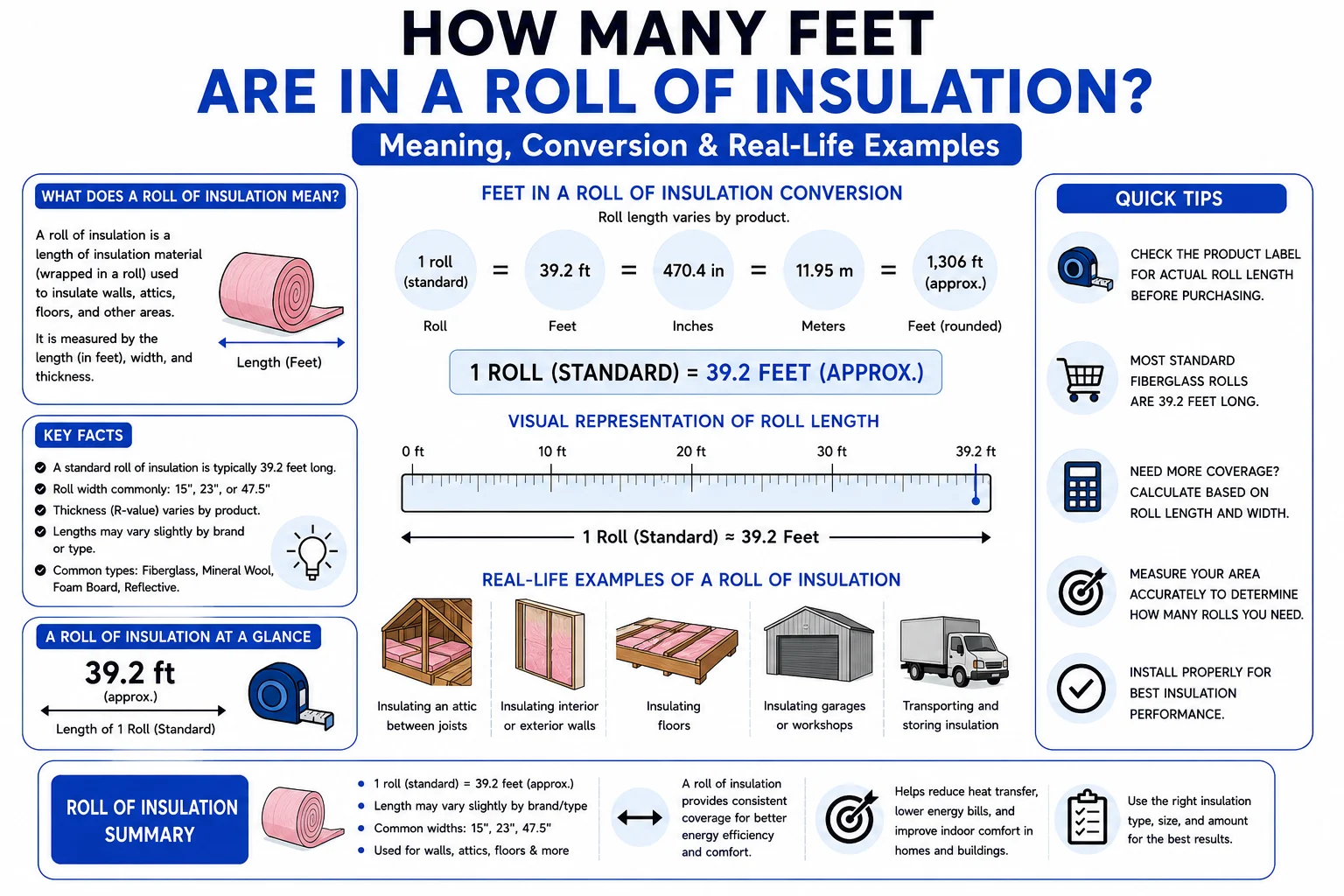
If you’re wondering how many feet are in a roll of insulation, the answer depends on the type, width, thickness, and R-value of the insulation.
Most residential insulation rolls contain between 25 and 50 linear feet, while some specialty rolls can exceed 70 feet.
Here’s a quick reference:
| Insulation Type | Typical Roll Length |
|---|---|
| R-13 Wall Insulation | 32–40 Feet |
| R-19 Floor Insulation | 39–50 Feet |
| R-30 Attic Insulation | 25–35 Feet |
| R-38 Attic Insulation | 20–30 Feet |
| Faced Fiberglass Rolls | 25–50 Feet |
| Unfaced Fiberglass Rolls | 30–70 Feet |
The exact number of feet in a roll varies by manufacturer and product specifications, so checking the package label is always recommended.
Why People Ask How Many Feet Are in a Roll of Insulation
Most homeowners ask this question because they are trying to estimate:
- How many rolls they need
- Total project costs
- Coverage area
- Material waste
- Energy-efficiency upgrades
Unlike flooring or drywall, insulation is sold in rolls with different widths and lengths. Understanding roll dimensions helps prevent overbuying or running short during installation.
Understanding Insulation Roll Measurements
Before calculating insulation requirements, it’s important to understand how insulation is measured.
Linear Feet
Linear feet measure the length of the insulation roll.
For example:
- A roll that is 40 feet long contains 40 linear feet of insulation.
Square Feet
Square footage measures total coverage.
Example:
- 40-foot roll
- 15-inch width
Coverage:
40 × 1.25 = 50 square feet
This is why insulation packages often display square-foot coverage more prominently than roll length.
Common Insulation Roll Sizes
Although dimensions vary, most fiberglass insulation rolls fall within standard ranges.
Wall Insulation Rolls
Wall insulation is usually designed to fit standard stud spacing.
Typical specifications:
| Width | Length |
|---|---|
| 15 Inches | 39.2 Feet |
| 15 Inches | 40 Feet |
| 23 Inches | 32 Feet |
These rolls generally provide between 49 and 61 square feet of coverage.
Floor Insulation Rolls
Floor insulation often comes in longer lengths.
Typical range:
- 39 feet
- 40 feet
- 48 feet
- 50 feet
Coverage ranges from 60 to 100 square feet.
Attic Insulation Rolls
Attic insulation typically has higher R-values and greater thickness.
Because the insulation is thicker, roll lengths are usually shorter.
Common lengths include:
- 20 feet
- 25 feet
- 30 feet
- 35 feet
How R-Value Affects Roll Length
One of the biggest factors affecting insulation roll length is the R-value.
R-value measures resistance to heat flow.
Higher R-values mean:
- Greater thickness
- Better thermal performance
- Shorter roll lengths
Example
| R-Value | Typical Roll Length |
|---|---|
| R-13 | 40–50 Feet |
| R-19 | 35–50 Feet |
| R-30 | 25–35 Feet |
| R-38 | 20–30 Feet |
| R-49 | 18–25 Feet |
This is why two rolls may have the same coverage area but different lengths.
How to Calculate Insulation Coverage
Knowing the length of a roll is helpful, but square-foot coverage matters more.
Use this formula:
Coverage = Length × Width
Example
A roll is:
- 40 feet long
- 15 inches wide
Convert width:
15 ÷ 12 = 1.25 feet
Coverage:
40 × 1.25 = 50 square feet
This roll covers approximately 50 square feet.
How Many Rolls of Insulation Do You Need?
Once you know your wall, attic, or floor area, calculating roll requirements becomes simple.
Example 1: Garage Wall
Wall dimensions:
- 20 feet wide
- 8 feet high
Area:
20 × 8 = 160 square feet
If each roll covers 50 square feet:
160 ÷ 50 = 3.2
You’ll need 4 rolls.
Example 2: Attic
Attic area:
1,200 square feet
Roll coverage:
80 square feet
Calculation:
1,200 ÷ 80 = 15
You’ll need approximately 15 rolls.
Fiberglass vs Mineral Wool Roll Sizes
Different insulation materials are packaged differently.
Fiberglass Rolls
Most common option.
Advantages:
- Affordable
- Widely available
- Lightweight
Typical lengths:
25–50 feet
Mineral Wool Rolls
Less common but excellent for fire resistance.
Advantages:
- Better soundproofing
- Moisture resistance
- Higher density
Typical lengths:
20–40 feet
Benefits of Roll Insulation
Many homeowners prefer roll insulation for larger projects.
Faster Installation
Long continuous sections reduce cutting time.
Less Waste
Custom lengths create fewer offcuts.
Better Coverage
Fewer seams can improve energy efficiency.
Lower Labor Costs
Large areas can be insulated more quickly.
Ideal for Open Spaces
Rolls work especially well in:
- Attics
- Floors
- Basements
- Crawl spaces
Common Mistakes When Buying Insulation Rolls
Avoid these common errors.
Focusing Only on Roll Length
A 50-foot roll is not necessarily better than a 30-foot roll.
Coverage depends on both length and width.
Ignoring R-Value Requirements
Local building codes often specify minimum insulation levels.
Forgetting Waste Allowance
Add 5–10% extra material for trimming and obstacles.
Buying the Wrong Width
Most residential framing uses:
- 16-inch centers
- 24-inch centers
Choose insulation designed for your framing layout.
Assuming All Rolls Are the Same
Manufacturers package insulation differently.
Always compare:
- Length
- Width
- Coverage
- R-value
Expert Tips for Choosing the Right Insulation Roll
To get the best results:
- Measure all spaces carefully.
- Check local insulation code requirements.
- Compare square-foot coverage rather than roll length alone.
- Buy slightly more than calculated.
- Choose the proper R-value for your climate zone.
- Use faced insulation where vapor barriers are required.
- Consider professional installation for large attic projects.
Conclusion
So, how many feet are in a roll of insulation? Most insulation rolls contain between 25 and 50 linear feet, although some products may be shorter or longer depending on the insulation type, width, thickness, and R-value.
When purchasing insulation, don’t focus solely on roll length. Instead, compare total square-foot coverage, insulation thickness, and energy-efficiency ratings. Understanding these factors will help you choose the right product, estimate materials accurately, and improve your home’s comfort while reducing energy costs.
Frequently Asked Questions
How many linear feet are in a standard roll of insulation?
Most residential insulation rolls contain between 25 and 50 linear feet, though specialty products may vary.
How much area does a roll of insulation cover?
Coverage typically ranges from 40 to 100 square feet depending on the roll width and length.
Does a higher R-value mean a shorter insulation roll?
Yes. Higher R-value insulation is thicker, so manufacturers generally package fewer linear feet per roll.
What is the most common insulation roll size?
A common fiberglass insulation roll measures approximately 15 inches wide and 39 to 40 feet long.
Should I calculate insulation by linear feet or square feet?
Square footage is usually the best measurement because it reflects the actual coverage area of the insulation.
Discover More
Within How Many Feet of an Oncoming Vehicle?
How Many Feet Is 14 Stories?
How Many Sq Feet Does a Pallet of Sod Cover?