

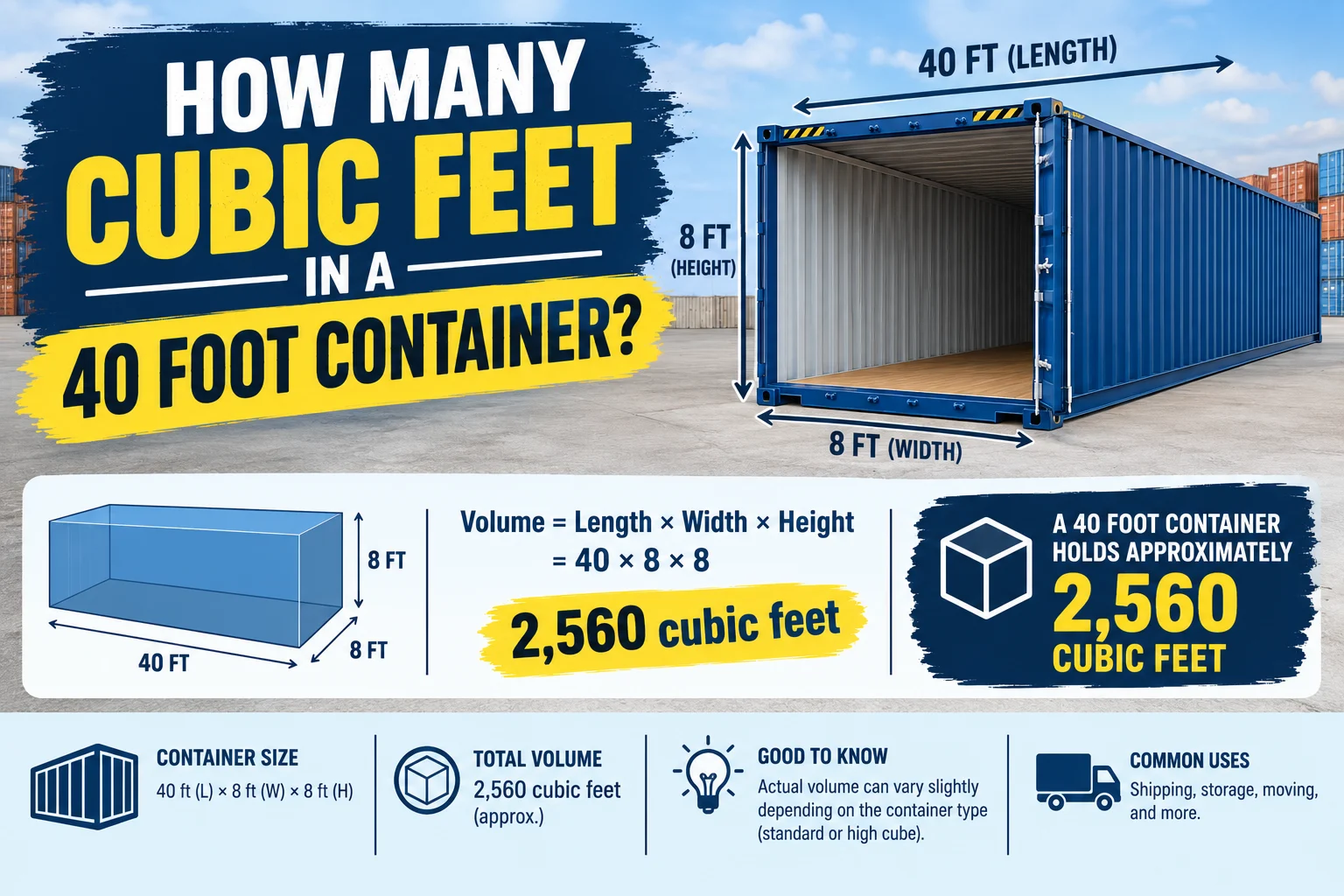
If you are planning to ship, store, or convert a shipping container into a workspace or living space, knowing its cubic capacity is important. A 40-foot shipping container provides significantly more storage space than a 20-foot container, but its exact cubic-foot capacity depends on the container type and its interior dimensions.
So, how many cubic feet are in a 40-foot container?
A standard 40-foot shipping container has an internal capacity of approximately 2,350 to 2,400 cubic feet. A typical standard 40-foot container has an internal volume of about 2,385 cubic feet, while a 40-foot high-cube container generally provides around 2,700 cubic feet of internal space.
The exact capacity can vary slightly between manufacturers and container models.
Quick Answer: How Many Cubic Feet in a 40 Foot Container?
A standard 40-foot container typically contains approximately:
2,350–2,400 cubic feet of usable interior volume.
For a common example, if the interior dimensions are approximately:
- Length: 39.5 feet
- Width: 7.7 feet
- Height: 7.8 feet
The calculation is:
39.5 × 7.7 × 7.8 ≈ 2,372 cubic feet
This is why you will commonly see a standard 40-foot container listed at roughly 2,350–2,400 cubic feet.
A 40-foot high-cube container is taller and usually provides approximately 2,700 cubic feet of interior volume.
What Does Cubic Feet Mean?
Cubic feet is a measurement of volume. It describes how much three-dimensional space an object or container holds.
One cubic foot is a space measuring:
1 foot × 1 foot × 1 foot
For a shipping container, cubic footage is calculated by multiplying its interior:
Length × Width × Height
For example:
39.5 ft × 7.7 ft × 7.8 ft = approximately 2,372 cubic feet
It is important to distinguish cubic feet from square feet.
- Square feet (sq ft) measures floor or surface area.
- Cubic feet (cu ft) measures total three-dimensional volume.
A 40-foot container may have roughly 300 square feet of interior floor area but more than 2,300 cubic feet of interior volume because the space also has substantial height.
Standard 40-Foot Shipping Container Dimensions
A typical standard 40-foot container has approximate exterior dimensions of:
| Dimension | Approximate Measurement |
|---|---|
| Exterior length | 40 ft |
| Exterior width | 8 ft |
| Exterior height | 8 ft 6 in |
| Interior length | 39–39.5 ft |
| Interior width | 7.7–7.8 ft |
| Interior height | 7.8–7.9 ft |
| Interior volume | About 2,350–2,400 cu ft |
Dimensions can vary slightly depending on the manufacturer, container series, age, and construction.
The 40-foot designation refers to the nominal exterior length, not the exact usable interior length.
The walls, doors, roof, flooring, and structural components take up some of the space, so the interior dimensions are smaller.
How to Calculate the Cubic Feet of a 40-Foot Container
The basic formula is simple:
Cubic Feet = Interior Length × Interior Width × Interior Height
Suppose your container has these interior dimensions:
- Length = 39.5 ft
- Width = 7.7 ft
- Height = 7.8 ft
Multiply them:
39.5 × 7.7 × 7.8 = 2,372.13 cubic feet
Therefore, the container holds approximately:
2,372 cubic feet
This calculation gives the container’s approximate geometric interior volume. The amount of cargo you can actually load may be less because of packaging, irregular shapes, pallets, doors, and required clearance.
40-Foot Standard vs. 40-Foot High-Cube Container
One of the most important distinctions when comparing containers is the difference between a standard-height 40-foot container and a 40-foot high-cube container.
Both are approximately 40 feet long and 8 feet wide, but the high-cube version is taller.
| Feature | 40-Foot Standard | 40-Foot High Cube |
|---|---|---|
| Nominal length | 40 ft | 40 ft |
| Exterior width | 8 ft | 8 ft |
| Exterior height | 8 ft 6 in | 9 ft 6 in |
| Interior height | About 7 ft 9 in | About 8 ft 9 in |
| Approx. interior volume | 2,350–2,400 cu ft | About 2,700 cu ft |
| Extra vertical space | Standard | Approximately 1 ft more |
The additional height can make a major difference when storing tall items or maximizing cargo volume.
How Many Cubic Feet Are in a 40-Foot High-Cube Container?
A 40-foot high-cube container generally provides approximately 2,700 cubic feet of interior volume.
For example, using approximate interior dimensions of:
- Length: 39.5 ft
- Width: 7.7 ft
- Height: 8.8 ft
The calculation is:
39.5 × 7.7 × 8.8 ≈ 2,677 cubic feet
Depending on the exact dimensions, manufacturers commonly list high-cube capacity at roughly 2,650–2,700+ cubic feet.
The extra cubic footage comes primarily from the additional interior height.
How Many Square Feet Is a 40-Foot Container?
A standard 40-foot container has approximately 300–305 square feet of interior floor space, depending on its exact interior dimensions.
For example:
39.5 × 7.7 ≈ 304.15 square feet
So you can think of a typical 40-foot container as having approximately:
304 square feet of interior floor area
Its exterior footprint is approximately:
40 × 8 = 320 square feet
This distinction matters when planning container placement, flooring, insulation, or a container conversion.
How Many Cubic Yards Are in a 40-Foot Container?
If you want to convert cubic feet into cubic yards, remember:
1 cubic yard = 27 cubic feet
Therefore:
Cubic yards = Cubic feet ÷ 27
For a container with approximately 2,372 cubic feet:
2,372 ÷ 27 ≈ 87.85 cubic yards
So a standard 40-foot container has roughly:
88 cubic yards of internal volume
A high-cube container with approximately 2,700 cubic feet would have:
2,700 ÷ 27 = 100 cubic yards
Therefore, a 40-foot high-cube container provides roughly 100 cubic yards of interior volume.
How Many Cubic Feet Are in a 20-Foot Container vs. 40-Foot Container?
A 40-foot container is approximately twice as long as a 20-foot container, so it provides roughly twice the floor area and substantially more total internal volume.
| Container | Approx. Interior Volume |
|---|---|
| 20-foot standard | 1,170–1,175 cu ft |
| 40-foot standard | 2,350–2,400 cu ft |
| 40-foot high cube | About 2,650–2,700+ cu ft |
The 40-foot standard container generally provides about twice the cubic capacity of a 20-foot standard container.
However, two 20-foot containers can sometimes be more convenient than one 40-foot container depending on access, site layout, and cargo requirements.
How Much Can a 40-Foot Container Hold?
Cubic footage tells you how much physical volume is available, but it does not tell you the maximum weight you can load.
A 40-foot container can hold a large quantity of:
- Furniture
- Boxes
- Household belongings
- Appliances
- Commercial inventory
- Building materials
- Machinery
- Retail products
- Palletized goods
- Industrial equipment
For example, when moving a household, a 40-foot container can provide considerable room for furniture, boxes, appliances, and other possessions.
However, cargo should never be loaded based solely on available cubic feet.
Weight limits are equally important.
A dense material may reach the container’s allowable payload weight long before the available volume is filled.
Cubic Capacity vs. Actual Usable Space
The calculated cubic capacity represents the theoretical interior volume.
You may not be able to use every cubic foot.
Several factors reduce practical loading efficiency.
1. Cargo Shape
Large or irregular objects can leave empty spaces.
2. Packaging
Boxes, protective materials, pallets, and shipping crates occupy additional space.
3. Doors and Access
Cargo must fit through the container doors.
An item may theoretically fit inside the container but still be impossible to load if it cannot pass through the door opening.
4. Weight Distribution
Heavy cargo should be distributed appropriately rather than concentrated in one location.
5. Required Clearance
You may need space around equipment, doors, ventilation areas, or other components.
For this reason, the theoretical volume should not be treated as the exact amount of cargo you can pack.
How Many Boxes Fit in a 40-Foot Container?
There is no single answer because box dimensions vary.
For example, suppose you have boxes measuring:
2 ft × 2 ft × 2 ft
Each box occupies:
2 × 2 × 2 = 8 cubic feet
If a container has approximately 2,372 cubic feet:
2,372 ÷ 8 ≈ 296 boxes
The mathematical result is approximately 296 boxes.
However, you would not necessarily be able to load 296 boxes because real-world packing creates gaps and requires consideration of doors, stacking, packaging, and weight.
A more accurate estimate requires the exact box dimensions and packing arrangement.
How Many Pallets Fit in a 40-Foot Container?
The number of pallets that fit depends on:
- Pallet dimensions
- Pallet height
- Cargo weight
- Loading pattern
- Container type
- Whether pallets can be double-stacked
A common standard pallet is approximately 48 × 40 inches, but pallet sizes vary around the world.
A 40-foot container can generally accommodate a substantial number of standard pallets, but the exact count depends on the pallet configuration and cargo height.
When planning a commercial shipment, calculate both floor-space utilization and maximum payload weight.
40-Foot Container Volume in Other Units
Understanding the same capacity in several units can make planning easier.
For a representative standard 40-foot container of approximately 2,372 cubic feet:
| Measurement | Approximate Capacity |
|---|---|
| Cubic feet | 2,372 cu ft |
| Cubic yards | 87.9 yd³ |
| Cubic meters | 67.2 m³ |
| Interior floor area | 304 sq ft |
The cubic-meter figure is particularly useful in international shipping because container capacities are often specified in cubic meters.
What Is the Difference Between Container Volume and Floor Area?
This is a common source of confusion.
Floor area measures the amount of space on the floor.
Volume measures the entire three-dimensional space.
For example, a 40-foot container might have:
Approximately 304 square feet of floor area
but:
Approximately 2,372 cubic feet of interior volume
The difference exists because the container has vertical space.
If you are buying flooring, calculate square footage.
If you are estimating storage capacity, shipping volume, or cargo space, cubic footage is more useful.
How to Estimate Storage Space in a 40-Foot Container
If you’re using a 40-foot container for storage, begin with its approximate interior volume.
For example:
Approximately 2,372 cubic feet
Then estimate how much space your belongings require.
If you have 100 storage boxes measuring 2 × 2 × 2 feet:
100 × 8 = 800 cubic feet
That leaves a theoretical:
2,372 − 800 = 1,572 cubic feet
However, this does not mean you will have exactly 1,572 cubic feet of usable empty space. Shelving, walkways, irregular objects, and packing gaps can reduce the practical capacity.
Why Container Dimensions Matter
When purchasing or renting a container, don’t rely only on the phrase “40-foot container.”
Ask for the actual dimensions.
Two containers with the same nominal length can have slightly different:
- Interior length
- Interior width
- Interior height
- Door dimensions
- Cubic capacity
- Maximum payload
This is especially important when your cargo has a specific size.
For example, if you’re storing machinery, vehicles, furniture, or tall equipment, the door opening and interior height may be more important than the advertised cubic footage.
Common Mistakes When Calculating 40-Foot Container Capacity
Mistake 1: Using exterior dimensions
Using 40 × 8 × 8.5 gives an approximate exterior volume rather than actual internal cargo capacity.
Mistake 2: Confusing square feet with cubic feet
Square feet measure area. Cubic feet measure volume.
Mistake 3: Ignoring container type
A standard container and high-cube container have different interior heights.
Mistake 4: Assuming every inch is usable
Walls, doors, structural features, cargo gaps, and packing requirements reduce practical capacity.
Mistake 5: Ignoring weight
A container can run out of allowable payload before it runs out of physical space.
Mistake 6: Forgetting the door opening
Large cargo must fit through the container doors, not merely fit within the interior dimensions.
Quick 40-Foot Container Conversion Table
| Question | Approximate Answer |
|---|---|
| 40-ft container exterior footprint | 320 sq ft |
| 40-ft container interior floor area | ~300–305 sq ft |
| 40-ft standard container volume | ~2,350–2,400 cu ft |
| 40-ft high-cube volume | ~2,650–2,700+ cu ft |
| Standard 40-ft volume in cubic yards | ~88 yd³ |
| High-cube volume in cubic yards | ~100 yd³ |
| Standard 40-ft volume in cubic meters | ~67 m³ |
| 1 cubic yard | 27 cu ft |
| 1 cubic meter | 35.315 cu ft |
FAQs
How many cubic feet are in a 40 foot container?
A standard 40-foot shipping container generally contains approximately 2,350 to 2,400 cubic feet of internal volume. A typical example is around 2,370 cubic feet.
How many cubic feet are in a 40-foot high cube?
A 40-foot high-cube container generally provides approximately 2,650 to 2,700+ cubic feet of interior volume, depending on the exact container dimensions.
Is a 40-foot container 320 cubic feet?
No. 320 is approximately the exterior square footage, calculated from 40 ft × 8 ft. The cubic volume is much larger because the container also has height.
How many cubic yards are in a 40-foot container?
A standard 40-foot container with approximately 2,372 cubic feet of capacity contains about 87.9 cubic yards of volume because 2,372 ÷ 27 ≈ 87.9.
How many square feet is the inside of a 40-foot container?
A typical 40-foot container has approximately 300–305 square feet of interior floor area, depending on its exact dimensions.
Is a 40-foot container twice the size of a 20-foot container?
In general, a standard 40-foot container provides roughly twice the internal volume of a standard 20-foot container. Exact capacities vary by container design.
Can I use the advertised cubic feet as usable storage space?
Not exactly. Advertised cubic footage is the geometric interior volume. Actual usable storage depends on packing efficiency, cargo shape, door access, weight limits, and the container’s internal features.
Final Answer: How Many Cubic Feet in a 40 Foot Container?
So, how many cubic feet are in a 40 foot container?
A typical standard 40-foot shipping container holds approximately 2,350–2,400 cubic feet of interior volume. Using representative interior dimensions of 39.5 × 7.7 × 7.8 feet gives approximately 2,372 cubic feet.
A 40-foot high-cube container is taller and generally provides around 2,650–2,700+ cubic feet of interior capacity.
Remember that the exact capacity depends on the container’s manufacturer, model, and dimensions. For storage or shipping calculations, always use the actual interior dimensions of the specific container rather than relying only on its nominal 40-foot length.


Pingback: How Many Feet Are in a Yard of Concrete?