

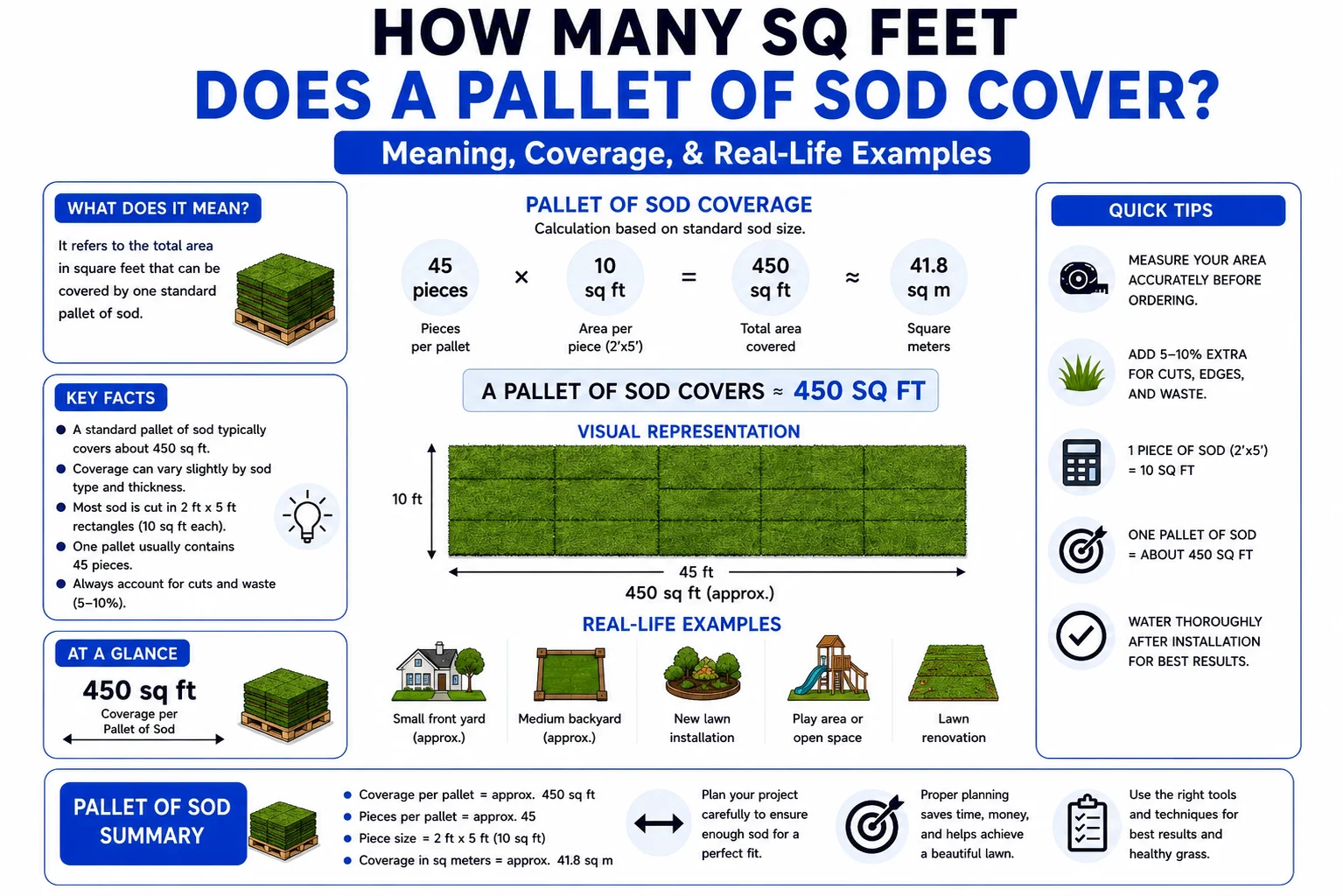
If you’re planning a lawn renovation, one of the first questions you’ll probably ask is: how many sq feet does a pallet of sod cover?
The short answer is that a standard pallet of sod typically covers 400 to 500 square feet, with 450 square feet being the most common average.
Knowing the coverage of a pallet is essential because it helps you:
- Estimate project costs
- Avoid ordering too much or too little sod
- Plan delivery and installation
- Reduce waste
Whether you’re replacing a small front lawn or installing grass across an entire property, understanding sod coverage can save both time and money.
Quick Answer: Sod Pallet Coverage
Most sod suppliers sell pallets that cover:
| Sod Type | Average Coverage |
|---|---|
| Standard Sod Pallet | 400–500 sq ft |
| Typical Residential Pallet | 450 sq ft |
| Large Roll Sod | 500–700 sq ft |
| Specialty Sod | Varies |
For most homeowners, it’s safe to estimate:
1 Pallet of Sod≈450 Square Feet
However, coverage varies depending on the supplier and grass variety.
What Is a Pallet of Sod?
A pallet of sod is a stack of mature grass that has been harvested along with a thin layer of soil and roots.
The sod is cut into manageable sections and loaded onto wooden pallets for transportation.
Homeowners use sod because it provides:
- Instant green lawns
- Faster establishment than seed
- Reduced erosion
- Immediate curb appeal
Instead of waiting weeks or months for grass seed to grow, sod creates a finished lawn almost immediately.
How Many Sq Feet Does a Pallet of Sod Cover on Average?
When asking how many sq feet does a pallet of sod cover, you’ll find that coverage differs slightly by supplier.
Standard Sod Pallets
The majority of residential sod pallets cover:
- 400 square feet
- 450 square feet
- 500 square feet
Most landscaping companies use 450 square feet as the planning standard.
Large Roll Sod Pallets
Commercial projects often use large roll sod.
These pallets may cover:
- 500–700 square feet
Large rolls are common for:
- Golf courses
- Athletic fields
- Parks
- Commercial properties
Regional Differences
Sod farms package products differently depending on:
- Climate
- Grass species
- Harvesting methods
- Transportation requirements
Always verify coverage before placing an order.
How to Calculate Sod Coverage for Your Lawn
Before purchasing sod, you need to know how much area requires coverage.
Measure Lawn Length and Width
For rectangular lawns:
- Measure length
- Measure width
Use feet whenever possible.
Calculate Square Footage
Use this formula:
Square Feet=Length×Width
Example:
A lawn measuring 40 feet by 30 feet equals:
40×30=1200
Total lawn size:
- 1,200 square feet
Determine Number of Pallets Needed
If one pallet covers 450 square feet:
1200÷450≈2.67
You’ll need approximately:
- 3 pallets
Always round upward.
Sod Coverage Chart by Lawn Size
This chart provides quick estimates.
| Lawn Area | Pallets Needed |
|---|---|
| 450 sq ft | 1 pallet |
| 900 sq ft | 2 pallets |
| 1,350 sq ft | 3 pallets |
| 1,800 sq ft | 4 pallets |
| 2,250 sq ft | 5 pallets |
| 4,500 sq ft | 10 pallets |
These estimates assume approximately 450 square feet per pallet.
Factors That Affect Sod Coverage
Several factors can influence actual coverage.
Sod Piece Size
Different farms cut sod into different dimensions.
Common sod slabs include:
- 16″ × 24″
- 18″ × 24″
- 24″ × 24″
Larger pieces may slightly affect pallet totals.
Grass Type
Different grass species are harvested differently.
Popular varieties include:
- Bermuda grass
- Zoysia grass
- Kentucky bluegrass
- St. Augustine grass
- Fescue
Coverage can vary slightly among these types.
Waste and Cutting
Most projects generate waste due to trimming around:
- Trees
- Flower beds
- Walkways
- Curved borders
Professionals usually recommend ordering:
- 5% to 10% extra
Irregular Yard Shapes
Yards with unusual layouts often require more cutting and fitting.
The more complex the design, the more waste you’ll create.
Real-World Examples
Small Front Yard
A homeowner has a lawn measuring:
- 20 feet × 20 feet
Calculation:
20×20=400
One pallet is sufficient.
Medium Backyard
Dimensions:
- 50 feet × 30 feet
Calculation:
50×30=1500
Pallet estimate:
1500÷450≈3.33
You’ll likely need:
- 4 pallets
Large Residential Property
Dimensions:
- 100 feet × 50 feet
Calculation:
100×50=5000
Pallet estimate:
5000÷450≈11.1
You’ll need approximately:
- 12 pallets
Benefits of Buying Sod by the Pallet
Purchasing sod by the pallet offers several advantages.
Easier Ordering
Buying full pallets simplifies estimating and delivery.
Lower Cost Per Square Foot
Many suppliers provide discounts on pallet quantities.
Faster Installation
Having all sod delivered at once speeds up installation.
Consistent Grass Quality
Full pallets usually come from the same harvest batch, creating a more uniform lawn appearance.
Common Mistakes When Ordering Sod
Underestimating Yard Size
Incorrect measurements often lead to shortages.
Measure twice before ordering.
Ignoring Waste
Many homeowners forget to account for trimming losses.
Always add extra coverage.
Ordering Too Early
Sod should be installed shortly after delivery.
Ordering too far in advance can damage grass quality.
Skipping Soil Preparation
Poor soil preparation reduces rooting success.
Prepare the ground before delivery day.
Expert Tips for Sod Installation
Prepare the Soil Properly
Before installation:
- Remove weeds
- Loosen compacted soil
- Grade uneven areas
- Add nutrients if necessary
Install Quickly
Fresh sod performs best when installed within:
- 24–48 hours
Water Immediately
Water thoroughly after installation.
New sod needs consistent moisture while roots establish.
Stagger Seams
Lay sod like brickwork rather than aligning seams in straight lines.
This creates a stronger and more attractive lawn.
Cost of a Pallet of Sod
Costs vary based on:
- Location
- Grass type
- Supplier
- Delivery distance
Typical pricing:
| Item | Average Cost |
|---|---|
| Standard Sod | $150–$400 per pallet |
| Premium Sod | $300–$600 per pallet |
| Delivery Fee | $50–$200 |
| Professional Installation | Additional labor charges |
Always request local quotes before budgeting.
Conclusion
If you’re asking how many sq feet does a pallet of sod cover, the most accurate general answer is approximately 450 square feet per pallet, although actual coverage may range from 400 to 500 square feet depending on the supplier and grass variety.
Understanding pallet coverage helps you:
- Estimate project costs
- Calculate material requirements
- Reduce waste
- Avoid installation delays
Before ordering, carefully measure your lawn, account for trimming waste, and confirm pallet specifications with your sod supplier. With proper planning and installation, sod provides an instant, healthy lawn that can transform your outdoor space in just a single day.
Frequently Asked Questions
How many sq feet does a pallet of sod cover on average?
Most pallets cover between 400 and 500 square feet, with 450 square feet being the most common average.
How many pallets of sod do I need for 1,000 square feet?
You typically need about 3 pallets when accounting for waste and trimming.
Should I order extra sod?
Yes. Most landscapers recommend ordering 5% to 10% extra.
How much does a pallet of sod weigh?
A standard pallet often weighs between 2,500 and 3,000 pounds.
How long can sod stay on a pallet?
For best results, install sod within 24 to 48 hours of delivery.