

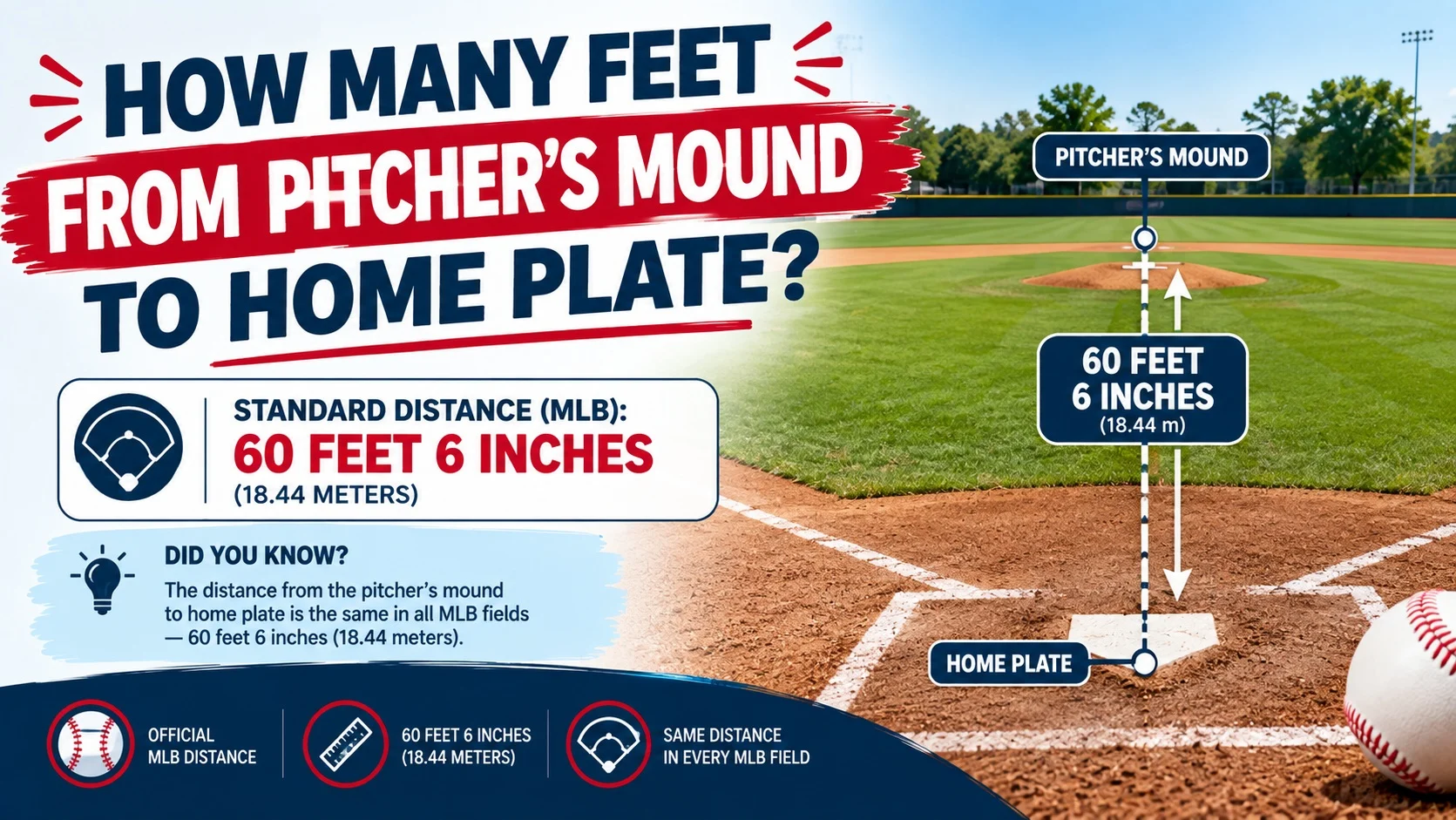
If you have ever watched a baseball game or worked on a baseball field, you may have wondered how many feet from the pitcher’s mound to home plate. The distance is an important part of baseball because it determines how far a pitcher must throw the ball and affects pitching speed, reaction time, and the overall dynamics of the game.
For standard professional and high-school baseball, the pitching distance is 60 feet 6 inches from the front edge of the pitcher’s rubber to the back point of home plate. That equals 60.5 feet.
However, the distance is not the same for every level of baseball. Little League, youth baseball, and some other divisions use shorter pitching distances to match the age and skill level of the players.
In this guide, you’ll learn the official pitching distance, how it is measured, how youth baseball distances compare, and how to calculate the distance in feet, inches, yards, and meters.
Quick Answer: How Many Feet From Pitcher’s Mound to Home Plate?
For standard adult baseball:
The distance from the pitcher’s rubber to home plate is 60 feet 6 inches, or 60.5 feet.
The measurement is taken from the front edge of the pitcher’s plate/rubber to the rear point of home plate.
Standard Baseball Pitching Distance
| Measurement | Distance |
|---|---|
| Feet | 60.5 feet |
| Feet and inches | 60 feet 6 inches |
| Inches | 726 inches |
| Yards | 20.17 yards |
| Meters | 18.44 meters |
| Centimeters | 1,844 cm |
So, if someone asks, “how many feet from pitcher’s mound to home plate?”, the standard answer is 60.5 feet.
Is the Distance From the Pitcher’s Mound or Pitcher’s Rubber?
This distinction is important.
People commonly say that the distance is measured from the pitcher’s mound to home plate, but the official measurement is based on the pitcher’s rubber, not simply any point on the mound.
The pitcher’s mound is the raised area surrounding the pitching rubber. Because the mound is several feet wide, measuring from its center or front edge could produce a different number.
The standard measurement is:
Front edge of pitcher’s rubber → back point of home plate = 60 feet 6 inches.
This provides a consistent pitching distance from one regulation field to another.
How Far Is 60 Feet 6 Inches in Decimal Feet?
Six inches equals half a foot.
Since:
6 inches ÷ 12 = 0.5 feet
you can convert 60 feet 6 inches to decimal feet:
60 + 0.5 = 60.5 feet
Therefore:
60 feet 6 inches = 60.5 feet
This decimal measurement is especially useful when calculating baseball field dimensions or creating a field layout.
How Far Is 60.5 Feet in Inches?
Because one foot contains 12 inches:
60.5 × 12 = 726 inches
Therefore:
60.5 feet = 726 inches
This is useful when measuring the field with a tape measure that uses inches.
How Far Is 60.5 Feet in Yards?
One yard equals 3 feet.
So:
60.5 ÷ 3 = 20.1667 yards
Rounded to two decimal places:
60.5 feet ≈ 20.17 yards
Thus, the pitching distance is a little more than 20 yards.
How Far Is 60.5 Feet in Meters?
One foot equals approximately 0.3048 meters.
Therefore:
60.5 × 0.3048 = 18.4404 meters
Rounded:
60.5 feet ≈ 18.44 meters
This is why international baseball measurements may be listed as approximately 18.44 meters.
Standard Pitching Distance by Baseball Level
Not every baseball player pitches from 60 feet 6 inches. Younger players generally use shorter distances.
The exact distance can vary by league and division, so league-specific rules should always be checked before laying out a field.
Here is a useful general comparison:
| Baseball Level | Approx. Pitching Distance |
|---|---|
| Professional / MLB | 60 ft 6 in |
| High School | 60 ft 6 in |
| College | 60 ft 6 in |
| Adult recreational baseball | Usually 60 ft 6 in |
| Little League Majors | 46 ft |
| Younger youth divisions | Often shorter than 46 ft |
The most important point is that 60 feet 6 inches is the standard distance for regulation adult baseball, while youth leagues use shorter distances.
Why Is the Pitching Distance 60 Feet 6 Inches?
The 60-foot-6-inch distance has become one of the defining dimensions of the baseball field.
It provides enough distance for pitchers to throw at high speeds while still giving batters a reasonable amount of time to see and react to the pitch.
A baseball traveling at a high velocity can cover the distance between the pitcher and batter extremely quickly. This makes pitching speed, pitch movement, batter reaction, and timing critical parts of the game.
The distance also creates a consistent playing environment. A pitcher on one regulation field is working with essentially the same pitching distance as a pitcher on another regulation field.
How Is the Pitching Distance Measured?
One of the most common mistakes when measuring a baseball field is measuring from the wrong point.
The standard measurement is taken:
From the front edge of the pitcher’s rubber to the back point of home plate.
It is not simply:
- The center of the mound to home plate
- The front of the mound to home plate
- The pitcher’s feet to home plate
- The center of the pitching rubber to the center of home plate
Using the correct reference points is important when constructing or marking a regulation baseball field.
Step-by-Step Measurement
If you are laying out a baseball field, you can think about the process this way:
Step 1: Locate Home Plate
Identify the back point of home plate. This is the reference point for the pitching-distance measurement.
Step 2: Locate the Pitcher’s Rubber
Find the pitching rubber on the mound.
Step 3: Identify the Front Edge
The official measurement uses the front edge of the pitching rubber.
Step 4: Measure 60 Feet 6 Inches
Measure in a straight line from the front edge of the rubber to the back point of home plate.
The resulting distance should be:
60 feet 6 inches.
Pitcher’s Mound vs. Pitcher’s Rubber
The terms “pitcher’s mound” and “pitcher’s rubber” are sometimes used interchangeably, but they refer to different things.
The pitcher’s mound is the raised section of the baseball field.
The pitcher’s rubber is the rectangular plate positioned on the mound that the pitcher uses when delivering the ball.
The pitching distance is officially associated with the rubber.
This matters because the mound itself has a larger surface area. If you simply place a tape measure from the center of the mound to home plate, you may not get the regulation measurement.
How Far Is the Pitcher’s Mound From Home Plate for Little League?
Little League uses a shorter pitching distance than adult baseball.
For the traditional Little League Majors field, the distance between the pitcher’s rubber and home plate is:
46 feet.
That is considerably shorter than the 60 feet 6 inches used in standard adult baseball.
Comparison
| Field | Pitching Distance |
|---|---|
| Adult regulation baseball | 60 ft 6 in |
| Little League Majors | 46 ft |
| Difference | 14 ft 6 in |
The shorter distance helps younger players develop pitching and hitting skills without requiring them to throw from the full adult distance.
Why Do Youth Players Use a Shorter Distance?
Young players generally have less physical strength and throwing experience than adult players.
A shorter pitching distance can help make the game more appropriate for their age and development.
It can provide:
- A more manageable throwing distance
- More realistic opportunities for young pitchers
- Better balance between pitching and hitting
- Appropriate field dimensions
- A smoother transition toward larger fields
Youth baseball is divided into different age groups and leagues, so the exact dimensions should be confirmed with the governing organization.
How Many Feet From Pitcher’s Mound to Home Plate in High School Baseball?
For standard high-school baseball, the pitching distance is:
60 feet 6 inches.
Therefore, if you’re building or measuring a standard high-school baseball field, the distance from the front of the pitching rubber to the back point of home plate is 60.5 feet.
Other field dimensions, including the mound, bases, and batter’s boxes, also need to meet the applicable rules.
How Many Feet From Pitcher’s Mound to Home Plate in College Baseball?
College baseball also uses the standard:
60 feet 6 inches
pitching distance.
That means professional, college, and high-school players generally pitch from the same basic distance.
The skill level, mound construction, ballpark dimensions, and other regulations can differ, but the pitching distance remains an important standard field dimension.
How Far Apart Are the Bases?
Another important baseball measurement is the distance between bases.
On a standard baseball diamond, the bases are:
90 feet apart.
This means:
- Home plate to first base = 90 feet
- First base to second base = 90 feet
- Second base to third base = 90 feet
- Third base to home plate = 90 feet
The pitching distance is therefore shorter than the distance between bases.
Pitching Distance vs. Base Distance
| Measurement | Distance |
|---|---|
| Pitcher’s rubber to home plate | 60 ft 6 in |
| Home to first base | 90 ft |
| First to second | 90 ft |
| Second to third | 90 ft |
| Third to home | 90 ft |
How Far Is the Pitcher’s Mound From Second Base?
This question can be confusing because the pitcher’s mound sits between home plate and second base.
On a regulation diamond, the distance from home plate to second base is approximately:
127 feet 3 3/8 inches
The pitcher’s rubber is positioned approximately halfway along that line.
Because the pitching distance is 60 feet 6 inches from the back point of home plate to the front of the rubber, the rubber is positioned near the center of the diamond’s home-to-second axis.
The exact layout uses established field-marking measurements rather than simply estimating by eye.
Why Does 60 Feet 6 Inches Matter for Pitching?
The distance between the pitcher and batter strongly affects the game.
A pitcher’s velocity, pitch movement, and release point determine how quickly the ball reaches the batter.
For example, a fast pitch can travel the 60.5-foot distance in a fraction of a second. That gives the batter limited time to recognize:
- Pitch type
- Ball speed
- Direction
- Spin
- Movement
- Location
This is one reason professional baseball hitters must develop extremely fast visual processing and reaction skills.
Does Pitch Speed Change the Actual Distance?
No.
A pitcher’s speed does not change the distance between the rubber and home plate.
Whether a pitcher throws 70 mph, 90 mph, or another speed, the regulation distance remains:
60 feet 6 inches.
What changes is the amount of time the ball takes to travel that distance.
For example, a faster pitch reaches the batter sooner than a slower pitch.
Common Mistakes When Measuring Pitching Distance
If you’re setting up a baseball field, several measurement mistakes are possible.
1. Measuring From the Center of the Mound
The mound is not the official reference point.
Use the pitcher’s rubber.
2. Measuring to the Front of Home Plate
The standard measurement uses the back point of home plate, not simply the closest edge.
3. Using 60 Feet Instead of 60 Feet 6 Inches
The difference is only 6 inches, but those 6 inches matter when constructing a regulation field.
4. Confusing Youth and Adult Dimensions
A youth field may use a shorter pitching distance.
Always identify the league and division before measuring.
5. Estimating the Distance by Eye
Even a small measurement error can affect the layout of the mound and the rest of the baseball diamond.
Use an accurate measuring tape and the appropriate field specifications.
How to Calculate Pitching Distance Yourself
If you need to convert the standard distance into different units, use these formulas.
Feet to Inches
Feet × 12 = inches
For 60.5 feet:
60.5 × 12 = 726 inches
Feet to Yards
Feet ÷ 3 = yards
60.5 ÷ 3 = 20.17 yards
Feet to Meters
Feet × 0.3048 = meters
60.5 × 0.3048 = 18.44 meters
Inches to Feet
Inches ÷ 12 = feet
726 ÷ 12 = 60.5 feet
Quick Conversion Chart for 60 Feet 6 Inches
| Unit | Equivalent |
|---|---|
| Feet | 60.5 ft |
| Feet & inches | 60 ft 6 in |
| Inches | 726 in |
| Yards | 20.17 yd |
| Meters | 18.44 m |
| Centimeters | 1,844 cm |
| Millimeters | 18,440 mm |
Pitcher’s Mound Distance vs. Other Common Distances
Putting the pitching distance next to familiar measurements can make it easier to visualize.
| Distance | Approximate Length |
|---|---|
| 10-yard line | 30 ft |
| 20 yards | 60 ft |
| Pitching distance | 60 ft 6 in |
| 25 yards | 75 ft |
| Base path | 90 ft |
| 100 yards | 300 ft |
The pitching distance is just slightly longer than 20 yards.
Does Every Baseball Field Have the Same Pitching Distance?
No.
Regulation fields for the same level of play generally follow the appropriate standard, but different types of baseball use different field dimensions.
For example:
- Professional baseball uses 60 feet 6 inches.
- High-school baseball uses 60 feet 6 inches.
- College baseball uses 60 feet 6 inches.
- Little League uses a shorter pitching distance.
- Other youth leagues may use their own age-specific dimensions.
- Recreational leagues may establish modified field rules.
Therefore, if you’re asking how many feet from pitcher’s mound to home plate, the correct answer depends on the level of baseball.
Why the Pitching Distance Is Important When Building a Field
If you’re constructing or renovating a baseball field, getting the pitching distance right is essential.
An incorrect pitching distance can affect:
- Pitching difficulty
- Batter reaction time
- Field symmetry
- Player safety
- Competitive fairness
- League compliance
The pitching distance is also connected to the placement of the bases and overall geometry of the diamond.
For a competitive or regulation field, the complete set of applicable field specifications should be followed rather than measuring only the mound-to-home distance.
FAQs
How many feet is it from the pitcher’s mound to home plate?
For standard adult baseball, the pitching distance is 60 feet 6 inches, or 60.5 feet, measured from the front edge of the pitcher’s rubber to the back point of home plate.
Is the pitching distance exactly 60 feet?
No. The standard distance is 60 feet 6 inches. In decimal form, that is 60.5 feet.
How many yards is the pitching distance?
The standard pitching distance is approximately 20.17 yards.
How many meters is 60 feet 6 inches?
60 feet 6 inches equals approximately 18.44 meters.
How far is a Little League pitcher from home plate?
A traditional Little League Majors field uses a 46-foot pitching distance.
Is the distance measured from the center of the pitcher’s mound?
No. The official pitching distance is measured from the front edge of the pitcher’s rubber to the back point of home plate.
How far apart are baseball bases?
Standard adult baseball bases are 90 feet apart.
Does a faster pitcher throw from a different distance?
No. Pitching velocity does not change the field dimensions. A standard pitcher still throws from 60 feet 6 inches.
Why do youth baseball fields have shorter pitching distances?
Youth fields generally use shorter distances to make the game more appropriate for younger players and their physical development. Exact dimensions depend on the league and division.
Final Answer: How Many Feet From Pitcher’s Mound to Home Plate?
So, how many feet from pitcher’s mound to home plate?
For standard adult, high-school, college, and professional baseball, the answer is:
60 feet 6 inches = 60.5 feet.
The official measurement is taken from the front edge of the pitcher’s rubber to the back point of home plate. In other units, this equals approximately 726 inches, 20.17 yards, or 18.44 meters.
Youth baseball uses shorter pitching distances, with Little League commonly using 46 feet. If you’re measuring or constructing a field, always use the rules for the specific league and age division rather than assuming every baseball field has the same dimensions.
Understanding this measurement also makes it easier to understand the geometry of a baseball diamond and why the pitching distance has such an important effect on the game.


Pingback: 4x8 Is How Many Square Feet? Complete Guide
Pingback: How Many Cubic Feet Equal a Cubic Yard?
Pingback: How Many Sq Feet Is in an Acre? Complete Article