

If you are ordering concrete, mulch, soil, gravel, sand, compost, or other bulk materials, understanding the difference between cubic feet and cubic yards is important. One of the most common questions is: how many cubic feet equal a cubic yard?
The exact answer is:
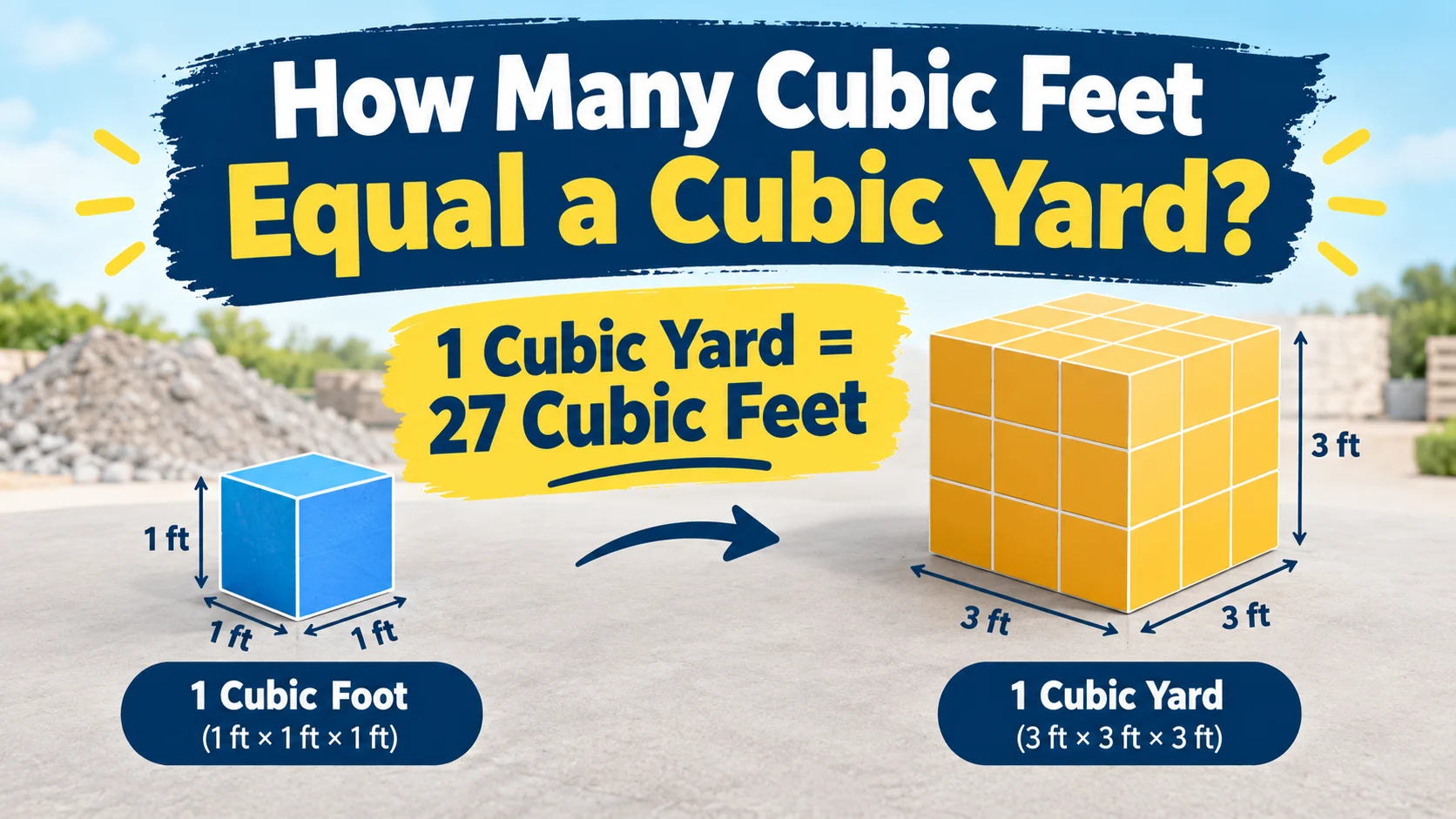
1 cubic yard = 27 cubic feet.
This conversion is straightforward because one yard equals 3 feet. Since a cubic measurement has three dimensions—length, width, and height—you multiply 3 × 3 × 3:
3 ft × 3 ft × 3 ft = 27 cubic feet
Therefore, one cubic yard contains exactly 27 cubic feet.
Knowing this conversion makes it much easier to estimate how much material you need for landscaping, construction, gardening, excavation, and home-improvement projects.
Quick Answer: How Many Cubic Feet Equal a Cubic Yard?
1 cubic yard equals exactly 27 cubic feet.
The basic conversion is:
1 yd³ = 27 ft³
Here are some common conversions:
| Cubic Yards | Cubic Feet |
|---|---|
| 0.25 yd³ | 6.75 ft³ |
| 0.5 yd³ | 13.5 ft³ |
| 0.75 yd³ | 20.25 ft³ |
| 1 yd³ | 27 ft³ |
| 2 yd³ | 54 ft³ |
| 3 yd³ | 81 ft³ |
| 4 yd³ | 108 ft³ |
| 5 yd³ | 135 ft³ |
| 10 yd³ | 270 ft³ |
| 20 yd³ | 540 ft³ |
| 50 yd³ | 1,350 ft³ |
| 100 yd³ | 2,700 ft³ |
The number to remember is 27.
Why Is a Cubic Yard Equal to 27 Cubic Feet?
To understand the conversion, start with the relationship between yards and feet.
1 yard = 3 feet
A cubic yard measures volume, so it has three dimensions:
- Length
- Width
- Height
A cube that measures 1 yard on every side is:
1 yd × 1 yd × 1 yd
Converting each yard to feet gives:
3 ft × 3 ft × 3 ft
Now multiply:
3 × 3 × 3 = 27
Therefore:
1 cubic yard = 27 cubic feet
This is why you multiply cubic yards by 27 when converting to cubic feet.
What Is a Cubic Foot?
A cubic foot is a unit of volume.
One cubic foot is the amount of space inside a cube that measures:
1 foot × 1 foot × 1 foot
Therefore:
1 ft³ = 1 × 1 × 1 = 1 cubic foot
Cubic feet are commonly used to measure:
- Soil
- Mulch
- Concrete
- Gravel
- Sand
- Storage space
- Refrigerators
- Shipping containers
- Rooms and other enclosed spaces
- HVAC air volume
For example, a box measuring 2 feet long, 3 feet wide, and 2 feet high contains:
2 × 3 × 2 = 12 cubic feet
What Is a Cubic Yard?
A cubic yard is another unit of volume, but it is larger than a cubic foot.
A cubic yard is a cube measuring:
1 yard × 1 yard × 1 yard
Since one yard equals three feet:
3 × 3 × 3 = 27 cubic feet
Therefore:
1 cubic yard = 27 cubic feet
Cubic yards are especially common when buying bulk landscaping and construction materials.
Cubic Feet to Cubic Yards Formula
If you know the volume in cubic feet and want to convert it to cubic yards, divide by 27.
Formula
Cubic Yards = Cubic Feet ÷ 27
Example
Suppose you have 54 cubic feet of soil.
54 ÷ 27 = 2 cubic yards
Therefore:
54 cubic feet = 2 cubic yards
Another example:
81 ÷ 27 = 3 cubic yards
So, 81 cubic feet equals 3 cubic yards.
Cubic Yards to Cubic Feet Formula
If you know the volume in cubic yards and want to convert it into cubic feet, multiply by 27.
Formula
Cubic Feet = Cubic Yards × 27
Example
Suppose you need 5 cubic yards of mulch.
5 × 27 = 135 cubic feet
Therefore:
5 cubic yards = 135 cubic feet
For 10 cubic yards:
10 × 27 = 270 cubic feet
So, 10 cubic yards equals 270 cubic feet.
Cubic Yard to Cubic Feet Conversion Chart
This chart provides quick conversions for common amounts:
| Cubic Yards | Cubic Feet |
|---|---|
| 0.1 | 2.7 |
| 0.25 | 6.75 |
| 0.5 | 13.5 |
| 0.75 | 20.25 |
| 1 | 27 |
| 1.5 | 40.5 |
| 2 | 54 |
| 2.5 | 67.5 |
| 3 | 81 |
| 4 | 108 |
| 5 | 135 |
| 6 | 162 |
| 7 | 189 |
| 8 | 216 |
| 9 | 243 |
| 10 | 270 |
| 15 | 405 |
| 20 | 540 |
Cubic Feet to Cubic Yard Conversion Chart
If your measurement is already in cubic feet, use this chart:
| Cubic Feet | Cubic Yards |
|---|---|
| 1 ft³ | 0.037 yd³ |
| 5 ft³ | 0.185 yd³ |
| 10 ft³ | 0.370 yd³ |
| 20 ft³ | 0.741 yd³ |
| 27 ft³ | 1 yd³ |
| 40 ft³ | 1.481 yd³ |
| 50 ft³ | 1.852 yd³ |
| 54 ft³ | 2 yd³ |
| 75 ft³ | 2.778 yd³ |
| 81 ft³ | 3 yd³ |
| 100 ft³ | 3.704 yd³ |
| 135 ft³ | 5 yd³ |
| 270 ft³ | 10 yd³ |
| 540 ft³ | 20 yd³ |
For non-whole conversions, round based on the needs of your project and the supplier’s ordering requirements.
How to Calculate Cubic Feet
Before converting to cubic yards, you may need to determine the volume of your project.
For a rectangular or box-shaped area, use:
Volume = Length × Width × Height
All measurements should be in feet.
Example: Soil Bed
Suppose you have a garden bed that is:
- 20 feet long
- 10 feet wide
- 0.5 feet deep
Calculate the volume:
20 × 10 × 0.5 = 100 cubic feet
Now convert cubic feet to cubic yards:
100 ÷ 27 = 3.70 cubic yards
You would need approximately 3.7 cubic yards of material before accounting for settling, waste, or overage.
How Many Cubic Feet Are in 2 Cubic Yards?
Two cubic yards contain:
2 × 27 = 54 cubic feet
Therefore:
2 cubic yards = 54 cubic feet
This is useful when a supplier sells material by the cubic yard but your project calculations are in cubic feet.
How Many Cubic Feet Are in 3 Cubic Yards?
Three cubic yards contain:
3 × 27 = 81 cubic feet
Therefore:
3 cubic yards = 81 cubic feet
How Many Cubic Feet Are in 5 Cubic Yards?
Five cubic yards contain:
5 × 27 = 135 cubic feet
Therefore:
5 cubic yards = 135 cubic feet
How Many Cubic Feet Are in 10 Cubic Yards?
Ten cubic yards contain:
10 × 27 = 270 cubic feet
Therefore:
10 cubic yards = 270 cubic feet
This is a substantial volume and could represent a large landscaping or construction material delivery.
Cubic Feet vs. Cubic Yards for Landscaping
Cubic yards are particularly common for bulk landscaping materials.
You may purchase:
- Topsoil
- Garden soil
- Mulch
- Compost
- Gravel
- Decorative stone
- Sand
- Wood chips
Suppliers frequently quote these materials by the cubic yard because bulk quantities can be much easier to sell and deliver using that measurement.
For example, if your calculations show that you need 81 cubic feet of mulch:
81 ÷ 27 = 3 cubic yards
You can order 3 cubic yards of mulch rather than trying to order 81 individual cubic feet.
Cubic Feet vs. Cubic Yards for Concrete
Concrete is another material commonly measured in cubic yards.
Suppose a slab is:
- 20 feet long
- 10 feet wide
- 4 inches thick
First convert 4 inches to feet:
4 ÷ 12 = 0.3333 feet
Calculate cubic feet:
20 × 10 × 0.3333 ≈ 66.67 cubic feet
Convert to cubic yards:
66.67 ÷ 27 ≈ 2.47 cubic yards
Therefore, the theoretical concrete volume is approximately 2.47 cubic yards.
In real projects, ordering decisions should account for the actual site conditions and an appropriate allowance rather than relying solely on a theoretical calculation.
How Many Cubic Feet Does a Cubic Yard Cover?
A cubic yard contains 27 cubic feet, but coverage depends on how thickly the material is spread.
For example, if one cubic yard of material is spread 1 foot deep:
27 ÷ 1 = 27 square feet
At 6 inches deep, which is 0.5 feet:
27 ÷ 0.5 = 54 square feet
At 3 inches deep:
3 ÷ 12 = 0.25 feet
Then:
27 ÷ 0.25 = 108 square feet
So one cubic yard covers approximately:
| Depth | Coverage From 1 Cubic Yard |
|---|---|
| 1 inch | 324 sq ft |
| 2 inches | 162 sq ft |
| 3 inches | 108 sq ft |
| 4 inches | 81 sq ft |
| 6 inches | 54 sq ft |
| 8 inches | 40.5 sq ft |
| 12 inches | 27 sq ft |
This calculation assumes an even layer and does not account for settling, compaction, or uneven surfaces.
How Many Cubic Yards Do You Need?
If you know the area of your project in square feet and the desired depth in inches, you can calculate the amount of material needed.
A useful formula is:
Cubic Yards = Square Feet × Depth in Inches ÷ 324
Example
Suppose you have 500 square feet and want 3 inches of mulch.
500 × 3 ÷ 324 = 4.63 cubic yards
You would need approximately 4.63 cubic yards before adding any additional allowance for settling or other project-specific factors.
Common Materials Measured in Cubic Yards
Many bulk materials are sold by cubic yard.
Mulch
Mulch is commonly purchased by the cubic yard for landscaping beds.
Topsoil
Large gardening and landscaping projects often require several cubic yards of topsoil.
Gravel
Driveways, pathways, drainage areas, and construction projects may require gravel measured in cubic yards.
Sand
Sand for construction, leveling, and landscaping can also be sold by the cubic yard.
Concrete
Ready-mix concrete is commonly ordered in cubic yards.
Compost
Large garden and soil-amendment projects can require compost by the cubic yard.
The material’s weight varies significantly, so cubic volume and weight are not interchangeable. A cubic yard of one material can weigh very differently from a cubic yard of another.
Cubic Yard vs. Cubic Foot vs. Square Foot
These measurements are sometimes confused, but they describe different things.
| Measurement | What It Measures | Example |
|---|---|---|
| Foot | Length | 10 ft long |
| Square foot | Area | 100 sq ft floor |
| Cubic foot | Volume | 20 ft³ of soil |
| Cubic yard | Volume | 3 yd³ of mulch |
A square foot measures two dimensions:
Length × Width
A cubic foot measures three:
Length × Width × Height
A cubic yard also measures three dimensions but uses yards as the base unit.
Why You Should Not Confuse Square Yards With Cubic Yards
A square yard measures area.
A cubic yard measures volume.
One square yard equals:
3 ft × 3 ft = 9 square feet
One cubic yard equals:
3 ft × 3 ft × 3 ft = 27 cubic feet
So:
1 square yard = 9 square feet
while:
1 cubic yard = 27 cubic feet
The extra dimension makes cubic measurements fundamentally different.
Common Mistakes When Converting Cubic Feet and Cubic Yards
Mistake 1: Using 3 Instead of 27
Because one yard equals three feet, some people incorrectly assume that one cubic yard equals three cubic feet.
That is incorrect.
For volume:
3 × 3 × 3 = 27
Therefore:
1 cubic yard = 27 cubic feet
Mistake 2: Dividing by 3
When converting cubic feet to cubic yards, divide by 27, not 3.
Correct:
81 ÷ 27 = 3 cubic yards
Mistake 3: Confusing Square and Cubic Measurements
Square feet measure area. Cubic feet measure volume.
If your project has a depth or height, you generally need a cubic measurement.
Mistake 4: Forgetting to Convert Inches to Feet
If a project is 4 inches deep, do not use 4 as though it were 4 feet.
Convert it first:
4 ÷ 12 = 0.3333 feet
Mistake 5: Ordering Exactly the Calculated Amount
A theoretical calculation may not account for uneven ground, settling, compaction, waste, or variations during installation.
Depending on the material and project, an appropriate additional allowance may be sensible.
FAQs
How many cubic feet equal a cubic yard?
One cubic yard equals exactly 27 cubic feet.
How do you convert cubic yards to cubic feet?
Multiply the number of cubic yards by 27.
Cubic feet = Cubic yards × 27
How do you convert cubic feet to cubic yards?
Divide cubic feet by 27.
Cubic yards = Cubic feet ÷ 27
Is a cubic yard bigger than a cubic foot?
Yes. One cubic yard contains 27 cubic feet, so it is 27 times the volume of one cubic foot.
How many cubic feet are in half a cubic yard?
Half a cubic yard equals:
0.5 × 27 = 13.5 cubic feet
How many cubic feet are in 2 cubic yards?
Two cubic yards equal 54 cubic feet.
How many cubic feet are in 5 cubic yards?
Five cubic yards equal 135 cubic feet.
How many cubic feet are in 10 cubic yards?
Ten cubic yards equal 270 cubic feet.
How many square feet does one cubic yard cover?
It depends on the depth. For example, one cubic yard covers approximately 108 square feet at 3 inches deep and 81 square feet at 4 inches deep.
Is cubic yard a measurement of weight?
No. A cubic yard measures volume, not weight. The weight of one cubic yard depends on the material’s density and moisture content.
Final Answer: How Many Cubic Feet Equal a Cubic Yard?
So, how many cubic feet equal a cubic yard?
The exact answer is:
1 Cubic Yard = 27 Cubic Feet
The conversion formulas are simple:
Cubic Feet = Cubic Yards × 27
Cubic Yards = Cubic Feet ÷ 27
For example, 3 cubic yards equals 81 cubic feet, while 100 cubic feet equals approximately 3.70 cubic yards.
This conversion is especially useful when calculating the amount of concrete, mulch, soil, gravel, sand, compost, or other bulk materials required for a project. Just remember that the 27-to-1 relationship applies to volume, while square feet and square yards measure area.

Pingback: How Many Sq Feet Is in an Acre? Complete Article