
If you’re learning to drive or preparing for a driver’s license test, one of the most common questions is: how many feet for turn signal use before making a turn?
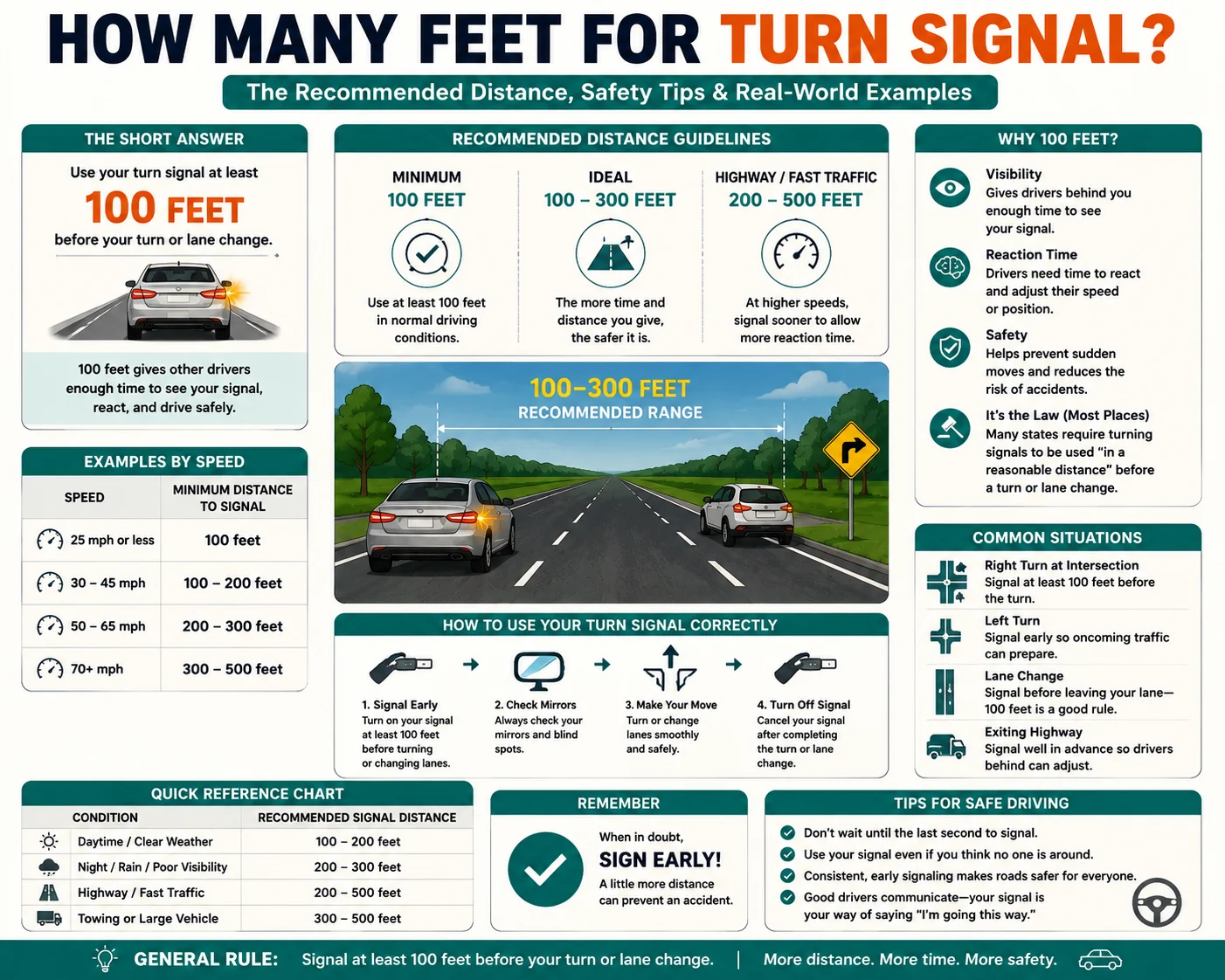
The general rule in most areas is that drivers should activate their turn signal at least 100 feet before turning. This gives other drivers, cyclists, and pedestrians enough time to understand your intentions and react safely.
Using turn signals correctly is one of the simplest yet most important driving habits. Proper signaling reduces confusion, helps prevent collisions, and may even help you avoid traffic citations.
In this guide, you’ll learn the recommended turn signal distance, why signaling matters, how laws vary by location, and the best practices for safe driving.
Quick Answer: How Many Feet for Turn Signal Use?
The standard recommendation is:
100 feet
Signal at least 100 feet before making a turn.
This distance applies to:
- Right turns
- Left turns
- Most city streets
- Residential roads
However, some jurisdictions require longer signaling distances, especially for higher-speed roads or commercial vehicles.
Always check your local driving regulations.
Why Turn Signals Matter
Many drivers underestimate the importance of turn signals.
In reality, signaling is one of the primary ways drivers communicate with each other.
Communicating With Other Drivers
Your turn signal tells others:
- You plan to turn
- You intend to change lanes
- You’re preparing to exit
- You’re entering traffic
Without signaling, other drivers must guess your next move.
That uncertainty increases accident risk.
Preventing Accidents
Proper signaling helps:
- Reduce rear-end collisions
- Prevent side-swipe accidents
- Improve traffic flow
- Protect pedestrians
- Increase reaction time for nearby drivers
Even a few extra seconds of warning can make a significant difference.
How Many Feet for Turn Signal Before a Turn?
The exact distance depends on local traffic laws, but most driver education programs teach the same general rule.
Standard Recommendation
For normal driving conditions:
Signal at least 100 feet before turning.
This provides adequate notice for:
- Vehicles behind you
- Drivers approaching intersections
- Cyclists sharing the roadway
- Pedestrians crossing streets
At city speeds, 100 feet typically provides several seconds of warning.
State Law Variations
Although many states use the 100-foot rule, some areas may have different requirements.
Examples may include:
- 100 feet minimum
- 200 feet on certain roads
- Greater distances for commercial vehicles
- Special highway requirements
Because traffic laws vary, drivers should always consult local regulations and driver’s manuals.
Turn Signal Distance Chart
The following chart provides common signaling recommendations.
| Driving Situation | Recommended Signal Distance |
|---|---|
| Residential Street Turn | 100 ft |
| City Intersection Turn | 100 ft |
| Highway Exit | 300–500 ft |
| Lane Change | Several seconds before moving |
| Roundabout Exit | Signal before exiting |
| Commercial Vehicle Turn | Often 100–300 ft+ |
These distances help maximize visibility and safety.
Signaling for Different Driving Situations
Different driving environments require slightly different signaling habits.
Turning at Intersections
For city and suburban intersections:
- Activate your signal about 100 feet before the turn.
- Maintain the signal through the turn.
- Cancel the signal after completing the maneuver.
This allows approaching traffic to anticipate your movement.
Highway Exits
Highway driving occurs at higher speeds.
Because vehicles travel much faster, signaling earlier is recommended.
Many driving experts suggest:
- Signal several hundred feet before the exit.
- Move into the exit lane gradually.
- Avoid last-second lane changes.
Lane Changes
Lane changes differ from turns.
Instead of measuring distance, drivers should:
- Signal several seconds in advance.
- Check mirrors.
- Check blind spots.
- Move smoothly into the new lane.
The key is providing enough notice for nearby drivers.
Roundabouts
Roundabouts have unique signaling requirements.
Generally:
- Signal left only when appropriate for local rules.
- Signal right before exiting.
- Maintain awareness of surrounding traffic.
Proper signaling improves roundabout safety significantly.
Turn Signal Rules for Driving Tests
Many driver’s license exams closely evaluate signaling behavior.
Examiners typically look for:
- Timely signal activation
- Proper distance before turns
- Consistent use during lane changes
- Signal cancellation after turning
Failing to signal correctly can result in:
- Point deductions
- Automatic errors
- Driving test failure in severe cases
Students should practice signaling habits before every turn and lane change.
Benefits of Early Signaling
Using turn signals early offers several advantages.
Increased Reaction Time
Other road users need time to respond.
Earlier signaling provides:
- More decision-making time
- Safer braking opportunities
- Better lane positioning
Improved Traffic Flow
When drivers know your intentions:
- Traffic moves more smoothly.
- Fewer sudden stops occur.
- Congestion may be reduced.
Reduced Accident Risk
Many crashes occur because one driver fails to communicate their intentions.
Proper signaling lowers that risk substantially.
Better Driving Test Performance
Consistent signaling is a hallmark of safe driving.
Driver examiners view proper signal use as evidence of good road awareness.
Common Turn Signal Mistakes
Even experienced drivers sometimes misuse turn signals.
Signaling Too Late
One of the most common mistakes is activating the signal just before turning.
This provides little warning to other drivers.
Forgetting to Signal
Some drivers rely on habit rather than conscious signaling.
Unfortunately, forgetting to signal creates unnecessary risk.
Leaving the Signal On
Failing to cancel a signal can confuse surrounding traffic.
Always verify the signal has turned off after completing a maneuver.
Signaling Without Checking Mirrors
A signal does not guarantee safety.
Drivers must still:
- Check mirrors
- Scan blind spots
- Confirm the path is clear
Last-Second Lane Changes
Signaling moments before changing lanes does not provide enough notice.
Signal first, then move after checking traffic.
Defensive Driving Tips for Proper Signaling
Good signaling habits are part of defensive driving.
Make Signaling Automatic
Develop a routine:
- Mirror
- Signal
- Check surroundings
- Move
Practicing this sequence improves consistency.
Signal Earlier Than Required
In many situations, signaling slightly earlier improves safety.
Just avoid signaling so early that it creates confusion.
Use Signals Even When Roads Are Empty
Building consistent habits ensures you signal correctly when traffic increases.
Signal Every Lane Change
Many drivers only signal when turning.
Lane changes require signaling too.
Watch Other Drivers Carefully
Not everyone uses signals correctly.
Remain alert for unexpected movements.
Turn Signal Laws and Penalties
Traffic laws vary by state, province, and country.
Common legal requirements include:
- Signaling before turning
- Signaling before lane changes
- Maintaining signals for a minimum distance
- Using signals whenever movement may affect other traffic
Failure to signal may result in:
- Traffic citations
- Fines
- Points on a driving record
- Increased liability after accidents
Following signaling rules is both safer and legally beneficial.
Real-World Example: What Does 100 Feet Look Like?
Many new drivers struggle to estimate 100 feet.
Helpful comparisons include:
- Approximately one-third of a football field
- About seven to eight average car lengths
- Roughly the length of a city block in some neighborhoods
With practice, estimating 100 feet becomes much easier.
Conclusion
So, how many feet for turn signal use? In most driving situations, the recommended distance is at least 100 feet before making a turn. This gives other drivers, cyclists, and pedestrians enough time to react safely and helps maintain smooth traffic flow.
Whether you’re preparing for a driver’s test, improving your driving skills, or simply reviewing traffic safety rules, remembering the 100-foot turn signal guideline is an essential habit. Consistent signaling not only reduces accident risk but also demonstrates responsible and defensive driving practices that benefit everyone on the road.
FAQs
1. How many feet before a turn should you signal?
In most areas, drivers should signal at least 100 feet before turning.
2. Do you need to signal for lane changes?
Yes. Drivers should signal several seconds before changing lanes and ensure the lane is clear.
3. Is the 100-foot rule the same everywhere?
No. Traffic laws vary by state and country, so local regulations should always be checked.
4. What happens if you don’t use a turn signal?
You may receive a traffic citation, increase accident risk, or lose points during a driving test.
5. Should you signal on an empty road?
Yes. Consistent signaling builds safe driving habits and ensures compliance with traffic laws.
Find more Articles
How Many Feet Is a Square Acre?
How Many Feet Is a Pickleball Court?
How Many Feet in 3 Acres?