
If you’re planning to build a court, convert an existing sports surface, or simply learn more about the game, one of the first questions you’ll ask is: how many feet is a pickleball court?
The official answer is simple:
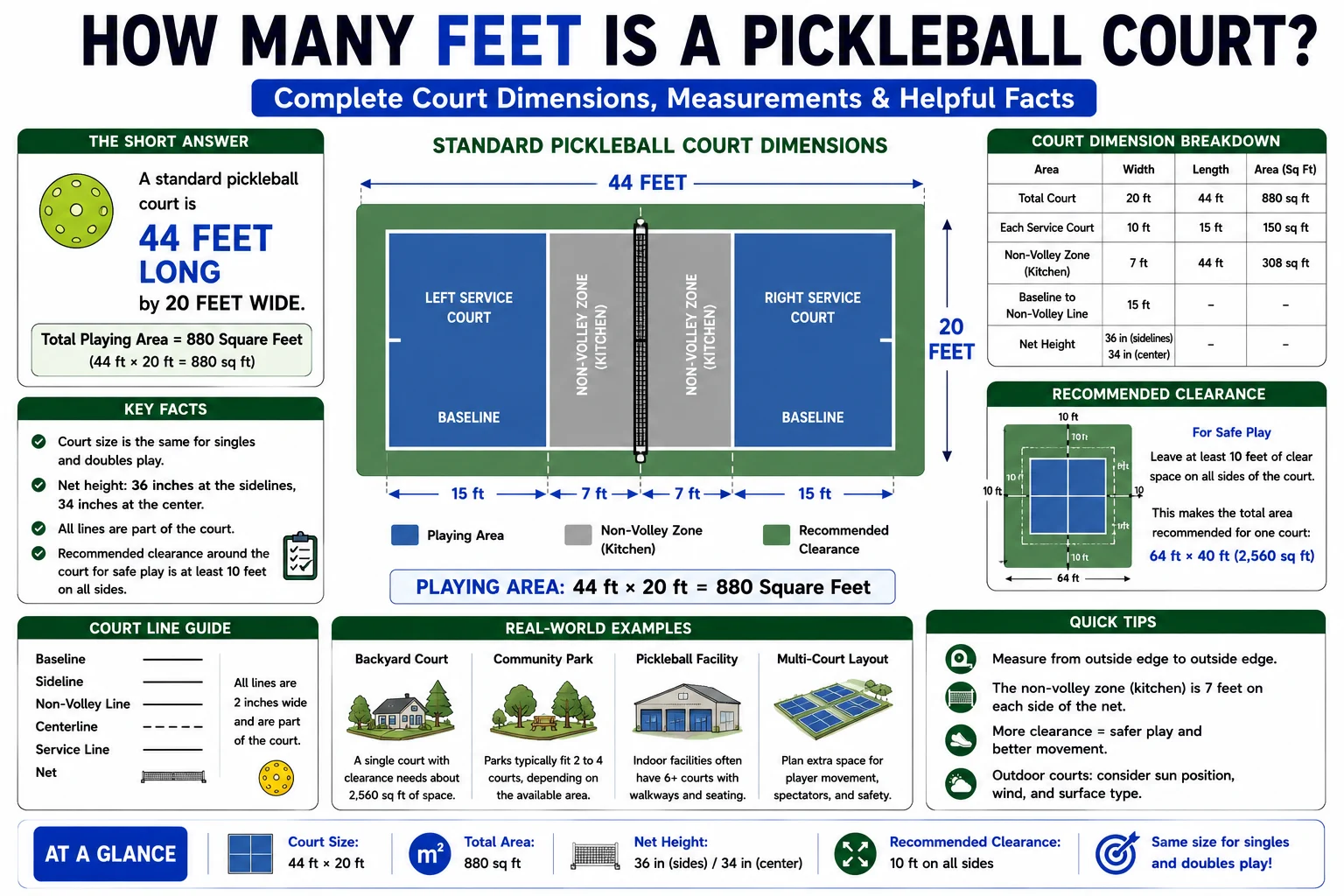
A standard pickleball court measures 44 feet long and 20 feet wide.
These dimensions are the same for both singles and doubles play. However, the actual space needed for comfortable play is larger because players require room beyond the court boundaries.
In this guide, you’ll learn official pickleball court dimensions, recommended playing space, court layouts, comparisons to tennis courts, and practical tips for building or measuring a court correctly.
Quick Answer: How Many Feet Is a Pickleball Court?
According to official pickleball standards:
44 feet×20 feet
A regulation pickleball court is:
- 44 feet long
- 20 feet wide
This equals:
44×20=880
880 square feet of playing area
These measurements apply to:
- Singles matches
- Doubles matches
- Recreational play
- Tournament competition
Official Pickleball Court Dimensions
The court dimensions are standardized across the sport.
Whether you’re playing at a local recreation center or a professional tournament, the measurements remain the same.
Court Length
The total court length is:
44 feet
This measurement includes:
- Both service courts
- The kitchen (non-volley zone)
- Baselines
The net divides the court into two equal halves.
Each side measures:
- 22 feet deep
Court Width
The official width is:
20 feet
The width includes:
- Left service area
- Right service area
- Sidelines
Each half of the court is divided evenly.
Total Playing Area
The playable court area equals:
44 feet × 20 feet = 880 square feet
This figure only includes the marked playing surface and not the recommended run-off space around the court.
Pickleball Court Layout Explained
Understanding the court’s layout helps players, builders, and facility managers create accurate court designs.
Baselines
The baselines are located at each end of the court.
They:
- Mark the back boundary
- Determine out-of-bounds shots
- Serve as the starting position for many players
Distance between baselines:
44 feet
Sidelines
The sidelines run the entire length of the court.
They:
- Define the court width
- Separate in-play and out-of-bounds areas
Distance between sidelines:
20 feet
Non-Volley Zone (Kitchen)
One of pickleball’s most unique features is the kitchen.
The non-volley zone extends:
7 feet from the net on each side
This area prevents players from smashing volleys directly at the net.
The kitchen measures:
- 20 feet wide
- 7 feet deep
Service Areas
Each side of the court contains:
- Left service court
- Right service court
These sections are divided by the centerline.
Players must serve diagonally into the opposing service court.
Pickleball Court Dimension Chart
| Court Feature | Measurement |
|---|---|
| Total Length | 44 ft |
| Total Width | 20 ft |
| Court Area | 880 sq ft |
| Net Height (Center) | 34 in |
| Net Height (Posts) | 36 in |
| Non-Volley Zone Depth | 7 ft |
| Service Court Width | 10 ft |
| Half Court Length | 22 ft |
This chart provides a quick reference for court planning and installation.
Recommended Total Space Around a Pickleball Court
Although the court itself measures 44 × 20 feet, players need additional space for movement.
Most experts recommend:
- At least 10 feet behind each baseline
- At least 5 feet on each side
This results in a recommended playing area of:
64 feet × 30 feet
Total recommended space:
1,920 square feet
Tournament facilities often provide even more clearance.
Pickleball Court vs Tennis Court
Many new courts are created by converting tennis courts.
Here’s how the sizes compare.
| Feature | Pickleball Court | Tennis Court |
|---|---|---|
| Length | 44 ft | 78 ft |
| Width | 20 ft | 36 ft |
| Playing Area | 880 sq ft | 2,808 sq ft |
A standard tennis court can often accommodate:
- Four pickleball courts
This efficiency has contributed significantly to pickleball’s rapid growth.
How Much Space Do You Need for a Backyard Pickleball Court?
Many homeowners install pickleball courts in their backyards.
For comfortable play, plan for:
| Area Type | Dimensions |
|---|---|
| Minimum Court | 44 ft × 20 ft |
| Recreational Setup | 60 ft × 30 ft |
| Recommended Setup | 64 ft × 30 ft |
| Tournament Setup | 66 ft × 34 ft |
Before construction, check:
- Property setbacks
- HOA regulations
- Drainage requirements
- Local building codes
Common Pickleball Court Surfaces
The surface affects performance and maintenance.
Asphalt
Benefits:
- Affordable
- Durable
- Widely available
Drawbacks:
- May develop cracks
Concrete
Benefits:
- Long lifespan
- Stable surface
Drawbacks:
- Higher installation cost
Acrylic Sports Surface
Benefits:
- Professional appearance
- Improved traction
- Better ball response
Drawbacks:
- Requires resurfacing over time
Indoor Court Flooring
Popular indoor surfaces include:
- Hardwood
- Modular sports tiles
- Gym flooring
Indoor courts eliminate weather-related issues.
Building a Pickleball Court: Step-by-Step Considerations
If you’re planning a court installation, proper preparation is essential.
Step 1: Measure Available Space
Ensure your property can accommodate:
- Court dimensions
- Safety run-off zones
Step 2: Choose Surface Material
Select a surface based on:
- Budget
- Climate
- Maintenance requirements
Step 3: Install Proper Drainage
Outdoor courts require efficient drainage systems.
Poor drainage shortens court lifespan.
Step 4: Mark Court Lines
Accurate line placement ensures compliance with official standards.
Step 5: Install the Net
Official net heights:
- 36 inches at posts
- 34 inches at center
Correct net height is critical for gameplay.
Common Mistakes When Measuring a Pickleball Court
Avoid these common errors.
Ignoring Run-Off Space
Many homeowners only measure the court itself.
Additional movement space is essential.
Incorrect Kitchen Dimensions
The non-volley zone must extend exactly:
- 7 feet from the net
Improper Net Height
Even small variations affect play quality.
Always verify measurements during installation.
Using Tennis Court Measurements
Pickleball courts have entirely different dimensions.
Do not assume tennis court markings will work without adjustments.
Expert Tips for Court Planning
Plan for Future Growth
Leave extra space if possible.
Many homeowners later add fencing, seating, or lighting.
Consider Sun Position
North-south court orientation minimizes glare during play.
Invest in Quality Surfacing
A properly finished court improves playability and durability.
Verify Measurements Twice
Even small measurement errors can create long-term problems.
Double-check all court markings before painting.
Conclusion
So, how many feet is a pickleball court? The official court size is 44 feet long and 20 feet wide, creating a total playing area of 880 square feet. These dimensions remain the same for both singles and doubles matches and are used in recreational and tournament play alike.
Whether you’re building a backyard court, upgrading a sports facility, or simply learning the game, understanding official pickleball court measurements is essential. By planning for the recommended surrounding space, choosing the right surface, and following regulation dimensions, you’ll create a court that delivers a safe and enjoyable playing experience for years to come.
FAQs
1. How many feet is a pickleball court?
A standard pickleball court measures 44 feet long and 20 feet wide.
2. How many square feet is a pickleball court?
The playing area contains 880 square feet.
3. Is a pickleball court the same size for singles and doubles?
Yes. Singles and doubles use the same court dimensions.
4. How much total space is needed for a pickleball court?
Experts recommend approximately 64 feet by 30 feet including run-off areas.
5. Can a tennis court be converted into pickleball courts?
Yes. A standard tennis court can often fit up to four pickleball courts.
Discover More
How Many Feet Is 5 Acres of Land?
How Many Cubic Feet Is 40 Quarts of Soil?
How Many Square Feet Are in 1 Acre?