

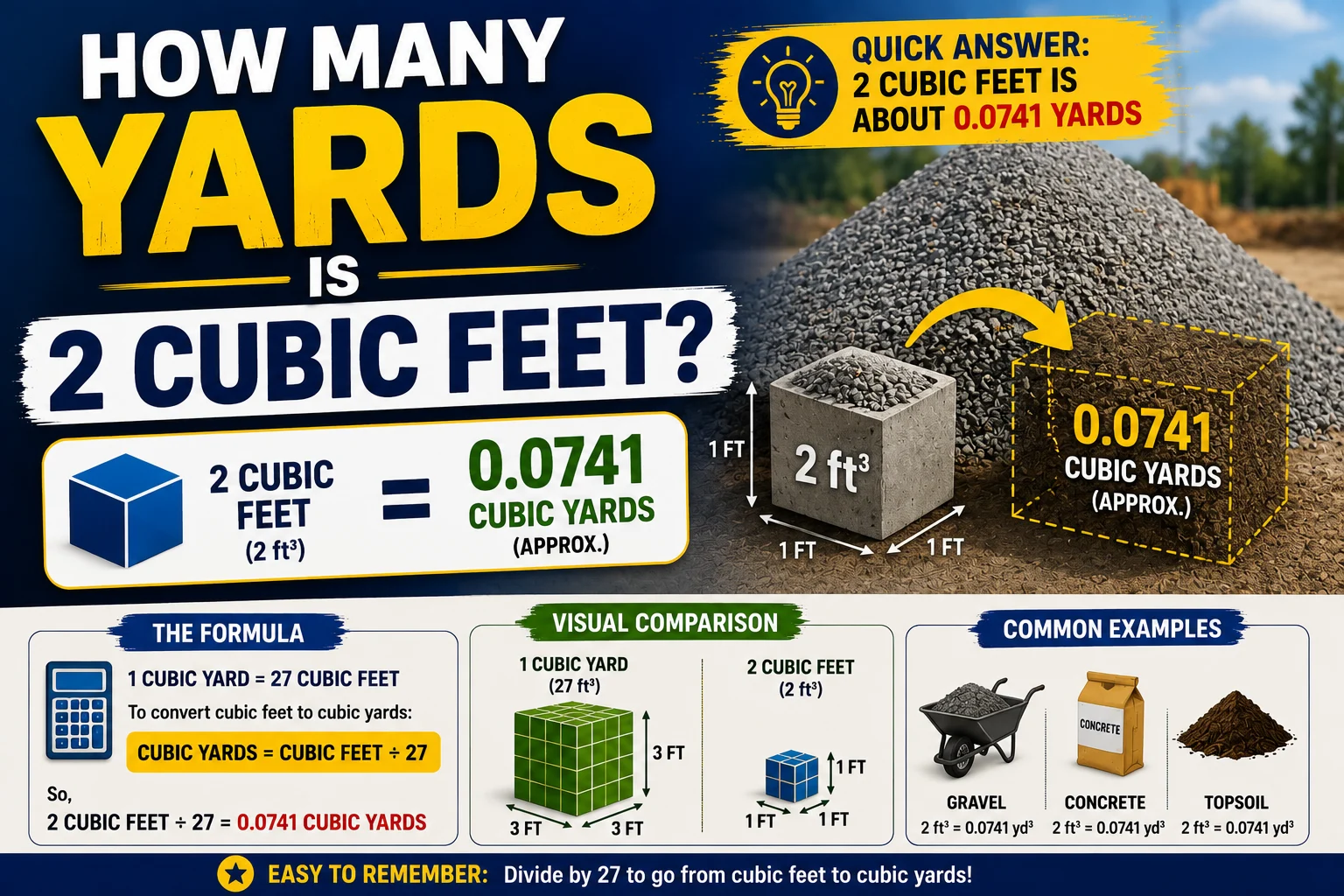
If you’re wondering how many yards is 2 cubic feet, the answer is:
2 cubic feet = 0.07407 cubic yards
A cubic yard is a unit of volume that contains 27 cubic feet. Therefore, to convert cubic feet to cubic yards, divide the number of cubic feet by 27.
The calculation is:
2 ÷ 27 = 0.07407 cubic yards
So, 2 cubic feet is approximately 0.074 cubic yards.
This conversion is useful when buying or estimating quantities of materials such as mulch, soil, gravel, sand, concrete, compost, and other bulk materials.
Quick Answer: 2 Cubic Feet Is How Many Yards?
The exact conversion is:
2 cubic feet = 2/27 cubic yards
In decimal form:
2 cubic feet ≈ 0.07407 cubic yards
For practical estimates, you can round this to:
0.074 cubic yards
| Cubic Feet | Cubic Yards |
|---|---|
| 1 cu. ft. | 0.03704 cu. yd. |
| 2 cu. ft. | 0.07407 cu. yd. |
| 3 cu. ft. | 0.11111 cu. yd. |
| 5 cu. ft. | 0.18519 cu. yd. |
| 10 cu. ft. | 0.37037 cu. yd. |
| 27 cu. ft. | 1 cu. yd. |
What Is a Cubic Yard?
A cubic yard measures volume.
One cubic yard is a cube measuring:
1 yard × 1 yard × 1 yard
Since one yard equals 3 feet:
3 ft × 3 ft × 3 ft = 27 cubic feet
Therefore:
1 cubic yard = 27 cubic feet
This is why converting cubic feet into cubic yards requires division by 27.
How to Convert 2 Cubic Feet to Cubic Yards
The conversion formula is:
Cubic Yards = Cubic Feet ÷ 27
For 2 cubic feet:
2 ÷ 27 = 0.074074…
Rounded to four decimal places:
0.0741 cubic yards
Therefore:
2 cubic feet ≈ 0.074 cubic yards
Why Do You Divide by 27?
The number 27 comes from converting all three dimensions from feet to yards.
Since:
1 yard = 3 feet
A cubic yard has three dimensions:
3 × 3 × 3 = 27 cubic feet
Therefore:
1 cubic yard = 27 cubic feet
If you have only 2 cubic feet, you’re dealing with a small fraction of a cubic yard:
2 ÷ 27 ≈ 0.07407
2 Cubic Feet in Fraction Form
You can express the conversion exactly as a fraction:
2 cubic feet = 2/27 cubic yards
The fraction cannot be simplified further because 2 and 27 have no common factor other than 1.
Therefore:
2 ft³ = 2/27 yd³
In decimal form:
2/27 ≈ 0.07407 yd³
2 Cubic Feet to Cubic Yards Conversion Chart
Here’s a quick reference for common cubic-foot measurements:
| Cubic Feet | Cubic Yards |
|---|---|
| 1 | 0.03704 |
| 2 | 0.07407 |
| 3 | 0.11111 |
| 4 | 0.14815 |
| 5 | 0.18519 |
| 6 | 0.22222 |
| 7 | 0.25926 |
| 8 | 0.29630 |
| 9 | 0.33333 |
| 10 | 0.37037 |
| 15 | 0.55556 |
| 20 | 0.74074 |
| 25 | 0.92593 |
| 27 | 1.00000 |
| 30 | 1.11111 |
| 40 | 1.48148 |
| 50 | 1.85185 |
| 100 | 3.70370 |
How Many Cubic Feet Are in a Cubic Yard?
There are exactly:
27 cubic feet in 1 cubic yard
This is one of the most important volume conversions to remember when working with landscaping and construction materials.
For example:
- 27 cubic feet = 1 cubic yard
- 54 cubic feet = 2 cubic yards
- 81 cubic feet = 3 cubic yards
- 108 cubic feet = 4 cubic yards
- 135 cubic feet = 5 cubic yards
How Many Cubic Yards Are in 4 Cubic Feet?
Using the same formula:
4 ÷ 27 = 0.14815
Therefore:
4 cubic feet ≈ 0.148 cubic yards
How Many Cubic Yards Are in 5 Cubic Feet?
Calculate:
5 ÷ 27 = 0.185185…
Therefore:
5 cubic feet ≈ 0.185 cubic yards
How Many Cubic Yards Are in 10 Cubic Feet?
Calculate:
10 ÷ 27 = 0.37037
Therefore:
10 cubic feet ≈ 0.370 cubic yards
How Many Cubic Yards Are in 20 Cubic Feet?
Calculate:
20 ÷ 27 = 0.74074
Therefore:
20 cubic feet ≈ 0.741 cubic yards
How Many Cubic Yards Are in 27 Cubic Feet?
Because one cubic yard equals 27 cubic feet:
27 ÷ 27 = 1
Therefore:
27 cubic feet = 1 cubic yard
How Many Cubic Yards Are in 54 Cubic Feet?
Calculate:
54 ÷ 27 = 2
Therefore:
54 cubic feet = 2 cubic yards
How Many Cubic Feet Are 2 Cubic Yards?
To convert in the opposite direction, multiply cubic yards by 27.
Cubic Feet = Cubic Yards × 27
For 2 cubic yards:
2 × 27 = 54 cubic feet
Therefore:
2 cubic yards = 54 cubic feet
Using 2 Cubic Feet for Mulch
Two cubic feet is a common bag size for products such as mulch.
To convert 2 cubic feet of mulch to cubic yards:
2 ÷ 27 = 0.07407 cubic yards
Therefore, one 2-cubic-foot bag contains approximately:
0.074 cubic yards of mulch
To determine how many bags you need for a project, first calculate the total cubic-yard requirement.
For example, if you need 1 cubic yard:
27 ÷ 2 = 13.5 bags
Since you cannot generally purchase half a bag, you would need 14 bags to have at least one cubic yard.
How Much Area Can 2 Cubic Feet Cover?
The area that 2 cubic feet can cover depends on the desired depth.
Use:
Area = Volume ÷ Depth
The depth must be expressed in feet.
For example, at a depth of 2 inches:
2 inches ÷ 12 = 0.1667 feet
Then:
2 ÷ 0.1667 ≈ 12 square feet
So 2 cubic feet of material can cover approximately 12 square feet at a 2-inch depth.
At a 3-inch depth:
3 ÷ 12 = 0.25 feet
2 ÷ 0.25 = 8 square feet
So 2 cubic feet can cover approximately 8 square feet at 3 inches deep.
2 Cubic Feet Coverage Chart
The following table provides approximate coverage for 2 cubic feet of material:
| Depth | Approximate Coverage |
|---|---|
| 1 inch | 24 sq. ft. |
| 2 inches | 12 sq. ft. |
| 3 inches | 8 sq. ft. |
| 4 inches | 6 sq. ft. |
| 6 inches | 4 sq. ft. |
| 12 inches | 2 sq. ft. |
These are mathematical estimates assuming uniform coverage and no settling or waste.
2 Cubic Feet of Soil
If you’re purchasing garden soil in bags, a bag may contain 2 cubic feet.
That means:
2 cubic feet of soil ≈ 0.074 cubic yards
If you need 1 cubic yard of soil:
27 ÷ 2 = 13.5
You would need approximately 14 two-cubic-foot bags to reach or exceed one cubic yard.
2 Cubic Feet of Compost
The same conversion applies to compost.
A 2-cubic-foot bag contains:
0.07407 cubic yards of compost
The material doesn’t change the mathematical conversion. Cubic feet and cubic yards measure volume regardless of whether you’re measuring soil, compost, mulch, gravel, or another material.
2 Cubic Feet of Gravel
Two cubic feet of gravel is also:
0.07407 cubic yards
However, the weight of two cubic feet of gravel will depend on the type and density of the gravel.
This distinction is important:
Volume ≠ weight
Two cubic feet always has the same volume, but different materials can have very different weights.
2 Cubic Feet vs. 1 Cubic Yard
The difference is substantial.
| Measurement | Volume |
|---|---|
| 1 cubic foot | 1 cu. ft. |
| 2 cubic feet | 2 cu. ft. |
| 5 cubic feet | 5 cu. ft. |
| 10 cubic feet | 10 cu. ft. |
| 20 cubic feet | 20 cu. ft. |
| 1 cubic yard | 27 cu. ft. |
Two cubic feet represents only about 7.4% of a cubic yard.
Calculation:
2 ÷ 27 × 100 ≈ 7.41%
How Many 2-Cubic-Foot Bags Make a Cubic Yard?
Since:
1 cubic yard = 27 cubic feet
and each bag contains:
2 cubic feet
Divide:
27 ÷ 2 = 13.5
Therefore, mathematically, 13.5 bags contain exactly one cubic yard.
In practice, because bags are sold as whole units, you would need:
14 bags
to have at least one cubic yard of material.
How Many 2-Cubic-Foot Bags Make 2 Cubic Yards?
Two cubic yards contain:
2 × 27 = 54 cubic feet
Then:
54 ÷ 2 = 27 bags
Therefore:
27 two-cubic-foot bags = 2 cubic yards
How Many 2-Cubic-Foot Bags Make 3 Cubic Yards?
Three cubic yards contain:
3 × 27 = 81 cubic feet
Then:
81 ÷ 2 = 40.5 bags
Since bags are normally sold individually, you’d need:
41 bags
to reach at least 3 cubic yards.
Common Mistakes When Converting Cubic Feet to Cubic Yards
Dividing by 3 Instead of 27
Because a yard is 3 feet, some people incorrectly divide cubic feet by 3.
That’s incorrect for volume.
You must account for all three dimensions:
3 × 3 × 3 = 27
Therefore, divide cubic feet by 27.
Confusing Cubic Feet With Square Feet
Square feet measure area.
Cubic feet measure volume.
For example:
- 100 square feet describes an area.
- 100 cubic feet describes a volume.
They cannot be directly converted without additional information.
Confusing Cubic Yards With Linear Yards
A linear yard measures length.
A cubic yard measures volume.
They are different types of measurements.
FAQs
How many yards is 2 cubic feet?
2 cubic feet equals approximately 0.07407 cubic yards.
How do you convert 2 cubic feet to cubic yards?
Divide cubic feet by 27:
2 ÷ 27 = 0.07407 cubic yards.
Is 2 cubic feet the same as 2 cubic yards?
No. A cubic yard contains 27 cubic feet. Therefore, 2 cubic feet is only about 0.074 cubic yards.
How many cubic feet are in one cubic yard?
There are exactly 27 cubic feet in one cubic yard.
How many 2-cubic-foot bags are in a cubic yard?
A cubic yard contains 27 cubic feet, so:
27 ÷ 2 = 13.5 bags
In practice, you would need 14 whole bags to have at least one cubic yard.
How much area does 2 cubic feet cover?
It depends on the depth. At 2 inches deep, 2 cubic feet covers approximately 12 square feet. At 3 inches deep, it covers approximately 8 square feet.
How many cubic yards are 10 cubic feet?
10 cubic feet ≈ 0.37037 cubic yards.
How many cubic feet are 2 cubic yards?
2 cubic yards = 54 cubic feet.
Can I use this conversion for mulch and soil?
Yes. The volume conversion is the same regardless of the material. Two cubic feet of mulch, soil, compost, or gravel equals approximately 0.074 cubic yards by volume.
Does material weight affect the conversion?
No. Weight doesn’t change the volume conversion. However, different materials have different densities, so their weights can vary even when they occupy the same volume.
Conclusion
So, how many yards is 2 cubic feet?
The answer is:
2 cubic feet = 0.07407 cubic yards
To make the conversion, divide cubic feet by 27 because:
1 cubic yard = 27 cubic feet
Therefore:
2 ÷ 27 = 0.07407 cubic yards
You can also express the answer as 2/27 cubic yards.
This conversion is especially useful when comparing bagged materials with bulk quantities. For example, a 2-cubic-foot bag of mulch or soil contains approximately 0.074 cubic yards. Since one cubic yard contains 27 cubic feet, you’ll need 14 two-cubic-foot bags to have at least one full cubic yard.
For quick calculations, remember:
Cubic feet ÷ 27 = cubic yards
and



Pingback: How Many Square Feet Is in Half an Acre? Complete Guide