

If you’re buying soil, mulch, gravel, concrete, sand, or another bulk material, you may have come across the term “yard.” This can be confusing because a yard is normally a measurement of length, while materials such as soil and mulch are usually sold by cubic yards, a measurement of volume.
So, 1 yard how many cubic feet?
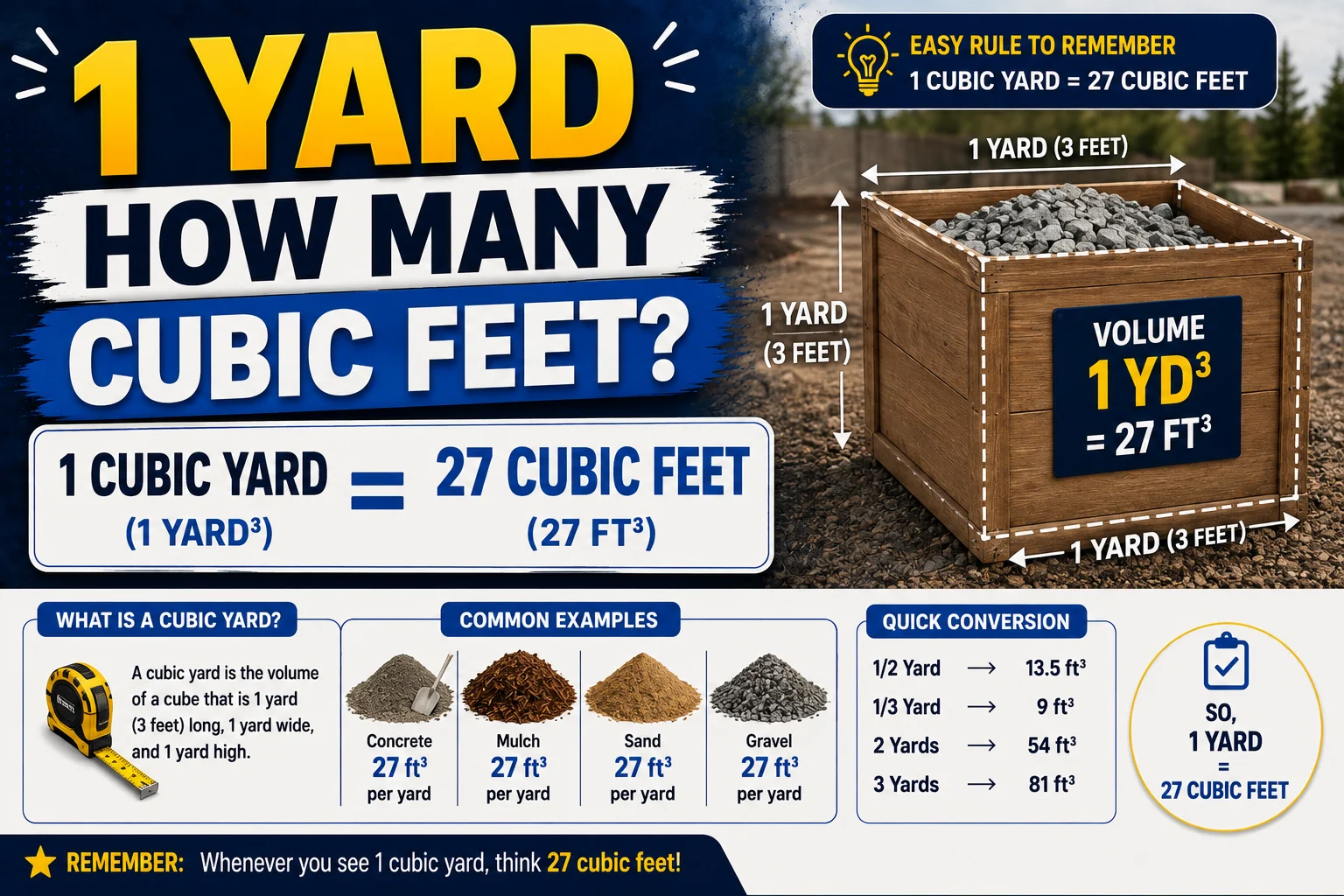
The answer depends on what you mean by “yard.” If you’re talking about a cubic yard, then:
1 cubic yard = 27 cubic feet
This conversion is based on the fact that one yard equals 3 feet. A cubic yard measures length, width, and height:
3 feet × 3 feet × 3 feet = 27 cubic feet
Therefore, one cubic yard contains exactly 27 cubic feet.
In this guide, you’ll learn how to convert cubic yards to cubic feet, how to calculate the volume of an area, and how this measurement applies to common materials such as mulch, soil, gravel, and concrete.
Quick Answer: 1 Yard Is How Many Cubic Feet?
If by “1 yard” you mean 1 cubic yard, the answer is:
1 cubic yard = 27 cubic feet
The formula is:
Cubic feet = Cubic yards × 27
For 1 cubic yard:
1 × 27 = 27 cubic feet
So:
1 cubic yard contains 27 cubic feet.
What Is a Cubic Yard?
A cubic yard is a unit of volume used primarily in the United States for measuring large quantities of materials.
One cubic yard represents a space that measures:
- 3 feet long
- 3 feet wide
- 3 feet high
You can visualize it as a cube that is 3 feet on every side.
The calculation is:
3 ft × 3 ft × 3 ft = 27 cubic feet
Therefore:
1 cubic yard = 27 cubic feet
Why Is a Cubic Yard 27 Cubic Feet?
The reason is simple.
One yard equals 3 feet:
1 yard = 3 feet
When measuring volume, you multiply three dimensions:
3 × 3 × 3 = 27
Therefore:
1 cubic yard = 27 cubic feet
This is different from a regular linear measurement.
For example:
- 1 yard = 3 feet
- 1 square yard = 9 square feet
- 1 cubic yard = 27 cubic feet
The word cubic is important because it indicates three-dimensional volume.
Cubic Yard vs. Square Yard vs. Linear Yard
These measurements are easy to confuse.
Linear Yard
A linear yard measures length.
1 yard = 3 feet
Square Yard
A square yard measures area.
1 square yard = 9 square feet
Because:
3 ft × 3 ft = 9 sq. ft.
Cubic Yard
A cubic yard measures volume.
1 cubic yard = 27 cubic feet
Because:
3 ft × 3 ft × 3 ft = 27 cu. ft.
Comparison Table
| Measurement | Equivalent |
|---|---|
| 1 linear yard | 3 feet |
| 1 square yard | 9 square feet |
| 1 cubic yard | 27 cubic feet |
This distinction is especially important when purchasing landscaping and construction materials.
How to Convert Cubic Yards to Cubic Feet
Converting cubic yards to cubic feet is straightforward.
Use this formula:
Cubic Feet = Cubic Yards × 27
For example, if you have 5 cubic yards:
5 × 27 = 135 cubic feet
Therefore:
5 cubic yards = 135 cubic feet
Cubic Yards to Cubic Feet Conversion Table
Here’s a quick reference table:
| Cubic Yards | Cubic Feet |
|---|---|
| 0.5 yd³ | 13.5 ft³ |
| 1 yd³ | 27 ft³ |
| 2 yd³ | 54 ft³ |
| 3 yd³ | 81 ft³ |
| 4 yd³ | 108 ft³ |
| 5 yd³ | 135 ft³ |
| 6 yd³ | 162 ft³ |
| 7 yd³ | 189 ft³ |
| 8 yd³ | 216 ft³ |
| 9 yd³ | 243 ft³ |
| 10 yd³ | 270 ft³ |
| 15 yd³ | 405 ft³ |
| 20 yd³ | 540 ft³ |
| 25 yd³ | 675 ft³ |
| 30 yd³ | 810 ft³ |
The pattern is always the same:
Cubic yards × 27 = cubic feet
How to Convert Cubic Feet to Cubic Yards
You can also convert in the opposite direction.
The formula is:
Cubic Yards = Cubic Feet ÷ 27
For example, suppose you have 81 cubic feet of material.
81 ÷ 27 = 3 cubic yards
Therefore:
81 cubic feet = 3 cubic yards
Cubic Feet to Cubic Yards Conversion Table
| Cubic Feet | Cubic Yards |
|---|---|
| 13.5 ft³ | 0.5 yd³ |
| 27 ft³ | 1 yd³ |
| 54 ft³ | 2 yd³ |
| 81 ft³ | 3 yd³ |
| 108 ft³ | 4 yd³ |
| 135 ft³ | 5 yd³ |
| 162 ft³ | 6 yd³ |
| 189 ft³ | 7 yd³ |
| 216 ft³ | 8 yd³ |
| 243 ft³ | 9 yd³ |
| 270 ft³ | 10 yd³ |
| 405 ft³ | 15 yd³ |
| 540 ft³ | 20 yd³ |
How to Calculate Cubic Feet
Before converting an area into cubic yards, you may need to calculate its volume in cubic feet.
For a rectangular space, use:
Length × Width × Height = Cubic Feet
For example, suppose you have an area that is:
- 10 feet long
- 5 feet wide
- 2 feet deep
Calculate:
10 × 5 × 2 = 100 cubic feet
The area contains:
100 cubic feet
To convert this to cubic yards:
100 ÷ 27 = 3.70 cubic yards
So you would need approximately 3.7 cubic yards of material to fill that space, before accounting for settling or other project-specific factors.
How to Calculate Cubic Yards From Feet
If your measurements are already in feet, first calculate cubic feet:
Length × Width × Depth
Then divide by 27:
Cubic Yards = Length × Width × Depth ÷ 27
For example:
- Length = 20 ft
- Width = 10 ft
- Depth = 0.5 ft
Calculation:
20 × 10 × 0.5 = 100 cubic feet
Then:
100 ÷ 27 = 3.70 cubic yards
So the project requires approximately:
3.7 cubic yards
How Many Cubic Feet Are in 2 Yards?
If you’re referring to 2 cubic yards, multiply by 27:
2 × 27 = 54
Therefore:
2 cubic yards = 54 cubic feet
How Many Cubic Feet Are in 3 Yards?
For 3 cubic yards:
3 × 27 = 81
Therefore:
3 cubic yards = 81 cubic feet
How Many Cubic Feet Are in 5 Yards?
For 5 cubic yards:
5 × 27 = 135
Therefore:
5 cubic yards = 135 cubic feet
How Many Cubic Feet Are in 10 Yards?
For 10 cubic yards:
10 × 27 = 270
Therefore:
10 cubic yards = 270 cubic feet
How Many Cubic Feet Are in Half a Yard?
Half of a cubic yard is:
0.5 × 27 = 13.5 cubic feet
Therefore:
½ cubic yard = 13.5 cubic feet
This can be useful when ordering smaller quantities of mulch, soil, gravel, or other bulk materials.
1 Cubic Yard of Soil Is How Many Cubic Feet?
One cubic yard of soil equals:
27 cubic feet
If a landscaping supplier sells you 1 cubic yard of topsoil, that represents 27 cubic feet of volume.
However, soil can settle after delivery and installation. The actual amount needed can therefore depend on soil type, moisture, compaction, and how the material is placed.
1 Cubic Yard of Mulch Is How Many Cubic Feet?
One cubic yard of mulch also equals:
27 cubic feet
The conversion doesn’t change based on the material.
Whether you’re measuring:
- Mulch
- Soil
- Gravel
- Sand
- Compost
- Concrete
a cubic yard always equals 27 cubic feet.
What changes is the material’s weight and density, not its volume.
1 Cubic Yard of Gravel Is How Many Cubic Feet?
One cubic yard of gravel contains:
27 cubic feet
The weight can vary considerably depending on the type and size of gravel, moisture content, and material density.
That’s why suppliers often provide both:
- Price per cubic yard
- Approximate weight per cubic yard
These are different measurements.
1 Cubic Yard of Concrete Is How Many Cubic Feet?
One cubic yard of concrete equals:
27 cubic feet
Concrete is commonly ordered in cubic yards because construction projects can require large volumes.
For example, if a concrete project requires 4 cubic yards:
4 × 27 = 108 cubic feet
So 4 cubic yards equals:
108 cubic feet
When ordering concrete, it’s important to calculate the slab dimensions carefully and include an appropriate allowance for variations in thickness and other project conditions.
How Many Square Feet Does 1 Cubic Yard Cover?
This is a common question, but there isn’t one fixed answer.
A cubic yard measures volume, while square feet measure area.
To determine how many square feet one cubic yard covers, you need to know the depth.
The formula is:
Square Feet Covered = 27 ÷ Depth in Feet
For example, at a depth of 3 inches:
3 inches ÷ 12 = 0.25 feet
Then:
27 ÷ 0.25 = 108 square feet
So 1 cubic yard can cover approximately:
108 square feet at 3 inches deep
Coverage of 1 Cubic Yard at Different Depths
The depth dramatically changes the coverage.
| Depth | Approximate Coverage From 1 Cubic Yard |
|---|---|
| 1 inch | 324 sq. ft. |
| 2 inches | 162 sq. ft. |
| 3 inches | 108 sq. ft. |
| 4 inches | 81 sq. ft. |
| 6 inches | 54 sq. ft. |
| 8 inches | 40.5 sq. ft. |
| 12 inches | 27 sq. ft. |
These calculations assume a uniform depth and don’t account for settling, compaction, or installation losses.
How Many Cubic Yards Do I Need?
To determine how many cubic yards you need for a project, measure:
- Length
- Width
- Depth
Make sure all measurements use the same unit.
If your dimensions are in feet:
Length × Width × Depth ÷ 27 = Cubic Yards
Example: Mulch for a Garden Bed
Suppose you have a garden bed that is:
- 20 feet long
- 10 feet wide
- 3 inches deep
First convert 3 inches to feet:
3 ÷ 12 = 0.25 feet
Then calculate volume:
20 × 10 × 0.25 = 50 cubic feet
Convert to cubic yards:
50 ÷ 27 = 1.85 cubic yards
You would need approximately:
1.85 cubic yards of mulch
In practice, you may order a little extra depending on how the material is delivered and whether it settles.
Why Depth Matters When Buying Material
Suppose you want to cover the same 500-square-foot area.
At 2 inches deep, you’ll need much less material than at 6 inches deep.
That’s because increasing depth increases volume.
For example, 500 square feet at 3 inches:
3 inches = 0.25 feet
500 × 0.25 = 125 cubic feet
Then:
125 ÷ 27 ≈ 4.63 cubic yards
So you’d need approximately 4.63 cubic yards.
Cubic Yard vs. Cubic Foot
Both are volume measurements, but they represent different amounts.
1 cubic foot
A cube measuring:
1 ft × 1 ft × 1 ft
1 cubic yard
A cube measuring:
3 ft × 3 ft × 3 ft
Therefore:
1 cubic yard = 27 cubic feet
This means a cubic yard is substantially larger than a cubic foot.
Is a Yard the Same as a Cubic Yard?
No.
A yard by itself is a unit of length.
A yard equals:
3 feet
A cubic yard is a unit of volume.
A cubic yard equals:
27 cubic feet
This difference is important.
If someone says they need “one yard of soil,” they almost certainly mean one cubic yard, because soil is sold by volume rather than length.
Common Uses for Cubic Yards
Cubic yards are commonly used to measure bulk materials such as:
- Topsoil
- Garden soil
- Mulch
- Compost
- Gravel
- Sand
- Crushed stone
- Concrete
- Fill dirt
- Wood chips
Landscaping companies and building-material suppliers frequently use cubic yards when calculating material quantities.
How Many Bags Equal One Cubic Yard?
The answer depends on the size of the bags.
For example, suppose each bag contains 2 cubic feet of material.
One cubic yard contains 27 cubic feet:
27 ÷ 2 = 13.5 bags
So you’d need approximately 14 two-cubic-foot bags to equal one cubic yard.
If bags contain 1 cubic foot:
27 ÷ 1 = 27 bags
Therefore:
27 one-cubic-foot bags = 1 cubic yard
Always check the actual volume printed on the bag because bag sizes vary.
Common Mistakes When Converting Cubic Yards
Mistake 1: Using 3 Instead of 27
Some people remember that one yard equals 3 feet and incorrectly assume one cubic yard equals 3 cubic feet.
That’s incorrect.
Because volume has three dimensions:
3 × 3 × 3 = 27
Mistake 2: Confusing Square Feet With Cubic Feet
Square feet measure area.
Cubic feet measure volume.
For example:
- 100 square feet = area
- 100 cubic feet = volume
You need a depth measurement to convert an area into a volume.
Mistake 3: Forgetting to Convert Inches to Feet
If your dimensions are:
- 20 feet
- 10 feet
- 4 inches deep
You can’t simply multiply 20 × 10 × 4.
Convert 4 inches first:
4 ÷ 12 = 0.333 feet
Then calculate the volume.
Mistake 4: Confusing a Linear Yard With a Cubic Yard
A linear yard measures length.
A cubic yard measures volume.
They’re not interchangeable.
FAQs
How many cubic feet are in 1 yard?
If you mean 1 cubic yard, there are exactly 27 cubic feet.
Is 1 yard equal to 27 cubic feet?
Only when you’re talking about a cubic yard. A regular yard is 3 feet long, while a cubic yard is 27 cubic feet of volume.
How many feet are in a cubic yard?
A cubic yard contains 27 cubic feet.
How do you convert cubic yards to cubic feet?
Multiply the number of cubic yards by 27.
Cubic feet = Cubic yards × 27
How do you convert cubic feet to cubic yards?
Divide cubic feet by 27.
Cubic yards = Cubic feet ÷ 27
How many cubic feet are in 5 cubic yards?
Five cubic yards equal:
5 × 27 = 135 cubic feet
How many cubic feet are in half a cubic yard?
Half a cubic yard equals:
0.5 × 27 = 13.5 cubic feet
How many cubic yards are in 100 cubic feet?
Divide 100 by 27:
100 ÷ 27 ≈ 3.70 cubic yards
How many square feet will one cubic yard cover?
It depends on the depth. At 3 inches deep, one cubic yard covers approximately 108 square feet.
Does the material change the cubic-yard conversion?
No. One cubic yard is always 27 cubic feet, regardless of whether the material is soil, mulch, gravel, sand, or concrete. The material’s weight and density can change, but its volume conversion does not.
Conclusion
If you’re asking “1 yard how many cubic feet?”, the answer is 27 cubic feet when you mean one cubic yard.
The conversion comes directly from the relationship between yards and feet:
1 yard = 3 feet
Because a cubic measurement has three dimensions:
3 × 3 × 3 = 27
Therefore:
1 cubic yard = 27 cubic feet
The easiest formulas to remember are:
Cubic feet = Cubic yards × 27
and
Cubic yards = Cubic feet ÷ 27
This conversion is especially useful when calculating quantities of mulch, soil, gravel, concrete, sand, compost, and other bulk materials.
Just remember that linear yards, square yards, and cubic yards are different measurements. A linear yard equals 3 feet, a square yard equals 9 square feet, and a cubic yard equals 27 cubic feet.



Pingback: How Many Feet Are in 1 Acre of Land? Complete Guide