

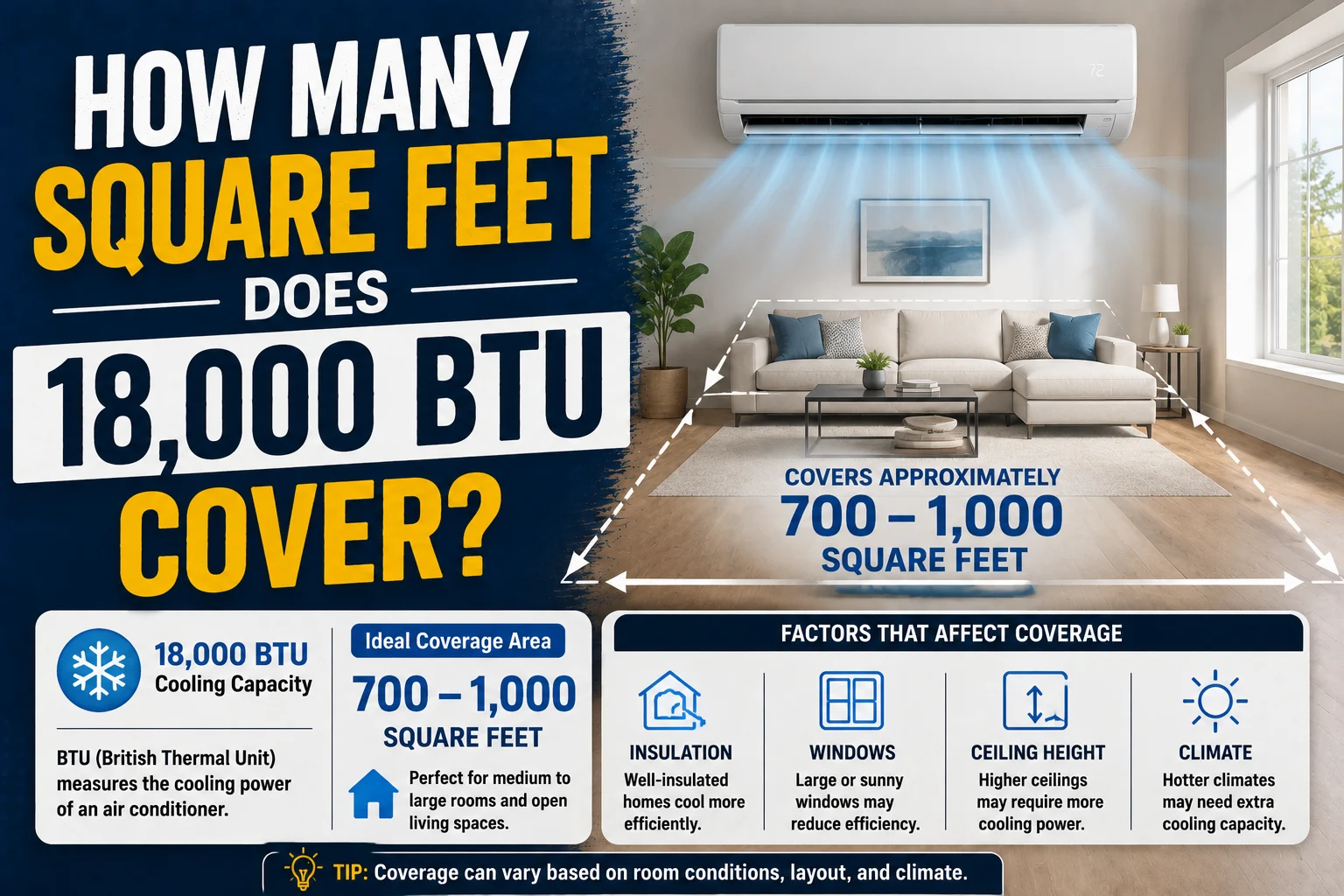
If you’re shopping for an air conditioner, one of the most important questions is how many square feet does 18,000 BTU cover?
As a general rule, an 18,000 BTU air conditioner can often cool approximately 700 to 1,000 square feet, depending on the home’s insulation, ceiling height, climate, sunlight, windows, number of occupants, and other heat sources.
For a relatively well-insulated space in a moderate climate, 18,000 BTU may be suitable for around 800–1,000 square feet. In a hot climate or a room with poor insulation and substantial direct sunlight, the same unit may effectively cover a smaller area.
It’s important to understand that square footage alone doesn’t determine the correct air-conditioner size. HVAC sizing is based on the actual cooling load of a space.
Quick Answer
An 18,000 BTU air conditioner typically covers about 700–1,000 square feet.
A useful general estimate is:
| Conditions | Approximate Coverage |
|---|---|
| Hot climate / poor insulation | 600–800 sq. ft. |
| Average conditions | 700–900 sq. ft. |
| Moderate climate / good insulation | 800–1,000 sq. ft. |
| Very favorable conditions | Up to around 1,000+ sq. ft. |
These are planning estimates rather than guarantees. The actual cooling capacity required depends on the property’s heat gain.
What Does BTU Mean?
BTU stands for British thermal unit. In air conditioning, BTU is commonly used to describe the unit’s cooling capacity.
An air conditioner rated at 18,000 BTU per hour can remove heat from a space at a nominal rate of 18,000 BTUs per hour under its rated conditions.
In everyday HVAC discussions, this is usually shortened to 18,000 BTU.
Higher BTU ratings generally indicate greater cooling capacity.
For example:
- 6,000 BTU — smaller cooling capacity
- 9,000 BTU — small-to-medium cooling capacity
- 12,000 BTU — medium cooling capacity
- 18,000 BTU — medium-to-large cooling capacity
- 24,000 BTU — larger cooling capacity
- 36,000 BTU — much larger cooling capacity
However, bigger isn’t automatically better. An oversized air conditioner can create its own problems.
How Much Space Can an 18,000 BTU AC Cool?
For general planning, an 18,000 BTU unit is often considered appropriate for approximately:
700–1,000 square feet
A space toward the lower end may be more appropriate when conditions are challenging.
For example, an 18,000 BTU unit may be suitable for:
- A large open living area
- A small apartment
- Several connected rooms
- A large bedroom suite
- A moderately sized office
- A compact open-plan home
Whether it can handle the entire space depends on the layout and cooling load.
18,000 BTU AC Coverage by Climate
Climate is one of the most important factors affecting air-conditioner sizing.
Mild or Moderate Climate
In a moderate climate, an 18,000 BTU unit may cool approximately:
800–1,000 square feet
if the building is reasonably well insulated.
Warm Climate
In a warm climate, you may want to plan closer to:
700–900 square feet
depending on the building.
Very Hot Climate
In very hot areas, the practical coverage can fall toward:
600–800 square feet
particularly when insulation is poor or the room receives substantial direct sunlight.
This is why a BTU-to-square-foot estimate should be treated as a starting point rather than a final HVAC specification.
Factors That Affect 18,000 BTU Coverage
Two homes with exactly the same square footage can require very different air-conditioner capacities.
Here are some of the most important factors.
1. Climate
Outdoor temperature and humidity have a major effect on cooling requirements.
A building in a hot region generally needs more cooling capacity than an identical building in a mild region.
2. Insulation
Good insulation reduces heat transfer through:
- Walls
- Roof
- Ceiling
- Floors
Poor insulation allows more heat into the building, increasing the cooling load.
3. Ceiling Height
Square footage doesn’t account for room height.
A 900-square-foot room with 8-foot ceilings contains substantially less air volume than a 900-square-foot room with 12-foot ceilings.
Higher ceilings can therefore increase cooling requirements.
4. Windows
Large windows can introduce significant solar heat, particularly when exposed to direct sunlight.
Energy-efficient windows and appropriate shading can reduce this heat gain.
5. Sun Exposure
Rooms with substantial afternoon sunlight may require more cooling than shaded spaces.
South- and west-facing windows can be particularly important depending on the location.
6. Number of People
People generate heat.
A room occupied by many people may require more cooling than an otherwise identical room with only one or two occupants.
7. Appliances and Electronics
Computers, televisions, ovens, refrigerators, lighting, and other equipment can contribute heat to an indoor space.
8. Air Leakage
Gaps around doors, windows, and other building openings can allow hot outdoor air to enter.
9. Floor and Roof Position
A top-floor room directly below a hot roof can experience greater heat gain than a room surrounded by conditioned spaces.
Is 18,000 BTU Enough for 500 Square Feet?
In many situations, 18,000 BTU would provide more cooling capacity than a 500-square-foot space requires.
However, the answer depends on conditions.
A 500-square-foot room in an extremely hot environment with poor insulation and large windows could have a much higher cooling load than a well-insulated 500-square-foot room.
Still, an 18,000 BTU unit may be considered large for a typical 500-square-foot space.
Oversizing can lead to:
- Short cycling
- Less consistent temperatures
- Poorer humidity control
- Higher purchase cost
- Potentially less efficient operation
The goal is not simply to buy the largest available unit.
Is 18,000 BTU Enough for 700 Square Feet?
It often can be.
A reasonably insulated 700-square-foot space may fall comfortably within the potential range of an 18,000 BTU air conditioner.
However, climate and room conditions still matter.
For example, a 700-square-foot well-insulated apartment may have very different cooling requirements from a poorly insulated attic space of the same size.
Is 18,000 BTU Enough for 800 Square Feet?
In many situations, yes.
An 800-square-foot space is within the commonly estimated range for an 18,000 BTU unit.
For moderate conditions, good insulation, average ceiling heights, and limited heat gain, 18,000 BTU may be suitable.
Is 18,000 BTU Enough for 900 Square Feet?
It may be.
A 900-square-foot space is near the upper-middle portion of the commonly estimated range.
An 18,000 BTU unit may work well if the building has:
- Good insulation
- Standard ceiling height
- Energy-efficient windows
- Moderate heat exposure
- A relatively open layout
Hot climates or poorly insulated buildings may require a different calculation.
Is 18,000 BTU Enough for 1,000 Square Feet?
It can be, but conditions matter.
An 18,000 BTU unit may cool approximately 1,000 square feet under favorable conditions.
However, if you’re in a very hot climate, have high ceilings, poor insulation, numerous windows, or significant afternoon sun, 18,000 BTU may not be enough.
For a 1,000-square-foot home, a proper cooling-load calculation is preferable to relying solely on a square-foot estimate.
Is 18,000 BTU Enough for 1,200 Square Feet?
For many homes, 18,000 BTU may be undersized for 1,200 square feet, especially in a hot climate.
An exceptionally well-insulated building in a mild climate could have a lower cooling requirement, but 1,200 square feet is beyond the range I’d use as a general recommendation for an 18,000 BTU unit without additional information.
If you’re cooling approximately 1,200 square feet, consider having the required capacity calculated based on the building’s actual characteristics.
18,000 BTU Coverage Chart
Here’s a quick reference:
| Area | 18,000 BTU Suitability |
|---|---|
| 400 sq. ft. | Likely more than needed |
| 500 sq. ft. | Often oversized |
| 600 sq. ft. | Generally sufficient |
| 700 sq. ft. | Often suitable |
| 800 sq. ft. | Often suitable |
| 900 sq. ft. | May be suitable |
| 1,000 sq. ft. | Possible under favorable conditions |
| 1,100 sq. ft. | May be undersized |
| 1,200 sq. ft. | Often insufficient |
| 1,500 sq. ft. | Generally insufficient |
These are general estimates and shouldn’t replace a professional cooling-load calculation.
18,000 BTU vs. Other AC Sizes
Understanding how 18,000 BTU compares with other common capacities can help when choosing an air conditioner.
| AC Capacity | Rough Planning Range* |
|---|---|
| 6,000 BTU | 200–300 sq. ft. |
| 9,000 BTU | 300–450 sq. ft. |
| 12,000 BTU | 400–600 sq. ft. |
| 18,000 BTU | 700–1,000 sq. ft. |
| 24,000 BTU | 1,000–1,400 sq. ft. |
| 30,000 BTU | 1,300–1,800 sq. ft. |
| 36,000 BTU | 1,500–2,000+ sq. ft. |
*Ranges vary based on climate, insulation, ceiling height, windows, occupancy, and other factors.
18,000 BTU Mini-Split Coverage
An 18,000 BTU mini-split can be an excellent option for cooling a large room or multiple connected areas.
The coverage depends heavily on:
- Indoor unit placement
- Floor plan
- Number of zones
- Insulation
- Doorways
- Air movement
- Outdoor conditions
An 18,000 BTU single-zone mini-split isn’t automatically equivalent to central air conditioning for an entire home.
For multiple rooms with closed doors, heat distribution can be uneven.
18,000 BTU Window AC Coverage
An 18,000 BTU window air conditioner can provide substantial cooling capacity.
However, window units are generally best suited to spaces where the cooled air can circulate effectively.
An open-plan 800-square-foot area may respond differently from an 800-square-foot home divided into several closed rooms.
Before purchasing, check the manufacturer’s recommended room size and installation requirements.
18,000 BTU Portable AC Coverage
Portable air conditioners can have different performance characteristics from window or central systems.
When shopping for a portable unit, pay attention to the manufacturer’s stated capacity and efficiency information.
Portable AC ratings can also be presented using different testing standards, so comparing BTU numbers without considering the rating method can be misleading.
For the most accurate comparison, look at the unit’s current standardized cooling-capacity information rather than BTU alone.
What Happens If an AC Is Too Small?
An undersized air conditioner may struggle to keep the space comfortable.
Common signs include:
- The unit runs continuously
- The room remains warm
- Temperature recovery is slow
- The system struggles during peak afternoon heat
- Energy consumption can increase because of extended operation
An 18,000 BTU unit may therefore be insufficient if the cooling load of the space is substantially higher than its capacity.
What Happens If an AC Is Too Large?
Buying a larger air conditioner isn’t always better.
An oversized unit can cool the air very quickly without adequately removing humidity.
Potential problems include:
- Short cycling
- Uneven temperatures
- Poor humidity control
- More frequent starts and stops
- Reduced comfort
For this reason, proper sizing is more important than simply maximizing BTUs.
How to Estimate Your Cooling Needs
For a basic preliminary estimate, start with your home’s square footage.
Then consider:
- Climate
- Insulation
- Ceiling height
- Number and size of windows
- Sun exposure
- Number of occupants
- Appliances
- Floor location
- Room layout
- Air leakage
For a major HVAC purchase, a proper load calculation is the better approach.
In the United States, HVAC professionals commonly use Manual J methodology to calculate residential heating and cooling loads.
Example: 800-Square-Foot Home
Suppose you have an 800-square-foot home with:
- 8-foot ceilings
- Good insulation
- Moderate climate
- Average windows
- Limited afternoon sun
- Two occupants
An 18,000 BTU air conditioner could be a reasonable candidate based on a basic square-foot estimate.
However, this doesn’t guarantee that 18,000 BTU is the exact required capacity.
A professional calculation could produce a different result.
Example: 800-Square-Foot Home in a Hot Climate
Now consider another 800-square-foot property with:
- Poor insulation
- Large unshaded windows
- High ceilings
- Strong afternoon sunlight
- Hot outdoor temperatures
- Several occupants
The cooling load could be considerably higher.
Although the floor area is still 800 square feet, the building may require more cooling than the first example.
This demonstrates why square footage is only one part of air-conditioner sizing.
How Many Tons Is 18,000 BTU?
Air conditioners are sometimes rated in tons of cooling capacity.
1 ton = 12,000 BTU/hour
Therefore:
18,000 ÷ 12,000 = 1.5 tons
So:
18,000 BTU = 1.5 tons of cooling capacity
This is a nominal capacity conversion.
It does not mean that every 1.5-ton system should automatically be used for a particular square footage.
How Much Electricity Does an 18,000 BTU AC Use?
BTU capacity alone doesn’t tell you exactly how much electricity an air conditioner will consume.
Electrical consumption depends on factors such as:
- Efficiency rating
- Compressor technology
- Outdoor temperature
- Indoor temperature setting
- Operating time
- Unit type
- Maintenance
- Installation
- Building heat load
Two 18,000 BTU air conditioners can have different electricity consumption.
To estimate operating cost, check the unit’s energy-efficiency information and your local electricity rate.
Tips to Help an 18,000 BTU AC Cool Better
Even a correctly sized air conditioner can perform poorly if the building has excessive heat gain.
You can improve cooling performance by:
Improve Insulation
Proper insulation helps keep outdoor heat from entering.
Seal Air Leaks
Check doors, windows, and other areas where conditioned air may escape.
Use Window Coverings
Curtains, blinds, and shades can reduce solar heat gain.
Keep Filters Clean
A dirty filter can restrict airflow and reduce system performance.
Maintain the Outdoor Unit
For systems with outdoor condensers, keep the surrounding area clear and follow the manufacturer’s maintenance recommendations.
Use Fans
Ceiling and portable fans can improve perceived comfort and air circulation.
FAQs
How many square feet does an 18,000 BTU air conditioner cover?
An 18,000 BTU air conditioner can generally cover around 700–1,000 square feet, depending on climate, insulation, ceiling height, windows, sunlight, and other factors.
Is 18,000 BTU enough for 1,000 square feet?
It can be under favorable conditions, but it may not be sufficient in a hot climate or poorly insulated building. A cooling-load calculation provides a more reliable answer.
Is 18,000 BTU enough for 800 square feet?
In many cases, yes. An 800-square-foot space is within the commonly estimated range for an 18,000 BTU unit.
Is 18,000 BTU too much for 500 square feet?
It may be oversized for a typical 500-square-foot room. However, the appropriate capacity depends on the actual cooling load.
How many tons is 18,000 BTU?
An 18,000 BTU air conditioner is equivalent to 1.5 tons of nominal cooling capacity.
Can an 18,000 BTU mini-split cool multiple rooms?
It can potentially cool multiple connected rooms if air can circulate effectively, but a single indoor unit may not distribute cooling evenly throughout rooms separated by doors or walls.
Does climate affect how many square feet 18,000 BTU can cool?
Yes. A hot climate generally requires more cooling capacity than a moderate climate for the same square footage.
Does ceiling height affect AC sizing?
Yes. Higher ceilings increase the volume of air inside the space and can affect the required cooling capacity.
Is bigger BTU always better?
No. An oversized air conditioner can cycle too quickly and may provide poorer humidity control. Proper sizing is more important than simply choosing a larger unit.
Conclusion
So, how many square feet does 18,000 BTU cover?
As a general estimate, an 18,000 BTU air conditioner can cover approximately 700 to 1,000 square feet under typical conditions.
For quick planning:
- 600 sq. ft.: Usually sufficient
- 700 sq. ft.: Often suitable
- 800 sq. ft.: Often suitable
- 900 sq. ft.: May be suitable
- 1,000 sq. ft.: Possible under favorable conditions
- 1,200+ sq. ft.: May require more capacity
Keep in mind that square footage alone isn’t enough to determine the correct AC size. Climate, insulation, ceiling height, windows, sunlight, occupancy, appliances, and floor plan all affect the cooling load.
An 18,000 BTU unit is equivalent to approximately 1.5 tons of cooling capacity, making it a common size for larger rooms, apartments, and moderately sized spaces.
For the most accurate result especially when installing a permanent HVAC system use a proper cooling-load calculation rather than relying only on a BTU-per-square-foot rule.


Pingback: How Many Feet Is in a Half Mile? Complete Conversion Guide
Pingback: How Many Feet Are 100 Yards? Complete Conversion Guide