

If you’re planning a landscaping project, one of the most important measurements to understand is how much area a cubic yard of mulch will cover.
So, how many cubic feet are in a cubic yard of mulch?
The answer is:
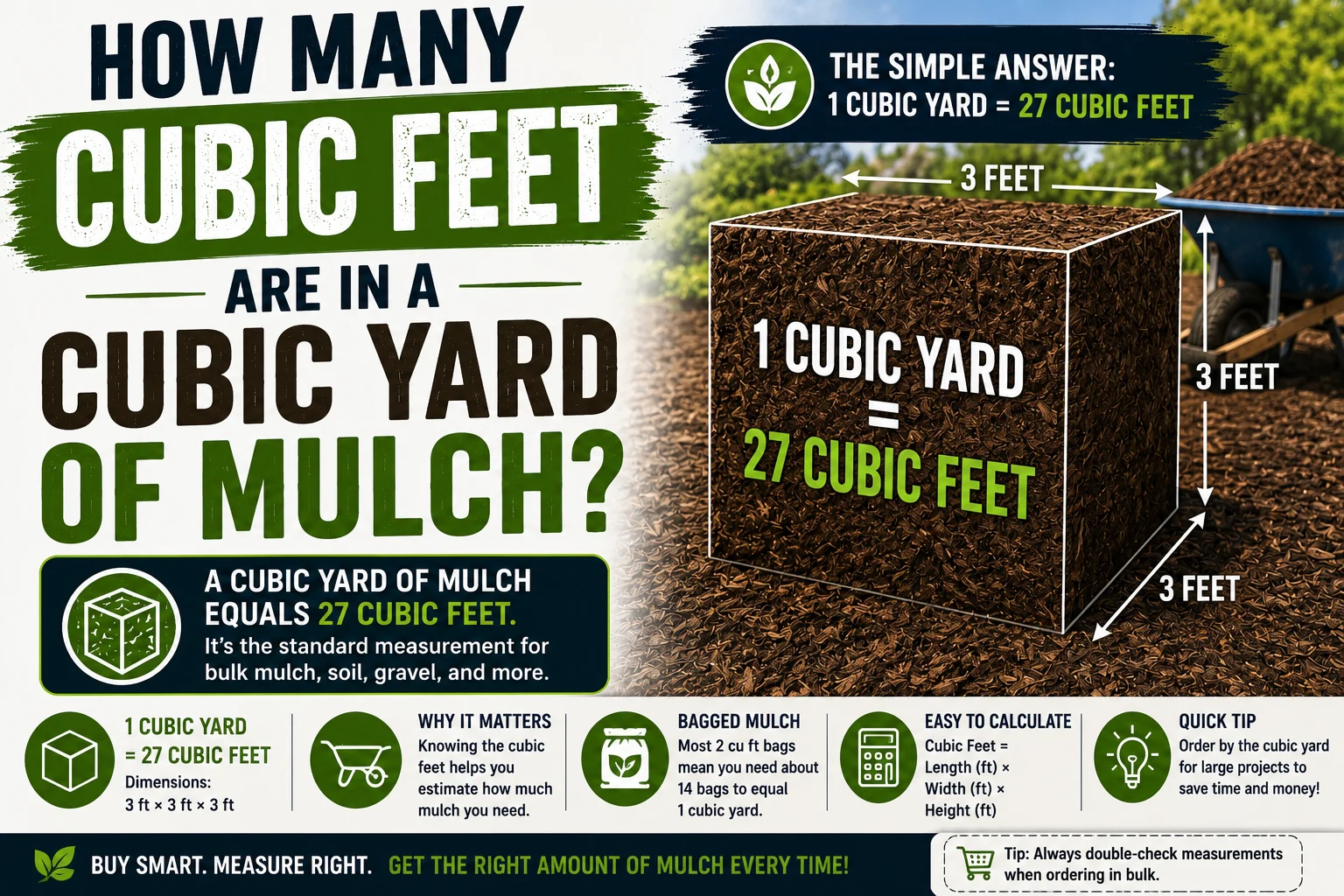
1 cubic yard of mulch = 27 cubic feet
This is an exact volume conversion. It doesn’t matter whether the mulch is hardwood, bark, shredded wood, colored mulch, or another type. A cubic yard is a measurement of volume, not weight.
Since:
1 yard = 3 feet
a cubic yard measures:
3 feet × 3 feet × 3 feet = 27 cubic feet
Therefore, one cubic yard of mulch contains 27 cubic feet.
However, knowing that one cubic yard equals 27 cubic feet is only part of the calculation. To determine how much area the mulch will cover, you also need to know how deep you plan to spread it.
Quick Answer
How many cubic feet are in a cubic yard of mulch?
There are exactly:
27 cubic feet in 1 cubic yard of mulch
The conversion is:
1 yd³ = 27 ft³
For example:
- ½ cubic yard = 13.5 cubic feet
- 1 cubic yard = 27 cubic feet
- 2 cubic yards = 54 cubic feet
- 3 cubic yards = 81 cubic feet
- 5 cubic yards = 135 cubic feet
- 10 cubic yards = 270 cubic feet
The amount of area covered depends on the depth of the mulch.
Why Is a Cubic Yard 27 Cubic Feet?
The reason is that a cubic yard is a three-dimensional measurement.
One yard equals three feet.
Imagine a cube that is:
- 3 feet long
- 3 feet wide
- 3 feet deep
Its volume is:
3 × 3 × 3 = 27 cubic feet
So:
1 cubic yard = 27 cubic feet
This same conversion applies to other materials sold by volume, including:
- Soil
- Compost
- Gravel
- Sand
- Wood chips
- Stone
- Concrete
The material doesn’t change the mathematical volume.
How Much Area Does 1 Cubic Yard of Mulch Cover?
This is one of the most common questions homeowners ask.
The answer depends on the depth of the mulch.
One cubic yard contains 27 cubic feet. To determine the surface area it covers, divide 27 cubic feet by the desired depth in feet.
For example, at a depth of 3 inches:
3 inches ÷ 12 = 0.25 feet
Then:
27 ÷ 0.25 = 108 square feet
So one cubic yard of mulch covers approximately:
108 square feet at 3 inches deep
One Cubic Yard of Mulch Coverage Chart
Here’s a convenient reference:
| Mulch Depth | Approximate Coverage per 1 Cubic Yard |
|---|---|
| 1 inch | 324 sq ft |
| 2 inches | 162 sq ft |
| 3 inches | 108 sq ft |
| 4 inches | 81 sq ft |
| 5 inches | 65 sq ft |
| 6 inches | 54 sq ft |
| 8 inches | 40.5 sq ft |
| 12 inches | 27 sq ft |
These are mathematical coverage estimates and assume the mulch is spread evenly at the specified depth.
How Many Square Feet Does a Cubic Yard of Mulch Cover at 2 Inches?
Two inches equals:
2 ÷ 12 = 0.1667 feet
One cubic yard contains 27 cubic feet.
Therefore:
27 ÷ 0.1667 ≈ 162 square feet
So:
1 cubic yard of mulch covers approximately 162 square feet at 2 inches deep.
A 2-inch layer can be useful for certain decorative applications, although the ideal mulch depth depends on the type of mulch and landscaping purpose.
How Many Square Feet Does a Cubic Yard of Mulch Cover at 3 Inches?
Three inches equals:
3 ÷ 12 = 0.25 feet
Calculate:
27 ÷ 0.25 = 108
Therefore:
1 cubic yard covers approximately 108 square feet at 3 inches deep.
This is one of the most useful figures to remember when planning a typical mulch installation.
How Many Square Feet Does a Cubic Yard of Mulch Cover at 4 Inches?
Four inches equals:
4 ÷ 12 = 0.3333 feet
Now calculate:
27 ÷ 0.3333 ≈ 81
Therefore:
1 cubic yard of mulch covers approximately 81 square feet at 4 inches deep.
As the mulch layer becomes deeper, the coverage area decreases.
How Many Square Feet Does a Cubic Yard of Mulch Cover at 6 Inches?
Six inches equals:
6 ÷ 12 = 0.5 feet
Then:
27 ÷ 0.5 = 54
Therefore:
1 cubic yard of mulch covers approximately 54 square feet at 6 inches deep.
A 6-inch layer is considerably deeper than many typical mulch applications, so always consider the requirements of your particular landscaping project.
How to Calculate How Much Mulch You Need
You can calculate the amount of mulch required using this formula:
Cubic Yards Needed = Length × Width × Depth ÷ 27
Your length and width should be measured in feet, while depth should also be converted to feet.
For example, suppose your garden bed is:
- 20 feet long
- 10 feet wide
- 3 inches deep
First convert 3 inches to feet:
3 ÷ 12 = 0.25 feet
Then calculate the volume:
20 × 10 × 0.25 = 50 cubic feet
Now convert cubic feet to cubic yards:
50 ÷ 27 ≈ 1.85 cubic yards
Therefore, you need approximately:
1.85 cubic yards of mulch
For a practical purchase, you may choose to order 2 cubic yards, depending on the supplier’s minimum quantities and the desired finished depth.
Mulch Calculation Example for a 1,000-Square-Foot Area
Suppose you have a 1,000-square-foot landscaping area and want to spread mulch 3 inches deep.
Three inches is:
0.25 feet
Calculate the volume:
1,000 × 0.25 = 250 cubic feet
Convert to cubic yards:
250 ÷ 27 ≈ 9.26 cubic yards
Therefore, you would need approximately:
9.26 cubic yards of mulch
For an actual project, you may want to purchase somewhat more depending on the shape of the area, settling, uneven ground, and how precisely you can spread the material.
Mulch Coverage by Number of Cubic Yards
At a depth of 3 inches, the approximate coverage is:
| Mulch Quantity | Coverage at 3 Inches |
|---|---|
| 0.5 cubic yard | 54 sq ft |
| 1 cubic yard | 108 sq ft |
| 1.5 cubic yards | 162 sq ft |
| 2 cubic yards | 216 sq ft |
| 3 cubic yards | 324 sq ft |
| 4 cubic yards | 432 sq ft |
| 5 cubic yards | 540 sq ft |
| 6 cubic yards | 648 sq ft |
| 8 cubic yards | 864 sq ft |
| 10 cubic yards | 1,080 sq ft |
These figures assume a consistent 3-inch depth.
How Many Bags of Mulch Equal a Cubic Yard?
The answer depends on the size of the bags.
A standard bag may contain 2 cubic feet of mulch.
Since one cubic yard equals 27 cubic feet:
27 ÷ 2 = 13.5 bags
So, theoretically, it takes:
13.5 two-cubic-foot bags to equal 1 cubic yard
Because you can’t purchase half a bag, you’d need 14 bags to slightly exceed one cubic yard.
If the bags contain 1.5 cubic feet:
27 ÷ 1.5 = 18 bags
Therefore:
18 bags of 1.5-cubic-foot mulch = 1 cubic yard
Always check the volume printed on the bag because bag sizes vary.
Cubic Yard vs. Bagged Mulch
Bulk mulch is commonly sold by the cubic yard, while packaged mulch is usually sold by the cubic foot or bag.
For larger projects, bulk mulch can be more convenient because you can order several cubic yards at once.
For small flower beds, bagged mulch may be easier to transport and distribute.
For example:
Bulk mulch
- Sold by cubic yard
- Good for large areas
- Usually delivered in bulk
- Requires less packaging
Bagged mulch
- Sold by individual bags
- Easier to carry
- Convenient for small projects
- More packaging per unit of material
Does Mulch Type Affect Cubic Footage?
No. A cubic yard is always 27 cubic feet.
However, different types of mulch can have different:
- Densities
- Moisture levels
- Particle sizes
- Settling characteristics
- Weights
For example, a cubic yard of fresh wood mulch and a cubic yard of bark mulch both occupy 27 cubic feet, but they may weigh very different amounts.
So don’t confuse volume with weight.
How Much Does a Cubic Yard of Mulch Weigh?
There isn’t one universal weight for a cubic yard of mulch.
Weight can vary depending on:
- Mulch type
- Moisture content
- Wood species
- Particle size
- Age
- Compaction
Dry mulch generally weighs less than wet mulch.
If you’re planning transportation, ask the supplier for the estimated weight of the specific mulch you’re purchasing.
The volume, however, remains:
1 cubic yard = 27 cubic feet
Does Mulch Settle After Installation?
Yes, mulch can settle over time.
Freshly delivered mulch may contain air spaces between pieces. After spreading and exposure to rain, movement, and natural settling, the material can become more compact.
This means the initial depth may decrease somewhat over time.
When estimating material quantities, consider the condition of the mulch and the desired finished depth.
What Is the Best Mulch Depth?
The ideal depth depends on the purpose, material, plants, and landscaping conditions.
Many landscaping applications use a relatively shallow layer rather than piling mulch deeply around plants.
A common planning range is approximately 2–4 inches, but you should consider the recommendations for your specific plants and mulch type.
Avoid piling mulch directly against tree trunks or plant stems. Excessive mulch around trunks can contribute to moisture and pest problems.
How Much Mulch Do You Need for a Flower Bed?
Suppose your flower bed measures:
15 feet × 12 feet
Area:
15 × 12 = 180 square feet
You want a 3-inch layer:
3 ÷ 12 = 0.25 feet
Volume:
180 × 0.25 = 45 cubic feet
Convert to cubic yards:
45 ÷ 27 ≈ 1.67 cubic yards
So you’d need approximately:
1.67 cubic yards of mulch
A practical order would generally be around 2 cubic yards, depending on how exact the coverage needs to be.
How Much Mulch Do You Need for 500 Square Feet?
At 3 inches deep:
500 × 0.25 = 125 cubic feet
Convert to cubic yards:
125 ÷ 27 ≈ 4.63 cubic yards
Therefore:
Approximately 4.63 cubic yards
of mulch are needed for 500 square feet at 3 inches deep.
How Much Mulch Do You Need for 1,500 Square Feet?
At 3 inches deep:
1,500 × 0.25 = 375 cubic feet
Then:
375 ÷ 27 ≈ 13.89 cubic yards
So you’d need approximately:
13.89 cubic yards of mulch
At a different depth, the required amount changes proportionally.
What Happens If You Spread Mulch Too Thin?
A very thin layer may not provide the desired landscaping effect or perform its intended function as effectively.
Depending on the purpose, insufficient mulch may:
- Provide less visual coverage
- Leave bare soil exposed
- Require more frequent replenishment
- Provide less protection from temperature fluctuations
The appropriate depth depends on the project.
What Happens If You Spread Mulch Too Thick?
More mulch isn’t necessarily better.
An excessively deep layer can cause problems, particularly when mulch is piled against trees and plants.
Potential concerns include:
- Poor air circulation near roots
- Excess moisture
- Pest habitat
- Root-related problems
- Difficulty maintaining healthy planting beds
For trees, avoid creating a “mulch volcano” around the trunk.
Common Mistakes When Calculating Mulch
1. Confusing Cubic Feet With Square Feet
Cubic feet measure volume, while square feet measure area.
A cubic yard contains 27 cubic feet, not 27 square feet.
2. Forgetting Mulch Depth
You cannot determine coverage without knowing how thickly the mulch will be spread.
3. Using Inches Without Converting
If the depth is given in inches, divide by 12 to convert it to feet.
4. Forgetting to Divide by 27
After calculating cubic feet, divide by 27 to determine cubic yards.
5. Ignoring Irregular Shapes
A curved or irregular garden bed may require dividing the area into smaller sections for a more accurate estimate.
6. Confusing Weight With Volume
A cubic yard is a volume measurement. Different mulch types can have very different weights.
FAQs
1. How many cubic feet are in a cubic yard of mulch?
There are exactly 27 cubic feet in one cubic yard of mulch.
2. How many square feet does one cubic yard of mulch cover?
At 3 inches deep, one cubic yard covers approximately 108 square feet. At 2 inches, it covers about 162 square feet, and at 4 inches, about 81 square feet.
3. How many bags of mulch equal one cubic yard?
If each bag contains 2 cubic feet, you need 13.5 bags mathematically, or 14 bags to exceed one cubic yard. The exact number depends on bag size.
4. How much mulch do I need for 100 square feet?
At 3 inches deep:
100 × 0.25 ÷ 27 ≈ 0.93 cubic yard
So approximately 1 cubic yard would cover 100 square feet at 3 inches.
5. How many cubic yards of mulch do I need for 1,000 square feet?
At 3 inches deep, you need approximately 9.26 cubic yards.
6. Does one cubic yard always equal 27 cubic feet?
Yes. The conversion is exact:
1 cubic yard = 27 cubic feet.
7. Does wet mulch take up more cubic feet?
The volume measurement remains a cubic yard, but moisture can change the material’s weight and may affect settling and handling.
8. How deep should mulch be?
A common landscaping planning range is approximately 2–4 inches, but the ideal depth varies depending on the material, plants, and purpose.
Conclusion
So, how many cubic feet are in a cubic yard of mulch?
The exact answer is:
1 cubic yard = 27 cubic feet
The amount of landscaping area that one cubic yard covers depends on how deeply you spread the mulch.
At common depths:
- 1 inch: about 324 square feet
- 2 inches: about 162 square feet
- 3 inches: about 108 square feet
- 4 inches: about 81 square feet
- 6 inches: about 54 square feet
To calculate the amount of mulch you need, measure the length and width of the area, convert the desired depth from inches to feet, and use:
Cubic Yards = Length × Width × Depth ÷ 27
For example, a 20 × 10-foot area covered with 3 inches of mulch requires about 1.85 cubic yards.
Understanding the difference between cubic feet, cubic yards, and square feet makes it much easier to order the right amount of mulch and avoid buying significantly more or less than your landscaping project requires.



Pingback: How Many Feet Is 20 Square Feet? Easy Conversion Guide