
If you’ve been searching “how many feet is Kilimanjaro,” you’re looking for one of the most famous mountain facts in the world. Mount Kilimanjaro is not just Africa’s tallest mountain—it’s also one of the most iconic peaks globally.
Understanding its height helps you appreciate its scale, difficulty, and global importance.
Let’s break everything down clearly.
Quick Answer: Height of Kilimanjaro in Feet
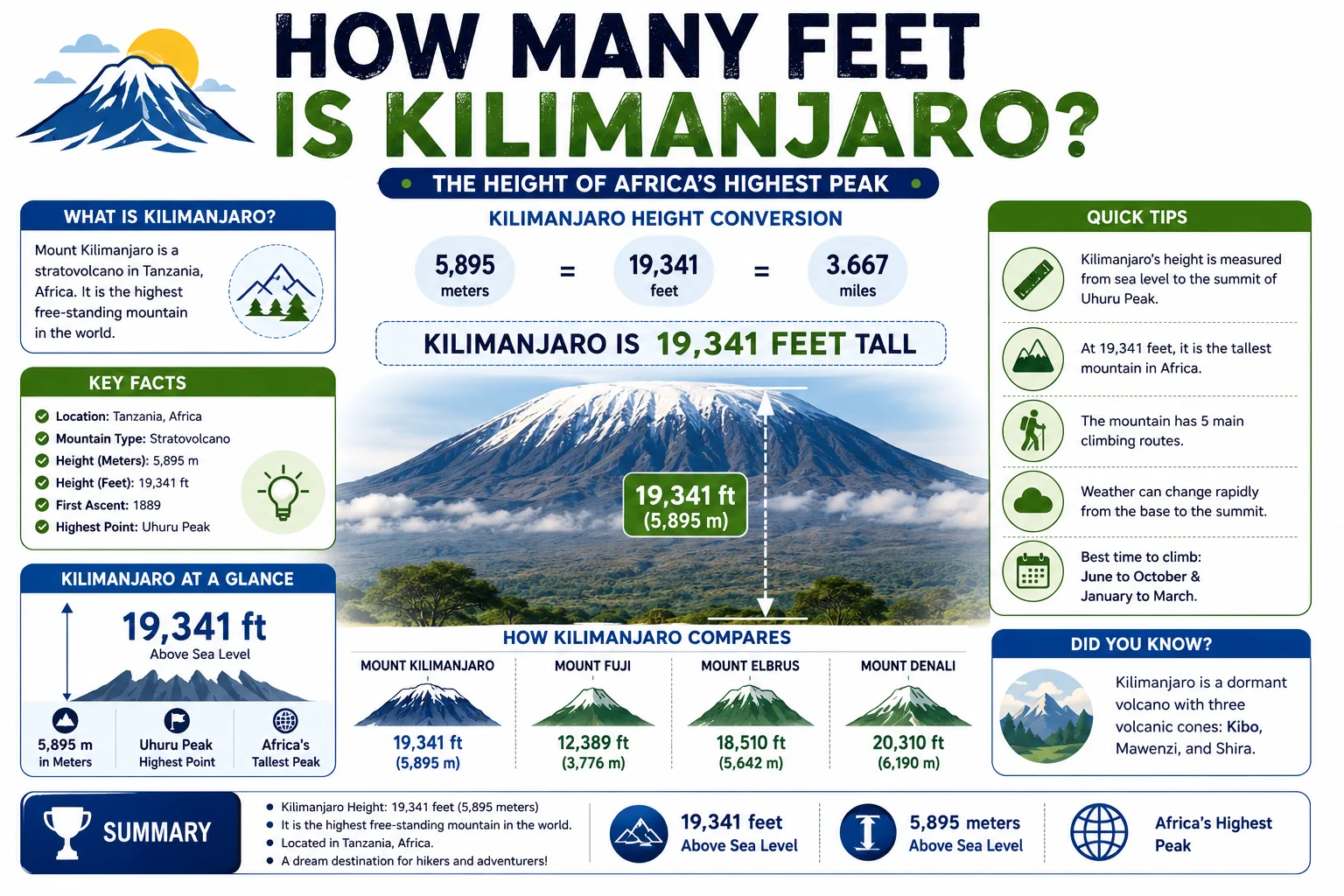
Mount Kilimanjaro is 19,341 feet tall
This height refers to its highest point, known as Uhuru Peak.
Where Is Mount Kilimanjaro Located?
Mount Kilimanjaro is located in Tanzania, East Africa.
It sits near the border with Kenya and is part of a protected national park. The mountain rises dramatically from flat plains, making it visually striking.
How Many Feet Is Kilimanjaro (Detailed Explanation)
The official height of Kilimanjaro is:
19,341 feet above sea level
This measurement is based on modern GPS and surveying methods.
What makes Kilimanjaro unique is that it is a free-standing mountain, meaning it is not part of a larger mountain range.
Kilimanjaro Height in Different Units
Here’s how Kilimanjaro’s height converts into different units:
| Unit | Height |
|---|---|
| Feet | 19,341 ft |
| Meters | 5,895 m |
| Kilometers | 5.895 km |
| Miles | 3.67 miles |
Comparison: Kilimanjaro vs Other Mountains
To understand its scale, compare it with other famous mountains:
| Mountain | Height (Feet) |
|---|---|
| Mount Everest | 29,032 ft |
| Mount Kilimanjaro | 19,341 ft |
| Mount Denali | 20,310 ft |
| Mount Elbrus | 18,510 ft |
Kilimanjaro is shorter than Everest but still one of the tallest standalone mountains on Earth.
Understanding Kilimanjaro’s Three Peaks
Kilimanjaro is actually made up of three volcanic cones:
- Kibo (highest peak)
- Mawenzi
- Shira
The summit, Uhuru Peak, sits on Kibo and is the highest point.
Why Kilimanjaro’s Height Matters
Its height is important for several reasons.
First, it is one of the Seven Summits, which are the highest mountains on each continent.
Second, it offers a unique climbing experience because you can reach extreme altitude without technical climbing skills.
Third, the height creates multiple climate zones as you climb upward.
Climbing Kilimanjaro: What to Expect
Climbing Kilimanjaro is challenging but achievable.
Typical climb duration ranges from 5 to 9 days depending on the route.
Climbers walk through different environments, starting from forests and ending in icy summit conditions.
Altitude and Its Effects
At 19,341 feet, altitude plays a major role.
As you go higher:
- Oxygen levels decrease
- Breathing becomes harder
- Energy levels drop
Common symptoms include headaches, fatigue, and dizziness.
Interesting Facts About Kilimanjaro
- It is a dormant volcano
- It has glaciers near the summit
- It is the tallest mountain in Africa
- It attracts over 30,000 climbers each year
Common Mistakes People Make
People often misunderstand key facts about Kilimanjaro:
- Confusing meters with feet
- Thinking it is part of a mountain range
- Assuming it is the tallest mountain in the world
- Underestimating the difficulty of climbing
Expert Tips for Understanding Mountain Heights
- Always check units carefully
- Compare with well-known mountains
- Learn the difference between elevation and height
- Use tables and visuals for clarity
Conclusion
So, how many feet is Kilimanjaro?
The correct answer is 19,341 feet
This makes it the highest mountain in Africa and one of the most impressive natural landmarks in the world.
Its height, combined with its unique location and accessibility, makes it a dream destination for climbers and a fascinating topic for learners.
FAQs
1. How many feet is Mount Kilimanjaro exactly?
Mount Kilimanjaro is 19,341 feet tall
2. Is Kilimanjaro taller than Mount Everest?
No, Mount Everest is much taller at over 29,000 feet
3. What is the highest point on Kilimanjaro?
The highest point is Uhuru Peak
4. How long does it take to climb Kilimanjaro?
It usually takes 5 to 9 days depending on the route
5. Is Kilimanjaro difficult to climb?
It is physically demanding due to altitude but does not require technical climbing skills